Expirobacter
Italy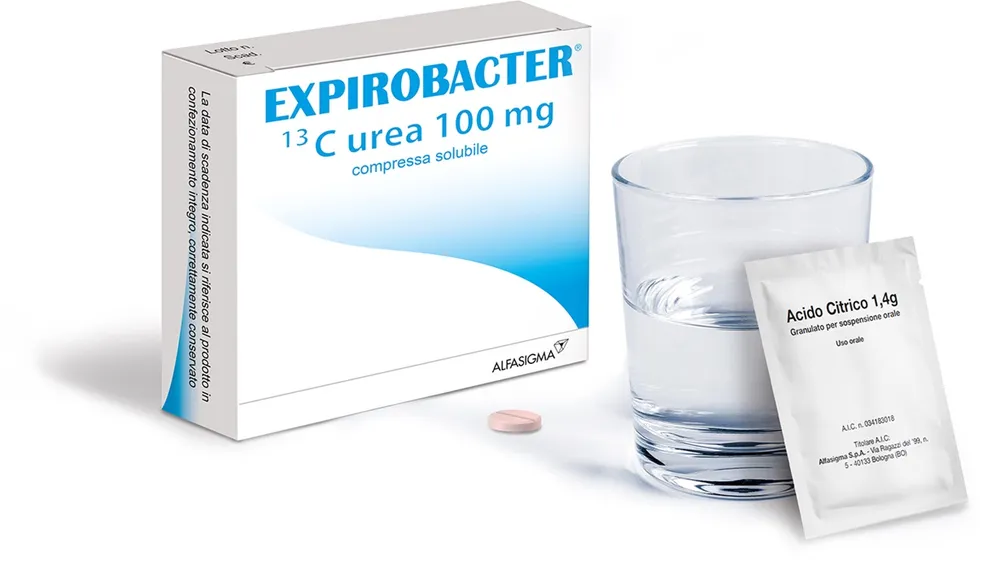
Table of Contents
- Package leaflet: Information for the user
- Expirobacter 100 mg effervescent tablet
- 1. What Expirobacter is and what it is used for
- 2. What you need to know before using Expirobacter
- 3. How to use Expirobacter
- 4. Possible side effects
- 5. How to store Expirobacter
- 6. Package contents and other information
- The following information is intended exclusively for healthcare professionals:
Package leaflet: Information for the user
Expirobacter 100 mg effervescent tablet
C Urea
Please read this leaflet carefully before using this medicine because it contains important information for you.
- Keep this leaflet. You may need to read it again.
- If you have any questions, ask your doctor or pharmacist.
- This medicine has been prescribed for you only. Do not give it to others, even if their symptoms are the same as yours, as it may be harmful.
- If you experience any side effect, including those not listed in this leaflet, talk to your doctor or pharmacist. See section 4.
Contents of this leaflet:
- What Expirobacter is and what it is used for
- What you need to know before taking Expirobacter
- How to take Expirobacter
- Possible side effects
- How to store Expirobacter
- Contents of the pack and other information
1. What Expirobacter is and what it is used for
Expirobacter is a test for the diagnosis of gastro-duodenal infection caused by a bacterium,
Helicobacter pylori, in adults and children.
Expirobacter is a breath test, in which a sample of exhaled air is collected.
This medicinal product is for diagnostic use only.
2. What you need to know before using Expirobacter
Do not use Expirobacter
- if you are allergic to the active substance or to any of the other ingredients of this medicine (listed in section 6).
Warnings and precautions
Talk to your doctor or pharmacist before using Expirobacter.
The test must be performed on an empty stomach. It is important not to eat or drink anything, or smoke, for the entire duration of the test.
The test result may be invalidated if you have recently taken antibiotics or bismuth-containing compounds (mucosal protectants).
Children and adolescents
Expirobacter is indicated for use in children and adolescents.
Other medicines and Expirobacter
Inform your doctor or pharmacist if you are taking, have recently taken, or might take any other medicines.
Do not use Expirobacter together with other medicines, as this could alter their absorption.
If you have recently taken antibiotics, bismuth-containing compounds, or medicines that reduce acidity and neutralize stomach acid (proton pump inhibitors), such as omeprazole, lansoprazole, pantoprazole, a false-negative test result may occur even if the bacterium has not actually been eradicated. In such cases, it is advisable to wait 3–4 weeks after stopping treatment with these medicines before performing the test.
Expirobacter with food and drinks
Use Expirobacter only on an empty stomach (see section “How to use Expirobacter”) and do not consume food or drinks for the entire duration of the test.
Pregnancy, breastfeeding and fertility
If you are pregnant, suspect you may be pregnant, are planning a pregnancy, or are breastfeeding, ask your doctor or pharmacist for advice before taking this medicine.
Expirobacter may be used during pregnancy and breastfeeding.
Driving and using machines
Expirobacter does not impair the ability to drive or operate machinery.
3. How to use Expirobacter
Use this medicine exactly as instructed by your doctor or pharmacist. If you have any doubts, consult your doctor or pharmacist.
The Expirobacter test must be performed on an empty stomach. It is important not to eat or drink anything, and not to smoke, throughout the duration of the test.
Expirobacter allows diagnosis of Helicobacter pylori infection using two different methods:
classical mass spectrometry, or an infrared spectrometry method such as molecular correlation spectrometry (e.g. Breath ID).
Measurement using mass spectrometry
Test procedure
1- Your doctor or pharmacist will ask you to blow through a straw to collect a first breath sample into a test tube.
2- You will be asked to drink half a glass of water in which the 100 mg Expirobacter tablet and the 1.4 g sachet of citric acid have been dissolved.
3- Thirty minutes after taking the solution, your doctor or pharmacist will ask you to blow again through a straw to collect a second breath sample into a test tube.
4- The labels already attached to the four test tubes will be completed with your personal details and the date the test was performed.
Your doctor or pharmacist will send the four test tubes containing the collected samples to the laboratory performing the instrumental analysis. Your doctor will inform you when the test results will be available and will indicate whom to contact to obtain them.
Measurement using molecular correlation infrared spectrometry
Test procedure:
- Wear the nasal prongs (Breath ID device) for breath sample collection.
- The device will measure baseline breath levels.
- At the end of baseline recording, you will be asked to drink half a glass of water in which the 100 mg Expirobacter tablet and the 1.4 g sachet of citric acid have been dissolved.
- The device will start the breath analysis procedure.
- Remain connected to the device until it signals the end of the test.
The duration of the test may vary, up to a maximum of 20 minutes.
Alternatively, your doctor may instruct you to go to qualified centers using any other validated method for analysis of exhaled air samples.
Use in children and adolescents
In children, the Expirobacter dose may be halved.
If you take more Expirobacter than you should
There is no evidence of overdose risk with Expirobacter.
4. Possible side effects
Like all medicines, this medicine can cause side effects, although not everybody will experience them.
No side effects have been reported with the use of Expirobacter.
Reporting of side effects
If you experience any side effect, including those not listed in this leaflet, please contact your doctor or pharmacist.
You can also report side effects directly via the national reporting system at https://www.aifa.gov.it/content/segnalazioni-reazioni-avverse.
By reporting side effects, you can help provide more information on the safety of this medicine.
5. How to store Expirobacter
Keep this medicine out of the sight and reach of children.
Keep the package in the outer packaging to protect the medicine from light and sources of heat.
Do not use this medicine after the expiry date stated on the packaging after "Exp". The expiry date refers to the last day of that month.
Do not dispose of any medicine via wastewater or household waste. Ask your pharmacist how to dispose of medicines you no longer use. This will help protect the environment.
6. Package contents and other information
What Expirobacter contains
- The active substance is carbon-13 labelled urea (C-Urea). Each Expirobacter soluble tablet contains 100 mg of C-Urea.
- The other ingredients are: sodium benzoate, sodium starch glycolate, microcrystalline cellulose, colloidal silicon dioxide.
Description of the appearance of Expirobacter and package contents
Expirobacter is available in the following pack sizes:
- Expirobacter 100 mg soluble tablet
- Expirobacter 100 mg soluble tablet + oral suspension granulate (citric acid)
A pack of Expirobacter 100 mg soluble tablet contains 1 aluminium sachet containing
1 soluble tablet of 100 mg C-Urea.
A pack of Expirobacter 100 mg soluble tablet + oral suspension granulate contains:
- 1 aluminium sachet containing 1 soluble tablet of 100 mg C-Urea
- 1 sachet of citric acid 1.4 g
Accessories:
- 2 test tubes labelled with white caps
- 2 test tubes labelled with blue caps
- 1 spatula
- 2 straws
It is possible that not all pack sizes are marketed.
Marketing Authorization Holder and Manufacturer
Marketing Authorization Holder
Alfasigma S.p.A. - Via Ragazzi del ’99, n. 5 - 40133 Bologna (BO)
Manufacturer
SOFAR S.p.A.
Via Firenze, 40
20060 Trezzano Rosa (MI)
INFORMATION FOR HEALTHCARE PROFESSIONALS
The following information is intended exclusively for healthcare professionals:
Expirobacter allows diagnosis of gastroduodenal infection with Helicobacter pylori using two different methods: the classic mass spectrometry method, or methods based on infrared spectrometry such as molecular correlation spectrometry (e.g., BreathID).
Measurement using mass spectrometry
- Open the test tube with the white cap and insert the straw into the tube to about 1 cm from the bottom. Blow into it for approximately 5–10 seconds until condensation appears on the glass. At this point, continue blowing while slowly removing the straw from the tube, which must then be immediately recapped. Repeat the procedure with the second test tube with the white cap (T0).
- Dissolve the 1.4 g sachet of citric acid together with the C-Urea tablet in half a glass of water. Stir, then drink. Record the time (hours and minutes) of administration.
- Thirty minutes after product intake, collect breath samples into the two test tubes with blue caps, following the same procedure as step 1 (T30).
- Complete the labels already affixed to the four test tubes with the patient's name and date.
The breath sample containers must then be sent to the designated laboratory for instrumental analysis.
Measurement using molecular correlation infrared spectrometry
BreathID is a validated diagnostic system in which the patient is connected via nasal prongs to the device that continuously reads the exhaled air.
Analysis of the exhaled air occurs during the test; the system uses molecular correlation infrared spectrometry to analyze the sample.
The test duration may vary, up to a maximum of 20 minutes.
- Have the patient wear the nasal prongs for sample collection.
- Record the baseline values measured by the device.
- At the end of the baseline recording, administer orally 1 tablet of 100 mg C-Urea dissolved in a solution containing one 1.4 g sachet of citric acid.
- Start the exhaled air measurement procedure.
- Keep the patient connected to the device until sufficient results are obtained to determine whether the test is positive or negative, as indicated by the device signaling test completion.
Alternatively, any other validated method available at qualified centers may be used for the analysis of exhaled air samples.