Etiltox
Italy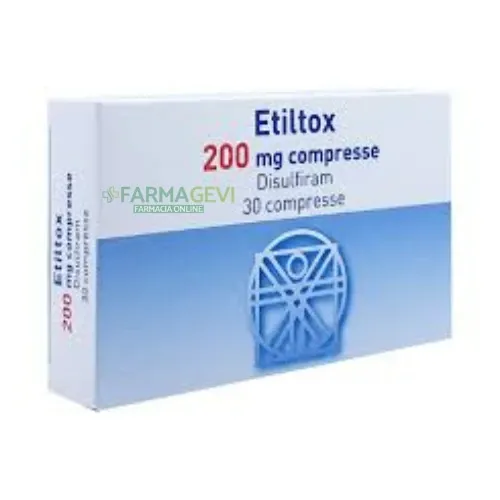
Table of Contents
Package leaflet: Information for the patient
ETILTOX 200 mg tablets
Disulfiram
Please read this leaflet carefully before taking this medicine because it contains important information for you.
- Keep this leaflet. You may need to read it again.
- If you have any questions, consult your doctor or pharmacist.
- This medicine has been prescribed for you only. Do not give it to others, even if their symptoms are the same as yours, as it could be harmful.
- If you experience any side effects, including those not listed in this leaflet, contact your doctor or pharmacist. See section 4.
Contents of this leaflet:
- What ETILTOX is and what it is used for
- What you need to know before taking ETILTOX
- How to take ETILTOX
- Possible side effects
- How to store ETILTOX
- Contents of the pack and other information
1. What ETILTOX is and what it is used for
ETILTOX contains the active substance disulfiram, which belongs to a group of medicines used in alcohol dependence that act on the process of alcohol metabolism in the body (aldehyde dehydrogenase inhibition). Specifically, disulfiram causes an accumulation of a substance called acetaldehyde, which leads to a condition (acetaldehyde syndrome) characterized by symptoms such as: feeling of warmth, headache, difficulty breathing, increased awareness of heartbeats (palpitations), increased heart rate (tachycardia), lowering of blood pressure (hypotension), marked anxiety, weakness, dizziness, and mental confusion. All these unpleasant symptoms discourage the alcoholic from continuing to consume alcoholic substances.
ETILTOX is indicated for the treatment of alcohol dependence (deterrence from chronic alcoholism).
2. What you should know before taking ETILTOX
Do not take ETILTOX
- if you are allergic to disulfiram or to any of the other ingredients of this medicine (listed in section 6);
- if you are under 18 years of age (See section “Children and adolescents”);
- if you have severe heart problems (heart failure, coronary artery disease);
- if you have serious problems with blood circulation in the brain (cerebrovascular events);
- if you have high blood pressure and are not receiving treatment for this condition (untreated hypertension);
- if you suffer from mental health disorders (severe personality disorder, psychosis, risk of suicide);
- if you consume alcoholic beverages or have recently taken medications containing alcohol, such as certain cough syrups, drops, tonics, or similar medicinal products (See sections “Warnings and precautions”, “Other medicines and ETILTOX”, and “ETILTOX with food, drinks and alcohol”);
- if you are exposed to a chemical substance called ethylene dibromide and its vapours;
- if you are breastfeeding (See section “Pregnancy and breastfeeding”).
Warnings and precautions
Talk to your doctor or pharmacist before taking ETILTOX.
This medicine must never be administered without the patient's knowledge, to unconscious individuals, or to those who have consumed alcohol within the previous 24 hours (See section “ETILTOX with food, drinks and alcohol”).
Take this medicine only under the direct supervision of a physician experienced in treating alcohol dependence, and only if you are genuinely committed to undergoing detoxification (selected, cooperative patients).
Before starting treatment, your doctor will perform appropriate tests to determine whether you are a suitable candidate for treatment with this medicine.
Additionally, your doctor will inform you about the alcohol content in liquid forms such as syrups, drops, toiletries, and mouthwashes, which may contain enough alcohol to cause serious adverse effects (See section “Other medicines and ETILTOX”).
Take this medicine with caution and under direct medical supervision:
- if you have severe kidney or liver problems (renal or hepatic insufficiency);
- if you suffer from respiratory diseases (chronic respiratory disorders);
- if you have diabetes (diabetes mellitus);
- if you have thyroid function disorders (hypothyroidism, hyperthyroidism);
- if you suffer from epilepsy;
- if you have suffered brain damage (cerebral injury);
- if you experience skin allergic reactions due to contact with rubber (contact dermatitis).
During treatment with this medicine, seek support from your family and from a specialist physician (psychotherapeutic treatment) to help you avoid consuming alcohol.
This medicine may cause serious liver damage (hepatic), especially after 1–3 months of treatment.
Therefore, during and after treatment, your doctor must monitor blood coagulation (coagulation factors) and liver function (tests for aminotransferases and phosphatase) through specific blood tests. If test results show abnormalities (transaminase levels three times higher than normal), your doctor must immediately discontinue ETILTOX therapy.
Children and adolescents
This medicine is contraindicated in children under 18 years of age (See section “Do not take ETILTOX”).
Other medicines and ETILTOX
Inform your doctor or pharmacist if you are taking, have recently taken, or might take any other medicines.
Do not take ETILTOX together with the following medicines, as they increase the effects of disulfiram:
- sulfonylureas, used to treat diabetes;
- phenylbutazone, aminophenazone, used to treat inflammation;
- moxalactam, cefamandole and cefoperazone, used to treat infections.
Do not take this medicine if you have recently undergone treatment with syrups or drops containing alcohol, as they may cause an alcohol-disulfiram reaction (See section “Possible side effects”).
Take ETILTOX with caution and inform your doctor if you are taking the following medicines:
- amitriptyline, used to treat depression, and chlorpromazine, used to treat certain mental disorders, as they may increase the intensity of the alcohol-disulfiram reaction;
- benzodiazepines such as chlordiazepoxide and diazepam, used to treat anxiety and sleep disorders, since disulfiram enhances their sedative effect;
- oral anticoagulants (warfarin), used to make blood less prone to clotting; oral hypoglycaemics, used to reduce blood sugar levels; hypnotics and sedatives (e.g. theophylline), used to treat sleep and breathing disorders; meperidine and morphine, used to treat pain; amphetamines, used as central nervous system stimulants; phenytoin, used to treat epilepsy; antipyrine, used to treat inflammation; rifampicin, used to treat bacterial infections. Disulfiram increases the effects and toxicity of these medicines, so a dose reduction may be necessary;
- metronidazole and isoniazid, used to treat bacterial infections, and paraldehyde, used to treat epilepsy, as taking these medicines together with ETILTOX increases the risk of adverse effects affecting the brain;
- pimozide, used to treat certain mental disorders, as a condition called organic brain syndrome, characterized by reduced mental function, may occur;
- blockers, vasodilators, used to treat various heart conditions and high blood pressure, and medicines whose actions on the CNS are mediated by noradrenaline, dopamine, or MAO inhibitors (phenelzine, tranylcypromine), used to treat depression, as serious adverse effects may occur.
ETILTOX with food, drinks and alcohol
During treatment and for 14 days after stopping therapy, do not consume alcoholic substances or foods containing liquid alcohol, as this may cause an alcohol-disulfiram reaction characterized by unpleasant, unpredictable, and sometimes fatal adverse effects. Also, pay particular attention when consuming “non-alcoholic” or “alcohol-free” beverages such as low-alcohol beer or wine, as excessive consumption may still trigger an alcohol-disulfiram reaction (See section “Possible side effects”).
Pregnancy and breastfeeding
If you are pregnant, suspect you may be pregnant, planning pregnancy, or breastfeeding, consult your doctor or pharmacist before taking this medicine.
This medicine is not recommended during the first three months (first trimester) of pregnancy.
ETILTOX is not recommended during pregnancy except in cases of absolute necessity and under direct medical supervision.
Do not take ETILTOX if you are breastfeeding (See section “Do not take ETILTOX”).
Driving and using machines
ETILTOX may cause drowsiness and fatigue. If you experience these symptoms, avoid driving vehicles or operating machinery.
3. How to take ETILTOX
Take this medicine exactly as directed by your doctor or pharmacist. If you have
any doubts, consult your doctor or pharmacist.
Treatment with ETILTOX is indicated only for adults and must be accompanied by
psychological support (psychotherapeutic).
Your doctor will determine, through appropriate tests, whether you are suitable to start treatment with ETILTOX.
You may take this medicine only if you have abstained from alcohol for at least 24 hours.
The recommended dose is 4-6 tablets per day, taken orally in a single administration for 3-4 consecutive days. Your doctor will gradually reduce the dose to 1-2 tablets per day.
To prevent relapses, your doctor will continue your therapy for several months (not exceeding 5 months), periodically evaluating your health condition.
If you take more ETILTOX than you should
Following an overdose of this medicine, the following effects may occur:
- nausea, vomiting, abdominal pain (abdominal), diarrhoea;
- drowsiness, delirium, hallucinations, feeling of tiredness (lethargy);
- increased heart rate (tachycardia);
- increased breathing rate (tachypnea);
- increased body temperature (hyperthermia);
- drop in blood pressure (hypotension);
- reduced muscle tone (hypotonia), especially in children;
- joint problems (reduced tendon reflexes);
- increased blood sugar levels (hyperglycaemia);
- reduced number of white blood cells in the blood (leucocytosis);
- alteration in fat metabolism (ketosis, often disproportionate to the degree of dehydration);
- blood disorders (methaemoglobinaemia);
- severe circulatory problems (cardiocirculatory collapse), deep unconsciousness (coma), and seizures, in the most severe cases;
- numbness or weakness in arms and legs (sensorimotor neuropathy);
- changes in heart activity (alterations in electrocardiogram, ECG);
- brain disorders (encephalopathy);
- mental disorders (psychosis, catatonia);
- movement disorders (dysarthria, myoclonus, ataxia, dystonia, akinesia). Your doctor will determine the most appropriate treatment for you, depending on the severity of symptoms.
In case of accidental ingestion of an excessive dose of ETILTOX, contact your doctor immediately or go to the nearest hospital.
If you forget to take ETILTOX
Do not take a double dose to make up for the missed tablet.
If you have any doubts about the use of this medicine, consult your doctor or pharmacist.
4. Possible side effects
Like all medicines, this medicine can cause side effects, although not everyone experiences them.
The following side effects may occur and tend to decrease during treatment or after a dose adjustment:
Common (may affect up to 1 in 10 people)
- drowsiness, headache (cephalalgia) at the beginning of treatment;
- nausea, vomiting, bad breath (halitosis), stomach pain (gastric pain), diarrhoea;
- feeling of weakness (asthenia) at the beginning of treatment.
Uncommon (may affect up to 1 in 100 people)
- allergic reactions (hypersensitivity);
- skin irritations (allergic dermatitis with rash, acne-like eruptions) and pruritus;
- sexual disorders (reduced libido, sexual dysfunction).
Rare (may affect up to 1 in 1,000 people)
- mental disorders (psychotic reactions, paranoia, schizophrenia, mania), depression;
- numbness, tingling, sensitivity and weakness in arms and legs (peripheral neuropathy), inflammation of the optic nerve (optic neuritis);
- yellowing of the skin and eyes (jaundice), changes in blood test values (elevated ASAT, ALAT, bilirubin). Very rare (may affect up to 1 in 10,000 people)
- liver problems (hepatic damage, fulminant hepatitis, hepatic necrosis). Frequency not known (cannot be estimated from the available data)
- brain problems (encephalopathy).
Alcohol-disulfiram reaction
If you consume alcohol during treatment with ETILTOX, an alcohol-disulfiram reaction may occur, with severe and potentially life-threatening symptoms. The reaction appears within 15 minutes of alcohol intake.
Symptoms last from 30 minutes to 1 hour and subside within a few hours. They include:
- increased blood flow (vasodilation) to the face and neck causing warmth ("flushing"), redness, increased body temperature, sweating, nausea, vomiting, pruritus, skin irritation (urticaria), anxiety, dizziness, headache (cephalalgia), blurred vision, increased awareness of heartbeat (palpitations), and breathing difficulties (hyperventilation);
- increased heart rate (tachycardia), drop in blood pressure (hypotension), severe breathing problem (respiratory depression), chest pain (thoracic pain), changes in heart rhythm (QT prolongation, ST depression, arrhythmias), deep unconsciousness (coma), and seizures;
- increased blood pressure (hypertension), difficulty breathing (bronchospasm), and blood disorders (methaemoglobinaemia). The doctor will provide appropriate treatment depending on the severity of symptoms (administration of oxygen and fluid replacement).
5. How to store ETILTOX
Keep this medicine out of the sight and reach of children.
Do not use this medicine after the expiry date stated on the packaging after “Exp.”. The expiry date refers to the last day of that month.
This medicine does not require any special storage conditions.
Do not dispose of any medicine via wastewater or household waste. Ask your pharmacist how to dispose of medicines you no longer use. This will help protect the environment.
6. Package contents and other information
What ETILTOX contains
- The active substance is disulfiram. Each tablet contains 200 mg of disulfiram.
- The other components are: microcrystalline cellulose, magnesium stearate.
Description of the appearance of ETILTOX and contents of the pack
Box containing 30 tablets.
Marketing Authorization Holder
Manufacturer
Istituto De Angeli S.r.l. Loc. Prulli n. 103/c – 50066 Reggello (FI) – Italy