Edoxaban Sandoz
Italy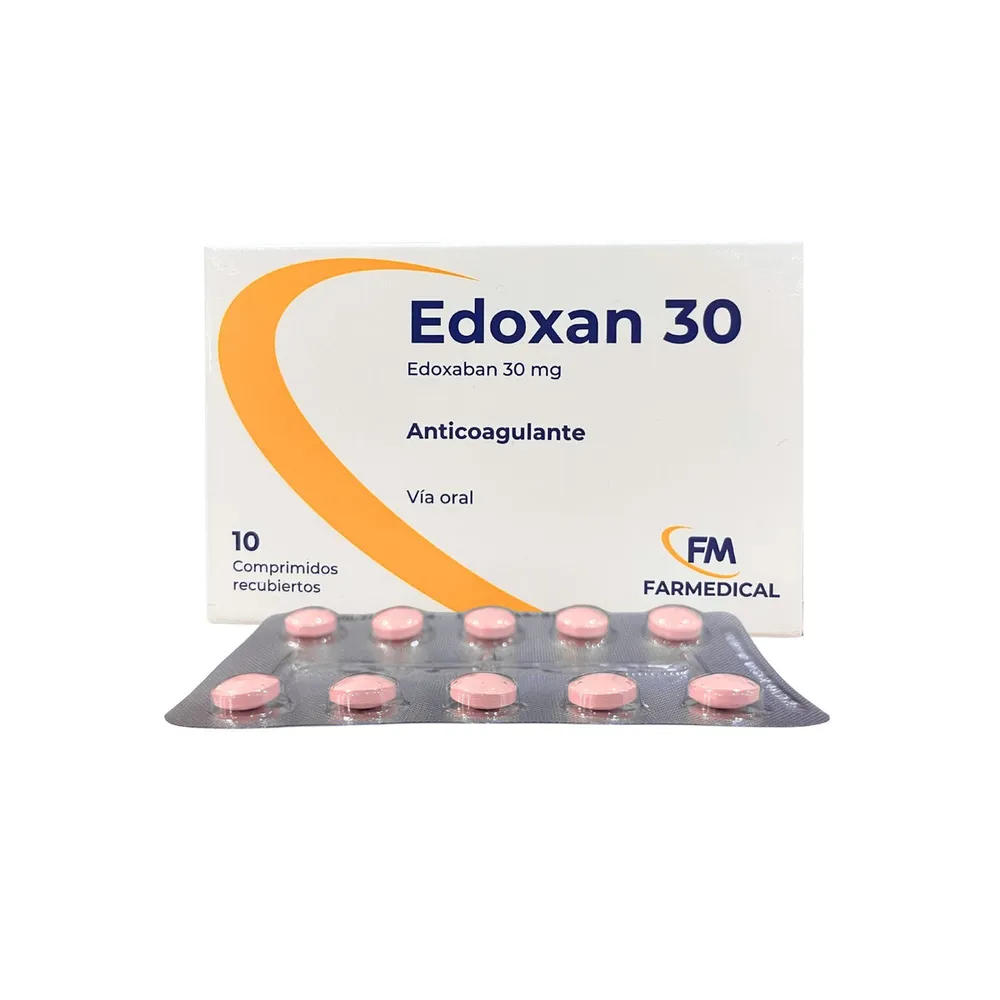
Table of Contents
- Patient Information Leaflet
- Edoxaban Sandoz 15 mg film-coated tablets, 30 mg film-coated tablets, 60 mg film-coated tablets
- 1. What Edoxaban Sandoz is and what it is used for
- 2. What you need to know before taking Edoxaban Sandoz
- 3. How to take Edoxaban Sandoz
- 5. How to store Edoxaban Sandoz
- 6. Package contents and other information
Patient Information Leaflet
Edoxaban Sandoz 15 mg film-coated tablets, 30 mg film-coated tablets, 60 mg film-coated tablets
Generic medicine
Please read all of this leaflet carefully before you start taking this medicine because it contains important information for you.
- Keep this leaflet. You may need to read it again.
- If you have any questions, ask your doctor or pharmacist.
- This medicine has been prescribed for you only. Do not pass it on to others. It may be harmful to other people, even if their symptoms are the same as yours.
- If you experience any side effects, including those not listed in this leaflet, tell your doctor or pharmacist. See section 4.
Contents of this leaflet
- What Edoxaban Sandoz is and what it is used for
- What you need to know before taking Edoxaban Sandoz
- How to take Edoxaban Sandoz
- Possible side effects
- How to store Edoxaban Sandoz
- Contents of the pack and other information
1. What Edoxaban Sandoz is and what it is used for
Edoxaban Sandoz contains the active substance edoxaban and belongs to a group of medicines
called anticoagulants. This medicine helps to prevent the formation of blood clots.
It works by blocking the activity of factor Xa, which is an important component in blood
coagulation.
Edoxaban Sandoz is used in adults:
- to prevent the formation of blood clots in the brain (stroke) and in other blood vessels of the body when there is an abnormal heart rhythm called non-valvular atrial fibrillation and at least one additional risk factor, such as heart failure, previous stroke, or high blood pressure;
- to treat blood clots in the veins of the legs (deep vein thrombosis) and in the blood vessels of the lungs (pulmonary embolism) and to prevent blood clots from recurring in the blood vessels of the legs and/or lungs.
2. What you need to know before taking Edoxaban Sandoz
Do not take Edoxaban Sandoz:
- if you are allergic to edoxaban or to any of the other ingredients of this medicine (listed in section 6);
- if you have active bleeding;
- if you have a disease or condition that increases the risk of serious bleeding (e.g. stomach ulcers, injuries or bleeding in the brain, or recent brain or eye surgery);
- if you are taking other medicines to prevent blood clotting (e.g. warfarin, dabigatran, rivaroxaban, apixaban, or heparins), except when switching anticoagulant therapy or when receiving heparins through a venous or arterial catheter to keep it open;
- if you have a liver disease that increases the risk of bleeding;
- if you have uncontrolled high blood pressure;
- during pregnancy or breastfeeding.
Warnings and precautions
Talk to your doctor or pharmacist before taking Edoxaban Sandoz
- if you have an increased risk of bleeding, such as if you have any of the following conditions:
- advanced kidney disease or if you are on dialysis;
- severe liver disease;
- coagulation disorders;
- a blood vessel disorder in the back of the eye (retinopathy);
- recent bleeding in the brain (intracranial or intracerebral haemorrhage);
- problems with blood vessels in the brain or spinal cord;
- if you have a mechanical heart valve.
Edoxaban Sandoz 15 mg should only be used when switching from Edoxaban Sandoz 30 mg to a vitamin K antagonist (e.g. warfarin) (see section 3, How to take Edoxaban Sandoz).
Take special care with Edoxaban Sandoz,
- if you know you have a condition called antiphospholipid syndrome (an immune system disorder that increases the risk of blood clots), inform your doctor, who will decide whether a change in therapy is necessary.
If you are scheduled for surgery,
- it is very important to take Edoxaban Sandoz before and after the procedure exactly as directed by your doctor. If possible, taking Edoxaban Sandoz should be stopped at least 24 hours before surgery. Your doctor will decide when to restart treatment with Edoxaban Sandoz. In emergency situations, your doctor will determine the appropriate actions to take regarding Edoxaban Sandoz.
Children and adolescents
This medicine is not recommended for children and adolescents under 18 years of age.
Other medicines and Edoxaban Sandoz
Tell your doctor or pharmacist if you are taking, have recently taken, or might take any other medicines.
If you are taking any of the following:
- certain antifungal medicines (e.g. ketoconazole);
- medicines for treating heart rhythm disorders (e.g. dronedarone, quinidine, verapamil);
- other medicines that reduce blood clotting (e.g. heparin, clopidogrel, or vitamin K antagonists such as warfarin, acenocoumarol, phenprocoumon, or dabigatran, rivaroxaban, apixaban);
- antibiotics (e.g. erythromycin, clarithromycin);
- medicines to prevent organ rejection after transplantation (e.g. cyclosporine);
- anti-inflammatory and pain medicines (e.g. naproxen or acetylsalicylic acid);
- antidepressants known as selective serotonin reuptake inhibitors or serotonin-norepinephrine reuptake inhibitors.
If any of the conditions described above apply to you, inform your doctor before taking Edoxaban Sandoz, as these medicines may increase the effects of Edoxaban Sandoz and the risk of unwanted bleeding. Your doctor will decide whether you should be treated with Edoxaban Sandoz and whether you need to be monitored.
If you are taking any of the following:
- certain medicines for epilepsy (e.g. phenytoin, carbamazepine, phenobarbital);
- St John’s wort, a herbal medicine used for anxiety and mild depression;
- rifampicin, an antibiotic medicine.
If any of the conditions described above apply to you, inform your doctor before taking Edoxaban Sandoz, as the effects of Edoxaban Sandoz may be reduced. Your doctor will decide whether you should be treated with Edoxaban Sandoz and whether you need to be monitored.
Pregnancy and breastfeeding
Do not take Edoxaban Sandoz if you are pregnant or breastfeeding. If you could become pregnant, use a reliable method of contraception during treatment with Edoxaban Sandoz. If you become pregnant while taking Edoxaban Sandoz, inform your doctor immediately. Your doctor will decide on the appropriate course of action.
Driving and using machines
Edoxaban Sandoz does not affect or has negligible effect on the ability to drive or use machines.
Edoxaban Sandoz contains lactose
If your doctor has diagnosed you with an intolerance to certain sugars, contact them before taking this medicine.
Edoxaban Sandoz contains sodium
This medicine contains less than 1 mmol (23 mg) of sodium per dose, i.e. essentially ‘sodium-free’.
3. How to take Edoxaban Sandoz
Take this medicine exactly as instructed by your doctor or pharmacist. If
you have any doubts, consult your doctor or pharmacist.
Dose to take
The recommended dose is one 60 mg tablet once daily.
- if kidney function is impaired, your doctor may decide to reduce the dose to one 30 mg tablet once daily;
- if body weight is 60 kg or less, the recommended dose is one 30 mg tablet once daily;
- if your doctor has prescribed medicines known as P-gp inhibitors: cyclosporine, dronedarone, erythromycin or ketoconazole, the recommended dose is one 30 mg tablet once daily.
How to take the tablet
Swallow the tablet, preferably with water.
Edoxaban Sandoz may be taken with or without food.
If you have difficulty swallowing the tablet whole, consult your doctor to discuss other ways of
taking Edoxaban Sandoz. The tablet may be crushed and mixed with water or apple puree immediately before administration. If necessary, your doctor may administer the crushed Edoxaban Sandoz tablet through a tube in the nose (nasogastric tube) or in the stomach (gastric tube).
Your doctor may adjust your anticoagulant treatment as follows:
Switching from vitamin K antagonists (VKA) (e.g. warfarin) to Edoxaban Sandoz
Stop treatment with the vitamin K antagonist (e.g. warfarin). Your doctor will perform blood tests and advise you when to start taking Edoxaban Sandoz.
Switching from oral anticoagulants other than VKAs (dabigatran, rivaroxaban or apixaban) to
Edoxaban Sandoz
Stop treatment with the previous medicine (e.g. dabigatran, rivaroxaban or apixaban) and start taking Edoxaban Sandoz at the time the next dose would have been due.
Switching from parenteral anticoagulants (e.g. heparin) to Edoxaban Sandoz
Stop treatment with the anticoagulant (e.g. heparin) and start taking Edoxaban Sandoz at the time the next dose would have been due.
Switching from Edoxaban Sandoz to vitamin K antagonists (e.g. warfarin)
If you are taking Edoxaban Sandoz 60 mg:
Your doctor will ask you to reduce the dose of Edoxaban Sandoz to one 30 mg tablet once daily and to take it together with a vitamin K antagonist (e.g. warfarin). Your doctor will perform blood tests and advise you when to stop taking Edoxaban Sandoz.
If you are taking Edoxaban Sandoz 30 mg (reduced dose):
Your doctor will ask you to reduce the dose of Edoxaban Sandoz to one 15 mg tablet once daily and to take it together with a vitamin K antagonist (e.g. warfarin). Your doctor will perform blood tests and advise you when to stop taking Edoxaban Sandoz.
Switching from Edoxaban Sandoz to oral anticoagulants other than VKAs (dabigatran, rivaroxaban or
apixaban)
Stop treatment with Edoxaban Sandoz and start taking the non-VKA oral anticoagulant (e.g. dabigatran, rivaroxaban or apixaban) at the time the next dose of Edoxaban Sandoz would have been due.
Switching from Edoxaban Sandoz to parenteral anticoagulants (e.g. heparin)
Stop treatment with Edoxaban Sandoz and start the parenteral anticoagulant (e.g. heparin) at the time the next dose of Edoxaban Sandoz would have been due.
Patients undergoing cardioversion:
If an abnormal heart rhythm is to be corrected by a procedure called cardioversion, take Edoxaban Sandoz according to the schedule provided by your doctor to prevent blood clots in the brain and other blood vessels in the body.
If you take more Edoxaban Sandoz than you should
Inform your doctor immediately if you have taken too many Edoxaban Sandoz tablets. If you have taken a higher dose than recommended, you may have an increased risk of bleeding.
If you forget to take Edoxaban Sandoz
Take the missed tablet immediately and then continue the next day with your usual once-daily dosing. Do not take a double dose on the same day to make up for a forgotten dose.
If you stop taking Edoxaban Sandoz
Do not stop treatment with Edoxaban Sandoz without first consulting your doctor, as Edoxaban Sandoz is used to treat and prevent serious conditions.
If you have any questions about how to use this medicine, consult your doctor or pharmacist.
- Possible side effects
Like all medicines, this medicine can cause side effects, although not everybody gets them.
Like other similar medicines (medicines that reduce blood clotting), Edoxaban Sandoz
can cause bleeding, which may be fatal. In some cases, bleeding may not be obvious.
If you experience any bleeding that does not stop on its own, or if you develop signs of excessive bleeding (unusual weakness, fatigue, paleness, dizziness, headache or unexplained swelling), consult your doctor immediately.
Your doctor may decide to monitor you closely or to adjust your medication.
General list of possible side effects:
Common (may affect up to 1 in 10 people)
- stomach ache;
- abnormal liver function tests;
- bleeding from or under the skin;
- anaemia (low red blood cell levels);
- nosebleeds;
- vaginal bleeding;
- rash;
- bleeding in the intestine;
- bleeding from the mouth and/or throat;
- blood in the urine;
- bleeding following injury (puncture);
- bleeding in the stomach;
- dizziness;
- feeling unwell;
- headache;
- itching sensation.
Uncommon (may affect up to 1 in 100 people)
- bleeding in the eyes;
- bleeding from a wound following surgery;
- coughing up blood;
- bleeding in the brain;
- other types of bleeding;
- reduced number of platelets in the blood (which may affect clotting);
- allergic reaction;
- hives.
Rare (may affect up to 1 in 1,000 people)
- bleeding in the muscles;
- bleeding in the joints;
- bleeding in the abdomen;
- bleeding in the heart;
- bleeding inside the skull;
- bleeding following a surgical procedure;
- anaphylactic shock;
- swelling in any part of the body due to an allergic reaction.
Not known (frequency cannot be estimated from available data)
- bleeding in the kidney, sometimes with blood in the urine, leading to the kidneys being unable to function properly (anticoagulant-related nephropathy).
Reporting of side effects
If you experience any side effect, including those not listed in this leaflet, consult your doctor or pharmacist. You may also report side effects directly via the national reporting system at https://www.aifa.gov.it/content/segnalazioni-reazioni-avverse.
By reporting side effects, you can help provide more information on the safety of this medicine.
5. How to store Edoxaban Sandoz
Keep this medicine out of the sight and reach of children.
Do not use this medicine after the expiry date stated on the carton, on each blister or
bottle after Exp. The expiry date refers to the last day of that month.
Store below 25 °C.
Do not dispose of any medicine via wastewater or household waste. Ask your pharmacist how to
dispose of medicines no longer required. This will help protect the environment.
6. Package contents and other information
What Edoxaban Sandoz contains
The active substance is edoxaban (as monohydrate tosylate).
Edoxaban Sandoz 15 mg film-coated tablets
Each film-coated tablet contains 15 mg of edoxaban (as monohydrate tosylate).
Edoxaban Sandoz 30 mg film-coated tablets
Each film-coated tablet contains 30 mg of edoxaban (as monohydrate tosylate).
Edoxaban Sandoz 60 mg film-coated tablets
Each film-coated tablet contains 60 mg of edoxaban (as monohydrate tosylate).
Other components are:
Edoxaban Sandoz 15 mg film-coated tablets
Tablet core: Hydroxypropylcellulose (E463), monohydrate lactose, magnesium stearate (E470b), microcrystalline cellulose (E460), sodium croscarmellose (E468).
Film coating: Hypromellose type 2910, 6.0 mPas (E464), macrogol, titanium dioxide (E171), talc (E553b), yellow iron oxide (E172) and red iron oxide (E172).
Edoxaban Sandoz 30 mg film-coated tablets
Tablet core: Hydroxypropylcellulose (E463), monohydrate lactose, magnesium stearate (E470b), microcrystalline cellulose (E460), sodium croscarmellose (E468).
Film coating: Hypromellose type 2910, 6.0 mPas (E464), macrogol, titanium dioxide (E171), talc (E553b) and red iron oxide (E172).
Edoxaban Sandoz 60 mg film-coated tablets
Tablet core: Hydroxypropylcellulose (E463), monohydrate lactose, magnesium stearate (E470b), microcrystalline cellulose (E460), sodium croscarmellose (E468).
Film coating: Hypromellose type 2910, 6.0 mPas (E464), macrogol, titanium dioxide (E171), talc (E553b) and yellow iron oxide (E172).
Description of the appearance of Edoxaban Sandoz and contents of the pack
Edoxaban Sandoz 15 mg film-coated tablets
Light orange film-coated tablet (diameter 6.7 mm), imprinted with "EX 15" on one side.
Edoxaban Sandoz 30 mg film-coated tablets
Light pink film-coated tablet (diameter 8.6 mm), imprinted with "EX 30" on one side.
Edoxaban Sandoz 60 mg film-coated tablets
Light yellow film-coated tablet (diameter 10.6 mm), imprinted with "EX 60" on one side.
Edoxaban Sandoz is packaged in PVC/Aluminum blisters, divisible PVC/Aluminum blisters for unit dose, or HDPE bottles with a polypropylene screw cap with child-resistant closure.
Blister packs:
Pack sizes:
15 mg:
10 and 14 film-coated tablets in blisters inside boxes.
10x1, 28x1 and 98x1 film-coated tablets in divisible unit-dose blisters inside boxes.
30 mg and 60 mg:
10, 14, 28, 30, 50, 84, 98 and 100 film-coated tablets in blisters inside boxes.
10x1, 28x1 and 98x1 film-coated tablets in divisible unit-dose blisters inside boxes.
The blisters may have calendar days printed on them.
Bottle packs:
100, 120 and 250 film-coated tablets.
Not all pack sizes may be marketed.
Marketing Authorization Holder
Sandoz S.p.A.
Viale Luigi Sturzo 43
20154 Milan
Italy
Manufacturer
Lek Pharmaceuticals d.d.
Trimlini 2d
9220 Lendava
Slovenia
This medicinal product is authorized in the Member States of the European Economic Area under the following names:
Belgium
Edoxaban Sandoz 15 mg filmomhulde tabletten
Edoxaban Sandoz 30 mg filmomhulde tabletten
Edoxaban Sandoz 60 mg filmomhulde tabletten
Denmark
Edoxaban Sandoz
Finland
Edoxaban Sandoz 15 mg tabletti, kalvopäällysteinen
Edoxaban Sandoz 30 mg tabletti, kalvopäällysteinen
Edoxaban Sandoz 60 mg tabletti, kalvopäällysteinen
Germany
Edoxaban HEXAL 15 mg Filmtabletten
Edoxaban HEXAL 30 mg Filmtabletten
Edoxaban HEXAL 60 mg Filmtabletten
Ireland
Edoxaban tosylate monohydrate 30 mg filmcoated tablets
Edoxaban tosylate monohydrate 30 mg filmcoated tablets
Iceland
Edoxaban Sandoz
Italy
Edoxaban Sandoz
Norway
Edoxaban Sandoz
Netherlands
Edoxaban Sandoz 15 mg, filmomhulde tabletten
Edoxaban Sandoz 30 mg, filmomhulde tabletten
Edoxaban Sandoz 60 mg, filmomhulde tabletten
Portugal
Edoxabano Sandoz
Czech Republic
Edoxaban Sandoz
Slovakia
Edoxaban Sandoz 30 mg
Edoxaban Sandoz 60 mg
Spain
Edoxabán Sandoz 15 mg comprimidos recubiertos con película EFG
Edoxabán Sandoz 30 mg comprimidos recubiertos con película EFG
Edoxabán Sandoz 60 mg comprimidos recubiertos con película EFG
Sweden
Edoxaban Sandoz
Hungary
Edoxaban Sandoz 30 mg filmtabletta
Edoxaban Sandoz 60 mg filmtabletta