Dropaxin
Italy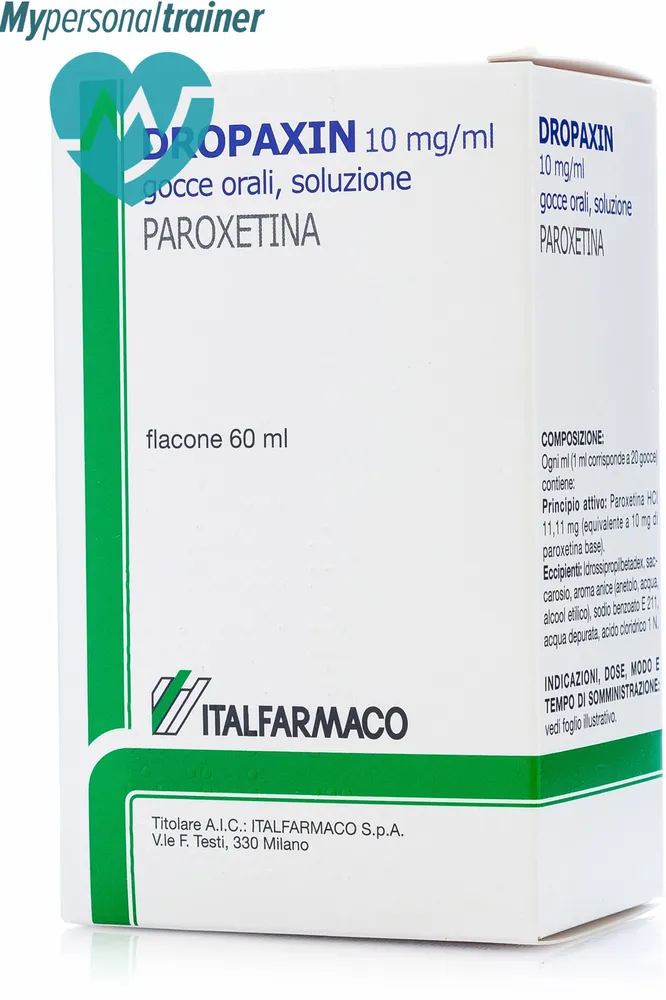
Table of Contents
Package leaflet: Information for the user
DROPAXIN 10 mg/ml oral drops solution
Paroxetine
Read this leaflet carefully before taking this medicine because it contains important information for you.
- Keep this leaflet. You may need to read it again.
- If you have any questions, ask your doctor.
- This medicine has been prescribed for you personally. Never give it to others. It could be harmful to other people, even if their symptoms are the same as yours.
- If you experience any side effect, including those not listed in this leaflet, tell your doctor. See section 4.
Contents of this leaflet:
- What DROPAXIN is and what it is used for
- What you need to know before taking DROPAXIN
- How to take DROPAXIN
- Possible side effects
- How to store DROPAXIN
- Contents of the pack and other information
1. What DROPAXIN is and what it is used for
Dropaxin is a treatment for adults with depression and/or anxiety disorders.
The anxiety disorders for which DROPAXIN is used include: obsessive-compulsive disorder (repetitive, obsessive thoughts with uncontrollable behaviour), panic disorder (panic attacks, including those caused by agoraphobia, which is a fear of open spaces), social anxiety disorder (fear of or avoidance of social situations), post-traumatic stress disorder (anxiety caused by a traumatic event), and generalized anxiety disorder (a general state of marked anxiety or nervousness).
Dropaxin belongs to a group of medicines called SSRIs (selective serotonin reuptake inhibitors).
Everyone has a substance in the brain called serotonin. People who are depressed or anxious have lower levels of serotonin than others. It is not fully understood how Dropaxin and other SSRIs work, but they may help by increasing the level of serotonin in the brain.
Proper treatment of depression and anxiety disorders is important to help you feel better.
2. What you should know before taking DROPAXIN
Do not take DROPAXIN:
- If you have previously had an allergic reaction to paroxetine or to any of the liquid ingredients of this medicine (listed in section 6).
- If you are currently taking, or have taken within the last two weeks, medicines called monoamine oxidase inhibitors (MAOIs, including moclobemide and methylene blue chloride (methylene blue)). Your doctor will advise you on how to start taking Dropaxin after stopping the MAOI.
- If you are taking an antipsychotic medicine called thioridazine or an antipsychotic called pimozide.
- If any of these apply to you, speak with your doctor before taking Dropaxin.
Warnings and precautions
Talk to your doctor or pharmacist before taking DROPAXIN
- If you are taking other medicines (see “Other medicines and Dropaxin”).
- If you have kidney, liver, or heart problems.
- If you have epilepsy or have had seizures or panic attacks.
- If you have episodes of mania (manic behaviors or thoughts).
- If you are receiving electroconvulsive therapy (ECT).
- If you have had bleeding disorders or are taking other medicines that may increase the risk of bleeding (these include medicines used to thin the blood, such as warfarin, antipsychotics such as perphenazine or clozapine, tricyclic antidepressants, medicines used for pain and inflammation called non-steroidal anti-inflammatory drugs – NSAIDs, such as acetylsalicylic acid, ibuprofen, celecoxib, etodolac, diclofenac, meloxicam) or if you are pregnant (see "Pregnancy, breastfeeding and fertility").
- If you are taking tamoxifen for the treatment of breast cancer or fertility issues, DROPAXIN may make tamoxifen less effective, so your doctor may recommend you take another antidepressant.
- If you have diabetes.
- If you are on a low-sodium diet.
- If you have glaucoma (increased eye pressure).
- If you are pregnant or planning to become pregnant (see Pregnancy, breastfeeding and fertility within this leaflet).
- If you are under 18 years of age (see Children and adolescents under 18 years within this leaflet).
In these cases, and if you have not already discussed them with your doctor, consult your doctor and ask what you should do regarding taking Dropaxin.
Children and adolescents under 18 years
DROPAXIN must not be used in children and adolescents under 18 years of age.
Furthermore, patients under 18 years of age have an increased risk of adverse effects such as suicide attempts, suicidal thoughts, and hostility (mainly aggression, oppositional behavior, and anger) when taking DROPAXIN. If your doctor has prescribed DROPAXIN for you (or for your child) and you wish to discuss this, speak to your doctor. You must inform your doctor if any of the symptoms listed above appear or worsen while you (or your child) are taking DROPAXIN.
In addition, in this age group, the long-term effects of DROPAXIN on growth, maturation, and cognitive and behavioral development have not yet been established.
In clinical studies of DROPAXIN in patients under 18 years of age, the common adverse effects occurring in less than 1 in 10 children/adolescents were: increased suicidal thoughts and suicide attempts, deliberate self-harm, hostile, aggressive or unfriendly behavior, loss of appetite, tremors, unusual sweating, hyperactivity (having too much energy), agitation, emotional changes (including crying and mood changes), and unusual bruising or bleeding (such as nosebleeds). These studies also showed that similar symptoms occurred in children and adolescents taking sugar pills (placebo) instead of DROPAXIN, although less frequently.
In these studies conducted in patients under 18 years of age, some patients experienced withdrawal symptoms after stopping DROPAXIN. These symptoms were mostly similar to those observed in adults after discontinuation of DROPAXIN (see section 3, How to take DROPAXIN, within this leaflet). In addition, patients under 18 years of age commonly (in less than 1 in 10) also experienced stomach pain, feeling nervous, and emotional changes (including crying, mood changes, self-harm attempts, suicidal thoughts, and suicide attempts).
Suicidal thoughts and worsening of depression or anxiety disorder
If you are depressed and/or have anxiety disorders, you may sometimes have thoughts of self-harm or suicide. These may increase when you first start taking antidepressants, as these medicines take time to work, usually about two weeks but sometimes longer. You may be more prone to such thoughts:
- If you have previously had suicidal or self-harming thoughts.
- If you are a young adult. Clinical studies have shown an increased risk of suicidal behavior in adults under 25 years of age with psychiatric disorders treated with an antidepressant. If at any time you have suicidal or self-harming thoughts, contact your doctor or go immediately to hospital. You may find it helpful to talk to a friend or relative about your depression or anxiety disorder, and you may ask them to read this leaflet. You could ask them to tell you if they think your depression or anxiety is getting worse or if they are concerned about changes in your behavior.
Important side effects observed with DROPAXIN
Some patients taking DROPAXIN develop a condition called akathisia, in which they feel restless and unable to sit still or remain at rest. Other patients develop a condition called serotonin syndrome or neuroleptic malignant syndrome, in which they experience some or all of the following symptoms: feeling very agitated or irritable, confusion, restlessness, feeling hot, sweating, tremors, chills, hallucinations (strange visions or sounds), muscle stiffness, sudden muscle contractions, or rapid heartbeat. Severity may increase, leading to loss of consciousness. If you experience any of these symptoms, contact your doctor. For more information on these or other side effects of DROPAXIN, see section 4, Possible side effects, within this leaflet.
Medicines like DROPAXIN (so-called SSRIs) may cause symptoms of sexual dysfunction (see section 4). In some cases, these symptoms may persist after stopping treatment.
Other medicines and DROPAXIN
Some medicines may affect the action of Dropaxin or increase the risk of side effects. Dropaxin may also affect the action of other medicines. These include:
- Medicines called monoamine oxidase inhibitors (MAOIs, including moclobemide and methylene blue chloride). See “Do not take Dropaxin” within this patient leaflet.
- Thioridazine or pimozide, antipsychotic medicines. See “Do not take Dropaxin” within this patient leaflet.
- Acetylsalicylic acid, ibuprofen, and other medicines called NSAIDs (Non-Steroidal Anti-Inflammatory Drugs) such as celecoxib, etodolac, diclofenac, meloxicam, and rofecoxib, used for pain and inflammation.
- Tramadol, buprenorphine, or pethidine, painkillers.
- Medicines called triptans such as sumatriptan, used to treat migraine.
- Other antidepressants including other SSRIs, and tricyclic antidepressants such as clomipramine, nortriptyline, and desipramine.
- A dietary supplement called tryptophan.
- Mivacurium and succinylcholine (used in anesthesia).
- Medicines such as lithium, risperidone, perphenazine, clozapine (called antipsychotics or neuroleptics) used to treat certain psychiatric disorders.
- St. John’s wort, an herbal remedy for depression.
- Atomoxetine, used to treat attention deficit and hyperactivity disorder (ADHD).
- Phenobarbital, phenytoin, or carbamazepine, used to treat seizures or epilepsy.
- Procyclidine, used to relieve tremors, especially in Parkinson’s disease.
- Warfarin or other medicines (called anticoagulants) used to thin the blood.
- Propafenone, flecainide, and medicines used for arrhythmias (irregular heartbeat).
- Metoprolol, a beta-blocker used to treat high blood pressure and heart disorders.
- Pravastatin, used to treat high cholesterol levels.
- Rifampicin, used to treat tuberculosis (TB) and leprosy.
- Linezolid, an antibiotic.
- Fentanyl, used in anesthesia or for treating chronic pain.
- A combination of fosamprenavir and ritonavir, used to treat Human Immunodeficiency Virus (HIV) infection.
- Tamoxifen, used for the treatment of breast cancer or fertility problems.
If you are taking a medicine from this list, and have not yet discussed it with your doctor, consult your doctor and ask what you should do. It may be necessary to adjust your dose or change your medicine.
If you are taking any other medicine, including those without a prescription, ask your doctor or pharmacist before taking Dropaxin. They will be able to advise you whether taking Dropaxin is safe in your case.
Taking Dropaxin with alcohol
Do not drink alcohol while taking Dropaxin. Alcohol may worsen your symptoms or side effects.
Pregnancy, breastfeeding and fertility
If you are pregnant or breastfeeding, or if you suspect you may be pregnant or are planning to become pregnant, consult your doctor or pharmacist before taking this medicine.
In newborns whose mothers took Dropaxin during the first months of pregnancy, there has been evidence of an increased risk of birth defects, particularly heart defects. In the general population, about 1 in 100 newborns is born with a heart defect. This risk increases to 2 in 100 newborns in mothers who took Dropaxin.
You and your doctor will decide whether it is better for you to switch to another treatment or gradually discontinue Dropaxin during pregnancy. However, based on your clinical condition, your doctor may advise that it is better to continue taking Dropaxin.
If you take DROPAXIN towards the end of pregnancy, there may be an increased risk of severe vaginal bleeding shortly after delivery, especially if you have a history of bleeding disorders. Your doctor or midwife should be aware that you are taking DROPAXIN so they can advise you.
Make sure your midwife or doctor knows that you are taking DROPAXIN. When medicines like DROPAXIN are taken during pregnancy, particularly during the last three months, they may increase the risk of a serious condition in the baby called persistent pulmonary hypertension of the newborn (PPHN). In PPHN, the blood pressure in the blood vessels between the newborn’s heart and lungs is too high. If you take Dropaxin during the last three months of pregnancy, your baby may also experience other symptoms, usually appearing within the first 24 hours after birth.
These symptoms include:
- Breathing difficulties
- Bluish, too hot, or too cold skin
- Blue lips
- Vomiting or feeding difficulties
- Lethargy, inability to sleep, or excessive crying
- Stiff or floppy muscles
- Tremors, restlessness, or seizures
- Exaggerated reflexes
If your baby shows any of these symptoms at birth or if you are concerned about your baby’s health, contact your doctor or midwife, who will be able to assist you.
Dropaxin may pass into breast milk in very small amounts. If you are taking Dropaxin, consult your doctor before starting breastfeeding. You and your doctor may decide that you can breastfeed while taking Dropaxin.
Paroxetine has been shown to reduce sperm quality in animal studies. Theoretically, this could affect fertility, but no impact on human fertility has been observed so far.
Effect on male fertility
Medicines like Dropaxin may reduce sperm quality. Although the impact on fertility is not known, fertility may be impaired in some men while taking Dropaxin.
Driving and using machines
Dropaxin may cause dizziness, confusion, drowsiness, and vision disturbances. If you experience these side effects, do not drive or operate machinery.
Dropaxin contains
- This product contains sucrose; therefore, if your doctor has diagnosed you with an intolerance to certain sugars, consult your doctor before taking this medicine. It may be harmful to teeth.
- This medicine contains 26.4 mg/ml of alcohol (ethanol) per ml, equivalent to 3.3% v/v. Each 2 ml dose (20 mg paroxetine) contains 52.8 mg of ethanol, and each 6 ml dose (60 mg paroxetine) contains 158.4 mg of ethanol. The amount in 1 ml of this medicine is equivalent to less than 1 ml of beer or 0.3 ml of wine (6 ml equivalent to 4 ml of beer or 1.6 ml of wine). The small amount of alcohol in this medicine will not have noticeable effects.
- This medicine contains 0.001 g of benzoate salt per ml, equivalent to 0.002 g/2 ml (20 mg paroxetine) or 0.006 g/6 ml (60 mg paroxetine). Benzoate salt may increase jaundice (yellowing of the skin and eyes) in newborns up to 4 weeks of age. This medicine contains less than 1 mmol (23 mg) of sodium per dose, i.e., essentially ‘sodium-free’. This product does not contain gluten and can be taken by people with celiac disease.
3. How to take DROPAXIN
Take Dropaxin drops, diluted in water, in the morning with breakfast.
It is important to take the medicine exactly as prescribed by your doctor, who will advise you on the appropriate dose when you first start taking Dropaxin. Most people begin to feel better after a couple of weeks. If you do not start to feel better after this time, inform your doctor, who may decide to gradually increase your dose up to the maximum allowed daily dose.
The usual doses for different indications are shown in the table below.
Your doctor will inform you about the daily dose and how long you should continue treatment. This may be for several months or longer.
Elderly patients
The maximum allowed dose for people aged over 65 years is 4 ml per day.
Patients with hepatic or renal impairment
If you have severe liver or kidney problems, your doctor may decide that you need a lower than normal dose.
If you take more Dropaxin than you should
Do not take more medicine than your doctor has prescribed. If you or someone else takes too many drops of Dropaxin, in addition to the symptoms listed in Section 4 “POSSIBLE SIDE EFFECTS”, you may experience vomiting, dilated pupils, fever, changes in blood pressure, headache, involuntary muscle contractions, agitation, anxiety, and faster than normal heartbeat.
In any case, contact your doctor immediately or go to the nearest hospital, taking the medicine bottle with you.
If you forget to take Dropaxin
Take the medicine at the same time every day. If you forget to take a dose and remember before going to bed, take it immediately and continue your treatment as usual the next day. If you only remember during the night or the following day, do not take the missed dose. You may experience withdrawal symptoms, but these will disappear once you take your usual dose at the regular time. Do not take a double dose to make up for a forgotten dose.
What to do if you are not improving
Dropaxin will not improve your symptoms immediately; all antidepressants require time to take effect. Some people start to feel better within a couple of weeks, while others need more time. Some people taking antidepressants may feel worse before they start to improve.
If you do not start to feel better after a couple of weeks, contact your doctor for advice. Your doctor should review your condition a couple of weeks after you have started treatment. Inform your doctor if you have not started to improve.
If you stop taking Dropaxin
Do not stop treatment with Dropaxin unless your doctor advises you to do so.
When you discontinue treatment, your doctor will help you gradually reduce the dose over several weeks or months to minimize the risk of withdrawal effects. One way to do this is to gradually reduce your daily dose of Dropaxin by 10 mg per week. Most people find that withdrawal symptoms are mild and resolve spontaneously within two weeks. However, for some people, these symptoms may be more severe or last longer.
If you experience withdrawal symptoms when stopping the drops, your doctor may decide to discontinue the medication more slowly. If you experience severe withdrawal symptoms when stopping Dropaxin, contact your doctor. Your doctor may advise you to restart taking the drops and then discontinue treatment more gradually. Despite withdrawal symptoms, you will still be able to stop taking Dropaxin.
Possible withdrawal symptoms when stopping treatment
Studies show that 3 out of 10 patients report one or more symptoms when stopping treatment with Dropaxin. Some withdrawal symptoms occur more frequently than others.
Symptoms that may occur in 1 out of 10 people:
- Dizziness, unsteadiness, or loss of balance.
- Tingling sensations, burning sensations, and (less commonly) electric shock-like sensations, including in the head, and ringing, buzzing, hissing, or other persistent noises in the ear (tinnitus).
- Sleep disturbances (vivid dreams, nightmares, difficulty falling asleep).
- Anxiety.
- Headache.
Symptoms that may occur in 1 out of 100 people:
- Malaise (nausea).
- Sweating (including night sweats).
- Restlessness or agitation.
- Tremors (shaking).
- Confusion or disorientation.
- Diarrhea (loose stools).
- Increased emotional sensitivity or irritability.
- Visual disturbances.
- Changes in heart rate (palpitations).
Inform your doctor if you are concerned about these withdrawal symptoms when stopping treatment with Dropaxin.
If you have further questions about the use of this medicine, ask your doctor or pharmacist.
4. Possible side effects
Like all medicines, this medicine can cause side effects, although not everyone gets them. Side effects are more likely to occur during the first few weeks of taking DROPAXIN.
If you experience any of the following side effects during treatment, contact your doctor or go
immediately to hospital.
Uncommon (affects 1 in 100 patients)
-
If you develop unexplained bruising or bleeding, including blood in your vomit or stools. Contact your doctor or go immediately to the nearest hospital.
-
If you have difficulty urinating. Contact your doctor or go immediately to the nearest hospital.
Rare (affects 1 in 1,000 patients) -
If you have seizures. Contact your doctor or go immediately to the nearest hospital.
-
If you feel restless or unable to sit still, you may be experiencing a condition called akathisia. Increasing your dose of Dropaxin could worsen these symptoms. Contact your doctor.
-
If you feel tired, weak, or confused and have muscle pain, stiffness, or incoordination, this could be due to a rare effect of Dropaxin that may lead to low sodium levels in your blood. Contact your doctor.
Very rare (affects 1 in 10,000 patients)
- Allergic reactions to Dropaxin, which can be severe. If you develop redness and skin rashes, swelling of the eyelids, face, lips, mouth, or tongue, itching, or difficulty breathing (shortness of breath) or swallowing, or if you feel weak or dizzy, leading to collapse or loss of consciousness, contact your doctor or go immediately to the nearest hospital.
- If you develop serotonin syndrome or neuroleptic malignant syndrome. Symptoms include: intense agitation or irritability, confusion, restlessness, feeling hot, sweating, shaking, tremors, hallucinations (strange visions or sounds), muscle rigidity, sudden muscle contractions, or rapid heartbeat. Severity may increase, leading to loss of consciousness. If you experience these symptoms, contact your doctor.
- Acute glaucoma. If your eyes become painful and you experience blurred vision, contact your doctor.
Not known (frequency cannot be estimated from available data)
- Some people have had thoughts of harming themselves or of suicide while taking DROPAXIN or immediately after stopping treatment (see section 2, What you should know before taking DROPAXIN).
- Some people have shown aggression during treatment with Dropaxin.
- Severe vaginal bleeding immediately after childbirth (postpartum haemorrhage); see "Pregnancy, breastfeeding and fertility" in section 2 for further information.
If you experience any of these side effects, contact your doctor.
Other possible side effects of lesser severity that may occur during treatment
Very common (affects more than 1 in 10 patients)
-
Feeling unwell (nausea). Taking the medicine in the morning with breakfast will reduce the likelihood of these symptoms.
-
Changes in sexual habits or sexual function. For example, lack of orgasm and, in men, abnormal erection and ejaculation.
Common (affects 1 in 10 patients) -
Increased cholesterol levels in the blood.
-
Loss of appetite.
-
Sleep disturbances (insomnia) or drowsiness.
-
Abnormal dreams (including nightmares).
-
Dizziness or shaking (tremors).
-
Difficulty concentrating.
-
Headache.
-
Feeling restless.
-
Blurred vision.
-
Yawning, dry mouth.
-
Diarrhoea or constipation.
-
Vomiting.
-
Weight gain.
-
Feeling unusually weak.
-
Sweating.
Uncommon (affects 1 in 100 patients)
- Transient increases or decreases in blood pressure, which may cause dizziness or fainting when standing up suddenly.
- Faster than normal heartbeat.
- Inability to move, stiffness, shaking, or abnormal movements of the mouth and tongue.
- Dilated pupils.
- Skin rashes.
- Itching.
- Confusion.
- Hallucinations (strange visions and sounds).
- Inability to urinate (urinary retention) or involuntary and uncontrollable loss of urine (urinary incontinence).
- If you are a diabetic patient, you may notice changes in your blood glucose levels during treatment with Dropaxin. In such cases, consult your doctor, who will explain how to adjust the dose of insulin or other medications you use for diabetes treatment.
Rare (affects 1 in 1,000 patients)
- Abnormal milk production in the mammary glands of men and women.
- Slowed heartbeat.
- Liver abnormalities detected by specific blood tests for liver function.
- Panic attacks.
- Manic behaviour or thoughts.
- Feeling detached from your body (depersonalisation).
- Anxiety.
- Irresistible urge to move the legs (Restless Legs Syndrome).
- Joint or muscle pain.
- Increased levels in the blood of a hormone called prolactin.
- Menstrual cycle disturbances (including heavy or irregular periods, bleeding between periods, or absence or delay of periods).
Very rare (affects 1 in 10,000 patients)
-
Liver problems causing yellowing of the skin or whites of the eyes.
-
Syndrome of inappropriate antidiuretic hormone secretion (SIADH), a condition in which the body retains too much water and sodium levels (salt) decrease, due to improper chemical signals. Patients with SIADH may become seriously ill or may have no symptoms at all.
-
Water and fluid retention, which may cause swelling of the arms or legs.
-
Sensitivity to sunlight.
-
Skin rash, which may present with blisters and appear as small targets (dark central spots surrounded by a lighter area, with a dark ring around the edge), known as erythema multiforme.
-
Widespread skin rash with blisters and peeling of the skin, particularly around the mouth, nose, eyes, and genitals (Stevens-Johnson syndrome).
-
Widespread skin rash with blisters and peeling of the skin over a large area of the body (toxic epidermal necrolysis).
-
Persistent and painful erection of the penis.
-
Unexpected bleeding, for example bleeding gums, blood in urine or vomit, or unexplained bruising or broken blood vessels (rupture of veins).
-
Some patients have reported ringing, buzzing, whistling, tinkling, or other persistent noises in the ear (tinnitus) while taking Dropaxin.
-
An increased risk of bone fractures has been observed in patients taking this type of medicine.
Frequency not known (frequency cannot be estimated from available data) -
Teeth grinding (bruxism).
-
Inflammation of the colon (causing diarrhoea).
If you have any concerns while taking Dropaxin, speak with your doctor and/or pharmacist, who can advise you.
Reporting of side effects
If you experience any side effect, including those not listed in this leaflet, talk to your doctor. You can also report side effects directly via the national reporting system at: https://www.aifa.gov.it/content/segnalazioni-reazioni-avverse.
By reporting side effects, you can help provide more information on the safety of this medicine.
5. How to store DROPAXIN
- Keep this medicine out of the sight and reach of children.
- Do not use this medicine after the expiry date stated on the carton after "exp.". The expiry date refers to the last day of the month.
- After first opening the bottle, the oral solution is stable for 30 days for the 30 ml bottle and 60 days for the 60 ml bottle.
- Do not dispose of any medicine via wastewater or household waste. Ask your pharmacist how to dispose of medicines you no longer use. This will help protect the environment.
6. Package contents and other information
What DROPAXIN contains
The active substance is paroxetine as paroxetine hydrochloride.
The other excipients are: hydroxypropylbetadex, sucrose, anise flavour (anethole, water, ethanol), sodium benzoate E211, purified water, hydrochloric acid 1N.
Description of the appearance of Dropaxin and pack contents
Each carton contains a 30 ml or 60 ml bottle and a graduated pipette. Each ml of solution (20 drops) contains 10 mg of paroxetine.
Marketing Authorisation Holder and Manufacturer
Italfarmaco S.p.A. – Viale F. Testi, 330 - Milan
Tel: +39.02.64431
Fax: +39.02.644346
e-mail: [email protected]
Manufacturer and final controller
Italfarmaco S.A.
28108 Alcobendas (Madrid) (E), San Rafael, 3 – Polig. Industrial de Alcobendas
Tel: +39.02.64431
Fax: +39.02.644346
This medicinal product is authorised in the Member States of the European Economic Area under the following names:
Italy: Dropaxin 10 mg/ml oral drops, solution
Portugal: Dropax 10 mg/ml oral drops, solution
Spain: Zuria 10 mg/ml oral drops in solution