Dramigel
Italy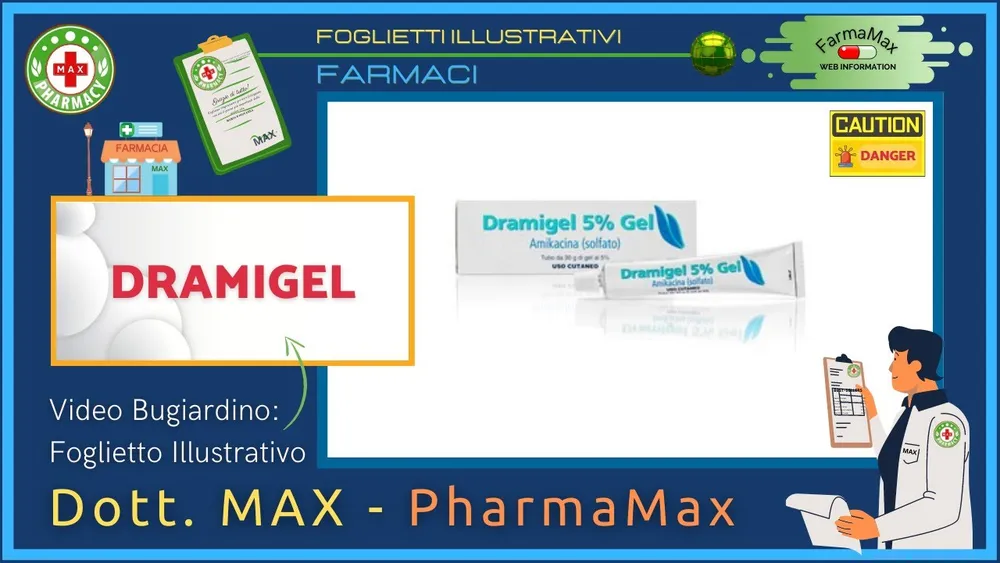
Table of Contents
PACKAGE LEAFLET
DRAMIGEL 5% gel
amikacin sulfate
Composition
Each 100 g of gel contains:
Active substance: amikacin sulfate equivalent to 5 g of amikacin
Excipients: hydroxyethylcellulose, methyl-p-hydroxybenzoate (E 218), propyl-p-hydroxybenzoate (E 216),
glycerol (E 422), purified water.
Pharmaceutical form and contents
Gel.
Box containing one tube of 30 g of 5% active substance gel.
Therapeutic category
Antibiotics for topical use.
Marketing Authorization Holder
MORGAN S.r.l. – Via Divisione Folgore, 46 – 36100 Vicenza
Marketing Authorization Holder's Representative
ITALFARMACO S.p.A.
Viale Fulvio Testi, 330 – 20126 MILAN
Manufacturer
Lab. It. Biochim. Farm.co LISAPHARMA S.p.A.
Via Licinio, 11 - 22036 ERBA (CO)
Therapeutic indications
Short-term treatment of severe infections caused by Gram-negative microorganisms sensitive to the antibiotic.
Contraindications
Individual hypersensitivity already known to amikacin and other aminoglycosides.
Precautions for use
Amikacin is potentially nephrotoxic, ototoxic, and neurotoxic. To avoid additive effects, do not associate with other ototoxic or nephrotoxic agents.
Ototoxicity: in patients with renal insufficiency, if treatment is expected to last longer than 5 days, an audiogram should be performed before starting therapy and during treatment. If tinnitus, hearing loss, or high-frequency hearing impairment occur, discontinue administration.
If you or your family members suffer from a genetic disorder causing mitochondrial mutation or hearing loss induced by antibiotics, we recommend informing your doctor or pharmacist before taking an aminoglycoside, as certain mitochondrial mutations associated with this product may increase the risk of hearing loss. Your doctor may recommend genetic testing prior to administration of Dramigel.
Nephrotoxicity: since alterations in renal function may occur during therapy, monitoring of blood creatinine levels is advisable. To reduce irritation of the renal tubules, the patient should be well hydrated, as amikacin is excreted in high concentrations in urine; hydration should be increased if signs of renal insufficiency occur. In such cases, the possibility of adjusting the dosage regimen should also be considered. If blood urea nitrogen increases or diuresis progressively decreases, treatment must be discontinued.
Neurotoxicity: since high doses of amikacin have shown muscle-paralyzing activity in experimental animals, the possibility of neuromuscular blockade and respiratory paralysis should be considered when amikacin is administered concomitantly with anesthetics or neuromuscular (\alpha)-blocking agents. In case of neuromuscular blockade, calcium salts are able to counteract this effect.
Cross-allergy with other aminoglycosides is possible. As with other antibiotics, therapy with amikacin may lead to superinfection by resistant microorganisms; in such cases, treatment should be discontinued and appropriate therapy initiated.
Interactions
This preparation must not be administered in combination with rapidly acting diuretics such as ethacrynic acid, furosemide, and mannitol, due to the risk of rapid hearing loss.
Combinations with other aminoglycosides, cephaloridine, colistin, and paromomycin increase the risk of renal and otovestibular damage.
Special warnings
Due to the presence of methyl-p-hydroxybenzoate and propyl-p-hydroxybenzoate, this medicine may cause hypersensitivity reactions, including delayed-type reactions (contact dermatitis); immediate reactions such as urticaria and bronchospasm are rare.
The use, especially prolonged, of topical products may lead to sensitization phenomena.
Pregnancy and breastfeeding
In pregnant women and very young infants, the product should be administered only when clearly needed and under direct medical supervision. Use of the product during breastfeeding should be avoided.
Effects on ability to drive and use machines
The substance does not interfere with the ability to drive or operate machinery.
Dosage, method and duration of administration
Apply the gel to the skin once daily (3–5 cm or more, depending on the size of the affected area), and gently massage.
Overdose
No cases of overdose are known with topical use of amikacin.
Undesirable effects
The main adverse effects that may occur during amikacin therapy, generally associated with doses higher than recommended or longer treatment duration, are: toxicity affecting the eighth cranial nerve (especially ototoxicity), with tinnitus, vertigo, partial deafness, and nephrotoxicity with albuminuria, presence of red and white blood cells and casts in urinary sediment, hyperazotemia, and oliguria. In addition to the above-mentioned side effects, cases of hypersensitivity skin rash, drug-induced fever, headache, paresthesia, tremors, nausea and vomiting, eosinophilia, anemia, and hypotension have been reported.
Following the instructions provided in this leaflet reduces the risk of adverse effects.
It is important to inform your doctor or pharmacist of any adverse effect, even if not described in this leaflet.
Expiry date and storage
See expiry date on the packaging.
Caution: do not use the medicine after the expiry date stated on the packaging.
The expiry date refers to the product stored in its original, unopened packaging under proper storage conditions.
Do not store at temperatures above 30°C.
Revision of the package leaflet by the Ministry of Health
KEEP THIS MEDICINE OUT OF THE SIGHT AND REACH OF CHILDREN