Dibaselab
Italy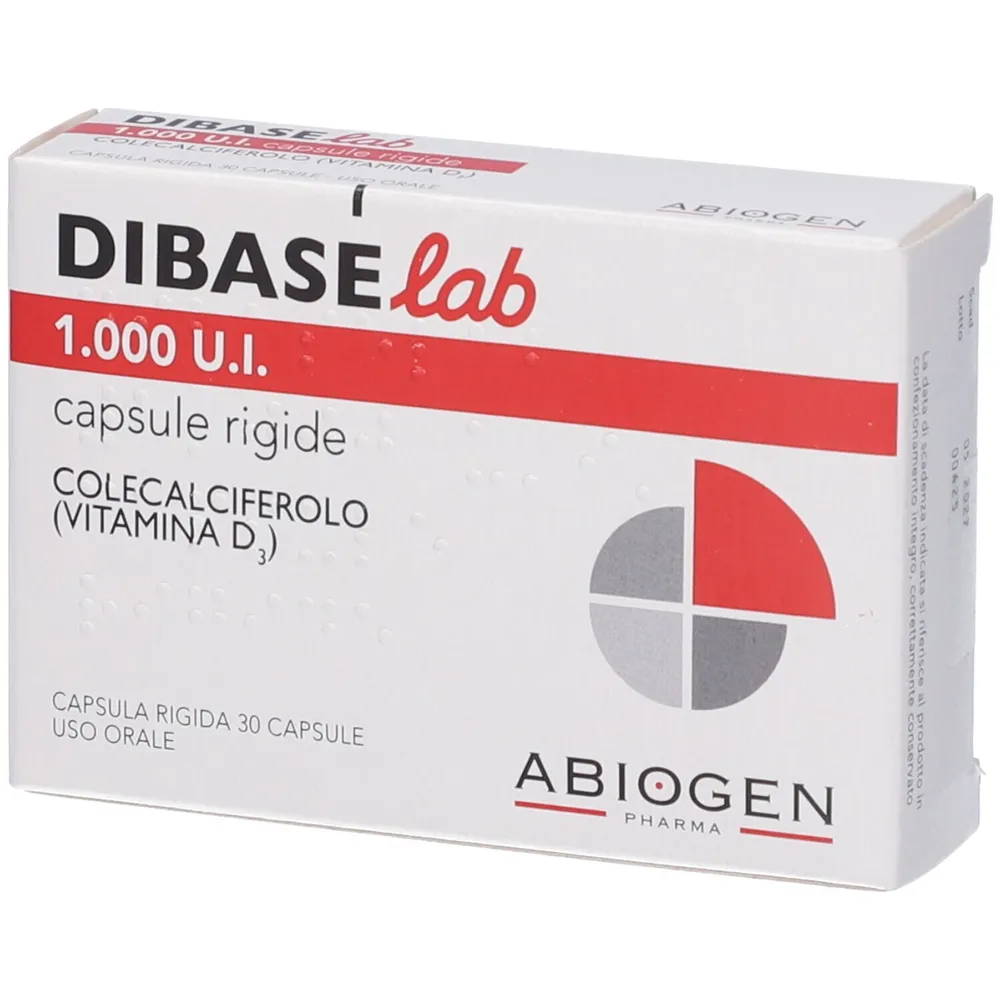
Table of Contents
Package leaflet: Information for the user
DIBASELAB hard capsules
colecalciferol (vitamin D)
Please read all of this leaflet carefully before taking this medicine because it contains important information for you.
Always take this medicine exactly as described in this leaflet or as your doctor or pharmacist has told you to do.
- Keep this leaflet. You may need to read it again.
- If you need more information or advice, consult your pharmacist.
- If you experience any side effects, including those not listed in this leaflet, contact your doctor or pharmacist. See section 4.
- Contact your doctor if you do not notice any improvement or if you notice a worsening of symptoms after 3 months.
Contents of this leaflet:
- What DIBASELAB is and what it is used for
- What you need to know before taking DIBASELAB
- How to take DIBASELAB
- Possible side effects
- How to store DIBASELAB
- Contents of the pack and other information
1. What DIBASELAB is and what it is used for
DIBASELAB contains cholecalciferol, better known as vitamin D.
DIBASELAB is indicated in adolescents over 12 years of age and in adults for the prevention of low vitamin D levels in conditions associated with insufficient production in the skin and/or increased vitamin D requirements (see section 3 "How to take DIBASELAB").
2. What you should know before taking DIBASELAB
Do not take DIBASELAB
- If you are allergic to colecalciferol (vitamina D) or to any of the other ingredients of this medicine (listed in section 6).
- If you have high levels of calcium in your blood (hypercalcemia) and/or in your urine (hypercalciuria).
- If you have kidney stones (nephrolithiasis) or calcium deposits in the kidneys (nephrocalcinosis).
- If you have severe kidney disease (severe renal failure). See section “Warnings and precautions”.
- If you have high levels of vitamin D.
Warnings and precautions
Talk to your doctor or pharmacist before taking DIBASELAB.
Inform your doctor in the following cases:
- if you are taking DIBASELAB for a long period;
- if you are elderly and are already being treated with medicines for certain heart conditions (cardiac glycosides) or with medicines that reduce blood pressure by increasing urine production (diuretics) (see section “Other medicines and DIBASELAB”);
- if you have mild to moderate kidney disease (mild to moderate renal impairment);
- if you have severe kidney disease (severe renal failure), medical supervision is required. See section “Do not take DIBASELAB”.
- If you have or have had kidney stones (nephrolithiasis) or calcium deposits in the kidneys (nephrocalcinosis), medical supervision is required. See section “Do not take DIBASELAB”.
- Inform your doctor in the following cases, as a review of the dosages indicated in section 3 “How to take DIBASELAB” may be necessary:
- if you are taking medicines for infections, such as rifampicin, isoniazid (see section “Other medicines and DIBASELAB”);
- if you are taking medicines used to treat epilepsy (antiepileptics) or barbiturates (see section “Other medicines and DIBASELAB”);
- if you are taking corticosteroids, medicines used to treat inflammation (see section “Other medicines and DIBASELAB”);
- if you are taking medicines to lower blood lipids such as colestipol, cholestyramine (see section “Other medicines and DIBASELAB”);
- if you are taking a medicine for obesity called orlistat (see section “Other medicines and DIBASELAB”);
- if you are taking antacids containing aluminium, medicines used to treat excessive stomach acid that may rise into the oesophagus (see section “Other medicines and DIBASELAB”);
- if you are obese;
- if you suffer from digestive disorders (intestinal malabsorption, cystic fibrosis);
- if you suffer from liver disease (hepatic insufficiency);
- if you suffer from sarcoidosis (an inflammatory disease that may affect the whole body and leads to nodule formation) and primary hyperparathyroidism (a condition leading to increased levels of calcium in blood and urine).
Children
DIBASELAB is not suitable for children aged between 0 and 12 years.
Other medicines and DIBASELAB
Tell your doctor or pharmacist if you are taking, have recently taken or might take any other medicines.
In particular, inform your doctor if you are taking the following medicines:
- digoxin, a medicine used to treat certain heart conditions; your doctor will monitor you closely and carefully evaluate whether tests are needed (see section “Warnings and precautions”);
- warfarin, a medicine used to make blood less likely to clot;
- thiazide diuretics, medicines used to treat high blood pressure by increasing urine production (see section “Warnings and precautions”);
- rifampicin, isoniazid, medicines used to treat infections;
- carbamazepine, phenobarbital, phenytoin, primidone, medicines used to treat epilepsy (antiepileptics);
- barbiturates, medicines used to treat epilepsy;
- corticosteroids, medicines used to treat inflammation;
- antacids containing aluminium, medicines used to treat excessive stomach acid that may rise into the oesophagus;
- colestipol, cholestyramine, medicines used to lower blood lipids;
- orlistat, a medicine used to treat obesity;
- actinomycin, an agent belonging to the group of actinomycins, antibiotics produced by various types of Streptomyces bacteria. Actinomycins exert a harmful effect on living cells;
- antifungal imidazoles (e.g., ketoconazole), agents capable of inhibiting the growth of fungal organisms;
- magnesium-containing preparations.
DIBASELAB with food, drinks and alcohol
To avoid taking an excessive dose of vitamin D, you should consider whether you are taking other products containing vitamin D, such as fortified foods or vitamin D-enriched milk (see section “How to take DIBASELAB”).
Long-term consumption of large amounts of alcohol (chronic alcoholism) reduces vitamin D stores in the liver.
Pregnancy, breastfeeding and fertility
If you are pregnant, think you may be pregnant, planning a pregnancy, or breastfeeding, consult your doctor or pharmacist before taking this medicine.
Pregnancy
You may take vitamin D during pregnancy when necessary.
During the first 6 months of pregnancy, you should take this medicine only if strictly necessary due to the risk of harmful effects on the foetus (see section 3 “If you take more DIBASELAB than you should”).
Breastfeeding
You may take vitamin D during breastfeeding when necessary. This does not replace the need for vitamin D supplementation in the newborn. Vitamin D and its metabolites are excreted in breast milk. This should be taken into account when administering additional vitamin D to the infant.
Fertility
There are no known effects of vitamin D on fertility.
Driving and using machines
It is unlikely that DIBASELAB will affect your ability to drive. However, you should be aware that drowsiness may occur as a side effect of treatment with DIBASELAB, although this is rare.
3. How to take DIBASELAB
Take this medicine exactly as stated in this leaflet or as instructed by your doctor or pharmacist. If you have any doubts, consult your doctor or pharmacist.
The intake of DIBASELAB is recommended in cases such as:
- during the last trimester of pregnancy,
- in breastfeeding women,
- in case of insufficient sun exposure (e.g. conditions forcing prolonged indoor stay) or ineffective sun exposure (e.g. use of sunscreens and protective barriers, winter period),
- in case of special diet (e.g. low-calcium diet, vegetarian diet, lactose-free diet, etc.),
- in case of deeply pigmented skin.
To avoid taking an excessive dose of vitamin D, you must consider whether you are taking other products already containing vitamin D, vitamin D-fortified foods, or vitamin D-enriched milk (see section 2 “DIBASELAB with food, drink and alcohol”).
It is recommended to take DIBASELAB with meals. The capsule should be swallowed whole.
Treatment cycles of 3 months are recommended.
The recommended dose is:
Adults
1 capsule daily.
Pregnancy (last trimester) and breastfeeding
1 capsule every 2 days.
Use in children and adolescents
DIBASELAB is not suitable for children aged between 0 and 12 years.
Adolescents (> 12 years)
1 capsule every 2 days.
If you take more DIBASELAB than you should
In case of accidental ingestion or intake of an excessive dose of DIBASELAB, contact your doctor immediately or go to the nearest hospital.
In case of overdose, increased calcium levels in the blood (hypercalcemia) and in the urine (hypercalciuria) may occur, with the following symptoms: nausea, vomiting, thirst, excessive thirst (polydipsia), increased urine output (polyuria), constipation and dehydration. Discontinue DIBASELAB if these symptoms occur.
Chronic excessive dosing may lead to calcium salt deposits in blood vessels and organs (a consequence of hypercalcemia).
Excessive vitamin D intake during the first 6 months of pregnancy may cause serious harm to the fetus and newborn (see section 2 “Pregnancy, breastfeeding and fertility”).
If you forget to take DIBASELAB
Do not take a double dose to make up for the missed dose.
If you stop taking DIBASELAB
If you have any doubts about using this medicine, consult your doctor or pharmacist.
4. Possible side effects
Like all medicines, this medicine can cause side effects, although not everybody experiences them.
The possible side effects are listed below by frequency:
uncommon (may affect up to 1 in 100 people)
-
increased levels of calcium in the blood (hypercalcaemia) and in the urine (hypercalciuria).
rare (may affect up to 1 in 1,000 people) -
allergic reactions
-
weakness, loss of appetite (anorexia), thirst
-
drowsiness, confusion
-
constipation, gas (flatulence), stomach pain, nausea, diarrhoea
-
skin rash, itching, hives
not known (frequency cannot be estimated from the available data) -
headache
-
vomiting, metallic taste, dry mouth
-
excessive deposition of calcium in the kidneys (nephrocalcinosis), increased amount of urine excreted (polyuria), intense thirst (polydipsia), kidney disease (renal failure).
Reporting of side effects
If you experience any side effect, including those not listed in this leaflet, talk to your doctor or pharmacist.
You can also report side effects directly via the national reporting system at the website
www.aifa.gov.it/content/segnalazioni-reazioni-avverse.
By reporting side effects, you can help provide more information on the safety of this medicine.
5. How to store DIBASELAB
Keep this medicine out of the sight and reach of children.
Do not use this medicine after the expiry date stated on the pack after EXP.
The expiry date refers to the last day of that month.
Do not dispose of medicines via wastewater or household waste. Ask your pharmacist
how to dispose of medicines no longer required. This will help protect the environment.
Do not freeze.
Store in the original packaging to protect the medicine from light.
6. Package contents and other information
What DIBASELAB contains
* The active substance is colecalciferol (vitamin D ) 0.025 mg, equivalent to 1,000 IU
* The other components are: gelatin, titanium dioxide (E171), iron oxide (E 172),
refined olive oil.
Description of the appearance of DIBASELAB and package contents
DIBASELAB is presented as hard capsules with a transparent body and white cap, with a pink sealing band.
It is available in a pack containing 3 blisters of 10 capsules each.
Marketing Authorization Holder and Manufacturer
Marketing Authorization Holder:
ABIOGEN PHARMA S.P.A. - Via Meucci, 36 – Ospedaletto – Pisa, Italy
Manufacturer:
ABIOGEN PHARMA S.P.A. - Via Meucci, 36 – Ospedaletto – Pisa, Italy