Dalacin C phosphate
Italy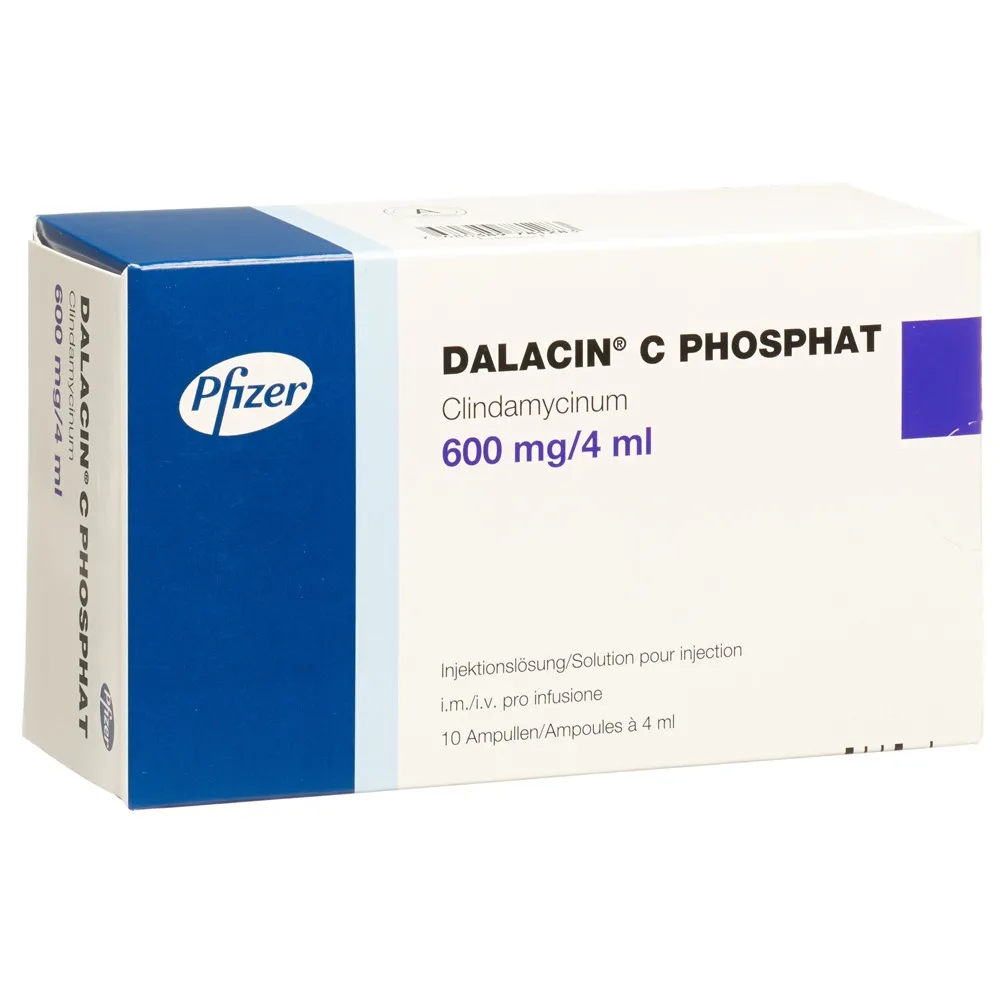
Table of Contents
- Package leaflet: Information for the user
- DALACIN C PHOSPHATE 600 mg/4 ml injectable solution
- 1. What Dalacin C Phosphate is and what it is used for
- 2. What you should know before using/administering Dalacin C Phosphate to your child
- 3. How to use/administer Dalacin C Phosphate to the child
- 4. Possible side effects
- 5. How to store Dalacin C Phosphate
- 6. Package contents and other information
- The following information is intended exclusively for physicians or healthcare professionals
Package leaflet: Information for the user
DALACIN C PHOSPHATE 600 mg/4 ml injectable solution
Clindamycin
Please read all of this leaflet carefully before you or your child are given this medicine because it contains important information for you and/or your child.
- Keep this leaflet. You may need to read it again.
- If you have any questions, ask your doctor, your child's doctor, or pharmacist.
- This medicine has been prescribed for you or your child only. Do not give it to others, even if their symptoms are the same as yours, because it could be harmful.
- If any adverse reaction occurs, including those not listed in this leaflet, contact your doctor, your child's doctor, or pharmacist. See section 4.
Contents of this leaflet:
- What Dalacin C Phosphate is and what it is used for
- What you need to know before using/administering Dalacin C Phosphate to your child
- How to use/administer Dalacin C Phosphate to your child
- Possible side effects
- How to store Dalacin C Phosphate
- Contents of the pack and other information
1. What Dalacin C Phosphate is and what it is used for
Dalacin C Phosphate contains the active substance clindamycin, an antibiotic that belongs to a group of
medicines called lincosamides. Clindamycin is used to treat serious infections caused by bacteria.
Dalacin C Phosphate is used in adults and children for the treatment of:
- serious infections caused by susceptible bacteria such as staphylococci, streptococci and pneumococci;
- gynecological infections caused by Chlamydia trachomatis (a bacterium), when other medicines cannot be used;
- infections caused by Toxoplasma gondii and Pneumocystis jiroveci (two types of bacteria) in patients with weakened immune systems.
2. What you should know before using/administering Dalacin C Phosphate to your child
Do not use/administer Dalacin C Phosphate to your child
- if you are allergic to clindamycin, to other similar medicines such as lincomycin, or to any of the other ingredients of this medicine (listed in section 6);
- if you are breastfeeding;
- if the child is under 2 years of age.
Warnings and precautions
Talk to your doctor, your child’s doctor, or pharmacist before using Dalacin C Phosphate.
Inform the doctor, your child’s doctor, or pharmacist before using/administering this medicine to your child if:
- you are elderly or you or your child are seriously ill;
- you or your child have previously had stomach or intestinal diseases;
- you or your child tend to develop allergic reactions easily;
- you have severe liver problems;
- you have severe kidney problems.
Acute kidney problems may occur. Inform your doctor about any medicines you are taking and about any kidney problems. If you experience reduced urine output, fluid retention causing swelling of the legs, ankles or feet, shortness of breath, or nausea, contact your doctor immediately.
Inform your doctor or your child’s doctor if any of the following conditions appear or worsen during treatment with Dalacin C Phosphate (see also section 4 “Possible side effects”):
- onset of diarrhea. If you or your child experience abdominal cramps and severe, prolonged diarrhea with blood and mucus in the stool, stop treatment with this medicine and consult your doctor. These may be symptoms of intestinal inflammation (pseudomembranous colitis) caused by the use of antibiotics. Inform your doctor immediately if you or your child experience these symptoms even several months after stopping treatment with Dalacin C Phosphate;
- new infections or persistence of existing infections. This may be due to germs that are not sensitive to Dalacin C Phosphate;
- allergic reactions or severe skin reactions. In this case, stop treatment with this medicine and consult your doctor.
Laboratory tests
During treatment with Dalacin C Phosphate, your doctor will perform regular checks of liver and kidney function and blood tests, especially if you or your child are undergoing long-term treatment with this medicine.
Children
In children and newborns (particularly premature infants), benzyl alcohol, one of the components of this medicine, may cause serious adverse effects, such as a condition called “gasping syndrome”, characterized by reduced brain function and deterioration of the nervous system, accumulation of lactic acid in the body, breathing difficulties, heart problems, and blood abnormalities (see section “Dalacin C Phosphate contains benzyl alcohol”).
Other medicines and Dalacin C Phosphate
Inform your doctor, your child’s doctor, or pharmacist if you are taking, have recently taken, or might take any other medicines.
The following medicines affect the effectiveness of Dalacin C Phosphate or Dalacin C Phosphate affects the effectiveness of the following medicines:
- vitamin K antagonists (e.g. warfarin, acenocoumarol, and phenindione), medicines used to thin the blood;
- neuromuscular blocking agents (e.g. ether, tubocurarine, and pancuronium), medicines used to relax muscles during surgery;
- antibiotics such as metronidazole, gentamicin, lincomycin, and rifampicin.
Pregnancy and breastfeeding
If you are pregnant, think you may be pregnant, planning to become pregnant, or breastfeeding, consult your doctor before taking this medicine.
Pregnancy
If you are pregnant, your doctor will prescribe Dalacin C Phosphate only if strictly necessary.
Dalacin C Phosphate contains benzyl alcohol (see “Dalacin C Phosphate contains benzyl alcohol and sodium”).
Breastfeeding
Dalacin C Phosphate passes into breast milk and may cause adverse effects in breastfed infants, such as diarrhea, blood in the stool, fungal infections (candidiasis), or skin rashes. Therefore, do not take Dalacin C Phosphate if you are breastfeeding (see section “Do not use/administer Dalacin C Phosphate to your child”).
Dalacin C Phosphate contains benzyl alcohol (see “Dalacin C Phosphate contains benzyl alcohol and sodium”).
Driving and using machines
Dalacin C Phosphate has no effect or a negligible effect on the ability to drive or use machinery.
Dalacin C Phosphate contains benzyl alcohol and sodium
Dalacin C Phosphate contains 9 mg, 18 mg, and 36 mg of benzyl alcohol in each 1 ml, 2 ml, and 4 ml of solution, respectively, equivalent to 9 mg/ml of benzyl alcohol. The use of benzyl alcohol may cause allergic reactions. The use of benzyl alcohol has been associated with serious adverse reactions, including respiratory problems (called “gasping syndrome”) in newborns and young children.
Do not use medicines containing benzyl alcohol in newborns (up to 4 weeks of age), and do not use these medicines for more than one week in children (under 3 years of age), unless otherwise advised by a doctor.
Consult your doctor or pharmacist if you have liver or kidney disease, or if you are pregnant or breastfeeding. This is because large amounts of benzyl alcohol may accumulate in the body and may cause adverse events such as increased acid levels in the blood (called "metabolic acidosis").
Dalacin C Phosphate contains less than 1 mmol (23 mg) of sodium per vial, i.e. essentially “sodium-free”.
3. How to use/administer Dalacin C Phosphate to the child
Use/administer this medicine to the child exactly as directed by the doctor. If you
have any doubts, consult the doctor or pharmacist.
Dalacin C Phosphate must be administered by injection into a muscle (e.g. the buttock) or by injection into
a vein. In the latter case, administration must be performed only by experienced healthcare personnel.
When the child's condition begins to improve, the doctor may decide to continue treatment with oral medicines containing the same active substance (e.g. Dalacin C capsules).
- Severe infections The recommended dose in adults is 600–1200 mg per day divided into 2, 3, or 4 doses. The recommended dose in children is 15–25 mg per kg of body weight per day divided into 3 or 4 doses.
- Very severe infections The recommended dose in adults is 1200–2700 mg per day divided into 2, 3, or 4 doses. The recommended dose in children is 25–40 mg per kg of body weight per day divided into 3 or 4 doses. In case of infections caused by Streptococcus beta-haemolyticus (a bacterium), treatment with Dalacin C Phosphate should last for at least 10 days.
- Gynecological infections The recommended dose is 900 mg every 8 hours administered intravenously in combination with another appropriate antibiotic. Treatment should continue for at least 4 days and for at least 48 hours after improvement occurs. The doctor will continue therapy with 450 mg clindamycin every 6 hours taken orally (e.g. Dalacin C capsules) until completing a 10–14 day treatment course.
- Infections caused by Toxoplasma gondii in patients with low immune defenses. The recommended dose is 600–1200 mg every 6 hours for 2 weeks. Afterwards, the dose may be reduced to 300–600 mg taken orally (e.g. Dalacin C capsules) every 6 hours for 8–10 weeks. The doctor will determine whether to combine Dalacin C Phosphate with other medicines depending on the severity of the infection.
- Infections caused by Pneumocystis jiroveci in patients with low immune defenses. The recommended dose is 600 mg every 6 hours or 900 mg every 8 hours for 21 days, combined with oral primaquine 15–30 mg once daily for 21 days.
If you use/administer more Dalacin C Phosphate than you should
Contact the doctor immediately if you think you have used/administered more Dalacin C Phosphate to your child than required.
If you forget to use/administer Dalacin C Phosphate
Do not use/administer a double dose to make up for a forgotten dose.
If you stop treatment with Dalacin C Phosphate
If you stop treatment with this medicine too early, the infection may recur or worsen.
Do not stop treatment with Dalacin C Phosphate unless instructed by the doctor.
If you have any questions about the use of this medicine, consult your doctor or pharmacist.
4. Possible side effects
Like all medicines, this medicine can cause side effects, although not everyone experiences them.
Contact your doctor immediately if you experience:
- fluid retention causing swelling of the legs, ankles or feet, breathlessness or nausea
Stop treatment with this medicine immediately and contact your doctor if you or your child experience:
- severe, persistent diarrhoea, or diarrhoea with blood and mucus in the stool (which may be associated with stomach pain or fever). These may be symptoms of a serious intestinal inflammation (**pseudomembranous **(colitis) (see section 2 “Warnings and precautions”);
- severe allergic reaction characterized by swelling in different parts of the body and difficulty breathing;
- allergic reaction characterized by skin rash, fever, and symptoms affecting multiple organs (Drug Reaction with Eosinophilia and Systemic Symptoms: DRESS);
- severe acute hypersensitivity reactions affecting the skin and mucous membranes (Stevens-Johnson syndrome, toxic epidermal necrolysis, acute generalized exanthematous pustulosis, angioedema);
- cessation of heart and lung function (cardiorespiratory arrest).
Contact your doctor if you or your child experience any of the following side effects:
Common (may affect up to 1 in 10 people):
- inflammation of blood vessels leading to blood clot formation
- abnormal liver function tests
- skin rash characterized by red patches on the skin surrounded by small blisters (maculopapular rash)
Uncommon (may affect up to 1 in 100 people):
- altered taste
- low blood pressure
- diarrhoea
- nausea
- skin rash characterized by red spots and blisters on the skin
- itching
- urticaria
- pain and abscess formation at the injection site
Frequency not known (frequency cannot be estimated from the available data):
- vaginal infection
- decrease in the number of white blood cells and platelets in the blood
- increase in the number of eosinophils (a type of white blood cell) in the blood
- abdominal pain
- vomiting
- yellow/yellowish discoloration of the skin and the white part of the eye (jaundice)
- skin and mucous membrane reactions characterized by blistering, pustules (pus-filled blisters), red patches and scaling (erythema, dermatitis)
- inflammation of blood vessels in the skin
- skin reaction characterized by symmetrical redness, clearly demarcated in skin folds, particularly in the buttocks, groin and armpits
- irritation at the injection site
Reporting of side effects
If you experience any side effect, including those not listed in this leaflet, contact your doctor or pharmacist.
You can also report side effects directly via the national reporting system at: https://www.aifa.gov.it/content/segnalazioni-reazioni-avverse.
By reporting side effects, you can help provide more information on the safety of this medicine.
5. How to store Dalacin C Phosphate
Keep this medicine out of the sight and reach of children.
Do not use this medicine after the expiry date stated on the carton and vial after "Exp.".
The expiry date refers to the last day of that month.
This medicine does not require any special storage conditions.
Do not dispose of any medicine via wastewater or household waste. Ask your pharmacist how to dispose of medicines you no longer use. This will help protect the environment.
6. Package contents and other information
What Dalacin C Phosphate contains
- The active substance is clindamycin (as clindamycin phosphate). Each 4 ml vial contains 712.92 mg of clindamycin phosphate (equivalent to 600 mg of clindamycin).
- The other components are: benzyl alcohol (E1519), disodium edetate, and water for injections (see section 2 “Dalacin C Phosphate contains benzyl alcohol and sodium”).
Description of the appearance of Dalacin C Phosphate and contents of the pack
Dalacin C Phosphate 600 mg/4 ml solution for injection is available in packs containing 1 glass vial with a safety pre-snap break.
Marketing Authorisation Holder and Manufacturer
Marketing Authorisation Holder
Pfizer Italia S.r.l.
Via Isonzo, 71
04100 Latina, Italy
Manufacturer
Pfizer Manufacturing Belgium N.V.
Rijksweg 12
2870 Puurs-Sint-Amands, Belgium
The following information is intended exclusively for physicians or healthcare professionals
DOSAGE AND ADMINISTRATION
The dosage and route of administration should be determined according to the severity of the infection, the patient's condition, and the sensitivity of the causative microorganism.
Dosage
Adults:
Administration by deep intramuscular injection or intravenous infusion.
Severe infections caused by aerobic gram-positive cocci and more sensitive anaerobes (generally not including Bacteroides fragilis, Peptococci, and Clostridia other than Clostridium perfringens): 600–1200 mg/day divided into 2, 3, or 4 doses.
Very severe infections, particularly those due to confirmed or suspected Bacteroides fragilis, Peptococci, or Clostridia other than Clostridium perfringens: 1200–2700 mg/day divided into 2, 3, or 4 doses.
These doses may, if necessary, be increased up to 4800 mg/day administered by intravenous infusion in those infections that may endanger the patient's life.
Clindamycin Phosphate must not be administered intravenously as an undiluted bolus injection, but must be infused over a period of at least 10–60 minutes.
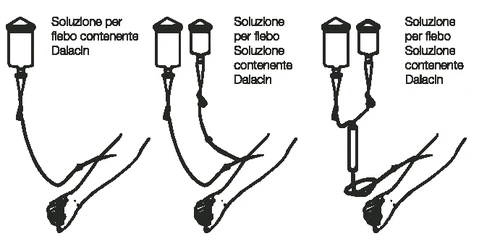
The drug may initially be administered by rapid intravenous infusion, followed by slower infusions according to the following schedule.
| To maintain clindamycin blood concentrations above: | start with a rapid intravenous infusion of: | then continue with: |
| 4 mcg/ml | 10 mg/min for 30' | 0.75 mg/min |
| 5 mcg/ml | 15 mg/min for 30' | 1.00 mg/min |
| 6 mcg/ml | 20 mg/min for 30' | 1.25 mg/min |
In pelvic inflammatory disease: 900 mg every 8 hours intravenously in combination with an appropriate antibiotic active against gram-negative aerobes. Continue therapy for at least 4 days and, in any case, for 48 hours after clinical improvement has been observed in the patient.
Continue treatment with oral clindamycin (Dalacin C) at a dosage of 450 mg every 6 hours until completing the treatment course (10–14 days).
Cerebral toxoplasmosis in high-risk immunocompromised patients: 600–1200 mg of clindamycin phosphate intravenously or clindamycin hydrochloride orally every 6 hours for two weeks, followed by 300–600 mg of oral clindamycin hydrochloride every 6 hours until completing the 8–10 week treatment course.
When clindamycin is combined with pyrimethamine, the latter should be administered orally at a dose of 25–75 mg for 8–10 weeks. With higher doses of pyrimethamine, administration of 10–20 mg/day of folinic acid is recommended.
Pneumocystis jiroveci pneumonia in high-risk immunocompromised patients: clindamycin phosphate 600 mg intravenously every 6 hours or 900 mg every 8 hours, or 300–450 mg of oral clindamycin hydrochloride every 6 hours, administered for 21 days, together with 15–30 mg of primaquine administered orally once daily for 21 days.
Paediatric population
For children over two years of age, administer by deep intramuscular injection or intravenous infusion.
Severe infections: 15–25 mg/kg/day divided into 3–4 doses.
Life-threatening infections: 25–40 mg/kg/day divided into 3–4 doses.
Alternatively, the paediatric dosage may be calculated based on body surface area: 350 mg/m²/day for severe infections and 450 mg/m²/day for life-threatening infections.
If severe diarrhoea occurs, discontinue the antibiotic.
Method of administration
Dilution and rate of administration
Do not administer intramuscular doses exceeding 600 mg as a single injection. The concentration of clindamycin in the infusion solution must not exceed 18 mg/ml and the infusion rate must not exceed 30 mg per minute.
Administration of Dalacin C Phosphate by intravenous infusion should be carried out as follows:
| Dose | Dilute in | Administration time |
| 300 mg | 50 ml | 10 minutes |
| 600 mg | 50 ml | 20 minutes |
| 900 mg | 50 -100 ml | 30 minutes |
| 1200 mg | 100 ml | 40 minutes |
It is recommended not to administer more than 1200 mg in a single one-hour infusion.
COMPATIBILITY
Clindamycin Phosphate has been found to be physically and chemically compatible for at least 24 hours in injectable solutions of
5% dextrose and 0.9% sodium chloride containing the following antibiotics at commonly used concentrations: amikacin, aztreonam, cefamandole, cefazolin, cefotaxime, cefoxitin, ceftazidime, ceftriaxone,
gentamicin, netilmicin, piperacillin and tobramycin.
Compatibility and stability duration of drug mixtures may vary depending on concentration and other conditions.
INCOMPATIBILITY
It is, however, incompatible with ampicillin, phenytoin, barbiturates, aminophylline, magnesium sulfate and calcium gluconate.