Codamol
Italy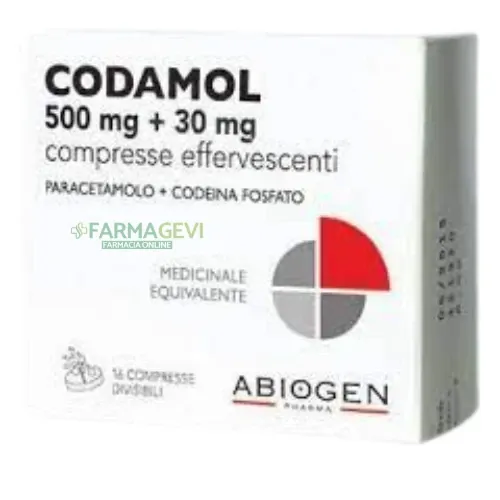
Table of Contents
- Package leaflet: Information for the patient
- CODAMOL 500 mg + 30 mg effervescent tablets, 500 mg + 30 mg film-coated tablets
- 1. What Codamol is and what it is used for
- 2. What you need to know before taking Codamol
- 3. How to take Codamol
- 4. Possible side effects
- 5. How to store Codamol
- 6. Package contents and other information
Package leaflet: Information for the patient
CODAMOL 500 mg + 30 mg effervescent tablets, 500 mg + 30 mg film-coated tablets
paracetamol + codeine phosphate
Generic medicine
Please read all of this leaflet carefully before you start taking this medicine, as it contains
important information for you.
- Keep this leaflet. You may need to read it again.
- If you have any questions, ask your doctor or pharmacist.
- This medicine has been prescribed for you only. Do not give it to other people, even if their symptoms are the same as yours, as it may be harmful.
- If you experience any side effect, including those not listed in this leaflet, tell your doctor or pharmacist. See section 4.
Contents of this leaflet:
- What Codamol is and what it is used for
- What you need to know before taking Codamol
- How to take Codamol
- Possible side effects
- How to store Codamol
- Contents of the pack and other information
1. What Codamol is and what it is used for
Codamol contains two active substances: paracetamol and codeine.
Codamol is indicated in adults and adolescents aged 12 to 18 years for the
treatment of moderate to severe pain symptoms that do not respond to treatment with
other analgesic medicines – such as paracetamol or ibuprofen used alone.
2. What you need to know before taking Codamol
Do not take Codamol
If you/the adolescent:
- is allergic to paracetamol, proparacetamol (a precursor of paracetamol), codeine, or any of the other ingredients of this medicine (listed in section 6),
- suffers from a lung disease (respiratory insufficiency), as codeine may worsen your condition,
- is under 12 years of age,
- is between 12 and 18 years of age and has undergone surgery to remove the tonsils and/or adenoids due to a condition called obstructive sleep apnoea syndrome,
- has a liver enzyme that causes your body to convert codeine into high levels of morphine (detected through urine testing), increasing the risk of serious adverse effects,
- is breastfeeding (see section 2. "Pregnancy and breastfeeding").
Additionally, do not take Codamol effervescent tablets if you/the adolescent:
- has fructose intolerance (see section 2. Codamol effervescent tablets contain sodium, sorbitol, and aspartame),
Warnings and precautions
Talk to your doctor or pharmacist before taking Codamol.
Paracetamol should be administered with caution in certain conditions; therefore, consult your doctor if you/the adolescent:
- has mild/moderate impairment of liver function (including Gilbert's syndrome, a condition characterized by excessive production of bilirubin, a substance causing yellowing of the skin and eyes),
- suffers from severe liver problems,
- has acute hepatitis (acute inflammation of the liver),
- has a deficiency of an enzyme called glucose-6-phosphate dehydrogenase (a substance normally present in the human body, whose deficiency may cause haemolytic anaemia),
- suffers from a disease caused by the destruction of certain blood cells, red blood cells (haemolytic anaemia),
- suffers from kidney disease (renal insufficiency),
- suffers from chronic alcoholism or consumes large amounts of alcohol, such as 3 or more alcoholic drinks per day (see section 2. Codamol with alcohol),
- has an eating disorder involving excessive or insufficient eating (bulimia or anorexia),
- suffers from a severe wasting condition characterized by extreme thinness, reduced muscle mass, and thinning of the skin due to chronic illness (cachexia),
- eats poorly or inadequately (chronic malnutrition),
- has lost a significant amount of body fluids (dehydration),
- has a reduced volume of circulating blood (hypovolaemia),
- has a cough with mucus production. Paracetamol may cause severe skin reactions which can be fatal. Treatment with CODAMOL must be stopped at the first sign of skin rash or any other sign of hypersensitivity (allergic reaction).
Opioid therapy may cause:
- respiratory depression (reduced respiratory function) and sedation,
- lowered seizure threshold (i.e. increased excitability of the nervous system, as in epilepsy),
- hyperalgesia (increased sensitivity to pain), constipation (difficult or infrequent bowel movements),
- nausea and vomiting,
- masking of symptoms of acute abdominal conditions (conditions characterized by severe pain and signs of abdominal irritation),
- obstruction of bile and pancreatic juice outflow, as in certain biliary tract diseases, for example pancreatitis (inflammation of the pancreas) and cholelithiasis (presence of gallstones in the gallbladder),
- increased release of histamine, as in asthma (obstruction of the bronchi),
- pruritus (itching),
- reduced hormone levels,
- inhibition of immunological function (i.e. impairment of the body's defence system),
- muscle rigidity and myoclonus (rapid involuntary muscle jerks),
- urinary retention (difficulty emptying the bladder), particularly in patients with urethral narrowing (the final part of the urinary tract) or enlarged prostate.
Use of high doses and/or prolonged use
The use of high or prolonged doses of paracetamol may cause liver disease (hepatopathy) and serious adverse effects on the kidneys and blood.
Prolonged use of analgesics, including opioids, increases the risk of medication-overuse headache. Furthermore, in elderly people, prolonged use may worsen an existing illness.
With prolonged use of opioids, reduced analgesic effectiveness (tolerance) may occur.
Prolonged administration of codeine or doses higher than therapeutic levels may lead to physical and psychological dependence (addiction) and withdrawal syndrome following sudden discontinuation, which may occur both in patients and in newborns born to codeine-dependent mothers. CODAMOL must be used with caution in patients with dependence or a history of opioid dependence, and alternative analgesic therapies should be considered.
Elderly
Elderly patients may be at higher risk of adverse effects associated with opioid use, such as respiratory depression and constipation.
Children and adolescents
Do not give codeine for pain relief in children and adolescents after removal of tonsils or adenoids for obstructive sleep apnoea syndrome.
Children and adolescents must be closely monitored for signs of central nervous system depression associated with codeine, such as extreme drowsiness and respiratory depression.
Codeine is not recommended in children and adolescents with respiratory problems, as symptoms of morphine toxicity may be more severe.
Other medicines and Codamol
Inform your doctor or pharmacist if you/the adolescent is taking, has recently taken, or might take any other medicines.
In particular, inform your doctor if you are taking:
other medicines containing paracetamol, because serious adverse effects may occur if paracetamol is taken in high doses,
other medicines containing opioids or other substances that depress the central nervous system, to avoid the risk of overdose or serious adverse effects,
coumarin anticoagulants including warfarin (medicines that delay blood clotting): your doctor will perform more frequent monitoring of INR values (the time it takes for blood to clot),
medicines or substances that stimulate liver enzymes (increasing liver activity), for example:
rifampicin (an antibiotic),
cimetidine (a medicine used in the treatment of stomach ulcers),
antiepileptics (medicines used to treat epilepsy), such as glutethimide, phenobarbital, carbamazepine, and phenytoin. If undergoing treatment with phenytoin, do not take high or prolonged doses of paracetamol.
The use of these medicines with CODAMOL requires extreme caution and must only be carried out under strict medical supervision.
probenecid, a medicine used to treat hyperuricaemia (elevated blood uric acid levels) and gout (joint inflammation due to uric acid deposits): your doctor may advise reducing the dose of CODAMOL,
salicylamide (an analgesic and antipyretic medicine),
flucloxacillin (an antibiotic), due to a serious risk of blood and fluid disorders (metabolic acidosis with high anion gap) requiring urgent treatment, which may particularly occur in cases of severe renal impairment, sepsis (when bacteria and their toxins circulate in the blood, causing organ damage), malnutrition, chronic alcoholism, or when maximum daily doses of paracetamol are used,
chloramphenicol (an antibiotic): may increase the risk of possible adverse effects,
medicines that slow gastric emptying, such as anticholinergics: these medicines delay the effect of CODAMOL,
zidovudine (a medicine for the treatment of HIV),
potent analgesics (buprenorphine, butorphanol, nalbuphine, nalorphine, pentazocine),
naltrexone (a medicine for treating drug dependence),
antihistamines (medicines for treating allergies),
analgesics (alfentanil, dextromoramide, dextropropoxyphene, fentanyl, dihydrocodeine, hydromorphone, morphine, oxycodone, pethidine, phenoperidine, remifentanil, sufentanil, tramadol),
medicines for treating cough (dextromethorphan, noscapine, pholcodine, codeine, ethylmorphine),
medicines for treating psychiatric disorders (chlorpromazine, haloperidol, levomepromazine, thioridazine),
methadone (a medicine for treating drug addiction),
meprobamate (a medicine for treating anxiety),
benzodiazepines and barbiturates (medicines for treating insomnia and anxiety),
medicines for treating depression (paroxetine, fluoxetine, bupropion, sertraline, imipramine, clomipramine, amitriptyline, nortriptyline, doxepin, mirtazapine, mianserin, trimipramine, and monoamine oxidase inhibitors),
antihypertensives (medicines for treating high blood pressure),
baclofen, a medicine to reduce and relieve muscle spasms (excessive muscle tension occurring in various diseases),
thalidomide, a medicine for treating multiple myeloma (a disease of the immune system, the body's defence system),
celecoxib (a medicine that reduces inflammation),
quinidine (a medicine for treating irregular heart rhythm),
dexamethasone (a medicine for treating various disorders such as inflammation and allergies),
anticholinergics (medicines for treating various conditions such as bladder problems, allergies, and depression).
Concomitant use of Codamol and sedative medicines such as benzodiazepines or related drugs increases the risk of drowsiness, breathing difficulties (respiratory depression), coma, and may be life-threatening. For this reason, concomitant use should only be considered when no other treatment options are available.
However, if your doctor prescribes Codamol together with sedative medicines, the dose and duration of concomitant treatment must be limited by the doctor.
Inform your doctor about all sedative medicines you are taking and carefully follow the dosage recommendations provided by your doctor. It may be helpful to inform friends or family members so they are aware of the signs and symptoms listed above. Contact your doctor if these symptoms occur.
Laboratory tests and Codamol
Administration of paracetamol may interfere with the measurement of certain blood values such as uric acid levels (uricaemia) and blood glucose levels (glycaemia).
Therefore, inform the laboratory that you are being treated with Codamol before undergoing blood tests.
Codamol and alcohol
Do not take Codamol if you regularly consume large amounts of alcohol (3 or more alcoholic drinks per day) or suffer from alcohol dependence (alcoholism).
Due to the presence of codeine, it is advisable not to consume alcoholic beverages: alcohol enhances the sedative effect of morphine-like analgesics.
Pregnancy and breastfeeding
If you are pregnant, suspect you may be pregnant, or are planning a pregnancy, consult your doctor or pharmacist before taking this medicine.
Take Codamol only when strictly necessary and under direct medical supervision. It is advisable to use the lowest possible dose that relieves pain and to take it for the shortest possible time. Contact your doctor if pain does not subside or if you need to take the medicine more frequently.
Pregnancy
Paracetamol
Clinical experience with paracetamol use during pregnancy is limited.
Codeine
Available data are insufficient to exclude an association between congenital malformations and codeine use during pregnancy.
Maternal use of codeine at any stage of pregnancy may be associated with planned caesarean delivery. Use during the third trimester may be associated with an increased risk of emergency caesarean section, postpartum haemorrhage, and possible onset in the newborn of opioid withdrawal symptoms including restlessness, excessive crying, tremors, increased muscle tone (hypertonia), increased respiratory rate (tachypnoea), fever (pyrexia), vomiting, and diarrhoea.
Breastfeeding
Do not take Codamol if you are breastfeeding. Codeine and morphine pass into breast milk.
Driving and using machines
Codamol may affect your ability to drive or operate machinery, as it may cause adverse effects such as drowsiness and cognitive disturbances, including impaired attention.
Codamol effervescent tablets contain sodium, sorbitol, and aspartame
This medicine contains 348 mg (15 mEq) of sodium per effervescent tablet. This corresponds to approximately 17% of the maximum recommended daily dietary intake for an adult. Talk to your doctor or pharmacist if you need one or more doses per day over a prolonged period, especially if you have been advised to follow a low-sodium diet.
This medicine contains 30 mg of aspartame per tablet. Aspartame is a source of phenylalanine: therefore, it may be harmful to individuals affected by phenylketonuria, a rare genetic disorder causing accumulation of phenylalanine because the body cannot properly eliminate it.
This medicine contains 252 mg of sorbitol. Sorbitol is a source of fructose. If your doctor has informed you that you (or the child) are intolerant to certain sugars, or if you have been diagnosed with hereditary fructose intolerance, a rare genetic disorder in which patients cannot metabolize fructose, talk to your doctor before you (or the child) take this medicine.
3. How to take Codamol
Take this medicine exactly as directed by your doctor or pharmacist. If you are unsure, consult your doctor or pharmacist.
The duration of treatment should be limited to 3 days; if you do not achieve effective pain relief, contact your doctor.
To avoid the risk of overdose, check that other medicines you are taking (with or without prescription) do not contain paracetamol or codeine.
Accidental ingestion of an excessive dose of paracetamol may cause severe liver damage and death (see section If you take more CODAMOL than you should).
Adults and adolescents aged 12 years and over with body weight above 60 kg
The recommended dose is 1 or 2 tablets, depending on the intensity of pain, taken 1 to 3 times daily at intervals of at least 6 hours.
Adolescents aged 12 years and over with body weight below 60 kg
Dosage should be determined according to body weight.
The recommended dosage is 1 tablet per dose, up to a maximum of 4 tablets per day, administered at intervals of at least 6 hours.
Children under 12 years of age
Do not give Co-Efferalgan to children under 12 years of age.
Elderly
The initial dose should be half the recommended adult dose and may be increased later if necessary.
Patients with kidney disease
If you suffer from severe kidney disease, the interval between doses should be at least 8 hours.
Patients with liver disease
If you have impaired liver function, the dose should be reduced or the interval between doses prolonged.
Method of administration
Film-coated tablets
Oral use. Swallow the film-coated tablet with a glass of water. Do not chew.
Effervescent tablets
Oral use. Dissolve the effervescent tablet in a glass of water and drink the solution immediately.
CODAMOOL tablets may be divided into equal parts.
If you take more Codamol than you should
If you take or ingest more than the recommended dose of this medicine, contact your doctor immediately or go to the nearest hospital.
Paracetamol
Taking an excessive dose of paracetamol increases the risk of poisoning and may lead to death, especially if:
- you have liver disease
- you abuse alcohol
- you suffer from chronic malnutrition
- you are taking medicines or substances that induce liver enzymes (increasing liver metabolism).
Symptoms that may appear within the first 24 hours after ingestion of very high doses of paracetamol include: - nausea
- vomiting
- anorexia (loss or reduction of appetite)
- pallor
- malaise
- diaphoresis (excessive sweating).
Ingestion of 7.5 g or more of paracetamol in adults, or 140 mg per kg of body weight in children, may result in severe liver damage, leading to abnormal blood test results (AST, ALT, lactate dehydrogenase, bilirubin, prothrombin), coma (a deep state of unconsciousness), or death. Symptoms of liver damage typically peak after 3–4 days.
Codeine
The maximum opioid dose varies from individual to individual.
An excessive dose of codeine or other opioids may primarily cause:
- respiratory depression, ranging from reduced respiratory rate to apnea (absence of breathing)
- extreme sedation, ranging from drowsiness to coma
- miosis (constriction of the pupils).
Other symptoms related to central nervous system effects may also occur, including:
- headache
- vomiting
- urinary retention (difficulty emptying the bladder)
- reduced intestinal motility (peristalsis)
- bradycardia (reduced heart rate)
- hypotension (low blood pressure).
Recommended treatment, in addition to standard procedures (e.g. gastric lavage), includes prompt administration of antidotes (substances that counteract the drug's toxic effects), such as acetylcysteine and naloxone, and assisted ventilation.
Your doctor will perform blood tests to assess your health status. In very severe cases, liver transplantation may be necessary.
If you forget to take Codamol
Do not take/don’t give the adolescent a double dose to make up for a missed dose.
If you stop taking Codamol
If you have any doubts about using this medicine, consult your doctor or pharmacist.
If you take Codamol at doses higher than the therapeutic doses, you risk developing dependence and experiencing withdrawal symptoms following sudden discontinuation of the medicine. These effects may also be observed in a newborn if the mother was codeine-dependent during pregnancy.
4. Possible side effects
Like all medicines, this medicine can cause side effects, although not everybody will experience them.
If you/your adolescent experience any of the following side effects, STOP taking this
medicine and contact your doctor IMMEDIATELY:
skin reactions such as:
itching,
urticaria (appearance of itchy skin wheals),
skin rash,
erythema (redness of the skin),
erythema multiforme (appearance of red skin spots with a "target-like" appearance associated with itching),
Stevens-Johnson syndrome (a severe skin disease with eruptions and skin peeling),
toxic epidermal necrolysis (a severe skin disease characterized by redness, blistering lesions, and areas of skin detachment and death),
generalized pustular eruption (eruption of hundreds of superficial pustules spread over the entire body);
allergic reactions such as:
laryngeal edema (swelling of the throat),
angioedema (swelling of hands, feet, ankles, face, lips, tongue and/or throat),
hypotension (low blood pressure),
anaphylactic shock (severe allergic reaction),
hypersensitivity,
respiratory depression (reduced respiratory activity).
In addition, the following side effects may occur, for which insufficient data are available to determine frequency:
anaemia (reduction in haemoglobin in the blood, the substance that carries oxygen),
thrombocytopenia (reduction in the number of platelets in the blood),
leucopenia/agranulocytosis/neutropenia (reduction in the number of white blood cells in the blood),
liver function abnormalities,
hepatitis (inflammation of the liver),
biliary colic (severe pain in the upper abdomen),
dizziness,
drowsiness,
vertigo,
myoclonus (sudden involuntary muscle jerk),
paraesthesia (tingling),
syncope (transient loss of consciousness),
tremor,
sedation,
confusional state,
drug abuse,
drug dependence,
hallucination,
euphoria (excitement),
dysphoria (depressed mood with irritability and restlessness),
acute renal failure (reduced kidney function),
interstitial nephritis (inflammation of the kidneys),
haematuria (blood in the urine),
anuria (cessation or reduction in urine production by the kidneys),
urinary retention (inability of the bladder to empty completely),
diarrhoea,
abdominal pain,
nausea,
vomiting,
constipation,
gastrointestinal reactions,
pancreatitis (inflammation of the pancreas),
dyspnoea (difficulty breathing),
increased liver enzymes,
decrease or increase in INR (a value used to express the time taken for blood to clot),
rhabdomyolysis (severe muscle damage),
asthenia (weakness),
malaise,
miosis (constriction of the pupils),
oedema (swelling due to fluid accumulation).
Reporting of side effects
If you/your adolescent experience any side effect, including those not listed in this leaflet, talk to your doctor or pharmacist. You can also report side effects directly via the national reporting system at the website: http://www.aifa.gov.it/content/segnalazioni-reazioni-avverse.
By reporting side effects, you can help provide more information on the safety of this medicine.
5. How to store Codamol
Codamol film-coated tablets
This medicine does not require any special storage conditions.
Codamol effervescent tablets
Do not store above 25°C.
Keep in the original packaging to protect the medicine from moisture.
Keep this medicine out of the sight and reach of children.
Do not use this medicine after the expiry date stated on the pack after EXP.
The expiry date refers to the last day of that month.
Do not dispose of any medicine via wastewater or household waste. Ask your pharmacist
how to dispose of medicines you no longer use. This will help protect the environment.
6. Package contents and other information
What Codamol contains
Codamol film-coated tablets
- The active substances are paracetamol and codeine phosphate. Each tablet contains 500 mg of paracetamol and 30 mg of codeine phosphate.
- The other components are core: low-substituted hydroxypropylcellulose, microcrystalline cellulose (E 460), povidone (E 1201), hydroxypropylcellulose (E 463), magnesium stearate (E 572), stearic acid (E 570), colloidal anhydrous silica (E 551). Coating: polyvinyl alcohol (E 1203), titanium dioxide (E 171), macrogol 3350 (E 1521), talc (E 553b).
Codamol effervescent tablets
- The active substances are paracetamol and codeine phosphate. Each tablet contains 500 mg of paracetamol and 30 mg of codeine phosphate.
- The other components are citric acid, sodium bicarbonate, sodium carbonate, sorbitol (E 420), aspartame (E 951), orange flavour, lemon flavour, docusate sodium, simeticone (see section 2. Codamol effervescent tablets contain sodium, aspartame and sorbitol).
Description of the appearance of Codamol and contents of the pack
Codamol film-coated tablets
CODAMOL is presented as divisible tablets.
It is available in packs of 16 tablets.
Codamol effervescent tablets
Codamol is presented as divisible effervescent tablets.
It is available in packs of 16 tablets.
Marketing Authorisation Holder and Manufacturer
Marketing Authorisation Holder
ABIOGEN PHARMA S.p.A.
Via Meucci, 36
Ospedaletto - PISA
Manufacturer
Film-coated tablets
ABIOGEN PHARMA S.p.A.
Via Meucci, 36
Loc. Ospedaletto - Pisa
Effervescent tablets
E-Pharma Trento S.p.A.
Frazione Ravina
Via Provina, 2
38123 Trento (TN)