Cefazolin Teva
Italy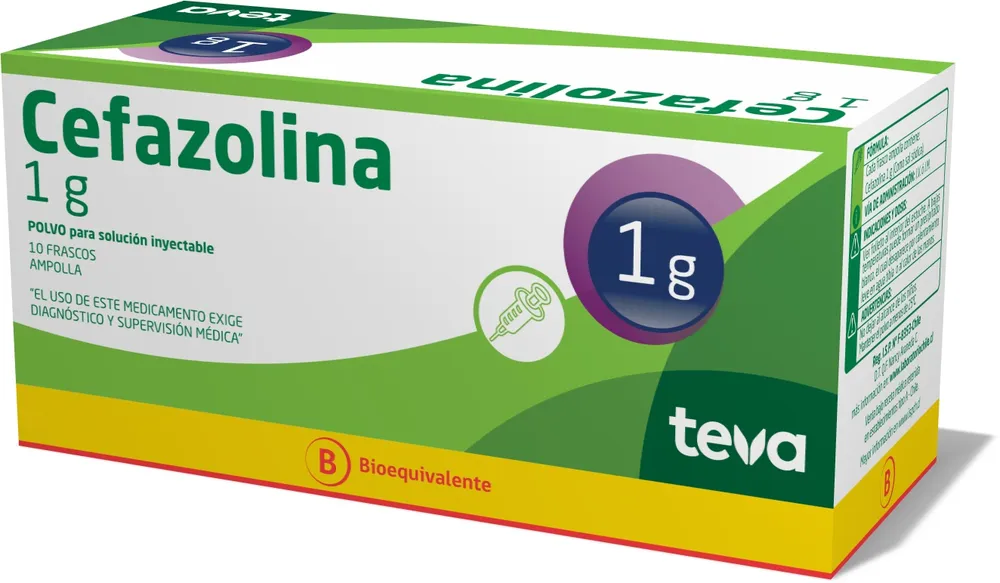
Table of Contents
- Package leaflet: information for the patient
- Cefazolin Teva 1 g powder and solvent for injectable solution, for injection/infusion solution
- 1. What Cefazolina Teva is and what it is used for
- 2. What you need to know before using Cefazolin Teva
- 3. How to use Cefazolin Teva
- 4. Possible side effects
- 5. How to store Cefazolin Teva
- 6. Package contents and other information
- The following information is intended for healthcare professionals only:
Package leaflet: information for the patient
Cefazolin Teva 1 g powder and solvent for injectable solution, for injection/infusion solution
Generic medicine
Please read this leaflet carefully before using this medicine because it contains important information for you.
- Keep this leaflet. You may need to read it again.
- If you have any questions, ask your doctor or pharmacist.
- This medicine has been prescribed for you only. Do not give it to other people, even if their symptoms are the same as yours, as it may be harmful.
- If you experience any side effects, including those not listed in this leaflet, contact your doctor or pharmacist. See section 4.
Contents of this leaflet:
- What Cefazolin Teva is and what it is used for
- What you need to know before using Cefazolin Teva
- How to use Cefazolin Teva
- Possible side effects
- How to store Cefazolin Teva
- Contents of the pack and other information
1. What Cefazolina Teva is and what it is used for
Cefazolina Teva contains cefazolin and is an antibiotic that works by killing bacteria causing bacterial infections.
Cefazolina Teva is indicated for the treatment of various types of infections affecting:
- the respiratory tract;
- the genital and urinary tract;
- the biliary tract;
- the skin and soft tissues;
- bones and joints;
- the heart (endocarditis);
- the veins (phlebitis and thrombophlebitis);
- the tissues lining the internal organs of the abdominal and pelvic cavity (peritonitis);
- the genital tract in pregnant women during childbirth or postpartum (puerperal sepsis);
- the entire body (septicaemia).
2. What you need to know before using Cefazolin Teva
Do not use Cefazolin Teva
- if you are allergic to cefazolin, or to any of the other ingredients of this medicine (listed in section 6).
Warnings and precautions
Talk to your doctor or pharmacist before using Cefazolin Teva if:
- you have previously experienced an allergic reaction to other antibiotics;
- you develop diarrhoea during treatment;
- you have severe renal impairment (uraemia). Prolonged use of the antibiotic may promote the growth of microorganisms not sensitive to it.
Laboratory tests
Administration of Cefazolin Teva may interfere with the results of certain laboratory tests performed on urine and blood.
Other medicines and Cefazolin Teva
Tell your doctor or pharmacist if you are taking, have recently taken, or might take any other medicines.
Inform your doctor if you are taking or need to take:
- other antibiotics such as kanamycin, streptomycin, colistin, viomycin, polymyxin, neomycin, gentamicin, penicillins;
- anticoagulants (medicines that delay blood clotting);
- probenecid (a medicine used in the treatment of gout, an inflammatory joint disease).
Pregnancy, breastfeeding and fertility
If you are pregnant, think you may be pregnant, plan to become pregnant, or are breastfeeding, ask your doctor or pharmacist for advice before using this medicine.
Pregnancy
Cefazolin Teva must not be used during pregnancy unless considered strictly necessary by your doctor.
Breastfeeding
Cefazolin is excreted in breast milk.
Driving and using machines
Cefazolin Teva does not affect the ability to drive or operate machinery.
3. How to use Cefazolin Teva
Use this medicine exactly as instructed by your doctor or pharmacist. If you have any doubts, consult your doctor or pharmacist.
Adults
The recommended dose is 1000–2000 mg per day, according to the doctor's instructions.
Children
The recommended dose ranges from 30 mg to 50 mg/kg per day, according to the doctor's instructions.
In cases of very severe infections, the doctor may consider increasing the dose.
Your doctor will decide whether you should receive the antibiotic via intramuscular or intravenous route, depending on the severity of the infection being treated.
Intramuscular route
If Cefazolin Teva is prescribed for intramuscular use, the daily dose may be divided into 2 equal doses administered every 12 hours. In severe infections, it may be divided into 3–4 doses.
Intravenous route (injection or infusion)
In case of initial intensive treatment or severe infections, your doctor may prescribe Cefazolin Teva for intravenous administration, which will be given by trained healthcare personnel.
Patients with impaired renal function
If you are a patient receiving Cefazolin Teva intravenously and you have impaired kidney function (renal insufficiency), your doctor will evaluate adjusting the dose based on the severity of your clinical condition.
Use in children
In early infancy, Cefazolin Teva should be administered only when clearly necessary and under medical supervision.
If you use more Cefazolin Teva than you should
In case of accidental ingestion or overdose of this medicine, contact your doctor immediately or go to the nearest hospital.
If you forget to use Cefazolin Teva
Do not take a double dose to make up for the missed dose.
If you stop treatment with Cefazolin Teva
Do not stop treatment with this medicine without first consulting your doctor.
If you have any doubts about how to use this medicine, consult your doctor or pharmacist.
4. Possible side effects
Like all medicines, this medicine can cause side effects, although not everyone experiences them.
Stop taking the medicine and contact your doctor immediately if you experience:
- skin rash, itching, difficulty breathing or swallowing, swelling of the face, hands and feet, eyes, lips and/or tongue. These may be signs of a severe allergic reaction (anaphylactic reaction).
Other possible side effects (frequency cannot be estimated from the available data) may include:
- inflammation of the tongue (glossitis);
- nausea;
- vomiting;
- stomach burning (pyrosis);
- abdominal pain;
- diarrhoea;
- reduced appetite;
- inflammation of the intestine associated with antibiotic use (pseudomembranous colitis);
- increased production of stomach acid (hyperchlorhydria);
- skin rashes;
- itching;
- joint pain (arthralgia);
- urticaria;
- increased number of a type of white blood cells (eosinophilia);
- reduced number of white blood cells (leucopenia and neutropenia);
- reduced number of platelets (thrombocytopenia);
- bleeding (haemorrhage);
- increased levels of liver enzymes known as transaminases and alkaline phosphatase;
- increased bilirubin levels;
- increased blood urea levels;
- dizziness;
- chest discomfort;
- inflammation of the veins (phlebitis) after intravenous administration;
- infection of the vulva and vagina (Candida vulvovaginitis);
- mouth infection (oral candidiasis).
Reporting of side effects
If you experience any side effect, including those not listed in this leaflet, talk to your doctor or pharmacist. You can also report side effects directly via the national reporting system at www.agenziafarmaco.gov.it/content/come-segnalare-una-sospetta-reazione-avversa.
By reporting side effects, you can help provide more information on the safety of this medicine.
5. How to store Cefazolin Teva
Keep this medicine out of the sight and reach of children.
Store the vials tightly closed.
After reconstitution, protect the solution from light and store at low temperature. Use within 24 hours.
Do not use this medicine after the expiry date stated on the packaging after "Exp". The expiry date refers to the last day of that month.
Do not dispose of any medicine via wastewater or household waste. Ask your pharmacist how to dispose of medicines you no longer use. This will help protect the environment.
6. Package contents and other information
What Cefazolina Teva contains
Cefazolina Teva 1 g powder and solvent for injectable solution for intramuscular use
- The active substance is cefazolin. One vial contains 1048 mg of sodium cefazolin (equivalent to 1000 mg of cefazolin acid).
- The other components are: lidocaine hydrochloride monohydrate, water for injections.
Cefazolina Teva 1 g powder for injectable solution/for infusion for intravenous use
- The active substance is cefazolin. One vial contains 1048 mg of sodium cefazolin (equivalent to 1000 mg of cefazolin acid).
Description of the appearance of Cefazolina Teva and contents of the pack
Cefazolina Teva 1 g powder and solvent for injectable solution for intramuscular use is supplied in a
carton containing 1 vial of 1000 mg freeze-dried powder and 1 ampoule of 4 ml solvent.
Cefazolina Teva 1 g powder for injectable solution/for infusion for intravenous use is supplied in a
carton containing 1 vial of 1000 mg freeze-dried powder.
Marketing Authorization Holder and Manufacturer
Marketing Authorization Holder
Teva Italia S.r.l. - Piazzale Luigi Cadorna, 4 - 20123 - Milan, Italy
Manufacturer
Laboratorio Farmaceutico CT S.r.l. - Via Dante Alighieri, 71 - 18038 San Remo (IM) - Italy
Mitim S.r.l. - Via Cacciamali, 34-38 - 25125 Brescia - Italy
The following information is intended for healthcare professionals only:
Intravenous injections
The powder in the vials must be dissolved in water for injections, or in glucose solution, physiological saline, 5% or 10% dextrose, 5% dextrose + 0.90% sodium chloride, 5% dextrose + 0.45% sodium chloride, 5% dextrose + 0.20% sodium chloride, 5% dextrose in Ringer's solution, Ringer's solution, lactated Ringer's solution, 5% sodium bicarbonate, 5% or 10% invertose.
Cefazolin Teva may be administered by direct intravenous injection or by slow intravenous infusion.
The medicinal product should be administered every 6 hours.
Incompatibilities
Cefazolin is incompatible with calcium gluceptate and calcium gluconate, tetracycline hydrochloride, chlortetracycline hydrochloride, oxytetracycline hydrochloride, amobarbital sodium, and pentobarbital sodium.
When mixed with amikacin sulfate, turbidity develops after 8 hours.
Recommended doses in patients with renal impairment
| Creatinine clearance | Initial dose | Maintenance dose | Approximate dosing interval |
| 50 - 80 ml/min | 0.5 - 1 g | same as initial dose | 12 hours |
| 30 - 50 ml/min | 0.5 - 1 g | same as initial dose | 16-24 hours |
| 25 ml/min | 0.5 - 1 g | half of initial dose | 8 hours |
| 20 ml/min | 0.5 - 1 g | half of initial dose | 9 - 10 hours |
| 15 ml/min | 0.5 - 1 g | half of initial dose | 12 hours |
| 10 ml/min | 0.5 - 1 g | half of initial dose | 16 hours |
| 5 ml/min | 0.5 - 1 g | half of initial dose | 24 hours |
| 0 ml/min | 0.5 - 1 g | half of initial dose | 48 hours |