Carediesse
Italy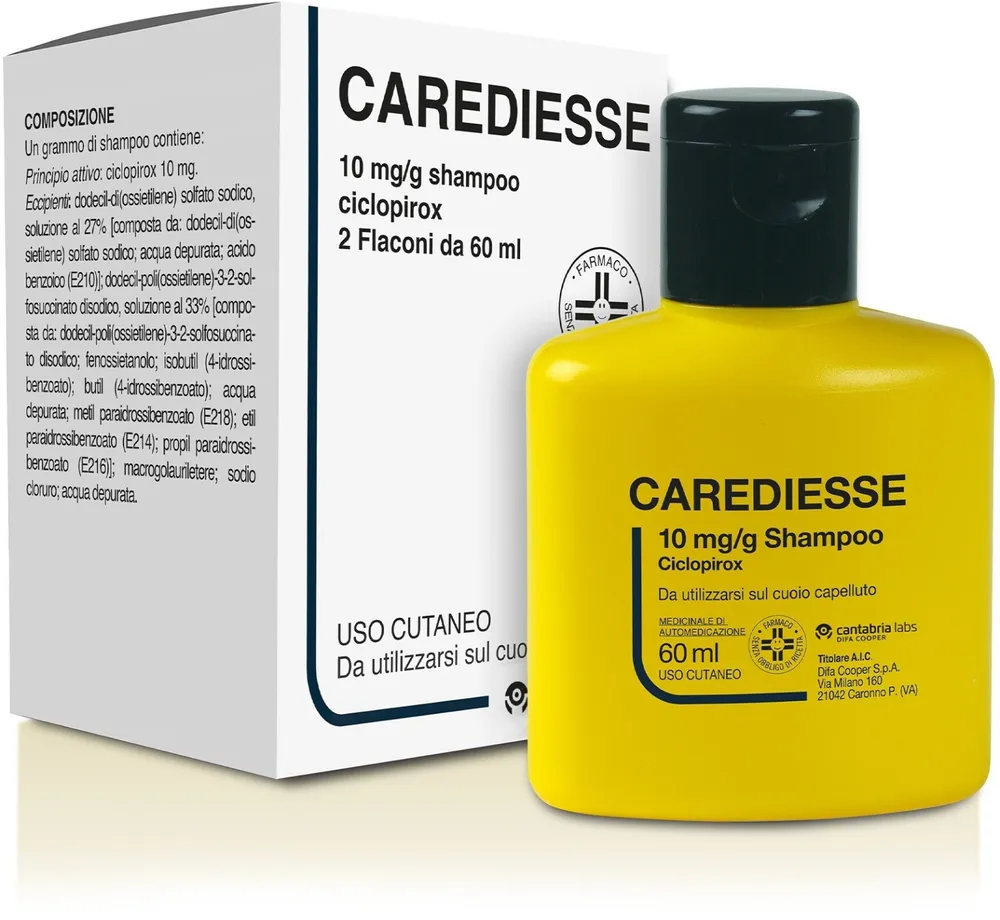
Table of Contents
Patient Information Leaflet: Information for the Patient
Carediesse
ciclopirox
Please read this leaflet carefully before using this medicine.
- Keep this leaflet. You may need to read it again.
- If you have any questions, consult your doctor or pharmacist.
- This medicine has been prescribed for you only. Do not give it to other people, even if their symptoms are the same as yours, as it could be harmful.
- If any side effect worsens or if you notice any side effect not listed in this leaflet, consult your doctor or pharmacist.
Contents of this leaflet:
- What Carediesse is and what it is used for
- What you need to know before using Carediesse
- How to use Carediesse
- Possible side effects
- How to store Carediesse
- Contents of the pack and other information
1. What Carediesse Shampoo is and what it is used for
What Carediesse is
Carediesse contains an active substance called "ciclopirox", an antifungal agent (which kills fungi and
yeasts).
What Carediesse is used for
Carediesse is used to treat a scalp condition called "seborrhoeic dermatitis". This
condition occurs when the skin on the head becomes irritated, leading to flaking, burning, and
itching.
How Carediesse works
Carediesse works by killing yeasts and fungi on the upper layers of the scalp. These yeasts and fungi
are one of the main causes of seborrhoeic dermatitis.
2. What you need to know before using Carediesse
Do not use Carediesse:
- If you are allergic to the active substance ciclopirox, ciclopirox olamine, or to any of the other ingredients of Carediesse (listed in section 6). If you are unsure, consult your doctor or pharmacist before using Carediesse.
Warnings and precautions
Talk to your doctor or pharmacist before using Carediesse.
If Carediesse accidentally gets into your eyes, rinse them thoroughly with plenty of water.
If you accidentally ingest Carediesse, contact your doctor or pharmacist immediately.
You may notice changes in hair color, especially if your hair has been damaged by chemical agents such as hair dyes, or if you have white or grey hair.
Other medicines and Carediesse
Inform your doctor or pharmacist if you are currently using, or have recently used, any other medicines, including those not requiring a prescription.
Pregnancy, breastfeeding, and fertility
If you are pregnant or breastfeeding, or if you suspect you may be pregnant or are planning a pregnancy, consult your doctor or pharmacist before using this medicine.
It is not known whether ciclopirox passes into breast milk; therefore, if you are breastfeeding, the use of Carediesse is not recommended.
Consult your doctor or pharmacist before taking any medicine if you are pregnant or breastfeeding.
No studies have been conducted on the effects of ciclopirox on human fertility; however, reduced fertility has been observed in rats following oral administration.
Carediesse contains benzoic acid and sodium benzoate
- These may irritate the skin, eyes, or mucous membranes (such as the tissues inside the mouth or nose).
3. How to use Carediesse
Use this medicine exactly as instructed by your doctor. If you have any doubts, consult your doctor or pharmacist.
Use of Carediesse
- Use Carediesse only on the scalp
- Wet your hair and apply Carediesse
- Rub to form a lather and massage the shampoo into the scalp
- Leave the shampoo lather on the scalp for about 3 minutes
- Then rinse thoroughly with water
How much shampoo to use
Use the dosing cap provided with the Carediesse bottle to measure the amount.
The recommended amount is one cap (approximately 5 ml) of Carediesse. Up to two caps (approximately 10 ml) may be used for hair longer than shoulder length.
How often to use this medicine
- At first, use the shampoo once or twice a week, depending on the severity of your symptoms. Continue this way for four weeks to clear the symptoms.
- Afterwards, you may continue using the shampoo once or twice a week for up to 12 weeks. This will help prevent symptoms from returning. Do not use Carediesse for more than 16 weeks continuously.
Use in children
Carediesse has not been studied in children.
If you use more Carediesse than you should
If you use more Carediesse than recommended, it is unlikely to cause adverse effects. There is no information available on overdose with medicinal products containing ciclopirox.
If you stop using Carediesse
Do not stop treatment with Carediesse without first talking to your doctor. Stopping treatment too early may reduce its effectiveness.
If you have any questions about how to use this medicine, consult your doctor or pharmacist.
4. Possible adverse reactions
Like all medicines, this medicine may cause adverse reactions, although not everybody gets them. The following adverse reactions may occur with this medicine.
Uncommon (affects less than 1 in 100 people)
- Scalp skin reactions – including skin irritation or eczema (inflamed skin with itching, redness, and often blisters that release fluid and form crusts), or discomfort such as burning or itching.
- Hair problems – such as mild hair loss, discoloration, dullness, heaviness, or mild dryness of hair.
Rare (affects less than 1 in 1,000 people)
- Skin redness at the site where the shampoo comes into contact with the skin (allergic contact dermatitis). Stop using Carediesse and consult your doctor if you experience skin or scalp reactions such as irritation or sensitization (allergic reactions) after prolonged use of the medicine. Your doctor may decide to start you on a different treatment.
Reporting of adverse reactions
If you experience any adverse reaction, including those not listed in this leaflet, consult your doctor or pharmacist. You can also report adverse reactions directly via the national reporting system at www.agenziafarmaco.gov.it/content/come-segnalare-una-sospetta-reazione-avversa. By reporting adverse reactions, you can help provide more information on the safety of this medicine.
5. How to store Carediesse
Keep this medicine out of the sight and reach of children.
Do not use this medicine after the expiry date stated on the carton and bottle after EXP.
The expiry date refers to the last day of that month.
Do not store above 30°C.
Carediesse can be used for up to 8 weeks after first opening the bottle.
Do not dispose of any medicine via wastewater or household waste. Ask your pharmacist how to dispose of medicines you no longer use. This will help protect the environment.
6. Package contents and other information
What Carediesse contains
The active substance is ciclopirox; 1 g of shampoo contains 10 milligrams (mg) of ciclopirox.
The other ingredients are:
Sodium dodecyl di(ethylene oxide) sulfate, 27% solution
Disodium dodecyl poly(ethylene oxide)-3-2-sulfosuccinate, 33% solution
Macrogol lauryl ether
Sodium chloride
Purified water
composed of: sodium dodecyl di(ethylene oxide) sulfate; purified water; benzoic acid (E210)
composed of: disodium dodecyl poly(ethylene oxide)-3-2-sulfosuccinate; sodium benzoate (E211); purified water
Description of the appearance of Carediesse and contents of the pack
The shampoo is nearly colourless to yellowish.
Carediesse is supplied in plastic bottles with zip closure, in the following pack sizes:
1 bottle of 60 ml
2 bottles of 60 ml (120 ml)
It is possible that not all pack sizes are marketed.
Marketing Authorisation Holder and Manufacturer
Marketing Authorisation Holder
Difa Cooper S.p.A
Via Milano 160
21042 Caronno Pertusella (VA)
Italy
Manufacturer:
Sanofi-Aventis Deutschland GmbH
D-65926 Frankfurt am Main
Germany
Dreiturm GmbH
Dr.-Rudolf-Hedler-Straße 1
36396 Steinau an der Straße
Germany
This medicinal product is authorised in the EEA Member States under the following names:
France: Mycoster 10mg/g shampoing
Germany: Batrafen S 10mg/g Shampoo
Italy: Carediesse