Calcitriol Teva
Italy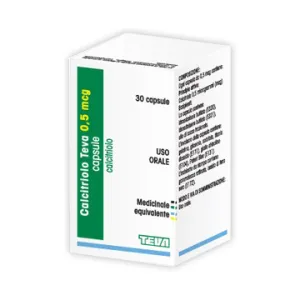
Table of Contents
- Package leaflet: Information for the patient
- Calcitriol Teva 0.25 micrograms capsules, 0.5 micrograms capsules
- 1. What Calcitriol Teva is and what it is used for
- 2. What you should know before taking Calcitriol Teva
- 3. How to take Calcitriol Teva
- 4. Possible side effects
- 5. How to store Calcitriol Teva
- 6. Package contents and other information
Package leaflet: Information for the patient
Calcitriol Teva 0.25 micrograms capsules, 0.5 micrograms capsules
Equivalent medicine
Please read all of this leaflet carefully before taking this medicine because it contains
important information for you.
- Keep this leaflet. You may need to read it again.
- If you have any questions, ask your doctor or pharmacist.
- This medicine has been prescribed for you only. Do not give it to other people, even if their symptoms are the same as yours, as it may be harmful.
- If you experience any side effects, including those not listed in this leaflet, contact your doctor or pharmacist. See section 4.
Contents of this leaflet
- What Calcitriol Teva is and what it is used for
- What you need to know before taking Calcitriol Teva
- How to take Calcitriol Teva
- Possible side effects
- How to store Calcitriol Teva
- Contents of the pack and other information
1. What Calcitriol Teva is and what it is used for
Calcitriol Teva is a medicine containing vitamin D, which is necessary for bone formation.
Calcitriol Teva is used to treat:
- a bone disease in patients with kidney problems (renal osteodystrophy), especially those undergoing haemodialysis (a method of blood filtration);
- diseases related to reduced function of the parathyroid glands (hypoparathyroidism, pseudohypoparathyroidism), glands located in the neck that secrete PTH (parathyroid hormone), the hormone regulating calcium metabolism;
- rickets: a disease characterized by defective formation and development of bones (vitamin D-resistant hypophosphataemic rickets, vitamin D-dependent rickets);
- a disease related to overactivity of the parathyroid glands caused by moderate to severe chronic kidney disease, not treated with dialysis (secondary hyperparathyroidism in patients with moderate to severe chronic renal insufficiency in pre-dialysis).
Calcitriol Teva is also indicated in women with confirmed menopause:
- for the treatment of a condition that weakens the bones and increases the risk of bone fractures (postmenopausal osteoporosis).
Calcitriol acts to increase the absorption of calcium from the diet by the body. This helps form healthy bones and reduce bone damage.
2. What you should know before taking Calcitriol Teva
Do not take Calcitriol Teva
- if you are allergic to calcitriol or to medicines similar to calcitriol or to any of the other ingredients of this medicine (listed in section 6).
- if you have high levels of calcium in your blood (hypercalcemia).
- if you have calcium deposits in your body (metastatic calcification).
- if you are suffering from illness due to high levels of vitamin D in your body. Do not take Calcitriol Teva if you are in any of the above conditions. If you have any doubts, consult your doctor or pharmacist before taking Calcitriol Teva.
Warnings and precautions
Talk to your doctor or pharmacist before taking Calcitriol Teva
- if you have difficulty moving (for example, after surgery), as this increases the risk of hypercalcemia (elevated calcium levels in the blood).
- if you have reduced kidney function (renal insufficiency), as this increases the risk of calcium deposits in body tissues where calcium is not needed (ectopic calcification) (your doctor may need to monitor phosphate levels in your blood and diet).
- if you suffer from a bone formation disorder (vitamin D-resistant rachitism with hypophosphatemia) and are being treated with phosphate-containing medicines.
- if you are already being treated with ergocalciferol (see section 2 “Other medicines and Calcitriol Teva”).
Monitoring of calcium and phosphate levels in blood
There is a close relationship between treatment with this medicine and increased levels of calcium and phosphate in the blood. For this reason:
- during treatment with Calcitriol Teva, follow the diet prescribed by your doctor to avoid increased levels of calcium and phosphate in the blood (see section “Calcitriol Teva with food and drink”);
- before and during therapy, your doctor will ask you to have blood tests to monitor your calcium and creatinine levels (a protein used to assess kidney function). If these levels are too high, your doctor will instruct you to stop treatment immediately until calcium levels return to normal (see section “Possible side effects”);
- your doctor will monitor your blood phosphate levels;
- your doctor will instruct you to recognize possible symptoms of elevated calcium and phosphate levels in the blood.
If you are postmenopausal and suffer from osteoporosis
If you are postmenopausal and this medicine has been prescribed to treat osteoporosis, your doctor will carefully monitor your kidney function and blood calcium levels before starting treatment and at regular intervals during therapy.
Dehydration
If you do not have kidney disorders, your doctor will advise you to drink plenty of water during treatment with this medicine to avoid dehydration (excessive loss of body fluids).
Children and adolescents
Calcitriol Teva must not be given to children and adolescents, as the safety and efficacy of the medicine in this patient group have not been sufficiently studied to allow dosage recommendations.
Other medicines and Calcitriol Teva
Inform your doctor or pharmacist if you are taking, have recently taken, or might take any other medicines. This includes medicines without a prescription and herbal medicines, as Calcitriol Teva may interact with how some medicines work, and some medicines may interfere with the proper function of Calcitriol Teva.
In particular, consult your doctor or pharmacist if you are taking any of the following medicines:
- other medicines containing vitamin D, including calcium supplements.
- diuretics (used to treat high blood pressure). These include bendroflumethiazide, chlorthalidone, and indapamide.
- medicines such as digoxin or digitoxin (used to treat heart conditions).
- medicines containing magnesium, such as antacids (used to treat heartburn).
- steroid medicines, such as hydrocortisone, prednisolone, and dexamethasone.
- colestyramine or other "ion-exchange resins" (used to treat high cholesterol levels in the blood) and sevelamer.
- phosphates (your doctor may need to monitor your blood phosphate levels).
- medicines that increase liver activity, such as phenytoin (used to treat epilepsy) or phenobarbital (a barbiturate).
Additionally, inform your doctor or pharmacist if you have taken a medicine containing vitamin D in the past few months that may have long-lasting effects. These medicines include ergocalciferol and cholecalciferol.
Calcitriol Teva with food and drink
- DO NOT take any vitamin or supplement containing vitamin D while taking Calcitriol Teva.
- DO NOT eat foods fortified with vitamin D (foods enriched with vitamin D) while taking Calcitriol Teva.
- It is very important to follow the diet prescribed by your doctor.
- Significant changes in dietary intake of calcium or vitamin D may increase the risk of side effects (for example, if you consume more dairy products such as milk and cheese, or take vitamins without your doctor’s knowledge).
- Drink plenty of fluids (such as water) to avoid dehydration. This does not apply if you have kidney problems.
Pregnancy and breastfeeding
If you are pregnant, think you might be pregnant, are planning to become pregnant, or are breastfeeding, consult your doctor or pharmacist before taking this medicine.
Pregnancy
Inform your doctor before taking Calcitriol Teva if you are pregnant, think you might be pregnant, or are planning to become pregnant. Your doctor will decide whether you can take Calcitriol Teva.
Breastfeeding
You may take Calcitriol Teva while breastfeeding. However, your doctor will prescribe blood tests for you and your baby to monitor for possible side effects.
Driving and using machines
It is unlikely that Calcitriol Teva will affect your ability to drive or use tools and machinery.
Calcitriol Teva contains sorbitol
Calcitriol Teva 0.25 microgram capsules
This medicine contains 10.73 mg of sorbitol per capsule.
Calcitriol Teva 0.5 microgram capsules
This medicine contains 10.79 mg of sorbitol per capsule.
If your doctor has told you that you have an intolerance to certain sugars, talk to your doctor before taking this medicine.
Calcitriol Teva contains sodium (component of Quinoline Yellow)
This medicine contains less than 1 mmol (23 mg) of sodium per capsule, i.e., essentially “sodium-free”.
3. How to take Calcitriol Teva
Take this medicine exactly as instructed by your doctor or pharmacist. If you have any doubts, consult your doctor or pharmacist.
Your doctor will determine the dose based on your body weight and your overall health condition. Your doctor will also perform frequent blood tests at the beginning of treatment to establish the most appropriate dose for you, and during treatment to monitor that your blood calcium levels do not become too high.
Bone disease caused by kidney disease in dialysis patients (renal osteodystrophy)
The effectiveness of treatment depends on concomitant calcium intake. In adults, a supplementary intake of 600–1000 mg of calcium per day should be ensured.
- The recommended initial dose for adults is 0.25 micrograms daily.
- If your blood calcium levels are normal or only slightly reduced, the recommended initial dose is 0.25 micrograms every 2 days.
- If no improvement is observed after 2–4 weeks, your doctor may increase the dose by 0.25 micrograms daily, at intervals of 2–4 weeks.
- During treatment, your doctor will adjust the dose between 0.5 micrograms and 1 microgram daily.
- If necessary, based on blood test results, your doctor may further adjust the dose and may instruct you to take Calcitriol Teva 2 or 3 times per week instead of daily. The maximum weekly dose is 12 micrograms.
Postmenopausal women
If you suffer from a disease that weakens the bones and increases the risk of bone fractures (confirmed postmenopausal osteoporosis):
- The recommended dose for women is 0.25 micrograms twice daily.
- If calcium levels do not show significant changes, your doctor will not change your dose. In this case, your doctor will not prescribe additional calcium supplementation.
If you suffer from a condition related to overactivity of the parathyroid glands (secondary hyperparathyroidism) in patients with moderate to severe renal insufficiency prior to dialysis:
- The recommended initial dose for adults is 0.25 micrograms daily.
- If necessary, the dose may be increased up to 0.5 micrograms daily.
If you suffer from a condition related to reduced parathyroid function (hypoparathyroidism) or if you have rickets:
- The recommended dose is 0.25 micrograms daily, taken in the morning.
- If no improvement occurs, your doctor may increase the dose every 2–4 weeks.
Monitoring calcium levels
Once your doctor has established the optimal dose, your blood calcium levels will be monitored once a month. Based on these checks, your doctor may decide to modify or temporarily discontinue treatment with this medicine (see section 4 “Possible side effects”). During any interruption or suspension of treatment, blood calcium and phosphate levels must be monitored daily.
Elderly
Elderly patients do not require a different dosage.
Use in children and adolescents
The use of Calcitriol Teva is not recommended in children.
Swallow the entire capsule with some water.
If you take more Calcitriol Teva than you should
If you take more Calcitriol Teva than prescribed, inform your doctor or go to the nearest hospital immediately. Take the medicine pack with you.
If you take too many capsules, too much calcium may accumulate in your blood (hypercalcemia). Symptoms include loss of appetite, weight loss, nausea, headache, fatigue, constipation, weakness, or drowsiness.
If you forget to take Calcitriol Teva
If you forget to take a dose, skip the missed dose and take the next dose at the usual time.
Do not take a double dose (two doses at the same time) to make up for the forgotten dose.
If you stop taking Calcitriol Teva
Do not stop treatment with Calcitriol Teva without consulting your doctor. This is because bone weakness requires long-term treatment.
If someone else accidentally takes your Calcitriol Teva capsules, inform a doctor or go to the nearest hospital immediately.
If you have any doubts about how to use this medicine, consult your doctor or pharmacist.
4. Possible side effects
Like all medicines, this medicine can cause side effects, although not everybody will experience them.
Very common (may affect more than 1 in 100 people).
Common (may affect up to 1 in 10 people).
Uncommon (may affect up to 1 in 100 people).
Rare (may affect up to 1 in 1,000 people).
Very rare (may affect up to 1 in 10,000 people).
Not known (frequency cannot be estimated from the available data).
If you experience:
- an increase in calcium or creatinine levels in the blood, treatment with Calcitriol Teva will be immediately discontinued until normal calcium levels in the blood are restored;
- abnormal levels of calcium and phosphate in the blood, treatment will be discontinued.
The possible side effects that may occur with this medicine are listed below, grouped by frequency:
Very common (may affect more than 1 in 100 people)
- increased calcium levels in the blood (hypercalcaemia), which may lead to calcium intoxication.
Common (may affect up to 1 in 10 people)
- headache (cephalalgia)
- nausea
- abdominal pain
- urinary tract infections
- skin rashes.
Uncommon (may affect up to 1 in 100 people)
- reduced appetite
- vomiting
- increased creatinine levels in the blood.
Not known (frequency cannot be estimated from the available data)
- allergic reactions (hypersensitivity)
- urticaria
- excessive thirst (polydipsia)
- dehydration
- weight loss
- apathy
- mental disorders
- muscle weakness
- sensory disturbances
- drowsiness
- irregular heartbeat
- constipation
- stomach pain
- intestinal obstruction
- itching
- skin redness (erythema)
- growth retardation
- frequent need to urinate (polyuria)
- bedwetting (nocturia)
- fever
- thirst
- deposition of calcium salts in the skin, in subcutaneous tissues and, more rarely, in tendons, tissues around joints and muscles (calcinosis).
Reporting of side effects
If you experience any side effect, including those not listed in this leaflet, talk to your doctor or pharmacist.
You can also report side effects directly via the national reporting system at: www.aifa.gov.it/content/segnalazioni-reazioni . By reporting side effects, you can help provide more information on the safety of this medicine.
5. How to store Calcitriol Teva
Keep this medicine out of the sight and reach of children.
Do not use this medicine after the expiry date stated on the pack after "Exp.". The expiry date refers to the last day of that month.
Store in the original container. Do not store above 30°C.
Do not dispose of any medicine via wastewater. Ask your pharmacist how to dispose of medicines no longer required. This will help protect the environment.
6. Package contents and other information
What Calcitriol Teva contains
- The active substance is calcitriol. Calcitriol Teva 0.25 micrograms capsules: Each capsule contains 0.25 micrograms of calcitriol. Calcitriol Teva 0.5 micrograms capsules: Each capsule contains 0.5 micrograms of calcitriol.
- The other ingredients are fractionated coconut oil, butylated hydroxyanisole (E320), butylated hydroxytoluene (E321), gelatin, glycerol (E422), sorbitol (E420), titanium dioxide (E171), quinoline yellow (E104) (contains sodium). The 0.5 microgram capsules also contain patent blue (E131).
Both dosage forms of the capsules bear printing in black ink containing
shellac (E904) and black iron oxide (E172).
Description of the appearance of Calcitriol Teva and contents of the pack
Calcitriol Teva 0.25 micrograms capsules are opaque, yellow, oval soft gelatin capsules imprinted with "0.25".
Calcitriol Teva 0.5 micrograms capsules are opaque, green, oblong soft gelatin capsules imprinted with "0.5".
The product is available in packs of 20, 30 and 100 capsules.
Not all pack sizes may be marketed.
Marketing Authorization Holder and Manufacturer
Marketing Authorization Holder
Teva Italia S.r.l. - Piazzale Luigi Cadorna, 4 - 20123 Milan, Italy
Manufacturers
Pharmachemie B.V., Swensweg 5, P.O. Box 552, 2003 HA Haarlem (The Netherlands)
Teva Pharmaceuticals Europe B.V., Swensweg 5, 2031 GA Haarlem (The Netherlands)
Balkanpharma Dupnitsa AD, Samokovsko Shosse strasse 3, 2600 Dupnitsa (Bulgaria)