Brufix
Italy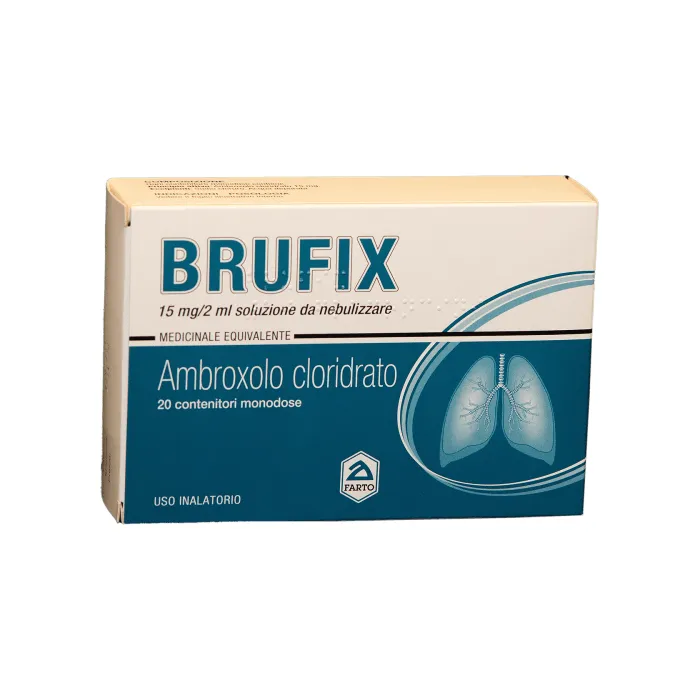
Table of Contents
Patient Information Leaflet: Information for the User
BRUFIX 15 mg/2 ml nebulising solution
EQUIVALENT MEDICINE
Ambroxol hydrochloride
Please read carefully this leaflet before using this medicine because it contains important information for you.
Always use this medicine exactly as described in this leaflet or as your doctor or pharmacist has instructed.
- Keep this leaflet. You may need to read it again.
- If you need more information or advice, consult your doctor or pharmacist.
- If you experience any of the side effects, including those not listed in this leaflet, contact your doctor or pharmacist. See section 4.
- Contact your doctor if you do not notice improvement or if you experience worsening of symptoms after a short period of treatment.
Contents of this leaflet:
- What Brufix is and what it is used for
- What you need to know before using Brufix
- How to use Brufix
- Possible side effects
- How to store Brufix
- Contents of the pack and other information
1. What Brufix is and what it is used for
Brufix contains ambroxol hydrochloride, a medicine that works by dissolving bronchial secretions and facilitating their elimination.
Brufix is used in the following conditions:
Treatment of secretory disorders in acute and chronic bronchopulmonary diseases.
2. What you need to know before using Brufix
Do not take Brufix if you have:
Hypersensitivity to the active substance (ambroxol) or to any of the excipients.
Severe hepatic and/or renal impairment.
Take special care with:
Ambroxol must be administered with caution in patients with peptic ulcer.
Since deep inhalation of aerosols may cause irritation-induced coughing, it is recommended to inhale and exhale normally during inhalation.
In particularly sensitive patients, it may be advisable to pre-warm the inhalation solution to body temperature. For patients with bronchial asthma, it is advisable to use a bronchial spasmolytic prior to inhalation.
Severe skin reactions have been reported following administration of ambroxol.
If you develop a skin rash (including lesions of mucous membranes such as mouth, throat, nose, eyes, genitals), stop taking Mucosolvan and contact your doctor immediately.
These reactions could be symptoms of serious skin diseases characterized by skin peeling and severe toxic skin reactions (Stevens-Johnson syndrome and Toxic Epidermal Necrolysis).
Additionally, during the initial phase of Stevens-Johnson syndrome or toxic epidermal necrolysis (TEN), patients may initially experience non-specific symptoms resembling those of influenza, such as fever, chills, rhinitis, cough, and sore throat. Due to these misleading symptoms, symptomatic treatment with cough and cold remedies may be initiated.
In case of mild or moderate renal impairment, BRUFIX may be used only after consulting your doctor.
As with any drug metabolized through the liver and eliminated via the kidneys, accumulation of ambroxol metabolites produced in the liver may occur in the presence of severe renal impairment (see "Do not take Brufix if you have").
Other medicines and Brufix:
Inform your doctor or pharmacist if you have recently taken any other medicines, including those without a prescription.
Following ambroxol administration, concentrations of antibiotics (amoxicillin, cefuroxime, erythromycin) in bronchopulmonary secretions and saliva are increased.
No clinically relevant unfavorable interactions with other medicines have been observed.
Use of Brufix with food and drinks:
Brufix does not interfere with food and drinks.
Pregnancy and breastfeeding
Consult your doctor or pharmacist before taking any medicine.
Ambroxol hydrochloride crosses the placental barrier.
During pregnancy and breastfeeding, ambroxol should be used only after consulting your doctor and evaluating with him the risk/benefit ratio in your individual case.
Consult your doctor if you suspect you are pregnant or if you are planning a pregnancy. Clinical data on ambroxol exposure during pregnancy are not available.
Animal studies do not indicate direct or indirect harmful effects on pregnancy, embryonal/fetal development, delivery, or postnatal development.
Despite preclinical studies and extensive clinical experience not showing any harmful effects after the 28th week of gestation, normal precautions regarding drug use during pregnancy are recommended. Brufix is not recommended during the first trimester.
Caution is required when prescribing this medicine to pregnant women.
During pregnancy, medicines should be used only if the expected benefit to the mother outweighs the potential risk to the fetus. All medicines should be avoided, if possible, during the first trimester of pregnancy.
The drug is excreted in breast milk. Ambroxol use by the mother may cause adverse effects in the breastfed infant; therefore, a decision must be made whether to discontinue breastfeeding or the medicinal treatment, taking into account the importance of the medicine for the mother.
Driving and using machines:
There is no evidence of an effect on the ability to drive vehicles or operate machinery. No studies have been conducted on the effects on driving and machine use.
Brufix nebulizing solution contains sodium
This medicine contains less than 1 mmol (23 mg) of sodium per dose, i.e., essentially "sodium-free".
3. How to use brufix
The nebulizer solution can be administered using standard nebulizing equipment. It may also be diluted in distilled water at a 1:1 ratio.
Adults: 1 single-dose container 2 or 3 times daily.
Children over 5 years: 1 single-dose container 2 times daily.
Children up to 5 years: ½ single-dose container 2 times daily.
Do not use ambroxol for prolonged treatments.
If you feel that the effect of Brufix is too strong or too weak, consult your doctor or pharmacist.
If you take more Brufix than you should:
Data regarding ambroxol overdose are limited.
Symptoms corresponding to the undesirable effects described can be expected.
In case of accidental ingestion/overdose of ambroxol, contact your doctor immediately or go to the nearest hospital.
If you forget to take Brufix:
Continue therapy as prescribed and do not take a double dose to make up for missed doses.
4. Possible side effects
Like all medicines, Brufix may have side effects, although not everyone experiences them.
The side effects listed by frequency are reported using the following convention:
Common (may affect up to 1 in 10 people); uncommon (may affect up to 1 in 100 people); rare (may affect up to 1 in 1,000 people); very rare (may affect up to 1 in 10,000 people); frequency not known (the frequency cannot be determined from the available data).
Immune system disorders
Frequency not known: anaphylactic reactions, including anaphylactic shock, angioedema (rapid swelling of the skin, subcutaneous tissues, mucosa, and submucosal tissues), pruritus, and other hypersensitivity reactions
Nervous system disorders
Common: Dysgeusia (e.g. altered sense of taste)
Rare: Headache
Respiratory, thoracic and mediastinal disorders
Common: Oral and pharyngeal hypoesthesia
Rare: Rhinorrhea
Frequency not known: Bronchial obstruction
Gastrointestinal disorders
Common: Nausea
Uncommon: Vomiting, diarrhoea, dyspepsia, abdominal pain, dry mouth
Rare: Pyrosis, constipation
Frequency not known: Dry throat
Skin and subcutaneous tissue disorders
Rare: Skin rashes, urticaria, contact dermatitis
Frequency not known: severe cutaneous adverse reactions (including erythema multiforme, Stevens-Johnson syndrome/toxic epidermal necrolysis, and generalized exanthematous pustulosis)
Renal and urinary disorders
Rare: Dysuria
General disorders and administration site conditions
Rare: Fatigue
Following the instructions provided in this leaflet reduces the risk of side effects.
If any of the side effects worsen, or if you notice any side effect not listed in this leaflet, inform your doctor or pharmacist.
Reporting of side effects
If you experience any side effect, including those not listed in this leaflet, please consult your doctor or pharmacist. You can also report side effects directly via the national reporting system at the following website:
https://www.aifa.gov.it/content/segnalazioni-reazioni-avverse.
By reporting side effects, you can help provide more information on the safety of this medicine.
5. How to store Brufix
Expiry date: see the expiry date stated on the packaging.
The expiry date refers to the product in its original, unopened packaging, stored correctly.
Warning: do not use the medicine after the expiry date stated on the packaging.
Medicines must not be disposed of via wastewater or household waste. Ask your pharmacist how to dispose of medicines you no longer use. This will help protect the environment.
Keep the medicine out of the reach and sight of children.
6. Package contents and other information
What Brufix contains
- The active substance is hydrochloride ambroxol.
- The excipients are sodium chloride, purified water.
Description of the appearance of Brufix and contents of the pack
Nebulisation solution. 20 single-dose containers.
Marketing Authorization Holder and Manufacturer
S.F. Group S.r.l.
Via Tiburtina, 1143
00156 Rome - Italy
Manufacturer
COC Farmaceutici
Via Modena, 15 – S. Agata Bolognese (Bologna)