Brufen analgesico
Italy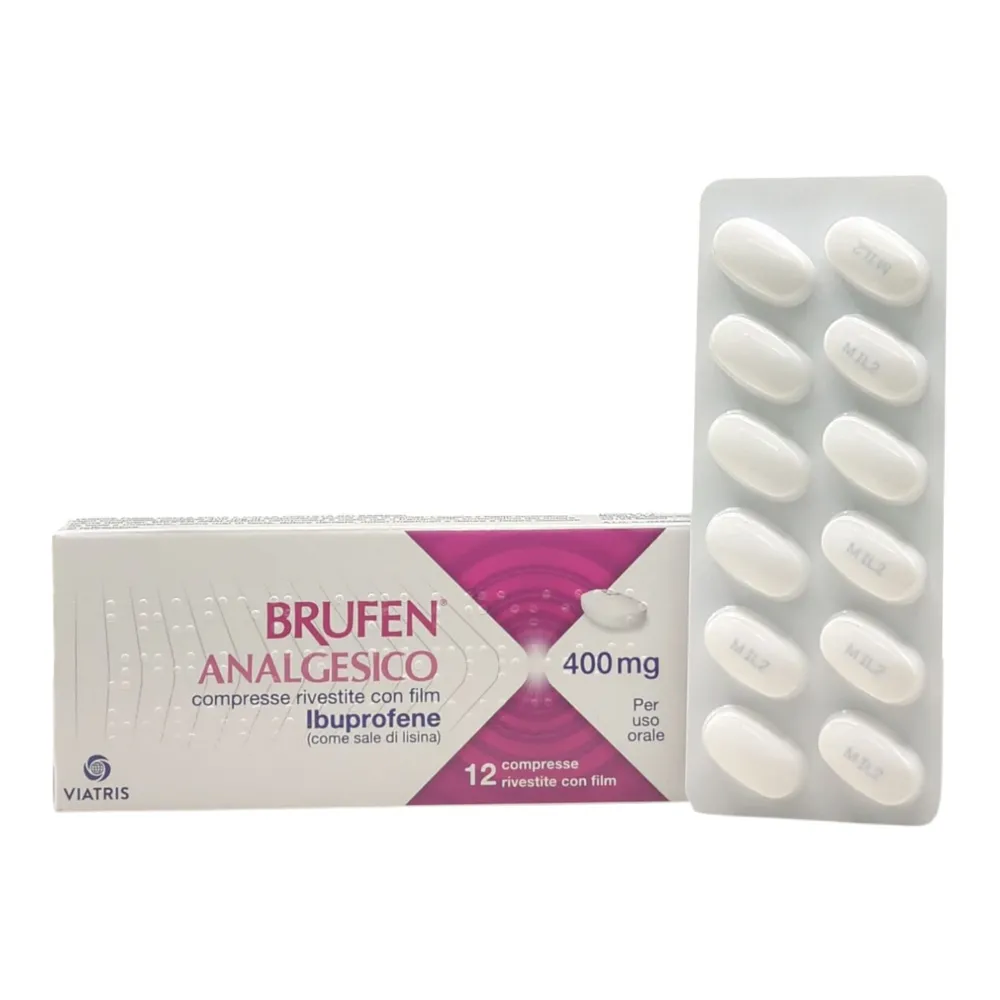
Table of Contents
- Package leaflet: Information for the user
- BRUFEN ANALGESIC 200 mg film-coated tablets, 400 mg film-coated tablets
- 1. What BRUFEN ANALGESIC is and what it is used for
- 2. What you should know before taking BRUFEN ANALGESIC
- 3. How to take BRUFEN ANALGESIC
- 4. Possible side effects
- 5. How to store BRUFEN ANALGESIC
- 6. Package contents and other information
Package leaflet: Information for the user
BRUFEN ANALGESIC 200 mg film-coated tablets, 400 mg film-coated tablets
ibuprofen (as lysine salt)
Please read all of this leaflet carefully before you take this medicine because it contains important information for you.
Always take this medicine exactly as described in this leaflet or as your doctor or pharmacist has told you to do.
- Keep this leaflet. You may need to read it again.
- If you need more advice or information, consult your pharmacist.
- If you experience any side effects, including those not listed in this leaflet, tell your doctor or pharmacist. See section 4.
- Consult your doctor if you do not notice any improvement or if your symptoms worsen after 3 days when treating fever, or after 4 days when treating pain.
Contents of this leaflet:
- What BRUFEN ANALGESIC is and what it is used for
- What you need to know before taking BRUFEN ANALGESIC
- How to take BRUFEN ANALGESIC
- Possible side effects
- How to store BRUFEN ANALGESIC
- Contents of the pack and other information
1. What BRUFEN ANALGESIC is and what it is used for
BRUFEN ANALGESIC contains the active substance ibuprofen. It belongs to a group of medicines known as non-steroidal anti-inflammatory drugs (NSAIDs). NSAIDs provide relief by altering the body's response to pain and fever.
BRUFEN ANALGESIC tablets are used for the symptomatic treatment of mild to moderate pain, such as headache, dental pain, menstrual pain, and pain and fever associated with the common cold.
2. What you should know before taking BRUFEN ANALGESIC
Do not take BRUFEN ANALGESIC:
- if you are allergic to ibuprofen or to any of the other ingredients of this medicine (listed in section 6)
- if you have experienced an allergic reaction such as asthma, difficulty breathing, swelling of the face, tongue or throat, hives, runny nose and itching, caused by acetylsalicylic acid (ASA) or other NSAIDs
- if you have (or have had two or more episodes of) stomach ulcer or gastrointestinal bleeding
- if you have had gastrointestinal perforation or bleeding while using NSAIDs
- if you suffer from cerebrovascular bleeding or other active bleeding
- if you suffer from blood disorders of unknown origin
- if you have severe dehydration (caused by vomiting, diarrhoea or insufficient fluid intake)
- if you suffer from severe liver, kidney or heart failure
- if you are in the last 3 months of pregnancy.
(200 mg only)
BRUFEN ANALGESIC is contraindicated in children under 6 years of age (less than 20 kg body weight).
(400 mg only)
BRUFEN ANALGESIC is contraindicated in adolescents under 40 kg body weight or in children under 12 years of age.
Warnings and precautions
Talk to your doctor or pharmacist before taking BRUFEN ANALGESIC:
- if you have recently undergone major surgery
- if you suffer from or have suffered from asthma or allergic diseases, as breathing difficulties may occur
- if you suffer from hay fever, nasal polyps or chronic obstructive pulmonary disease, because the risk of allergic reactions increases. Allergic reactions may present as asthma attacks (so-called analgesic-induced asthma), Quincke's oedema or urticaria
- if you suffer from heart problems
- if you have a history of gastrointestinal disorders (such as ulcerative colitis, Crohn's disease)
- if you suffer from systemic lupus erythematosus or mixed connective tissue disease (a disease affecting the skin, joints and kidneys)
- if you suffer from certain inherited blood disorders (e.g. acute intermittent porphyria)
- if you suffer from blood coagulation disorders
- if you are taking other NSAIDs. Concomitant use with other NSAIDs, including specific cyclo-oxygenase-2 inhibitors, increases the risk of adverse reactions (see section “Other medicines and BRUFEN ANALGESIC” below) and should be avoided
- if you have chickenpox, it is advisable to avoid using BRUFEN ANALGESIC
- if you are elderly
- if you have an infection – see section “Infections” below.
Patients with kidney or liver problems should consult a doctor before taking ibuprofen tablets.
Anti-inflammatory medicines such as ibuprofen may be associated with a small increased risk of heart attack (myocardial infarction) or stroke, particularly when administered at high doses. Do not exceed the recommended dose or duration of treatment (see section 3).
You should discuss treatment with your doctor or pharmacist before taking BRUFEN ANALGESIC if:
- you suffer from heart problems, including heart failure, angina (chest pain), or have a history of heart attack, bypass surgery, peripheral arterial disease (circulation problems in legs or feet due to narrowed or blocked arteries), or any type of stroke (including "mini-stroke" or transient ischaemic attack, "TIA")
- you suffer from hypertension, diabetes, high cholesterol, have a family history of heart disease or stroke, or are a smoker.
Skin reactions
Severe skin reactions have been reported in association with treatment with BRUFEN ANALGESIC.
Stop taking BRUFEN ANALGESIC and consult your doctor immediately if you develop rash, mucosal lesions, blisters or other signs of allergy, as these may be early signs of a very serious skin reaction. See section 4.
Infections
BRUFEN ANALGESIC may mask symptoms of infection such as fever and pain. Therefore, BRUFEN ANALGESIC may delay appropriate treatment of the infection, potentially increasing the risk of complications. This has been observed in bacterial pneumonia and bacterial skin infections associated with chickenpox. If you take this medicine while having an infection and infection symptoms persist or worsen, consult your doctor immediately.
Adverse effects can be minimized by using the lowest effective dose for the shortest possible time. Elderly patients have an increased risk of adverse effects.
In general, habitual use of analgesics (even of different types) may lead to serious and persistent kidney problems. This risk may increase during physical exercise associated with loss of salts and dehydration. Therefore, such use should be avoided. There is a risk of impaired kidney function in dehydrated children and adolescents.
Prolonged use of any type of analgesic for headache may worsen it. If this condition is present or suspected, medical advice should be sought and treatment discontinued. Medication-overuse headache should be suspected in patients who have headaches despite (or because of) regular use of headache medicines.
Regular monitoring of liver function, kidney function and blood cell counts is required during prolonged administration of BRUFEN ANALGESIC. Your doctor may require you to have blood tests during treatment.
Other medicines and BRUFEN ANALGESIC
What to avoid when taking this medicine?
BRUFEN ANALGESIC may affect or be affected by other medicines. For example:
- medicines with anticoagulant effect (i.e. substances that thin the blood to prevent clotting, e.g. acetylsalicylic acid, warfarin, ticlopidine),
- medicines that reduce hypertension (ACE inhibitors such as captopril, beta-blockers such as atenolol, angiotensin II receptor antagonists such as losartan)
Other medicines may also affect or be affected by treatment with BRUFEN ANALGESIC. Therefore, you should always consult your doctor or pharmacist before using BRUFEN ANALGESIC with other medicines.
Inform your doctor or pharmacist if you are taking, have recently taken or might take any other medicines. In particular, inform them if you are taking:
- Acetylsalicylic acid or other NSAIDs because this may increase the risk of ulcers (anti-inflammatory and analgesic agents) or gastrointestinal bleeding
- Digoxin (for heart failure) because the effect of digoxin may be increased
- Glucocorticoids (medicines containing cortisone or cortisone-like substances) because this may increase the risk of ulcers or gastrointestinal bleeding
- Antiplatelet agents because this may increase the risk of bleeding
- Acetylsalicylic acid (at low dose) because the blood-thinning effect may be compromised
- Medicines to thin the blood (such as warfarin) because ibuprofen may enhance the effects of these medicines
- Phenytoin (for epilepsy) because the effect of phenytoin may be increased
- Selective serotonin reuptake inhibitors (medicines used for depression) because they may increase the risk of gastrointestinal bleeding
- Lithium (a medicine for manic-depressive illness and depression) because the effect of lithium may be increased
- Probenecid and Sulfinpyrazone (medicines for treating gout) because excretion of ibuprofen may be delayed
- Medicines for hypertension and diuretics because ibuprofen may reduce the effects of these medicines and there may be an increased risk to the kidneys
- Potassium-sparing diuretics because this may lead to hyperkalaemia (elevated blood potassium levels)
- Methotrexate (a medicine for cancer and rheumatism) because the effect of methotrexate may be increased
- Tacrolimus and cyclosporine (immunosuppressive medicines) because kidney damage may occur
- Zidovudine (a medicine for treatment of HIV/AIDS) because use of ibuprofen may increase the risk of bleeding into a joint or bleeding causing swelling in HIV (+) haemophiliacs
- Sulfonylureas (antidiabetic medicines) interactions are possible
- Quinolone antibiotics because the risk of seizures may increase
- Mifepristone (a medicine prescribed to terminate pregnancy) because ibuprofen may reduce the effect of this medicine
- Bisphosphonates (medicines prescribed to treat osteoporosis) because these may increase the risk of gastrointestinal ulcers and bleeding
- Oxypentifylline (pentoxifylline) (a medicine prescribed to improve blood flow in arms and legs) because this may increase the risk of gastrointestinal bleeding
- Baclofen, a muscle relaxant because the toxicity of baclofen may increase
Low-dose acetylsalicylic acid (ASA)
Do not take this medicine if you are taking ASA at a dose exceeding 75 mg per day. If you are on low-dose ASA (up to 75 mg per day), discuss with your doctor or pharmacist before taking BRUFEN ANALGESIC.
BRUFEN ANALGESIC and alcohol
Alcohol consumption should be avoided during use of BRUFEN ANALGESIC as it may intensify possible adverse effects.
Pregnancy, breastfeeding and fertility
Do not take BRUFEN ANALGESIC during the last 3 months of pregnancy.
If you are in the first 6 months of pregnancy, suspect you may be pregnant, are planning a pregnancy, or are breastfeeding, consult your doctor or pharmacist before using this medicine.
BRUFEN ANALGESIC belongs to a group of medicines that may affect fertility in women. This effect is reversible after stopping treatment. It is unlikely that occasional use of BRUFEN ANALGESIC will affect the likelihood of becoming pregnant; however, inform your doctor before taking this medicine if you have difficulty becoming pregnant.
Driving and using machines
For short-term use at normal dosage, this medicine does not affect or affects negligibly the ability to drive or use machines. If adverse effects such as fatigue, dizziness, drowsiness or visual disturbances occur, you must not drive or use machines. Alcohol consumption increases the risk of such effects.
3. How to take BRUFEN ANALGESIC
Take this medicine exactly as described in this leaflet or as directed by your doctor or pharmacist. If you have any doubts, consult your doctor or pharmacist.
This product is intended only for short-term use. The lowest effective dose should be used for the shortest duration necessary to relieve symptoms. If you have an infection, contact your doctor immediately if symptoms (e.g. fever and pain) persist or worsen (see section 2).
Do not take BRUFEN ANALGESIC for more than 3 days for fever, or for more than 4 days for pain relief, unless otherwise advised by your doctor.
If symptoms persist or worsen, consult your doctor.
(200 mg only)
Adults and adolescents above 40 kg body weight (12 years of age or older)
The recommended dose is 200 mg to 400 mg (1 or 2 tablets) up to three times daily, as needed. Allow at least four hours between 200 mg doses (1 tablet) and at least six hours between 400 mg doses (2 tablets). Do not exceed 1200 mg (6 tablets) in 24 hours.
Use in children over 6 years (body weight 20 kg – 40 kg)
The recommended daily dose is 20 mg to 30 mg of ibuprofen per kg of body weight, divided into three or four separate doses, as shown in the table below. Allow at least six to eight hours between doses.
Body weight Single dose Maximum daily dose
20 kg – 29 kg One 200 mg tablet (equivalent to 200 mg ibuprofen) Three 200 mg tablets (equivalent to 600 mg ibuprofen)
30 kg – 39 kg One 200 mg tablet (equivalent to 200 mg ibuprofen) Four 200 mg tablets (equivalent to 800 mg ibuprofen)
If this medicine is required for more than 3 days in children over 6 years of age and adolescents, or if symptoms worsen, consult your doctor.
Use in children under 6 years (less than 20 kg body weight)
BRUFEN ANALGESIC is contraindicated for use in children under 6 years of age (less than 20 kg body weight).
(400 mg only)
Adults and adolescents above 40 kg body weight (12 years of age or older)
The recommended dose is 400 mg (1 tablet) up to three times daily, as needed. Allow at least six hours between 400 mg doses (1 tablet). Do not exceed 1200 mg (3 tablets) in 24 hours.
If this medicine is required for more than 3 days in adolescents over 12 years of age or if symptoms worsen, consult your doctor.
Use in adolescents weighing less than 40 kg or in children under 12 years of age
BRUFEN ANALGESIC is contraindicated for use in adolescents weighing less than 40 kg or in children under 12 years of age.
Method of administration
BRUFEN ANALGESIC tablets should be swallowed whole with plenty of water. Do not chew the tablets.
Patients with a sensitive stomach should take the tablets during a meal. Taking the tablets after a meal may delay the onset of pain or fever relief. Do not exceed the recommended dose or take the tablets more frequently than advised.
If you take more BRUFEN ANALGESIC than you should
If you have taken more BRUFEN ANALGESIC than recommended, or if a child has accidentally ingested this medicine, contact your doctor or go to the nearest hospital for advice on the risk and necessary actions.
Symptoms may include nausea, stomach ache, vomiting (which may contain blood), headache, tinnitus, confusion and abnormal eye movements. At high doses, drowsiness, chest pain, palpitations, loss of consciousness, seizures (especially in children), weakness, dizziness, blood in urine, feeling cold and breathing difficulties have been reported.
If you forget to take BRUFEN ANALGESIC
Simply follow the instructions above on how to take the medicine and do not take more than recommended.
Do not take a double dose to make up for a missed dose.
If you have any doubts about how to use this medicine, consult your doctor or pharmacist.
4. Possible side effects
Like all medicines, this medicine can cause side effects, although not everyone will experience them.
Side effects can be minimised by taking the lowest effective dose for the shortest duration needed to relieve symptoms. Elderly patients using this product have a higher risk of developing problems associated with side effects.
Medicines such as BRUFEN ANALGESIC may be associated with a small increased risk of heart attack (myocardial infarction) or stroke.
Some of the side effects listed below occur less frequently when the maximum daily dose is 1200 mg, compared to higher-dose therapy in rheumatic patients.
If you think you are experiencing any of the following side effects or symptoms, stop taking this
medicine and seek immediate medical help:
- Gastric or intestinal ulcers, sometimes with bleeding and perforation, vomiting blood or black, tarry stools (common: may affect up to 1 in 10 people)
- Kidney problems with blood in the urine, which may be associated with kidney failure (uncommon: may affect up to 1 in 100 people)
- Severe allergic reactions (very rare: may affect up to 1 in 10,000 people), such as:
- Unexplained shortness of breath or wheezing
- Dizziness or rapid heartbeat
- Drop in blood pressure causing shock
- Swelling of the face, tongue or throat
- Potentially life-threatening skin rashes, with formation of severe blisters and bleeding of the lips, eyes, mouth, nose and genitals (Stevens-Johnson syndrome), or severe skin reactions starting with painful red areas, followed by large blisters and eventually shedding of skin layers. This is accompanied by fever, chills, muscle pain and general malaise (toxic epidermal necrolysis) (very rare: may affect up to 1 in 10,000 people)
- Severe skin condition affecting the mouth and other body parts, with symptoms including red, often itchy patches resembling measles rash, starting on the limbs and sometimes on the face and rest of the body. The patches may swell or progress into raised, red spots with pale centres. Affected patients may have fever, sore throat, headache and/or diarrhoea (very rare: may affect up to 1 in 10,000 people)
- Severe peeling or shedding of the skin (very rare: may affect up to 1 in 10,000 people)
- A serious skin reaction known as DRESS syndrome may occur. DRESS syndrome includes: skin rash, fever, swollen lymph nodes and increased eosinophils (a type of blood cell) (frequency not known: cannot be estimated from available data)
- Inflammation of the pancreas with severe epigastric pain, often accompanied by nausea and vomiting (very rare: may affect up to 1 in 10,000 people)
- Nausea, vomiting, loss of appetite, general malaise, fever, itching, yellowing of the skin and eyes, pale stools, dark urine, which may indicate hepatitis or liver failure (very rare: may affect up to 1 in 10,000 people)
- Heart problems with shortness of breath and swelling of the feet or legs due to fluid retention (heart failure) (frequency not known: cannot be estimated from available data)
- Aseptic meningitis (infection around the brain or spinal cord, with symptoms including: fever, nausea, vomiting, headache, neck stiffness and extreme sensitivity to bright light, and mental confusion leading to disorientation) (very rare: may affect up to 1 in 10,000 people)
- Heart attack (myocardial infarction, very rare: may affect up to 1 in 10,000 people) or stroke (frequency not known: cannot be estimated from available data)
- Severe kidney damage (papillary necrosis, particularly with long-term use) (rare: may affect up to 1 in 1,000 people)
- Worsening of inflammation related to an infection (e.g. development of "flesh-eating bacteria" syndrome), particularly when using other NSAIDs (very rare: may affect up to 1 in 10,000 people)
Stop taking the medicine and inform your doctor if the following occur:
Very common: (may affect more than 1 in 10 people)
- Indigestion or heartburn
- Abdominal pain (stomach pain) or other stomach disturbances
Frequency not known (cannot be estimated from available data)
- Visual disturbances
- A widespread, red, scaly rash with pustules under the skin and blisters mainly in skin folds, trunk and upper limbs, accompanied by fever at the beginning of treatment (generalised exanthematous pustulosis). Stop using BRUFEN ANALGESIC if you develop these symptoms and contact your doctor immediately. See also section 2.
Inform your doctor if any of the following side effects occur:
Very common (may affect more than 1 in 10 people)
- Nausea, flatulence, diarrhoea, constipation, vomiting
Common (may affect up to 1 in 10 people)
- Headache, drowsiness, dizziness, sensation of spinning, fatigue, restlessness, inability to sleep, irritability
- Gastric and duodenal ulcers, sometimes with bleeding and perforation, occult blood loss which may lead to anaemia (a condition in which there is a reduction in red blood cells; symptoms include fatigue, headache, shortness of breath during physical activity, dizziness and paleness), black, tarry stools, vomiting blood, mouth ulcers and herpes, inflammation of the colon (symptoms include diarrhoea, usually with blood and mucus, stomach pain and fever), worsening of inflammatory bowel disease, inflammation of the intestinal wall
Uncommon (may affect up to 1 in 100 people)
- Urticaria, itching, unusual bleeding or bruising under the skin, skin rash, asthma attack (sometimes with hypotension)
- Runny or blocked nose, sneezing, facial pain or pressure, difficulty breathing
- Inflammation of the stomach (symptoms include: pain, nausea, vomiting, vomiting blood, blood in stools)
- Increased sensitivity of the skin to sunlight
- Swelling of the face, lips, mouth, tongue or throat, which may cause difficulty swallowing or breathing, sometimes with hypertension
- Fluid retention in body tissues, especially in patients with hypertension or kidney problems
Rare (may affect up to 1 in 1,000 people)
- A disease affecting the skin, joints and kidneys (lupus erythematosus syndrome)
- Depression, confusion, hallucinations, mental illness with strange or disturbing thoughts or mood
- Ringing, buzzing, hissing, sounds or other persistent noises in the ears (tinnitus)
- Increased blood urea nitrogen, transaminases and alkaline phosphatase, decreased haemoglobin and haematocrit values, inhibition of platelet aggregation, prolonged bleeding time, decreased serum calcium, increased serum uric acid, all observed in blood tests
- Loss of visual acuity
Very rare (may affect up to 1 in 10,000 people)
- Rapid or irregular heartbeat (palpitations)
- Increased fluid in body tissues
- Inflammation of the oesophagus, narrowing of the intestine
- Liver disorders, liver damage (especially with long-term use), liver failure, yellowing of the skin and/or eyes (jaundice)
- Severe skin infections with complications in soft tissues, which may occur if you have chickenpox
- Fluid accumulation in the lungs, symptoms include breathlessness, which can be very severe and usually worsens when lying down
Not known (frequency cannot be estimated from available data)
- Worsening of an inflammatory condition that may affect any part of the gastrointestinal tract (symptoms include pain, fever, diarrhoea and weight loss), worsening of inflammation of the colon (symptoms: diarrhoea, usually with blood and mucus, stomach pain, fever)
- High blood pressure
- Unusual hair loss or early baldness
- Menstrual disorders
Reporting of side effects
If you experience any side effect, including those not listed in this leaflet, talk to your doctor or pharmacist. You can also report side effects directly via the national reporting system at the following website: https://www.aifa.gov.it/content/segnalazioni-reazioni-avverse. By reporting side effects, you can help provide more information on the safety of this medicine.
5. How to store BRUFEN ANALGESIC
Keep this medicine out of the sight and reach of children.
Do not use this medicine after the expiry date which is stated on the blister, on the bottle, and on the
packaging after "Exp". The expiry date refers to the last day of that month.
This medicine does not require any special storage conditions.
Bottles: use within 60 days after opening. After opening, keep the bottle tightly closed.
Do not dispose of any medicine via wastewater or household waste. Ask your pharmacist how to
dispose of medicines you no longer use. This will help protect the environment.
6. Package contents and other information
What BRUFEN ANALGESIC contains
The active substance is ibuprofen (as lysine).
Each 200 mg tablet contains 200 mg of ibuprofen (as lysine).
Each 400 mg tablet contains 400 mg of ibuprofen (as lysine).
The other components (excipients) in a tablet are: microcrystalline cellulose, colloidal anhydrous silica, crospovidone, povidone, magnesium stearate, talc (E553b).
The tablet coating contains: hydrolysed polyvinyl alcohol, titanium dioxide (E171), macrogol (E1521), talc (E553b). The printing ink contains: shellac, black iron oxide (E172), ammonium hydroxide (E527).
Description of the appearance of BRUFEN ANALGESIC and contents of the pack
The 200 mg tablet is white to off-white, film-coated, round, biconvex, with bevelled edges, printed in black ink with "M" above "IL1" on one side of the tablet and plain on the other side.
The 400 mg tablet is white to off-white, film-coated, oval, biconvex, with bevelled edges, printed in black ink with "M" above "IL2" on one side of the tablet and plain on the other side.
BRUFEN ANALGESIC is available in blisters containing 2, 4, 6, 10, 12, 16, 20, 24, 30, 36, 48, 50, 100, 200 tablets and in bottles containing 48, 100, 200 tablets (dispensing pack). Each bottle also contains silica gel (desiccant) to help protect the tablets from moisture.
Not all pack sizes may be marketed.
Marketing Authorisation Holder
Mylan S.p.A.
Via Vittor Pisani, 20
20124 Milan, Italy
Manufacturers
McDermott Laboratories Limited T/A Gerard Laboratories, 35/36 Baldoyle Industrial Estate, Grange Road, Dublin 13, Ireland
Generics [UK] Ltd, Station Close, Potters Bar, Hertfordshire, EN6 1TL, United Kingdom
Mylan Hungary Kft., H-2900 Komarom, Mylan street 1, Hungary
This medicinal product is authorised in the European Economic Area Member States under the following names:
| Belgium | Ibuprofen Lysine Mylan Pharma 200 mg film-coated tablets Ibuprofen Lysine Mylan Pharma 400 mg film-coated tablets |
| Germany | Ibuprofen Mylan 400 mg Film-coated tablets |
| Ireland | Ibuprofen 200 mg film-coated tablets Ibuprofen 400 mg film-coated tablets |
| Italy | BRUFEN ANALGESIC |
| Luxembourg | Ibuprofen Lysine Mylan Pharma 200 mg film-coated tablets Ibuprofen Lysine Mylan Pharma 400 mg film-coated tablets |
| Poland | Myibuprofen Myibuprofen Forte |
| Netherlands (RMS) | Ibuprofen (as lysine) Mylan OTC 200 mg, film-coated tablets Ibuprofen (as lysine) Mylan OTC 400 mg, film-coated tablets |