Bronchitol
Italy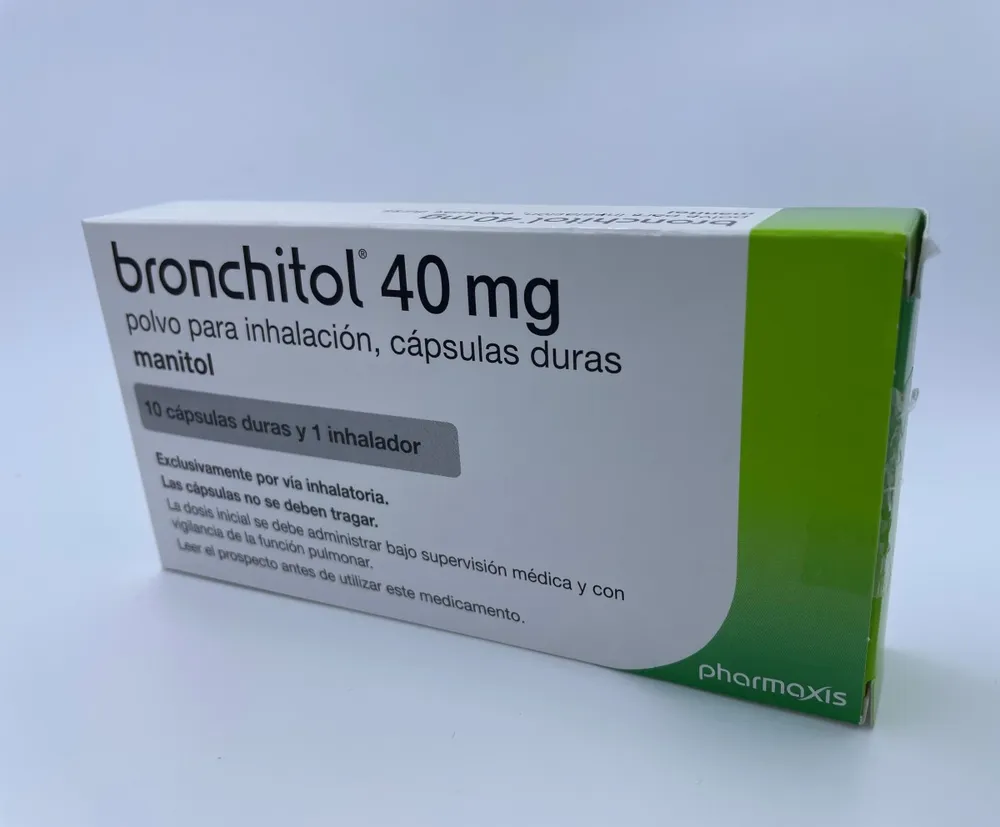
Table of Contents
- Patient Information Leaflet: Instructions for the User
- Bronchitol 40 mg inhalation powder, hard capsules
- 1. What Bronchitol is and what it is used for
- 2. What you should know before using Bronchitol
- 3. How to use Bronchitol
- 4. Possible side effects
- 5. How to store Bronchitol
- 6. Package contents and other information
- 1. Removal of the cap
- 2. Opening the inhaler
- 3. Inserting the capsule
- 4. Closing the inhaler
- 5. Piercing the capsule
- 6. Preparation for inhalation
- 7. Inhalation
- 8. Exhalation
- 9. Capsule check
- 10. Removal of the used capsule
- 11. Repeat steps 3 to 10 for each capsule.
Patient Information Leaflet: Instructions for the User
Bronchitol 40 mg inhalation powder, hard capsules
Mannitol
Please read this leaflet carefully before using this medicine because it contains important information for you.
- Keep this leaflet. You may need to read it again.
- If you have any questions, consult your doctor or pharmacist.
- This medicine has been prescribed for you only. Do not give it to other people, even if their symptoms are the same as yours, as it may be harmful.
- If you experience any side effects, including those not listed in this leaflet, contact your doctor or pharmacist. See section 4.
Contents of this leaflet:
- What Bronchitol is and what it is used for
- What you need to know before using Bronchitol
- How to use Bronchitol
- Possible side effects
- How to store Bronchitol
- Package contents and other information
1. What Bronchitol is and what it is used for
What Bronchitol is
Bronchitol contains a medicine called mannitol, which is a mucolytic substance.
What Bronchitol is used for
Bronchitol is indicated in adults aged 18 years and older. Bronchitol can be used alongside other medications that are part of the standard treatment for cystic fibrosis.
How Bronchitol works
Bronchitol is inhaled into the lungs in cases of cystic fibrosis, an inherited disease affecting the glands of the lungs, intestines, and pancreas that secrete fluids such as mucus and gastric juices.
Bronchitol helps increase the amount of water on the surface of the airways and within the mucus.
This facilitates the removal of mucus from the lungs. It also contributes to improving lung function and breathing. As a result, a productive cough occurs, which further aids in clearing mucus from the lungs.
2. What you should know before using Bronchitol
Do not use Bronchitol
- if you are allergic to mannitol
- if you are sensitive to mannitol. Before starting treatment with Bronchitol, your doctor will assess the sensitivity of your airways to mannitol. If you are hypersensitive to mannitol, your airways may narrow, causing breathing difficulties. If any of the above apply to you (or if you are unsure), consult your doctor or pharmacist before using this medicine.
Warnings and precautions
Talk to your doctor or pharmacist before using this medicine:
- if you have asthma;
- if you have coughing with bleeding or blood in your sputum;
- if you have severe cystic fibrosis, particularly if your lung function measured by forced expiratory volume in one second (FEV1) is usually less than 30%.
Inhaled medicines may cause chest tightness and difficulty breathing, which may occur immediately after taking Bronchitol. Your doctor will assist you when taking the first dose of Bronchitol and will monitor your lung function before, during, and after the dose. Your doctor may recommend that you use other medicines, such as a bronchodilator, before taking Bronchitol.
Like other inhaled medicines, Bronchitol may cause coughing. Consult your doctor if coughing persists or concerns you.
Children and adolescents
Bronchitol must not be used in children and adolescents under 18 years of age. This is because there is limited information available for this patient group.
Other medicines and Bronchitol
Inform your doctor or pharmacist if you are taking, have recently taken, or might take any other medicines.
You may continue using your cystic fibrosis medications during treatment with Bronchitol, including inhaled antibiotics such as tobramycin and colistimethate sodium. If you have any doubts, consult your doctor or pharmacist before using Bronchitol.
Pregnancy and breastfeeding
- If you are pregnant, suspect you may be pregnant, or are planning a pregnancy, ask your doctor for advice before using this medicine. Use of this medicine during pregnancy should be avoided.
- If you are breastfeeding or considering breastfeeding, ask your doctor for advice before using this medicine. It is not known whether this medicine passes into breast milk.
Driving and using machines
Bronchitol has no influence on the ability to drive vehicles or use tools or machinery.
3. How to use Bronchitol
Use this medicine exactly as instructed by your doctor. If you have any doubts, consult your
doctor or pharmacist.
Always take a bronchodilator before using Bronchitol.
Dosage
Adults from 18 years of age
Initial dose
Before being prescribed Bronchitol, your doctor will assist you in taking the first dose of Bronchitol and
will monitor your lung function at each step to rule out sensitivity to
mannitol. The first dose is taken in 4 steps:
Step 1 – 1 capsule (40 mg)
Step 2 – 2 capsules (80 mg)
Step 3 – 3 capsules (120 mg)
Step 4 – 4 capsules (160 mg)
At the end of the initial dosing, you will have taken 10 capsules (400 mg), which is the same amount as the normal dose.
Maintenance dose (2-week pack)
- You must take Bronchitol every day.
- The usual dose is 10 capsules (400 mg) inhaled in the morning and 10 capsules inhaled in the evening.
- Take the evening dose 2–3 hours before going to bed.
- To achieve optimal results, inhale each capsule one after the other with as little delay as possible between capsules.
Order of administration
Use Bronchitol as part of your regular daily treatment routine. The recommended order is as follows, unless your doctor advises otherwise:
- Use the bronchodilator;
- Wait 5–15 minutes;
- Use Bronchitol before physiotherapy, if physiotherapy is part of your treatment routine;
- Dornase alfa (Pulmozyme), if included in your treatment routine;
- Inhaled antibiotics, if part of your treatment routine.
How to use the medicine
- Bronchitol is administered by inhalation as a powder from the capsule using the inhaler provided in the pack. It is for inhalation only and must not be used in any other way. The capsules must not be swallowed.
- The powder contained in the capsules must be inhaled only using the inhaler supplied in the pack.
- Use a new inhaler every week.
- Each of the ten capsules must be inserted into the inhaler one at a time.
- Inhale the contents of each capsule using the inhaler, with one or two inhalations.
For instructions on how to use the inhaler, see the last section of this leaflet.
If you use more Bronchitol than you should
If you think you have used too much of this medicine, inform your doctor or
pharmacist immediately. You may:
- feel unable to breathe;
- have difficulty breathing;
- cough severely.
Your doctor may administer oxygen and medicines to help you breathe.
If you forget to use Bronchitol
- If you miss a dose, take it as soon as possible and then continue as usual. However, if it is almost time for your next dose, skip the missed dose.
- Do not use a double dose to make up for the missed dose.
If you stop using Bronchitol
If you stop taking Bronchitol, your symptoms may worsen. Do not stop using Bronchitol without first consulting your doctor, even if you feel better. Your doctor will advise you on how long to use this medicine.
If you have any doubts about how to use this medicine, consult your doctor or pharmacist.
4. Possible side effects
Like all medicines, this medicine can cause side effects, although not everyone gets them.
Stop using Bronchitol and contact your doctor immediately if you experience any of the following serious side effects:
- Breathing difficulties, which may be due to narrowing of the airways, worsening asthma symptoms, or wheezing. This is a frequent side effect and may affect up to 1 in 10 people.
- Coughing up blood or blood in the sputum. This is a frequent side effect.
Contact your doctor immediately if you notice any of the following side effects:
- Severe cough. This is a frequent side effect.
- Worsening of symptoms. This is a frequent side effect.
Other side effects include:
Common (may affect more than 1 in 10 people)
- Cough
- Chest discomfort
- Headache
- Pain in the back of the mouth and throat, and difficulty swallowing
- Vomiting, cough-induced vomiting
Uncommon (may affect up to 1 in 100 people)
- Burning or painful sensation on the tongue
- Cystic fibrosis-related diabetes
- Chest and abdominal pain
- Voice changes
- Cold sweats
- Congestion
- Dehydration
- Loss of appetite
- Diarrhoea
- Ear pain
- Feeling of fatigue
- Dizziness
- Malaise (nausea)
- Feeling unwell
- Influenza and fever
- Bloating
- Heartburn
- Pain due to hernia
- Hyperventilation
- Itching, skin rash, acne
- Stiffness and joint pain
- Morbid thoughts
- Mouth ulcers
- Respiratory tract infection
- Runny nose
- Infection in the sputum
- Sore throat
- Restless sleep
- Fungal infection in the mouth (thrush)
- Involuntary loss of urine
Reporting of side effects
If you get any side effects, including those not listed in this leaflet, talk to your doctor or pharmacist. You can also report side effects directly via the national reporting system listed in Annex V.
Reporting side effects can help provide more information on the safety of this medicine.
5. How to store Bronchitol
Keep this medicine out of the sight and reach of children.
Do not use this medicine after the expiry date which is stated on the carton and blister after
EXP. The expiry date refers to the last day of that month.
Store below 30°C.
Keep in the original packaging to protect the medicine from moisture.
Once a capsule has been removed from the blister, it should be used immediately.
Do not dispose of any medicine via wastewater or household waste. Ask your pharmacist how to
dispose of medicines you no longer use. This will help protect the environment.
6. Package contents and other information
What Bronchitol contains:
The active substance is mannitol. Each capsule contains 40 mg of mannitol. The average inhaled dose per
capsule is 32.2 milligrams of mannitol.
Description of the appearance of Bronchitol and package contents:
Bronchitol is an inhalation powder contained in hard capsules. Bronchitol 40 mg inhalation powder, hard capsules contain a white or almost white powder in transparent, colourless, hard capsules marked with “PXS 40 mg”. The powder is inhaled into the lungs using the inhaler provided in the pack.
A Bronchitol starter pack contains 1 blister with 10 capsules and 1 inhaler. The starter pack is intended for initial dose assessment by the physician.
A 2-week treatment pack contains 28 blisters with 10 capsules each (280 capsules in total) and 2 inhalers. The 2-week treatment pack is intended for maintenance therapy.
Marketing Authorization Holder
Pharmaxis Europe Limited, 108 Q House, Furze Road, Sandyford, Dublin 18, D18AY29, Ireland.
Manufacturer
MIAS Pharma Limited, Suite 1, Stafford House, Strand Road, Portmarnock, Co. Dublin, D13 WC83, Ireland.
For further information about this medicinal product, please contact the local representative of the Marketing Authorization Holder:
België/Belgique/Belgien Lietuva
Pharmaxis Europe Limited Pharmaxis Europe Limited
Tél/Tel: +353 (0) 1431 9816 Tél/Tel: +353 (0) 1431 9816
България Luxembourg/Luxemburg
Pharmaxis Europe Limited Pharmaxis Europe Limited
Teл.: +353(0)14319816 Tél/Tel: +353 (0) 1431 9816
Česká republika Magyarország
4 Life Pharma CZ, s.r.o. Pharmaxis Europe Limited
Tel: +420 244 403 003 Tel: +353 (0) 1431 9816
Danmark Malta
Pharmaxis Europe Limited Pharmaxis Europe Limited
Tlf: +353 (0) 1431 9816 Tel: +353 (0) 1431 9816
Deutschland Nederland
Pharmaxis Europe Limited Pharmaxis Europe Limited
Tel: +353 (0) 1431 9816 Tel: +353 (0) 1431 9816
Eesti Norge
Pharmaxis Europe Limited Pharmaxis Europe Limited
Tél/Tel: +353 (0) 1431 9816 Tlf: +353 (0) 1431 9816
Ελλάδα Österreich
Pharmaxis Europe Limited Pharmaxis Europe Limited
Τηλ: +353 (0) 1431 9816 Tel: +353 (0) 1431 9816
España Polska
Pharmaxis Europe Limited Pharmaxis Europe Limited
Tel: +353 (0) 1431 9816 Tel: +353 (0) 1431 9816
France Portugal
Pharmaxis Europe Limited Pharmaxis Europe Limited
Tél: +353 (0) 1431 9816 Tel: +353 (0) 1431 9816
Hrvatska România
Pharmaxis Europe Limited Pharmaxis Europe Limited
Tél/Tel: +353 (0) 1431 9816 Tel: +353 (0) 1431 9816
Ireland Slovenija
Pharmaxis Europe Limited Pharmaxis Europe Limited
Tel: +353 (0) 1431 9816 Tél/Tel: +353 (0) 1431 9816
Ísland Slovenská republika
Pharmaxis Europe Limited 4 Life Pharma SK, s.r.o.
Sími: +353 (0) 1431 9816 Tel: +420 244 403 003
Italia Suomi/Finland
Pharmaxis Europe Limited Pharmaxis Europe Limited
Tel: +353 (0) 1431 9816 Puh/Tel: +353 (0) 1431 9816
Κύπρος Sverige
Pharmaxis Europe Limited Pharmaxis Europe Limited
Τηλ: +353 (0) 1431 9816 Tel: +353 (0) 1431 9816
Latvija United Kingdom (Northern Ireland)
Pharmaxis Europe Limited Pharmaxis Europe Limited
Tél/Tel: +353 (0) 1431 9816 Tel: +353 (0) 1431 9816
Other sources of information
More detailed information on this medicinal product is available on the website of the European Medicines Agency: http://www.ema.europa.eu/. In addition, links to other websites on rare diseases and their therapeutic treatments are provided.
How to use the inhaler
Below is a diagram showing the appearance of the inhaler. Use Bronchitol capsules only with the inhaler provided in the pack.
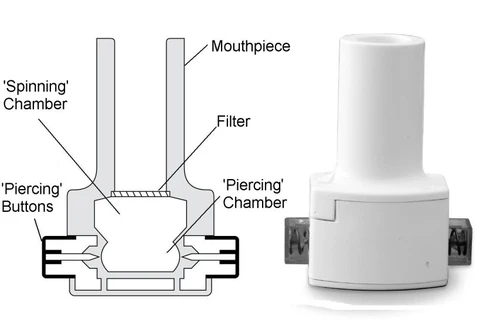
| Spinning Chamber | Spinning Chamber |
| Mouthpiece | Mouthpiece |
| Filter | Filter |
| Piercing Chamber | Piercing Chamber |
| Piercing Buttons | Piercing Buttons |
Inhalation device
The following steps explain how to use the inhaler. For further information on how to maintain
the inhaler, see the final part of these instructions.
1. Removal of the cap
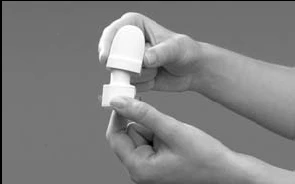
- Using both hands, hold the inhaler in an upright position and remove the cap.
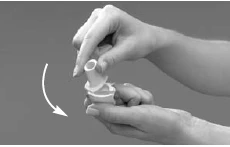
2. Opening the inhaler
- Hold the base of the inhaler steady with one hand.
- The inhaler must be held at the base to avoid pressing the 'piercing' buttons.
- Then open it by turning the mouthpiece in the direction of the arrow on the inhaler.
3. Inserting the capsule
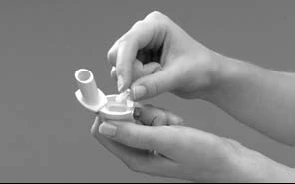
- Make sure your hands are dry.
- Then remove a capsule from the blister (only remove the capsule immediately before use).
- Insert the capsule into the designated space at the bottom of the inhaler.
4. Closing the inhaler
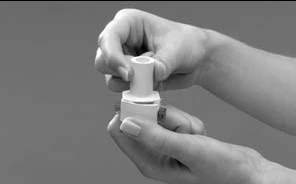
- Hold the inhaler in an upright position.
- Then rotate the mouthpiece to the closed position until you hear a 'click'.
5. Piercing the capsule
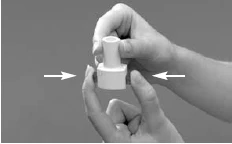
- This step allows the powder inside the capsule to be released when you inhale. In this leaflet, we refer to the perforation as "piercing".
- Hold the inhaler in an upright position and press both "piercing" buttons located on the sides of the inhaler fully inward at the same time, then release them. Perform this action only once. Piercing the capsule more than once may cause it to tear or break.
6. Preparation for inhalation

- Tilt the inhaler so that the mouthpiece is slightly pointing downwards.
- This allows the capsule to fall forward into the rotating chamber.
- Keep the inhaler in this tilted position and breathe out fully (away from the inhaler).
7. Inhalation
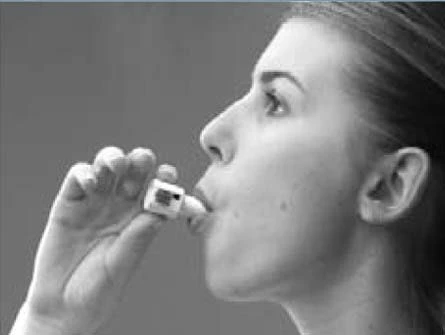
- Tilt the head slightly backward.
- With the inhaler pointed downward, place it in the mouth and firmly close the lips around the mouthpiece.
- Breathe in steadily and deeply to fill the lungs—then hold the breath for 5 seconds. While inhaling, a 'rattling' sound should be heard as the capsule rotates inside the inhaler. If this does not occur, the capsule may be blocked.
- If no rattling sound is heard, hold the inhaler with the mouthpiece facing downward and tap firmly on the base of the inhaler. Do not attempt to unblock the capsule by pressing the 'piercing' buttons again. Repeat inhalation to take the dose.
8. Exhalation
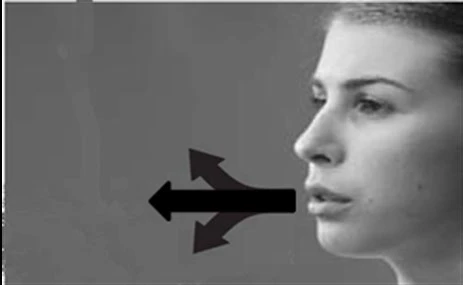
- Hold the inhaler away from your mouth.
- Exhale, then breathe normally.
9. Capsule check
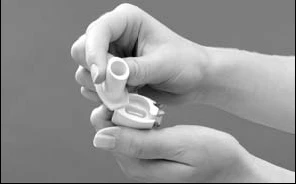
- Check that the capsule is empty – the capsule should rotate inside the inhaler to empty completely. If the capsule has not emptied, repeat steps 6 to 8.
10. Removal of the used capsule
- Turn the inhaler upside down, tap on the base, and remove the empty capsule.
11. Repeat steps 3 to 10 for each capsule.
- Perform these steps for each of the ten capsules.
- To achieve optimal results from taking Bronchitol, inhale the capsules one after the other.
Additional information on inhaler maintenance
- Keep the inhaler dry and always ensure your hands are dry before using it.
- Never breathe into or cough into the inhaler.
- Never leave the inhaler unattended.
- Never insert a capsule directly into the mouthpiece of the inhaler.
- Never leave a used capsule in the inhaler's capsule chamber.
- Use a new inhaler every week.
- If the inhaler breaks, use the spare inhaler and contact your doctor.
Cleaning the inhaler – The inhaler normally delivers the correct dose of medicine for 7 days
without requiring cleaning. However, if cleaning is needed, follow these steps:
- Ensure the inhaler is empty.
- Wash the inhaler with warm water with the mouthpiece open.
- Shake it to remove the larger water droplets inside the inhaler.
- Air-dry it – place it on its side with the mouthpiece open.
- It must dry completely, which may take up to 24 hours. Use the spare inhaler while it is drying.
Annex IV
Scientific conclusions and grounds for the variation of the terms
of the marketing authorisation(s)
Scientific conclusions
Taking into account the PRAC assessment report on the Periodic Safety Update Reports (PSURs) for mannitol (indicated in cystic fibrosis), the PRAC's scientific conclusions are as follows:
In light of the available data on the risk of bronchospasm, haemoptysis and cough-related sequelae, and considering the knowledge acquired over the past decade on the safety profile of mannitol (indicated in cystic fibrosis), and given that the information contained in the additional risk minimisation measures (aRMM) is already reflected in the SmPC, the PRAC considered that the aRMM can be removed from Annex II.D. The PRAC concluded that the terms of the marketing authorisations for medicinal products containing mannitol (indicated in cystic fibrosis) should be amended accordingly.
Following review of the PRAC recommendation, the CHMP agrees with the overall conclusions and reasoning of the PRAC.
Grounds for the variation of the terms of the marketing authorisation(s)
Based on the scientific conclusions regarding mannitol (indicated in cystic fibrosis), the CHMP considers that the benefit-risk balance of the medicinal product(s) containing mannitol (indicated in cystic fibrosis) remains favourable, subject to the proposed changes to the product information.
The CHMP recommends that the terms of the marketing authorisation(s) be varied.