Bromazepam ABC
Italy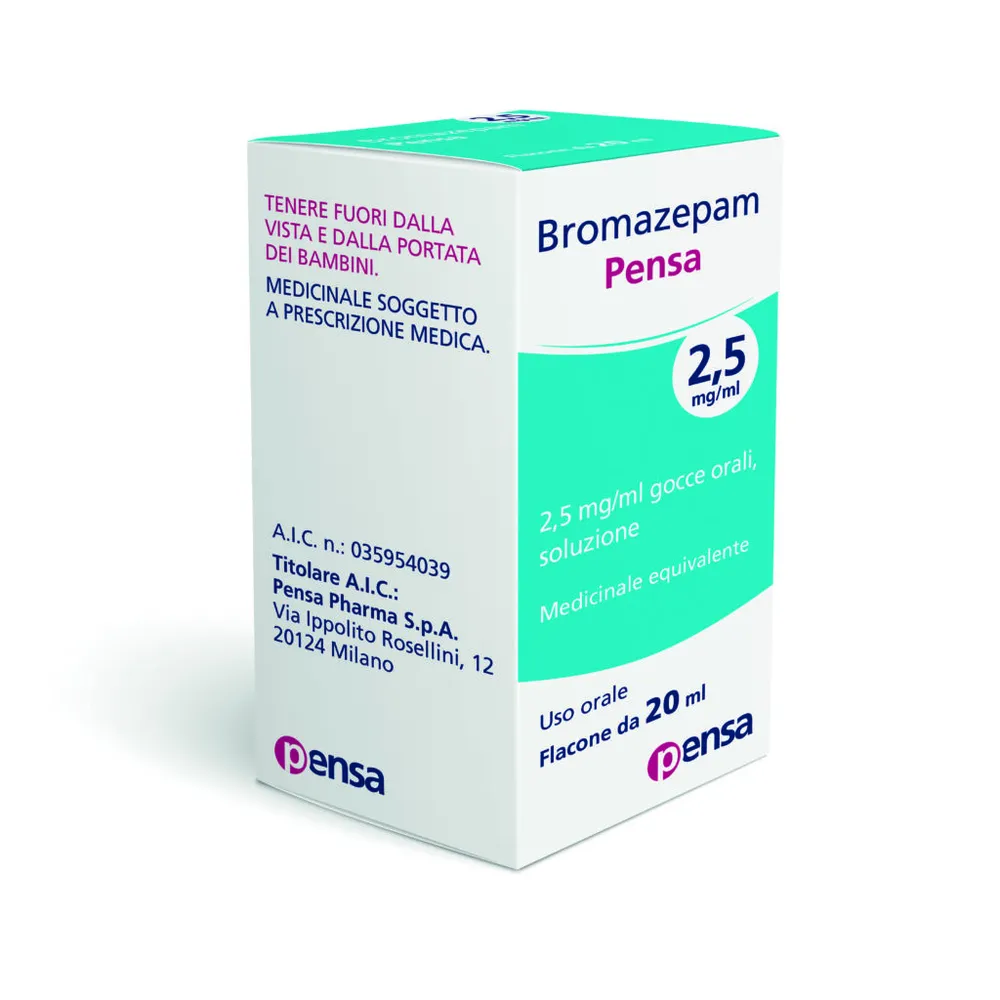
Table of Contents
- PACKAGE LEAFLET: INFORMATION FOR THE PATIENT
- BROMAZEPAM ABC 2.5 mg/ml oral drops, solution
- 1. What BROMAZEPAMD ABC is and what it is used for
- 2. What you need to know before taking BROMAZEPAM ABC
- 3. How to take BROMAZEPAM ABC
- 4. Possible side effects
- 5. How to store BROMAZEPAM ABC
- 6. Package contents and other information
PACKAGE LEAFLET: INFORMATION FOR THE PATIENT
BROMAZEPAM ABC 2.5 mg/ml oral drops, solution
Bromazepam
Generic Medicine
Please read this leaflet carefully before taking this medicine because it contains important information for you.
- Keep this leaflet. You may need to read it again.
- If you have any questions, ask your doctor or pharmacist.
- This medicine has been prescribed for you only. Do not give it to others, even if their symptoms are the same as yours, because it could be harmful.
- If you experience any side effects, including those not listed in this leaflet, contact your doctor or pharmacist. See section 4.
Contents of this leaflet:
- What BROMAZEPAM ABC is and what it is used for
- What you need to know before taking BROMAZEPAM ABC
- How to take BROMAZEPAM ABC
- Possible side effects
- How to store BROMAZEPAM ABC
- Contents of the pack and other information
1. What BROMAZEPAMD ABC is and what it is used for
BROMAZEPAM ABC contains the active substance bromazepam, which belongs to a class of medicines called "benzodiazepines".
BROMAZEPAM ABC is used in adults to treat the following conditions:
- Anxiety, emotional tension and other symptoms associated with anxiety;
- Insomnia; only when it is severe, disabling and causes severe distress in normal daily life.
Contact your doctor if you do not feel better or if you feel worse.
2. What you need to know before taking BROMAZEPAM ABC
Do not take BROMAZEPAM ABC
- if you are allergic to bromazepam or to any of the other ingredients of this medicine (listed in section 6);
- if you are allergic to benzodiazepines (a class of medicines to which bromazepam belongs);
- if you suffer from severe myasthenia gravis (a serious disease affecting the muscles, causing weakness and fatigue);
- if you suffer from severe respiratory insufficiency (severe reduction in respiratory system function);
- if you suffer from severe liver problems (severe hepatic insufficiency);
- if you suffer from sleep apnoea syndrome (temporary cessation of breathing during sleep);
- if you suffer from narrow-angle glaucoma (an eye disease caused by increased pressure of the fluid inside the eye);
- if you are consuming excessive amounts of alcohol (acute alcohol intoxication);
- if you are taking excessive amounts of medicines:
- hypnotics (medicines that are calming and promote sleep);
- analgesics (medicines used to treat acute or chronic pain of high intensity);
- psychotropics (medicines used for mental disorders and/or depression).
Warnings and precautions
Talk to your doctor or pharmacist before taking BROMAZEPAM ABC.
- In particular, consult your doctor or pharmacist before taking BROMAZEPAM ABC if you think any of the following conditions apply to you: you suffer from depression or anxiety associated with depression, because BROMAZEPAM ABC may worsen your condition and may lead to suicidal thoughts (attempting to kill yourself);
- you have previously had problems with drug or alcohol abuse;
- you are dependent on alcohol or use opioids (medicines used for pain relief);
- you have previously experienced a severe allergic reaction after taking a benzodiazepine (anaphylactic/anaphylactoid reaction);
- you suffer from chronic respiratory insufficiency (reduced respiratory system function);
- you suffer from renal insufficiency (reduced kidney function);
- you suffer from severe hepatic insufficiency (severe reduction in liver function);
- you suffer from cardiac insufficiency (reduced heart function);
- you suffer from low blood pressure;
- you suffer from a mental disorder causing altered perception of reality, thought disturbances, or mental confusion (psychosis).
Development of tolerance
After repeated use of this medicine for several weeks, its effectiveness may decrease (tolerance).
Development of dependence
Using high doses and/or prolonged use of bromazepam may lead to physical and psychological dependence.
This risk is higher if you have previously abused medicines, drugs, or alcohol.
The risk of dependence is reduced if you take BROMAZEPAM ABC at the appropriate dose, as prescribed by your doctor, and for the shortest possible duration (see section 3 “How to take BROMAZEPAM ABC”).
If you are elderly
If you are elderly, take BROMAZEPAM ABC with caution and under medical supervision.
This medicine may increase the risk of falls and fractures due to side effects such as ataxia (reduced motor coordination and gait), muscle weakness, dizziness, drowsiness, fatigue, and tiredness.
Children and adolescents
Benzodiazepines must not be administered to patients under 18 years of age. They may be administered under direct medical supervision only if strictly necessary, and the treatment duration should be as short as possible.
Other medicines and BROMAZEPAM ABC
Inform your doctor or pharmacist if you are taking, have recently taken, or might take any other medicines.
Inform your doctor or pharmacist if you are taking any of the following medicines:
- medicines used for certain mental illnesses (antipsychotics/neuroleptics);
- calming and sleep-inducing medicines (hypnotics);
- medicines causing physical and mental drowsiness (anxiolytics/sedatives);
- medicines used to treat depression (antidepressants, such as fluvoxamine);
- medicines used to treat severe acute or chronic pain (narcotic analgesics);
- medicines used to treat epilepsy (antiepileptics);
- anaesthetics;
- medicines used to treat allergic reactions (sedating antihistamines);
- medicines used for cough (antitussive opioids);
- cimetidine (a medicine used for stomach ulcers);
- theophyllines or aminophyllines (medicines used for bronchial asthma);
- antifungals (medicines used for fungal infections), protease inhibitors (medicines used in HIV therapy), macrolides (a type of antibiotic);
- propranolol (a medicine used to treat various heart conditions).
The concomitant use of BROMAZEPAM ABC and opioids (strong analgesics, medicines used in addiction therapy, and some cough medicines) increases the risk of drowsiness, breathing difficulties (respiratory depression), coma, and may be life-threatening. Therefore, concomitant use should only be considered when no other treatment options are available.
However, if your doctor prescribes BROMAZEPAM ABC together with opioids, the dose and duration of concomitant treatment must be limited by your doctor.
Inform your doctor about all opioid medicines you are taking and carefully follow your doctor’s dosage recommendations. It may be helpful to inform friends or family members to watch for the symptoms listed above.
Contact your doctor if you experience any of these symptoms.
BROMAZEPAM ABC and alcohol
Do not drink alcohol while taking BROMAZEPAM ABC, as the sedative effect may be increased.
Consuming alcohol with BROMAZEPAM ABC may impair your ability to drive or operate machinery (see section “Driving and use of machines”).
Pregnancy and breastfeeding
If you are pregnant, think you may be pregnant, planning to become pregnant, or breastfeeding, consult your doctor or pharmacist before taking this medicine.
Pregnancy
The safety of using bromazepam during pregnancy has not yet been established. Treatment with benzodiazepines at high doses during the second and/or third trimester of pregnancy may cause reduced fetal movements and changes in fetal heart rate.
- If you plan to become pregnant and are currently being treated with BROMAZEPAM ABC, contact your doctor immediately. Your doctor will advise you on how to gradually discontinue this medicine.
- If, for serious medical reasons, the product is administered during the late stages of pregnancy or during labour at low doses, the newborn may develop the “floppy infant syndrome,” characterized by axial hypotonia (loss of muscle tone) and sucking difficulties, leading to poor weight gain. These symptoms are reversible but may last from 1 to 3 weeks, depending on the product’s half-life. At high doses, respiratory depression or apnoea and hypothermia may occur in newborns. Furthermore, newborns born to mothers who have chronically taken benzodiazepines during the later stages of pregnancy may develop physical dependence and may be at risk of experiencing withdrawal symptoms in the postnatal period, such as hyperexcitability, agitation, and tremors—even several days after birth and in the absence of the “floppy infant syndrome.”
Breastfeeding
Do not take BROMAZEPAM ABC if you are breastfeeding, as BROMAZEPAM ABC passes into breast milk.
Driving and use of machines
Do not drive or operate machinery if, during treatment with BROMAZEPAM ABC, you experience side effects such as sedation (physical and mental relaxation), amnesia (memory disturbances), impaired concentration, or impaired muscle function. These effects may worsen if you consume alcohol together with BROMAZEPAM ABC (see section “BROMAZEPAM ABC and alcohol”).
Your alertness may be impaired, especially if your sleep duration was insufficient after taking BROMAZEPAM ABC.
BROMAZEPAM ABC contains sodium
BROMAZEPAM ABC contains less than 1 mmol (23 mg) of sodium per 3 mg dose (equivalent to 30 drops of oral solution), i.e., essentially ‘sodium-free’.
BROMAZEPAM ABC contains propylene glycol
This medicine contains 1180 mg of propylene glycol per 3 mg dose (equivalent to 30 drops of oral solution), equivalent to 983 mg/ml.
If the child is less than 4 weeks old, speak with your doctor or pharmacist before administering this medicine, especially if the child is taking other medicines containing propylene glycol or alcohol.
If the child is under 5 years of age, speak with your doctor or pharmacist before administering this medicine, especially if the child is taking other medicines containing propylene glycol or alcohol.
If you are pregnant or breastfeeding, do not take this medicine unless otherwise recommended by your doctor. Your doctor may perform additional monitoring during treatment.
If you suffer from liver or kidney disease, do not take this medicine unless otherwise recommended by your doctor. Your doctor may perform additional monitoring during treatment. If you suffer from liver or kidney disease, do not take this medicine unless otherwise recommended by your doctor. Your doctor may perform additional monitoring during treatment.
3. How to take BROMAZEPAM ABC
Take this medicine exactly as directed by your doctor or pharmacist. If you have
any doubts, consult your doctor or pharmacist.
Adults
Your doctor will determine the most appropriate dose and frequency for you in order to avoid taking an excessive
dose of this medicine.
The recommended dose ranges from 1.5 mg (15 drops) to 3 mg (30 drops), 2–3 times daily.
If you are elderly or have liver problems, your doctor will assess whether to prescribe lower doses than those
indicated above.
Duration of treatment
Your doctor will prescribe the shortest possible duration of treatment.
Depending on the condition for which your doctor has prescribed this medicine, the duration of treatment is as follows:
- Anxiety: treatment duration should not exceed 8–12 weeks, including a period of gradual withdrawal
- Insomnia: treatment duration varies from a few days to 2 weeks, up to a maximum of 4 weeks, including a period of gradual withdrawal. In certain cases, after re-evaluating your health status, your doctor may decide to extend the treatment duration indicated above. During the period of discontinuation of BROMAZEPAM ABC treatment, your doctor will explain how to gradually reduce the dose of this medicine in order to reduce the risk of withdrawal and rebound symptoms (see sections “If you stop taking BROMAZEPAM ABC” and “Possible side effects”).
If you take more BROMAZEPAM ABC than you should
In case of accidental ingestion/overdose of BROMAZEPAM ABC, contact your doctor immediately or go to the nearest hospital.
Symptoms
Benzodiazepines commonly cause drowsiness, ataxia (reduced motor coordination and gait), dysarthria (speech disorder), and nystagmus (oscillating, rhythmic, involuntary eye movements).
Overdose with bromazepam rarely poses a life-threatening risk if the drug is taken alone, but may lead to dysarthia (slow and slurred speech), areflexia (absence of reflexes), apnea (absence of breathing), hypotension (low blood pressure), cardiorespiratory depression (reduced heart and lung activity), and coma (loss of consciousness).
In mild cases, symptoms following accidental overdose of BROMAZEPAM ABC may include:
- drowsiness;
- confusion;
- lethargy (continuous sleep and reduced response to normal stimuli).
In more severe cases, symptoms may include:
- ataxia (reduced motor coordination and gait);
- hypotonia (reduced muscle tone);
- hypotension (low blood pressure);
- respiratory depression (reduced breathing);
- coma (loss of consciousness);
- death.
If you forget to take BROMAZEPAM ABC
Do not take a double dose to make up for a forgotten dose.
If you stop taking BROMAZEPAM ABC
- Do not stop treatment with BROMAZEPAM ABC without first consulting your doctor.
- Your doctor will gradually reduce your dose during the discontinuation phase.
- Sudden discontinuation of this medicine may cause:
- Withdrawal symptoms: headache, diarrhoea, muscle pain, extreme anxiety, tension, restlessness, confusion, and irritability
- Severe withdrawal symptoms: depersonalization (feeling detached or estranged from oneself), derealization (distorted perception of the external world), hyperacusis (increased sensitivity to sound), numbness and tingling in the extremities (hands and feet), hypersensitivity to light, noise, and physical contact, hallucinations (perception of non-existent things), epileptic seizures
- Other withdrawal symptoms: depression, insomnia, sweating, persistent tinnitus (ringing in the ears), involuntary movements, vomiting, paraesthesia (tingling sensation), perceptual disturbances (altered perceptions), abdominal and muscle cramps, tremor, myalgia (muscle pain), agitation, palpitations (awareness of heart beating), tachycardia (increased heart rate), panic attacks, dizziness, hyperreflexia (exaggerated reflexes), short-term memory loss (inability to recall recent events), hyperthermia (increased body temperature)
- Rebound symptoms (when symptoms that led to treatment with bromazepam reappear in a more severe form after stopping treatment), such as mood changes, anxiety, restlessness, or sleep disturbances. These symptoms are especially likely if you have developed physical dependence on this medicine (see section “Warnings and precautions”). If you have any doubts about using this medicine, consult your doctor or pharmacist.
4. Possible side effects
Like all medicines, this medicine can cause side effects, although not everyone gets them.
Contact your doctor immediately if, during treatment with BROMAZEPAM, you experience any of the following serious side effects; your doctor will explain how to discontinue the medicine:
- depression
- restlessness
- agitation
- irritability
- aggressiveness
- distorted perception of reality (delusions)
- anger
- nightmares
- perception of non-existent things (hallucinations)
- behavioural changes
- psychosis (mental disorder causing altered perception of reality, thought disturbances, mental confusion). These reactions may be more frequent in elderly patients.
In addition, the following side effects may occur with unknown frequency (frequency cannot be determined from the available data):
- confusion
- emotional disturbances, altered libido (sexual desire)
- dependence
- medicine abuse
- withdrawal syndrome
- long-term memory disturbances (anterograde amnesia)
- memory disturbances
- drowsiness
- headache (cephalalgia)
- dizziness
- reduced alertness
- ataxia (reduced motor coordination and gait)
- blurred vision
- diplopia (double vision)
- nausea
- vomiting
- constipation
- skin rash
- pruritus (itching)
- urticaria (hives)
- muscle weakness
- urinary retention
- fatigue
- falls
- fractures
- respiratory depression (reduced respiratory activity)
- apnoea (temporary cessation of breathing)
- worsening of sleep apnoea
- cardiac failure (reduced heart function), including cardiac arrest
- allergic reaction (hypersensitivity)
- severe allergic reaction (anaphylactic shock)
- swelling, sometimes of the face or mouth (angioedema), causing breathing difficulties (angioedema)
- jaundice (yellow/yellowish discoloration of the skin, mucous membranes, and whites of the eyes)
- changes in certain blood tests (increased bilirubin, transaminases, and alkaline phosphatase)
- thrombocytopenia (reduced platelet count)
- agranulocytosis (reduced number of granulocytes, a type of white blood cell)
- pancytopenia (reduced count of all blood cells)
- syndrome of inappropriate antidiuretic hormone (ADH) secretion, causing water retention in the body and reduced sodium levels in the blood
Other side effects reported with other medicines belonging to the benzodiazepine class, such as BROMAZEPAM ABC:
- memory disturbances (amnesia and anterograde amnesia)
- behavioural changes
- depression
- restlessness
- agitation
- irritability
- aggressiveness
- delirium
- anger
- nightmares
- hallucinations
- psychosis
- insomnia
- rebound anxiety (occurring after discontinuation of the medicine)
- dependence
Reporting of side effects
If you experience any side effect, including those not listed in this leaflet, talk to your doctor or pharmacist. You can also report side effects directly via the website:
https://www.aifa.gov.it/content/segnalazioni-reazioni-avverse . By reporting side effects, you can help provide more information on the safety of this medicine.
5. How to store BROMAZEPAM ABC
Keep this medicine out of the sight and reach of children.
Do not use this medicine after the expiry date which is stated on the packaging after "Exp.".
The expiry date refers to the last day of that month.
The expiry date applies to the product in its original, unopened packaging, stored correctly.
This medicine does not require any special storage conditions.
This medicine should be used within 9 months after first opening the bottle.
Any excess product must be discarded.
Do not dispose of any medicine via wastewater or household waste. Ask your pharmacist how to dispose of medicines you no longer use. This will help protect the environment.
6. Package contents and other information
What BROMAZEPAM ABC contains
The active substance is bromazepam. 1 ml of solution contains 2.5 mg of bromazepam.
The other components are: sodium saccharin, disodium edetate (sequestrene Na2), mixed fruit flavors, purified water, propylene glycol.
Description of the appearance of BROMAZEPAM ABC and contents of the pack
Pack containing 1 bottle of 20 ml or 30 ml of solution.
Marketing Authorization Holder
ABC Farmaceutici S.P.A. - Corso Vittorio Emanuele II, n. 72 - 10121 Turin
Manufacturer
ABC Farmaceutici S.p.A. - Canton Moretti, 29, 10090 San Bernardo d’Ivrea (TO)