Beyfortus
Italy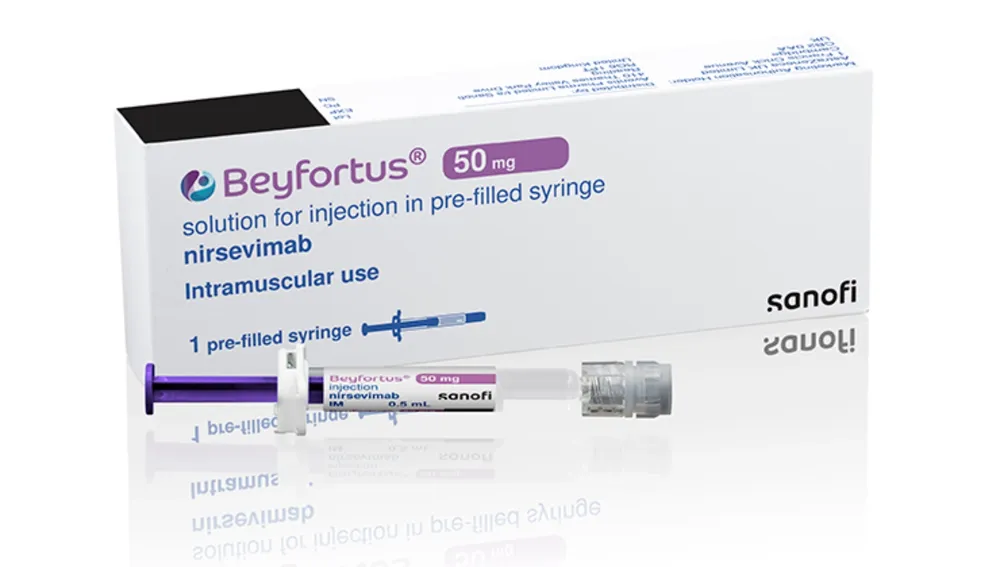
Table of Contents
- Package leaflet: Information for the user
- Beyfortus 50 mg solution for injection in pre-filled syringe, 100 mg solution for injection in pre-filled syringe
- 1. What Beyfortus is and what it is used for
- 2. What you should know before your child uses Beyfortus
- 3. How and when Beyfortus is administered
- 4. Possible side effects
- 5. How to store Beyfortus
- 6. Package contents and other information
- The following information is intended exclusively for healthcare professionals:
Package leaflet: Information for the user
Beyfortus 50 mg solution for injection in pre-filled syringe, 100 mg solution for injection in pre-filled syringe
nirsevimab
▼Medicinal product subject to additional monitoring. This will allow rapid identification of
new safety information. You can help by reporting any side effects you observe in your child
while he/she is receiving this medicine. See the end of section 4 for information on how to report
side effects.
Please read this leaflet carefully before giving this medicine to your child as it contains
important information for you and your child.
- Keep this leaflet. You may need to read it again.
- If you have any questions, ask your doctor, pharmacist or nurse.
- If your child experiences any side effects, including those not listed in this leaflet, contact your doctor, pharmacist or nurse. See section 4.
Contents of this leaflet
- What Beyfortus is and what it is used for
- What you need to know before your child uses Beyfortus
- How and when Beyfortus is given
- Possible side effects
- How to store Beyfortus
- Contents of the pack and other information
1. What Beyfortus is and what it is used for
What Beyfortus is
Beyfortus is a medicine given as an injection to protect infants and children under 2 years of age from respiratory syncytial virus (RSV). RSV is a common respiratory virus that usually causes mild symptoms similar to those of a common cold. However, especially in infants, vulnerable children, and older adults, RSV can cause serious diseases, including bronchiolitis (inflammation of the small airways in the lung) and pneumonia (lung infection), which may lead to hospitalization or even death. The virus is usually more common during winter.
Beyfortus contains the active substance nirsevimab, an antibody (a protein designed to bind to a specific target) that attaches to a protein required by RSV to infect the body. By binding to this protein, Beyfortus blocks its action, preventing the virus from entering and infecting human cells.
What Beyfortus is used for
Beyfortus is a medicine that protects the child against RSV disease.
2. What you should know before your child uses Beyfortus
Your child must not use Beyfortus if he or she is allergic to nirsevimab or to any of the other
components of this medicine (listed in section 6).
Inform your child’s doctor, pharmacist, or nurse if this applies to your child. If
you are unsure, check with your child’s doctor, pharmacist, or nurse before the
medicine is administered.
If your child shows signs of a severe allergic reaction, contact a doctor immediately.
Warnings and precautions
Contact a doctor immediately or seek immediate medical help if you notice any
signs of an allergic reaction, such as:
- difficulty breathing or swallowing,
- swelling of the face, lips, tongue, or throat,
- severe skin itching, with a red rash or raised bumps.
Talk to the doctor before your child is given Beyfortus if your child has a
low platelet count (which help blood to clot), has bleeding problems, experiences frequent bruising, or is taking an anticoagulant (a medicine to prevent blood clots).
In certain chronic health conditions where excessive proteins are lost through urine or the intestine, such as nephrotic syndrome and chronic liver disease, the level of protection provided by Beyfortus may be reduced.
Beyfortus contains 0.1 mg of polysorbate 80 in each 50 mg (0.5 mL) dose and 0.2 mg in each 100 mg (1 mL) dose. Polysorbates may cause allergic reactions. Inform the doctor if your child has known allergies.
Children and adolescents
Do not administer this medicine to children aged between 2 and 18 years, as it has not been studied in this age group.
Other medicines and Beyfortus
No interactions between Beyfortus and other medicines are known. However, inform the doctor,
pharmacist, or nurse if your child is taking, has recently taken, or might take any other medicines.
Beyfortus may be administered simultaneously with vaccines included in the national immunization programme.
3. How and when Beyfortus is administered
Beyfortus is administered by a healthcare professional as an injection into the muscle. It is usually
injected into the outer part of the thigh.
The recommended dose is:
- 50 mg for children weighing less than 5 kg and 100 mg for children weighing 5 kg or more during their first RSV season.
- 200 mg for children who remain vulnerable to severe RSV disease during their second RSV season (administered as two 100 mg injections at separate sites).
Beyfortus should be given before the RSV season. The virus is usually most common during winter (known as RSV season). If your child was born during winter, Beyfortus should be administered after birth.
If your child is undergoing heart surgery (cardiac surgical procedure), they may be given an additional dose of Beyfortus after the surgery to ensure adequate protection for the remainder of the RSV season.
If you have any doubts about the use of this medicine, consult your doctor, pharmacist, or nurse.
4. Possible side effects
Like all medicines, this medicine can cause side effects, although not everybody gets them.
Possible side effects include:
Uncommon (may occur in up to 1 in 100 children)
- rash
- injection site reaction (i.e. redness, swelling and pain at the site where the injection is given)
- fever
Not known (frequency cannot be estimated from the available data)
- allergic reactions
Reporting of side effects
If your child experiences any side effect, including those not listed in this leaflet, consult your doctor, pharmacist or nurse. You can also report side effects directly through the national reporting system listed in Annex V. By reporting side effects, you can help provide more information on the safety of this medicine.
5. How to store Beyfortus
The doctor, pharmacist, or nurse is responsible for the storage of this medicine and for the proper disposal of unused product. The following information is intended for healthcare professionals.
Keep this medicine out of the sight and reach of children.
Do not use this medicine after the expiry date stated on the carton after "Exp.". The expiry date refers to the last day of that month.
Store in a refrigerator (2°C – 8°C). After removal from the refrigerator, Beyfortus must be protected from light and used within 8 hours or discarded.
Keep the pre-filled syringe in the outer packaging to protect the medicine from light.
Do not freeze, shake, or expose to direct heat.
Any unused medicine and waste material arising from this medicine must be disposed of in accordance with local regulations.
6. Package contents and other information
What Beyfortus contains
- The active substance is nirsevimab.
- A 0.5 mL pre-filled syringe of solution contains 50 mg of nirsevimab.
- A 1 mL pre-filled syringe of solution contains 100 mg of nirsevimab.
- The other ingredients are L-histidine, L-histidine hydrochloride, L-arginine hydrochloride, sucrose, polysorbate 80 (E433), and water for injections.
Description of the appearance of Beyfortus and contents of the pack
Beyfortus is an injectable solution, colourless to yellow.
Beyfortus is available as:
- 1 or 5 pre-filled syringe(s) without needles.
- 1 pre-filled syringe packaged with two separate needles of different sizes.
It is possible that not all pack sizes are marketed.
Marketing Authorisation Holder
Sanofi Winthrop Industrie
82 avenue Raspail
94250 Gentilly
France
Manufacturer
AstraZeneca AB
Karlebyhusentren, Astraallen
152 57 Södertälje
Sweden
For further information about this medicinal product, please contact the local representative of the Marketing Authorisation Holder:
België/Belgique/Belgien Lietuva
Sanofi Belgium Swixx Biopharma UAB
Tél/Tel: +32 2 710.54.00 Tel: +370 5 236 91 40
България Luxembourg/Luxemburg
Swixx Biopharma EOOD Sanofi Belgium
Тел.: +359 2 4942 480 Tél/Tel: +32 2 710.54.00
Česká republika Magyarország
Sanofi sanofi-aventis zrt
s.r.o. Tel: +36 1 505 0055
Tel: +420 233 086 111
Danmark Malta
Sanofi A/S Sanofi S.r.l.
Tel: +45 4516 7000 Tel: +39 02 39394275
Deutschland Nederland
Sanofi-Aventis Deutschland GmbH Sanofi B.V.
Tel: 0800 54 54 010 Tel: +31 20 245 4000
Tel from abroad: +49 69 305 21 130
Eesti Norge
Swixx Biopharma OÜ Sanofi-aventis Norge AS
Tel: +372 640 10 30 Tel: +47 67 10 71 00
Ελλάδα Österreich
ΒΙΑΝΕΞ Α.Ε. Sanofi-Aventis GmbH
Τηλ: +30.210.8009111 Tel: +43 1 80 185-0
España Polska
sanofi-aventis, S.A. Sanofi Pasteur Sp. z o.o.
Tel: +34 93 485 94 00 Tel: +48 22 280 00 00
France Portugal
Sanofi Winthrop Industrie Sanofi – Produtos Farmacêuticos, Lda.
Tél: 0 800 222 555 Tel: +351 21 35 89 400
From abroad: +33 1 57 63 23 23
Hrvatska România
Swixx Biopharma d.o.o. Sanofi Romania SRL
Tel: +385 1 2078 500 Tel: +40(21) 317 31 36
Ireland Slovenija
sanofi-aventis Ireland T/A SANOFI Swixx Biopharma d.o.o
Tel: +353 (0) 1 4035 600 Tel: +386 1 235 51 00
Ísland Slovenská republika
Vistor Swixx Biopharma s.r.o.
Sími: +354 535 7000 Tel: +421 2 208 33 600
Italia Suomi/Finland
Sanofi S.r.l. Sanofi Oy
Tel: 800536389 Puh/Tel: +358 (0) 201 200 300
Κύπρος Sverige
C.A. Papaellinas Ltd. Sanofi AB
Τηλ: +357 22 741741 Tel: +46 8-634 50 00
Latvija United Kingdom (Northern Ireland)
Swixx Biopharma SIA sanofi-aventis Ireland Ltd. T/A SANOFI
Tel: +371 6 616 47 50 Tel: +44 (0) 800 035 2525
More detailed information on this medicinal product is available on the European Medicines Agency website: http://www.ema.europa.eu.
The following information is intended exclusively for healthcare professionals:
In order to improve the traceability of biological medicinal products, it is necessary to clearly record the
name and batch number of the administered product.
Visually inspect Beyfortus for particulate matter and discoloration prior to administration.
Beyfortus is a solution ranging from clear to opalescent, from colourless to yellow. Do not inject Beyfortus if the liquid is cloudy, discoloured, or contains large or foreign particles.
Do not use this medicinal product if the pre-filled syringe of Beyfortus has been dropped or damaged, or if the security seal on the carton is broken.
Administer the entire contents of the pre-filled syringe as an injectable preparation by intramuscular injection, preferably in the anterolateral aspect of the thigh. The gluteal muscle should not be frequently used as an injection site due to the risk of sciatic nerve injury.