Beriate
Italy
Table of Contents
- PACKAGE LEAFLET: INFORMATION FOR THE PATIENT
- Beriate 500 IU, 1000 IU, 2000 IU
- 1. What Beriate is and what it is used for
- 2. What you should know before using Beriate
- 3. How to use BERIATE
- 4. Possible side effects
- 5. How to store Beriate
- 6. Package contents and other information
- The following information is intended exclusively for physicians or healthcare professionals:
PACKAGE LEAFLET: INFORMATION FOR THE PATIENT
Beriate 500 IU, 1000 IU, 2000 IU
Powder and solvent for solution for injection or infusion
Human coagulation Factor VIII
Read this leaflet carefully before using this medicine because it contains important information for you.
- Keep this leaflet. You may need to read it again.
- If you have any questions, consult your doctor or pharmacist.
- This medicine has been prescribed for you only. Do not give it to others, even if their symptoms are the same as yours, as it could be harmful.
- If any adverse reaction occurs, including those not listed in this leaflet, contact your doctor or pharmacist. See section 4.
Contents of this leaflet:
- What Beriate is and what it is used for
- What you need to know before using Beriate
- How to use Beriate
- Possible side effects
- How to store Beriate
- Contents of the pack and other information
1. What Beriate is and what it is used for
Beriate is presented as a powder and solvent. The solution obtained must be
administered by intravenous injection or infusion.
Beriate is derived from human plasma (which is the liquid component of blood) and contains
human coagulation Factor VIII. It is used to prevent or stop bleeding caused by a deficiency of Factor VIII in the blood (haemophilia A). It may also be used in the treatment of acquired Factor VIII deficiency.
Factor VIII is involved in blood coagulation. A lack of Factor VIII results in blood clotting more slowly than it should, leading to an increased tendency to bleed. Replacing Factor VIII with Beriate temporarily normalizes the coagulation mechanism.
2. What you should know before using Beriate
The following sections contain information that you and your doctor should consider before using Beriate.
Do not use Beriate
- If you are allergic (hypersensitive) to human coagulation Factor VIII or to any of the other ingredients of this medicine (listed in section 6).
Warnings and precautions
Traceability
It is strongly recommended that whenever Beriate is administered, the date of administration, the batch number of the product administered, and the volume of infused product be recorded in your treatment diary.
Talk to your doctor or pharmacist before using Beriate.
- Allergic hypersensitivity reactions may occur. Your doctor must inform you about the first signs of a hypersensitivity reaction. These include urticaria, generalized skin rash, tightness in the chest, breathing difficulties, drop in blood pressure, and anaphylaxis (a severe allergic reaction causing serious breathing problems or dizziness). If these symptoms occur, you must immediately stop administering the product and contact your doctor.
- The development of inhibitors (antibodies) is a known complication that may occur during treatment with any Factor VIII-containing medicine. Inhibitors, especially at high levels, may prevent the treatment from working properly, and you or your child will be closely monitored for the development of such inhibitors. If Beriate does not control bleeding in you or your child, inform your doctor immediately.
- If you know you have heart conditions or are at risk of heart conditions, inform your doctor or pharmacist.
- If a central venous access device (CVAD) is required to administer Beriate, your doctor must consider the risk of CVAD-related complications, including local infections, presence of bacteria in the blood (bacteremia), and formation of a blood clot in the vessel where the catheter has been inserted (thrombosis).
Your doctor will carefully evaluate the benefit-risk ratio of treatment with Beriate versus the risk of such complications.
Viral safety
When medicines are prepared from human blood or plasma, specific measures are taken to prevent transmission of infections to patients. These measures include careful selection of blood and plasma donors to ensure potentially infected donors are excluded, and testing of each donation and plasma pool to detect possible infections/viruses. In addition, manufacturers of these medicines incorporate steps in the production process capable of inactivating or removing viruses. Despite these measures, when administering medicinal products prepared from human blood or plasma, the possibility of transmitting infectious agents cannot be completely ruled out. This also applies to unknown or emerging viruses or other types of infectious agents.
The measures taken are considered effective against lipid-enveloped viruses such as human immunodeficiency virus (HIV, the AIDS virus), hepatitis B virus, and hepatitis C virus (liver inflammation), as well as against non-enveloped viruses such as hepatitis A virus and parvovirus B19.
Your doctor may recommend vaccination against hepatitis A and hepatitis B if you regularly/repeatedly use medicinal products derived from human plasma (e.g., Factor VIII).
Other medicines and Beriate
- Inform your doctor or pharmacist if you are taking, have recently taken, or might take any other medicines.
- Beriate must not be mixed with other medicines or with diluents and solvents different from those recommended by the manufacturer (see section 6).
Pregnancy, breastfeeding, and fertility
- If you are pregnant, suspect you may be pregnant, planning a pregnancy, or are breastfeeding, ask your doctor or pharmacist for advice before taking this medicine.
- During pregnancy and breastfeeding, Beriate should be used only if clearly indicated.
- There are no data available on fertility.
Driving and using machines
Beriate does not affect your ability to drive or operate machinery.
Beriate contains Sodium
Beriate 500 IU contains less than 1 mmol of sodium (23 mg) per vial, i.e., essentially "sodium-free".
Beriate 1000 IU and 2000 IU contain 27.55 mg of sodium (a main component of table salt) per vial. This corresponds to 1.4% of the maximum daily recommended dietary intake for an adult.
3. How to use BERIATE
Use this medicine exactly as prescribed by your doctor. If you have any
doubts, contact your doctor or pharmacist.
Treatment of haemophilia A should be initiated and continued under the supervision of a
physician experienced in the management of this type of disorder.
The required Factor VIII dosage and duration of therapy depend on several
factors, such as your body weight, severity of the condition, location and extent of
bleeding, or the need to prevent bleeding during surgical procedures or diagnostic
investigations.
If Beriate is administered at home, your doctor will ensure that you have been properly
instructed on how to perform the infusion and how much product to use.
Follow carefully the instructions provided by your doctor or the paramedical staff at the
haemophilia treatment centre.
Use in children and adolescents
The dose is based on body weight and generally the same guidelines apply as for adults.
If you use more Beriate than you should
Symptoms of Factor VIII overdose have not been reported to date.
If you forget to use Beriate
Take the next dose as soon as possible and continue at regular intervals as advised by
your doctor. Do not take a double dose to make up for the missed dose.
Reconstitution and administration
General instructions:
- The lyophilisate (powder) must be mixed (reconstituted) with the solvent (liquid) and withdrawn from the vial under aseptic conditions.
- The reconstituted solution should be clear or slightly opalescent, meaning that when held up to the light, it may show a slight shimmer. Occasionally, a small amount of floccules or particles may appear in the vial. The filter included in the Mix2Vial device removes these particles. This filtration does not affect the dosage calculation. After filtration and withdrawal of the product into the syringe (see below) and before administration, visually inspect the solution in the syringe for the presence of particulate matter or discoloration. Do not use solutions that appear cloudy or contain deposits or particles in the syringe.
- Once the product has been transferred into the syringe, it must be used immediately. Do not store the product in the syringe.
- Any unused product and waste materials resulting from this medicine must be disposed of in accordance with local legal regulations and as instructed by your doctor.
Reconstitution:
Without opening either vial, bring both the Beriate lyophilisate (powder) and the solvent (liquid) to room temperature or warm to body temperature. This can be achieved by leaving the vials at room temperature for about one hour or by holding them in your hands for several minutes.
DO NOT EXPOSE the vials to direct heat. The vials must not be heated above body temperature (37 °C).
Carefully remove the protective caps from the vials containing the powder and the solvent, and clean the rubber stopper surfaces with an alcohol swab.
Wait for the stoppers to dry before opening the Mix2Vial package, then follow the instructions below.
1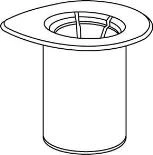 |
|
2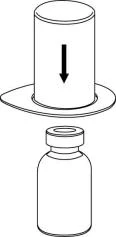 |
|
3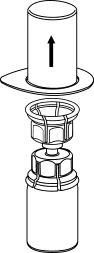 |
|
4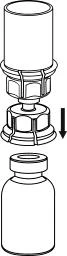 |
|
5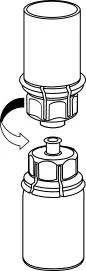 |
|
6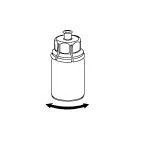 |
|
7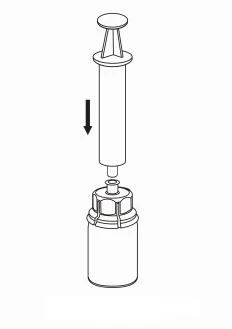 |
|
Withdrawal and administration:
8 |
|
9 |
|
It is recommended to use the infusion set supplied with the medicine; insert the needle into a
vein. Allow blood to flow toward the tip of the cannula. Attach the syringe to the threaded connector,
screwing the intravenous injection set fully into place.
Slowly inject the reconstituted solution intravenously according to the doctor's instructions.
The injection or infusion rate must not exceed 2 mL per minute. Take care to avoid blood flowing back into the syringe containing the product.
When administration of a large volume is required, an alternative may be infusion. In this case, the reconstituted product must be transferred into a suitable infusion system. The infusion should then be carried out in accordance with the doctor's instructions.
Be alert for any adverse reactions that may occur during administration. If you experience any adverse reaction that could be related to the administration of Beriate, the injection or infusion must be stopped (see section 2).
If you have further questions about the use of this medicine, consult your doctor or pharmacist.
4. Possible side effects
Like all medicines, this medicinal product can cause side effects, although
not everyone will experience them.
If you experience any of the following side effects, contact your doctor immediately
or go to the nearest Emergency Department or Haemophilia Centre at the hospital:
- Symptoms of angioedema such as: ➢ swelling of the face, tongue or pharynx; ➢ difficulty swallowing; ➢ hives and breathing difficulties. These side effects have been observed very rarely (may affect up to 1 in 10,000 people), and in some cases may progress to severe allergic reactions (anaphylaxis), including shock. Loss of effectiveness (ongoing bleeding)
- For children who have not previously been treated with factor VIII-containing medicines, the development of inhibitory antibodies (see section 2) can be very common (more than 1 in 10 patients); however, in patients who have previously received factor VIII treatment (more than 150 days of treatment), the risk is uncommon (less than 1 in 100 patients). If this occurs, the medicine may no longer work properly and you or your child may experience persistent bleeding.
Other side effects:
- Allergic reactions (hypersensitivity) which may include: ➢ burning sensation and stinging pain at the site of injection or infusion; ➢ chills, flushing, generalized skin rash, hives; ➢ headache; ➢ drop in blood pressure, restlessness, rapid heartbeat, chest tightness, wheezing; ➢ fatigue (lethargy); ➢ nausea, vomiting; ➢ tingling. These side effects have been observed very rarely and in some cases may progress to severe allergic reactions (anaphylaxis), including shock.
- Fever has been observed in very rare cases.
Side effects in children and adolescents
The frequency, type and severity of adverse reactions in children and adolescents are expected to be the same as in adults.
Reporting of side effects
If you experience any side effect, including those not listed in this leaflet,
please consult your doctor, pharmacist or nurse.
You may also report side effects directly via the national reporting system at www.aifa.gov.it/content/segnalazioni-reazioni-avverse .
By reporting side effects, you can help provide more information on the safety of this medicine.
5. How to store Beriate
Do not use this medicinal product after the expiry date stated on the label and
on the carton. The expiry date refers to the last day of that month.
- Store in a refrigerator between 2°C and 8°C.
- Within the shelf life period, Beriate may be stored up to a temperature of 25°C for a total period not exceeding 1 month. Individual periods of storage at room temperature must be recorded in your treatment diary to ensure that the total maximum duration of 1 month is not exceeded.
- Beriate does not contain preservatives; therefore, the reconstituted product should preferably be used immediately.
- If the reconstituted product is not used immediately, it may be stored in the vial at room temperature for no more than 8 hours. Once transferred into the syringe, the product must be used immediately.
- Do not freeze. Keep the container in the outer packaging to protect it from light. Keep this medicine out of the sight and reach of children.
6. Package contents and other information
What Beriate contains
Active substance:
Beriate is supplied as a powder (with a nominal content of 500 IU, 1000 IU or 2000
IU of human coagulation Factor VIII per vial) and a liquid (solvent). The reconstituted
solution is intended for administration by injection or infusion.
Beriate 500 IU/vial and 1000 IU/vial, after reconstitution with 5 mL or 10 mL of water for
injections, respectively, contains approximately 100 IU/mL of human coagulation Factor VIII.
Beriate 2000 IU/vial must be reconstituted with 10 mL of water for injections and contains
approximately 200 IU/mL of human coagulation Factor VIII.
Other components:
Glycine, calcium chloride, sodium hydroxide (in small quantities) for pH adjustment,
sucrose, sodium chloride. Solvent: Water for injections 5 mL and 10 mL, respectively.
Description of the appearance of Beriate and contents of the pack
Beriate is presented as a white powder, and the pack also includes water for injections.
The reconstituted solution should be clear or slightly opalescent, meaning that – when held up to the light – it may show a slight shimmer, but must never contain visible particles.
Presentations
500 IU pack containing:
1 vial of powder
1 vial with 5 mL of water for injections
1 20/20 transfer device with integrated filter
Administration set (inner box):
1 single-use 5 mL syringe
1 intravenous injection set
2 alcohol swabs
1 non-sterile adhesive plaster
1000 IU pack containing:
1 vial of powder
1 vial with 10 mL of water for injections
1 20/20 transfer device with integrated filter
Administration set (inner box):
1 single-use 10 mL syringe
1 intravenous injection set
2 alcohol swabs
1 non-sterile adhesive plaster
2000 IU pack containing:
1 vial of powder
1 vial with 10 mL of water for injections
1 20/20 transfer device with integrated filter
Administration set (inner box):
1 single-use 10 mL syringe
1 intravenous injection set
2 alcohol swabs
1 non-sterile adhesive plaster
Not all pack sizes may be marketed.
MARKETING AUTHORISATION HOLDER AND MANUFACTURER
CSL Behring GmbH
Emil von Behring-Str. 76
35041 Marburg
Germany
Representative in Italy
CSL Behring S.p.A. – 20151 Milan.
This medicinal product is authorised in the Member States of the European Economic Area
under the following names:
Austria:
Beriate 100 IU/mL Powder and solvent for solution for injection or infusion (500 IU, 1000 IU)
Beriate 200 IU/mL Powder and solvent for solution for injection or infusion (2000 IU)
Bulgaria:
Beriate 500 IU Powder and solvent for solution for injection or infusion
Beriate 1000 IU Powder and solvent for solution for injection or infusion
Beriate 2000 IU Powder and solvent for solution for injection or infusion
Croatia:
Beriate 500 IU prašak i otapalo za otopinu za injekciju ili infuziju
Beriate 1000 IU prašak i otapalo za otopinu za injekciju ili infuziju
Beriate 2000 IU prašak i otapalo za otopinu za injekciju ili infuziju
Estonia:
Beriate
Germany:
Beriate 500, Beriate 1000, Beriate 2000
Italy:
Beriate
Latvia:
Beriate 500 SV pulveris un šķīdinātājs injekciju vai infūziju šķīduma pagatavošanai
Beriate 1000 SV pulveris un šķīdinātājs injekciju vai infūziju šķīduma pagatavošanai
Beriate 2000 SV pulveris un šķīdinātājs injekciju vai infūziju šķīduma pagatavošanai
Lithuania:
Beriate 500 TV milteliai ir tirpiklis injekciniam ar infuziniam tirpalui
Beriate 1000 TV milteliai ir tirpiklis injekciniam ar infuziniam tirpalui
Beriate 2000 TV milteliai ir tirpiklis injekciniam ar infuziniam tirpalui
Portugal:
Beriate
Czech Republic:
Beriate 500 IU, Beriate 1000 IU, Beriate 2000 IU
Romania:
Beriate 500 pulbere şi solvent pentru soluţie injectabilă/perfuzabilă
Beriate 1000 pulbere şi solvent pentru soluţie injectabilă/perfuzabilă
Beriate 2000 pulbere şi solvent pentru soluţie injectabilă/perfuzabilă
Slovakia:
Beriate 500 IU
Beriate 1000 IU
Beriate 2000 IU
Slovenia:
Beriate 500 i.e. prašek in vehikel za raztopino za injiciranje/infundiranje
Beriate 1000 i.e. prašek in vehikel za raztopino za injiciranje/infundiranje
Beriate 2000 i.e. prašek in vehikel za raztopino za injiciranje/infundiranje
Spain:
Beriate 500 UI polvo y disolvente para solución inyectable o perfusión
Beriate 1000 UI polvo y disolvente para solución inyectable o perfusión
Beriate 2000 UI polvo y disolvente para solución inyectable o perfusión
Hungary:
Presentations of Beriate 500 and 1000:
BERIATE 100 NE/ml por és oldószer oldatos injekcióhoz vagy infúzióhoz
Presentation 2000:
BERIATE 200 NE/ml por és oldószer oldatos injekcióhoz vagy infúzióhoz
Date of revision of this Patient Information Leaflet: April 2026
The following information is intended exclusively for physicians or healthcare professionals:
Dosage
Treatment Monitoring
During treatment, it is advisable to accurately determine factor VIII levels in order to establish the appropriate dose and frequency of infusion. Individual patients may show variability in their response to factor VIII, with different half-lives and recovery levels. Dosing based on body weight may require adjustments in underweight or overweight patients. In the case of major surgical procedures, precise monitoring of replacement therapy through coagulation parameters (plasma factor VIII activity) is essential.
Patients should be monitored for the development of factor VIII inhibitors. See also section 2.
The number of units of Factor VIII administered is expressed in International Units (IU), referenced to the current WHO standard concentrate for factor VIII products.
Factor VIII activity in plasma is expressed as a percentage (relative to normal human plasma) or preferably in IU (referenced to an International Standard for Factor VIII in plasma).
One IU of factor VIII activity corresponds to the amount of factor VIII present in 1 mL of normal human plasma.
On-demand treatment
The calculation of the required dose of factor VIII is based on the empirical observation that 1 IU of factor VIII per kg of body weight increases factor VIII activity in plasma by approximately 2% (2 IU/dL) of normal activity. The required dose can be calculated using the following formula:
Required units = body weight (kg) × desired increase in FVIII (% or IU/dL) × 0.5
The dose and frequency of administration should always be adjusted according to clinical efficacy in the individual case.
In the case of the following bleeding events, factor VIII levels during the corresponding period must not fall below the indicated level of plasma activity (in % of normal value or IU/dL). The table below can be used as a guide for determining dosage in bleeding episodes and surgical procedures:
| Severity of bleeding / Type of surgical procedure | Required Factor VIII level (% or IU/dL) | Dosing frequency (hours) / Duration of therapy (days) |
| Bleeding | ||
| Early hemarthrosis, muscle bleeding, or oral cavity bleeding | 20-40 | Repeat infusion every 12-24 hours. For at least 1 day, until resolution of the bleeding episode, as indicated by relief of pain or healing. |
| More extensive hemarthrosis, muscle bleeding, or hematomas | 30-60 | Repeat infusion every 12-24 hours for 3-4 days or longer, until resolution of pain or acute disability. |
| Life-threatening bleeding | 60-100 | Repeat infusion every 8-24 hours until the life-threatening risk has been eliminated. |
| Surgery | ||
| Minor surgery, including dental extractions | 30-60 | Every 24 hours, for at least 1 day, until healing is achieved. |
| Major surgery | 80-100 (pre- and post-operatively) | Repeat infusion every 8-24 hours until adequate wound healing is achieved; continue therapy for at least another 7 days to maintain Factor VIII activity at 30%-60% (30-60 IU/dL, corresponding to 0.30-0.60 IU/mL). |
Prophylaxis
For long-term prophylaxis of bleeding in patients with severe haemophilia A, the usual doses range between 20 and 40 IU of FVIII per kg of body weight, administered at intervals of 2–3 days. In some cases, especially in younger patients, shorter administration intervals or higher doses may be required.
Paediatric population
Dosing in children is based on body weight; therefore, the same guidelines as for adults generally apply. The frequency of administration should always be adjusted according to the achievement of clinical efficacy in the individual case. Data are available on treatment in children under 6 years of age.
Information on the pharmacological properties of vWf
Von Willebrand factor, in addition to acting as a protective protein for factor VIII, mediates platelet adhesion at sites of vascular injury and plays a role in platelet aggregation.