Beclometasone and formoterol Cipla
Italy
Table of Contents
- Package leaflet: Information for the user
- Beclometasone and Formoterol Cipla 100 micrograms/6 micrograms per dose solution
- 1. What Beclometasone and Formoterol Cipla is and what it is used for
- 2. What you need to know before using Beclometasone and Formoterolo Cipla
- 3. How to use Beclometasone and Formoterol Cipla
- 4. Possible side effects
- 5. How to store Beclometasone and Formoterol Cipla
- 6. Contents of the pack and other information
Package leaflet: Information for the user
Beclometasone and Formoterol Cipla 100 micrograms/6 micrograms per dose solution
pressurised inhalation
beclometasone dipropionate/formoterol fumarate dihydrate
equivalent medicine
Please read all of this leaflet carefully before you start using this medicine because it contains important information for you.
- Keep this leaflet. You may need to read it again.
- If you have any questions, ask your doctor, pharmacist or nurse.
- This medicine has been prescribed for you only. Do not give it to other people, even if they have the same symptoms as you, because it may be harmful.
- If you experience any side effects, including those not listed in this leaflet, tell your doctor, pharmacist or nurse. See section 4.
Contents of this leaflet:
- What Beclometasone and Formoterol Cipla is and what it is used for
- What you need to know before using Beclometasone and Formoterol Cipla
- How to use Beclometasone and Formoterol Cipla
- Possible side effects
- How to store Beclometasone and Formoterol Cipla
- Contents of the pack and other information
1. What Beclometasone and Formoterol Cipla is and what it is used for
Beclometasone and Formoterol Cipla is a pressurised solution for inhalation containing two active substances which are inhaled through the mouth and released directly into the lungs.
The two active substances are beclometasone dipropionate and formoterol fumarate dihydrate.
Beclometasone dipropionate belongs to a group of medicines called corticosteroids, which have an anti-inflammatory action by reducing swelling and irritation in the lungs.
Formoterol fumarate dihydrate belongs to a group of medicines called long-acting bronchodilators, which relax the muscles of the airways and help you breathe more easily.
Together, these two active substances make breathing easier, providing relief from symptoms such as shortness of breath, wheezing and coughing in patients with asthma or COPD, and also help prevent asthma symptoms.
Asthma
Beclometasone and Formoterol Cipla is indicated for regular treatment of asthma in adult patients in whom:
- asthma is not adequately controlled using inhaled corticosteroids and short-acting bronchodilators used "as needed", or
- asthma is well controlled with treatment combining inhaled corticosteroids and long-acting bronchodilators.
COPD
Beclometasone and Formoterol Cipla may also be used for the treatment of symptoms of severe chronic obstructive pulmonary disease (COPD) in adult patients. COPD is a chronic airway disease of the lungs, primarily caused by cigarette smoking.
2. What you need to know before using Beclometasone and Formoterolo Cipla
Do not take Beclometasone and Formoterolo Cipla
- If you are allergic to beclometasone dipropionate or formoterol fumarate dihydrate, or to any of the excipients of this medicine (listed in section 6).
Warnings and precautions
Talk to your doctor, pharmacist, or nurse before using Beclometasone and Formoterolo Cipla:
- If you have heart problems, such as angina (chest pain), a recent heart attack (myocardial infarction), heart failure, narrowing of the arteries around the heart (coronary heart disease), heart valve disease, or any other known heart conditions, or if you have a condition known as obstructive hypertrophic cardiomyopathy (also known as HOCM, a condition in which the heart muscle is abnormal).
- If you have narrowing of the arteries (also known as arteriosclerosis), if you have high blood pressure, or if you know you have an aneurysm (an abnormal widening of blood vessel walls).
- If you have heart rhythm disorders such as rapid or irregular heartbeat, rapid pulse, or palpitations, or if you have been told that your electrocardiogram (ECG) is abnormal.
- If you have an overactive thyroid gland.
- If you have low potassium levels in your blood.
- If you have any liver or kidney disorders.
- If you have diabetes (inhaling high doses of formoterol may increase blood glucose levels, so additional tests to monitor blood sugar levels may be needed when starting this inhaler and occasionally during treatment).
- If you have a tumour of the adrenal gland (known as phaeochromocytoma).
- If you are due to undergo anaesthesia. Depending on the type of anaesthesia, you may need to stop treatment with Beclometasone and Formoterolo Cipla at least 12 hours before the procedure.
- If you are, or have ever been, being treated for tuberculosis (TB), or if you have a known viral or fungal infection in the chest.
- If you should avoid alcohol for any reason.
If any of the above apply to you, always inform your doctor before using
Beclometasone and Formoterolo Cipla.
If you have or have had any medical conditions or allergies, or if you are unsure whether you can use
Beclometasone and Formoterolo Cipla, consult your doctor, a nurse experienced in asthma management, or
a pharmacist before using the inhaler.
Treatment with a beta-2 agonist, such as formoterol contained in Beclometasone and Formoterolo Cipla,
may cause a sudden decrease in serum potassium levels (hypokalaemia).
If you have severe asthma, you should exercise particular caution. This is due to low oxygen levels in the
blood and to some of the other treatments that may be taken together with Beclometasone and Formoterolo
Cipla, such as medicines for heart conditions or high blood pressure known as diuretics, or other medicines
used to treat asthma, which may worsen the reduction in potassium levels. For this reason, your doctor may
wish to monitor your blood potassium levels periodically.
If you have used high doses of inhaled corticosteroids for long periods of time, you may require additional
corticosteroids during periods of stress. Stressful situations may include hospitalization following an
accident, sustaining a serious injury, or before surgery. In such cases, your doctor may decide whether you
need an increased dose of corticosteroids and may prescribe steroid tablets or a steroid injection.
If you go to hospital, remember to bring all your medicines and inhalers, including Beclometasone and
Formoterolo Cipla, and any over-the-counter medicines or tablets, preferably in their original packaging.
Contact your doctor if you experience blurred vision or other visual disturbances.
Children and adolescents
Beclometasone and Formoterolo Cipla must not be used in children and adolescents under 18 years of age
until further data are available.
Other medicines and Beclometasone and Formoterolo Cipla
Inform your doctor or pharmacist if you are taking, have recently taken, or might take any other medicines,
including medicines for asthma or COPD, or over-the-counter medicines.
Some medicines may increase the effects of Beclometasone and Formoterolo Cipla, and your doctor may
wish to monitor you closely if you are taking these medicines (including some medicines for HIV: ritonavir,
cobicistat).
Do not take beta-blockers with this medicine.
Beta-blockers such as atenolol, propranolol, and sotalol are used to treat various conditions, including high
blood pressure and heart conditions such as abnormal heart rhythms and heart failure; timolol is used to
treat glaucoma. If beta-blockers must be used, including beta-blocker eye drops, the effect of formoterol may
be reduced or formoterol may not work at all. On the other hand, concomitant use of other beta-adrenergic
drugs (medicines that work similarly to formoterol) may increase the effect of formoterol.
Taking Beclometasone and Formoterolo Cipla with:
- Medicines for abnormal heart rhythm (quinidine, disopyramide, procainamide), medicines used to treat allergic reactions (antihistamines), medicines used to treat symptoms of depression or mental disorders, such as monoamine oxidase inhibitors (e.g. phenelzine and isocarboxazide), tricyclic antidepressants (e.g. amitriptyline and imipramine), and phenothiazines may cause certain changes in the electrocardiogram (ECG). They may also increase the risk of heart rhythm disorders (ventricular arrhythmias).
- Medicines for Parkinson’s disease (L-dopa), for the treatment of hypothyroidism (L-thyroxine), medicines containing oxytocin (which causes uterine contractions), and alcohol may reduce cardiac tolerance to beta-2 agonists such as formoterol.
- Monoamine oxidase inhibitors (MAOIs), including drugs with similar properties such as furazolidone and procarbazine, used in the treatment of mental disorders, may cause an increase in blood pressure.
- Medicines for heart conditions (digoxin) may cause a decrease in blood potassium levels. This may increase the likelihood of heart rhythm abnormalities.
- Other medicines used to treat asthma (theophylline, aminophylline, or steroids) and diuretics may cause a decrease in blood potassium levels.
- Some anaesthetics may increase the risk of abnormal heart rhythm.
Pregnancy and breastfeeding
There are no clinical data on the use of Beclometasone and Formoterolo Cipla during pregnancy.
Beclometasone and Formoterolo Cipla must not be used if you are pregnant, think you may be pregnant, are
planning a pregnancy, or are breastfeeding, unless specifically advised by your doctor.
Driving and using machines
It is unlikely that Beclometasone and Formoterolo Cipla will affect your ability to drive or use machines.
However, if you experience side effects such as dizziness and/or tremor, your ability to drive or use machines
may be impaired.
Beclometasone and Formoterolo Cipla contains alcohol
This medicine contains 7 mg of alcohol (ethanol) per dose (inhalation). The amount of alcohol in this medicine
is equivalent to less than 1 ml of beer or 1 ml of wine.
This small amount of alcohol in the medicine will not have noticeable effects.
For athletes: using the medicine without therapeutic need constitutes doping and may lead to a positive
anti-doping test.
3. How to use Beclometasone and Formoterol Cipla
Beclometasone and Formoterol Cipla is for inhalation use. Beclometasone and Formoterol Cipla must be inhaled through the mouth into the lungs.
Use this medicine exactly as directed by your doctor or pharmacist. If you have any doubts, consult your doctor or pharmacist.
Asthma
Your doctor will monitor you regularly to ensure you are taking the optimal dose of Beclometasone and Formoterol Cipla. Your doctor will adjust your treatment to the lowest dose that provides adequate control of your symptoms.
Your doctor may prescribe Beclometasone and Formoterol Cipla in one of two treatment regimens:
a) Daily use of Beclometasone and Formoterol Cipla for asthma treatment, together with another inhaler to be used “as needed” to treat sudden worsening of asthma symptoms, such as shortness of breath, wheezing, and cough.
b) Daily use of Beclometasone and Formoterol Cipla for asthma treatment, with additional use of this same medicine as needed to treat sudden worsening of asthma symptoms, such as shortness of breath, wheezing, and cough.
a) Use of Beclometasone and Formoterol Cipla together with another reliever inhaler:
Adults and elderly:
The recommended dose of this medicine is one or two inhalations twice daily. The maximum daily dose is 4 inhalations.
Remember: You must always carry your fast-acting inhaler with you to use “as needed” in case of worsening asthma symptoms or sudden asthma attack.
b) Use of Beclometasone and Formoterol Cipla as the only inhaler for asthma:
Adults and elderly:
The recommended dose is one inhalation in the morning and one in the evening.
You should also use this medicine as a reliever inhaler “as needed” to treat sudden asthma symptoms.
If you experience asthma symptoms, take one inhalation and wait a few minutes.
If you do not feel better, take another inhalation.
Do not take more than 6 inhalations of Beclometasone and Formoterol Cipla “as needed” per day.
The maximum daily dose of Beclometasone and Formoterol Cipla as the only inhaler for asthma is 8 inhalations.
If you feel you need more inhalations per day to control your asthma symptoms, contact your doctor for advice. Your treatment may need to be changed.
Use in children and adolescents under 18 years of age:
Children and adolescents under 18 years of age must NOT use this medicine.
Chronic obstructive pulmonary disease (COPD)
Adults and elderly:
The recommended dose is two inhalations in the morning and two inhalations in the evening.
Patients at risk:
Elderly patients do not need to adjust the dose. There is no available information on the use of Beclometasone and Formoterol Cipla in patients with liver or kidney problems.
Beclometasone and Formoterol Cipla is effective in the treatment of asthma at a dosage of beclometasone dipropionate that may be lower than that of other inhalers containing beclometasone dipropionate. If you previously used a different beclometasone dipropionate inhaler, your doctor will advise you on the exact dose of Beclometasone and Formoterol Cipla to take for asthma.
Do not increase the dose
If you feel the medicine is not working well, always consult your doctor before increasing the dose.
Method of administration
Beclometasone and Formoterol Cipla is for inhalation use.
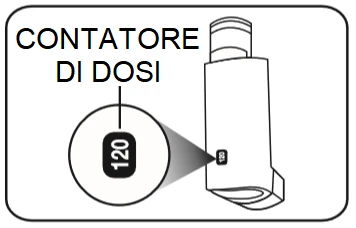
This medicine is contained in a pressurized canister inside a plastic holder with a mouthpiece. On the back of the inhaler is a dose counter indicating how many doses remain. Each time you press the canister, one dose of medicine is released and the dose counter decreases by one. Be careful not to drop the inhaler, as this may cause the dose counter to decrease by one dose.
Checking that the inhaler is working
Before using the inhaler for the first time, or if you have not used it for 14 days or more, you must check that the inhaler is working properly.
- Remove the protective cap from the mouthpiece.
- Hold the inhaler upright with the mouthpiece pointing downwards.
- Turn the mouthpiece away from yourself and press firmly on the canister to release one puff.
- Check the dose counter. If you are using the inhaler for the first time, the dose counter should display the number 120.
How to use the inhaler
Whenever possible, stand or sit upright when inhaling.
Before starting, check the dose counter: any number between “1” and “120” means doses remain. If the counter shows “0”, no doses remain—discard the inhaler and use a new one.

-
Remove the protective cap from the mouthpiece and check that the mouthpiece is clean, free of dust, dirt, or any foreign objects.
-
Breathe out as slowly and deeply as possible.
-
Hold the canister vertically with the inhaler body upright, and place your lips around the mouthpiece. Do not bite the mouthpiece.
-
Breathe in slowly and deeply through your mouth, and immediately after starting to inhale, press firmly on the top of the inhaler to release one dose. If you have weak grip strength, it may be easier to hold the inhaler with both hands: place both index fingers on the top of the inhaler and both thumbs on the bottom.
-
Hold your breath as long as possible, then remove the inhaler from your mouth and breathe out slowly. Do not breathe into the inhaler.
If another inhalation is needed, keep the inhaler upright for about half a minute and repeat steps 2 to 5.
Important: Do not perform steps 2 to 5 too quickly.
After use, replace the protective cap and check the dose counter.
Replace the inhaler when the dose counter reads 20. Stop using the inhaler when the dose counter reads 0, as the remaining doses may not be sufficient to deliver a full dose.
If you see a “mist” escaping from the top of the inhaler or from the sides of your mouth, this means Beclometasone and Formoterol Cipla is not reaching your lungs as intended. Take another dose by repeating the instructions from step 2.
To reduce the risk of developing a fungal infection in the mouth or throat, rinse your mouth with water, gargle, or brush your teeth after using the inhaler.
If you think the effect of Beclometasone and Formoterol Cipla is too strong or not strong enough, tell your doctor or pharmacist.
If you have difficulty coordinating inhaler use with the start of inhalation, you may use the AeroChamber Plus™ spacer device. Ask your doctor, pharmacist, or nurse for information about this device.
It is important to read the instruction leaflet provided with the AeroChamber Plus™ spacer device and carefully follow the instructions for its use and cleaning.
Cleaning
You should clean the inhaler once a week.
During cleaning, do not remove the canister from the inhaler and do not use water or other liquids to clean the inhaler.
To clean the inhaler:
- Remove the protective cap from the mouthpiece by pulling it off the inhaler.
- Wipe the inside and outside of the mouthpiece and inhaler with a clean, dry cloth or tissue.
- Replace the protective cap on the mouthpiece.
If you use more Beclometasone and Formoterol Cipla than you should:
- Taking too much formoterol may cause the following effects: feeling unwell, malaise, rapid heartbeat, palpitations, heart rhythm disturbances, certain changes in the electrocardiogram (ECG), headache, tremor, drowsiness, excess acid in the blood, low potassium levels in the blood, and high blood glucose levels. Your doctor may wish to perform blood tests to monitor your potassium and glucose levels.
- Excessive use of beclometasone dipropionate may cause temporary disturbances in adrenal gland function. These problems will resolve spontaneously within a few days, but your doctor may decide to monitor your blood cortisol levels.
Contact your doctor if you experience any of these symptoms.
If you forget to take Beclometasone and Formoterol Cipla:
Do not take a double dose to make up for a forgotten dose. Take the missed dose as soon as you remember. If it is almost time for your next dose, skip the missed dose and take the next dose at the usual time.
If you stop treatment with Beclometasone and Formoterol Cipla:
Do not reduce the dose or stop taking the medicine. Even if you feel better, do not stop taking Beclometasone and Formoterol Cipla or reduce the dose without first talking to your doctor. It is very important that you take this medicine regularly, even when you have no symptoms.
If your breathing worsens:
If you experience worsening shortness of breath or wheezing (a clearly audible whistling sound when breathing) immediately after inhaling the medicine, stop using the Beclometasone and Formoterol Cipla inhaler immediately and use your fast-acting “as needed” inhaler right away. Contact your doctor immediately. Your doctor will assess your symptoms and, if necessary, may decide to start you on a different treatment regimen.
See also section 4. Possible side effects.
If your asthma worsens:
If your symptoms worsen or are difficult to control (for example, if you are using your reliever inhaler or Beclometasone and Formoterol Cipla as a reliever more frequently), or if your reliever inhaler or Beclometasone and Formoterol Cipla does not improve your symptoms, contact your doctor immediately. Asthma can worsen, and your doctor may need to increase your dose of Beclometasone and Formoterol Cipla or prescribe an alternative treatment.
If you have any further questions about the use of this medicine, ask your doctor or pharmacist.
4. Possible side effects
Like all medicines, this medicine can cause side effects, although not everybody gets them.
As with other inhaled treatments, there is a risk of worsening breathlessness and wheezing immediately after using this medicine, a condition known as paradoxical bronchospasm. If this occurs, you must IMMEDIATELY STOP using Beclometasone and Formoterolo Cipla and use your "as needed" fast-acting inhaler immediately to treat symptoms of breathlessness and wheezing. You must contact your doctor immediately.
Inform your doctor immediately if you experience any hypersensitivity reactions such as skin allergies, skin itching, skin rash, skin redness, or swelling of the skin or mucous membranes, particularly around the eyes, face, lips, and throat.
Other possible side effects are listed below according to their frequency.
Common (may affect up to 1 in 10 people):
- Fungal infections (of mouth and throat)
- headache
- hoarseness
- sore throat
Pneumonia in patients with COPD: Inform your doctor if you experience any of the following symptoms while taking Beclometasone and Formoterolo Cipla, as they could be signs of a lung infection:
- fever or chills
- increased mucus production, changes in mucus colour
- increased cough or worsening breathing difficulties
Uncommon (may affect up to 1 in 100 people):
- unusually fast heartbeat and heart rhythm disturbances
- certain changes in the electrocardiogram (ECG)
- asthma attack
- tremor
- restlessness
- dizziness
- palpitations
- flu-like symptoms
- vaginal fungal infections
- sinusitis
- ear inflammation
- throat irritation
- cough and productive cough
- nausea
- taste disturbances or altered taste
- lip burning
- dry mouth
- difficulty swallowing
- indigestion
- stomach discomfort
- diarrhoea
- muscle pain and cramps
- facial flushing
- excessive sweating
- increased blood flow in certain body tissues
- rhinitis
Changes in certain blood components:
- reduced number of white blood cells
- increased number of blood platelets
- reduced potassium levels in the blood
- increased blood sugar levels
- increased levels of insulin, free fatty acids, and ketones in the blood
- urticaria
The following side effects have also been reported as "uncommon" in patients with Chronic Obstructive Pulmonary Disease (COPD):
- Reduced blood cortisol levels; this is caused by the effect of corticosteroids on the adrenal glands.
- Irregular heartbeat
Rare (may affect up to 1 in 1,000 people):
- chest tightness
- sensation of missed heartbeat
- increase or decrease in blood pressure
- kidney inflammation
- persistent swelling of the skin and mucous membranes lasting for several days
Very rare (may affect up to 1 in 10,000 people):
- worsening of asthma
- breathlessness
- decreased number of blood platelets
- swelling of hands and feet
Long-term use of high-dose inhaled corticosteroids may, in very rare cases, cause systemic effects. These include:
- impaired adrenal gland function (adrenal suppression)
- increased intraocular pressure (glaucoma)
- cataract
- growth retardation (slowed growth in children and adolescents)
- reduced bone mineral density (thinning of the bones)
Not known (frequency cannot be estimated from the available data):
- sleep disorders
- depression or anxiety
- restlessness
- nervousness
- hyperexcitability or irritability
These effects occur mainly in children.
- Blurred vision
Reporting of side effects
If you experience any side effect, including those not listed in this leaflet, tell your doctor, pharmacist, or nurse. You may also report side effects directly via the national reporting system at https://www.aifa.gov.it/content/segnalazioni-reazioni-avverse.
By reporting side effects, you can help provide more information on the safety of this medicine.
5. How to store Beclometasone and Formoterol Cipla
- Keep this medicine out of the sight and reach of children.
- Before dispensing: store the inhaler in the refrigerator (at 2-8 °C).
- After dispensing (after receiving this medicine from the pharmacist):
o Do not use this medicine for more than 3 months after the date of purchase at the pharmacy, and never use it after the expiry date stated on the packaging and label after "Exp.". The expiry date refers to the last day of that month.
o Do not store the inhaler above 25 °C.
o If the inhaler has been exposed to low temperatures, warm it with your hands for a few minutes before use. Never warm the inhaler using artificial methods.
Caution: the canister contains liquid under pressure. Do not expose the canister to temperatures above 50 °C. Do not pierce the canister.
o Do not dispose of any medicine via wastewater or household waste. Ask your pharmacist how to dispose of medicines no longer in use. This will help protect the environment.
6. Contents of the pack and other information
What Beclometasone and Formoterolo Cipla contains
- The active substances are beclometasone dipropionate and formoterol fumarate dihydrate. Each inhalation/dose delivered from the inhaler contains 100 micrograms of beclometasone dipropionate and 6 micrograms of formoterol fumarate dihydrate. This corresponds to a dose delivered from the mouthpiece of 84.6 micrograms of beclometasone dipropionate and 5.0 micrograms of formoterol fumarate dihydrate.
- This medicinal product contains fluorinated greenhouse gases. Each inhaler contains 8.15 g of HFC-134a (norflurane), equivalent to 0.012 tonnes of CO₂ equivalent (global warming potential = 1430).
- The excipients are: anhydrous ethanol and hydrochloric acid.
Description of the appearance of Beclometasone and Formoterolo Cipla and contents of the pack
Beclometasone and Formoterolo Cipla is contained in a 19 ml aluminium pressurised canister closed with a metering valve, inserted into a plastic polypropylene actuator incorporating a dose counter and a mouthpiece, and fitted with a protective plastic cap.
Pack sizes:
1 pressurised container providing 120 actuations, or
2 pressurised containers providing 120 actuations each.
Not all pack sizes may be marketed.
Marketing Authorisation Holder:
Cipla Europe NV
De Keyserlei 60C, Bus-1301
2018 Antwerp, Belgium
Manufacturer:
Cipla Europe NV
De Keyserlei 60C, Bus-1301
2018 Antwerp, Belgium
S&D Pharma CZ, spol. s r.o.
Theodor 28
273 08 Pchery (Pharmos a.s. facility)
Czech Republic
This medicinal product is authorised in the Member States of the European Economic Area under the following names:
Austria Beclometason/ Formoterol Cipla 100 micrograms/6 micrograms per puff
pressurised inhalation, solution
Bulgaria BIBECFO 100 micrograms per actuation pressurised inhalation solution
Czech Republic Beklometason/Formoterol Cipla
Germany Beclometason/ Formoterol Cipla 100 micrograms/6 micrograms per puff
pressurised inhalation, solution
Spain Bibecfo 100 micrograms /6 micrograms per puff solution for pressurised inhalation
France BÉCLOMÉTASONE/FORMOTÉROL CIPLA 100/6 micrograms/dose, solution for inhalation in pressurised container
Italy Beclometasone e Formoterolo Cipla
Norway Beklometasondipropionat/Formoterol Cipla
Romania Beclometazonă/Formoterol Cipla 100/6 micrograms per dose pressurised inhalation solution
Sweden Brofobec
Slovakia BIBECFO 100/6 micrograms per inhalation inhalation solution in pressurised container