Atriace
Italy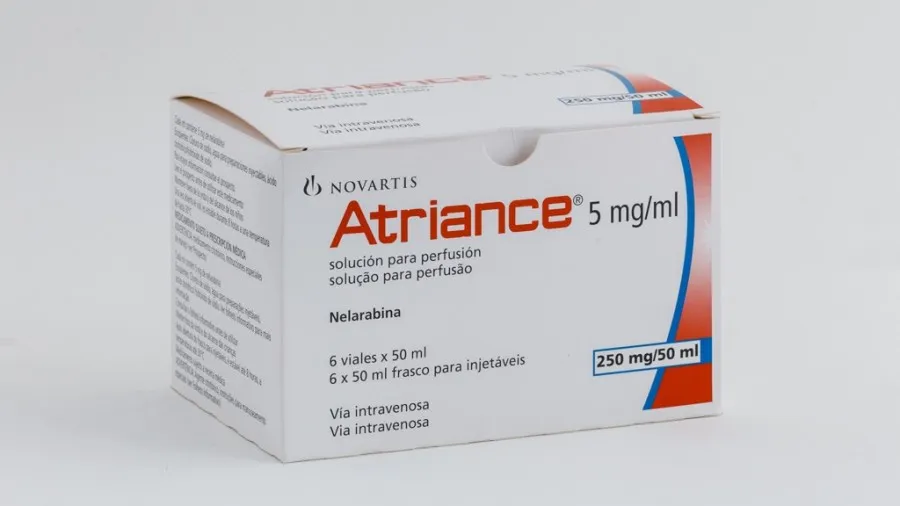
Table of Contents
Package leaflet: Information for the patient
Atriance 5 mg/ml solution for infusion
nelarabine
This medicinal product is subject to additional monitoring. This will allow for rapid identification of new safety information. You can help by reporting any side effects you experience while taking this medicine. See the end of section 4 for information on how to report side effects.
Please read all of this leaflet carefully before you start using this medicine because it contains important information for you.
- Keep this leaflet. You may need to read it again.
- If you have any questions, ask your doctor or pharmacist.
- This medicine has been prescribed for you only. Do not give it to other people, even if their symptoms are the same as yours, as it may be harmful.
- If you experience any side effect, including those not listed in this leaflet, tell your doctor or pharmacist. See section 4.
Contents of this leaflet:
- What Atriance is and what it is used for
- What you need to know before using Atriance
- How to use Atriance
- Possible side effects
- How to store Atriance
- Contents of the pack and other information
1. What Atriance is and what it is used for
Atriance contains nelarabine, which belongs to a group of medicines known as antineoplastic agents, used in chemotherapy to kill certain types of cancer cells.
Atriance is used to treat patients with:
a type of leukemia called T-cell acute lymphoblastic leukemia. Leukemia causes an abnormal increase in the number of white blood cells (blood cells). Excessively high numbers of white blood cells may appear in the blood and in other parts of the body. The type of leukemia is defined by the type of white blood cells mainly involved. In this case, they are called lymphoblasts.
a type of lymphoma called T-cell lymphoblastic lymphoma. This lymphoma is caused by a mass of lymphoblasts, a type of white blood cells.
For any questions regarding your condition, please consult your doctor.
2. What you should know before using Atriance
You (or your child, if they are receiving treatment) must not receive Atriance
if you (or your child, if they are receiving treatment) are allergic to nelarabine or to any of the
other ingredients of this medicine (listed in section 6).
Warnings and precautions
Serious nervous system effects have been reported with the use of Atriance. Symptoms may be
mental (e.g. fatigue) or physical (e.g. seizures, numbness or tingling sensations, weakness, and paralysis).
Your doctor will regularly check for the appearance of these symptoms during treatment
(see also section 4, “Possible side effects”).
Your doctor should also be informed of the following before this medicine is administered:
if you (or your child, if they are receiving treatment) have any kidney or liver problems.
Your dose of Atriance may need to be adjusted.
if you (or your child, if they are receiving treatment) have recently been vaccinated, or plan to be,
with a live vaccine (e.g. for polio, varicella, typhoid).
if you (or your child, if they are receiving treatment) have any blood disorders (e.g. anemia).
Blood tests during treatment
Your doctor may request regular blood tests during treatment to monitor for problems that may be
associated with the use of Atriance.
Elderly patients
If you are elderly, you may be more sensitive to the nervous system side effects (see the list under
“Warnings and precautions”). Your doctor will monitor you regularly for these symptoms during treatment.
Please inform your doctor if any of these situations apply to you.
Other medicines and Atriance
Tell your doctor or pharmacist if you are taking, have recently taken, or might take any other
medicines. This includes any herbal products or over-the-counter medicines.
Remember to inform your doctor if you start taking any other medicines while being treated with Atriance.
Pregnancy, breastfeeding and fertility
Atriance is not recommended for use in pregnant women. It may harm a fetus conceived before, during,
or immediately after treatment. You are advised to discuss with your doctor the use of an appropriate
contraceptive method. Do not attempt to conceive or father a child until your doctor confirms it is safe to do so.
Male patients who may wish to father children should consult their doctor for advice or fertility planning.
If pregnancy occurs during treatment with Atriance, inform your doctor immediately.
It is not known whether Atriance is excreted in human breast milk. Breastfeeding must be discontinued
while you are receiving Atriance. Ask your doctor for advice before taking any medicine.
Driving and using machines
Atriance may cause drowsiness or somnolence, both during treatment and for several days afterward.
If you feel tired or weak, do not drive or operate any tools or machinery.
Atriance contains sodium
This medicine contains 88.51 mg (3.85 mmol) of sodium (the main component of table salt) per vial (50 ml).
This corresponds to 4.4% of the maximum daily recommended dietary intake of sodium for an adult.
3. How to use Atriance
The dose of Atriance you will be given is based on:
your/your child's body surface area (if your child is being treated) (this will be calculated by the
physician based on height and weight).
the results of blood tests performed before treatment.
Adults and adolescents (aged 16 years and older)
The usual dose is 1,500 mg/m² of body surface area per day.
A doctor or nurse will administer the appropriate dose of Atriance to you by intravenous infusion (drip).
The infusion is usually given into the arm over a period of approximately 2 hours.
You will receive one infusion (drip) per day on treatment days 1, 3 and 5. This treatment schedule is
normally repeated every three weeks. This treatment may vary depending on the results of blood tests
performed at regular intervals. Your doctor will decide how many treatment cycles are needed.
Children and adolescents (aged up to 21 years)
The recommended dose is 650 mg/m² of body surface area per day.
A doctor or nurse will administer an appropriate dose of Atriance to you/your child (if being treated) by
intravenous infusion (drip). The infusion is usually given into the arm over a period of approximately 1 hour.
You/your child (if being treated) will receive one infusion (drip) per day for 5 days. This treatment
schedule is normally repeated every three weeks. This treatment may vary depending on the results of blood
tests performed at regular intervals. Your doctor will decide how many treatment cycles are needed.
If treatment with Atriance is stopped
Your doctor will decide when to stop treatment.
If you have any doubts about how to use this medicine, consult your doctor or pharmacist.
4. Possible side effects
Like all medicines, this medicine can cause side effects, although not everybody gets them.
Most of the side effects reported with Atriance have been observed in adults, children, and adolescents. Some side effects have been reported more frequently in adult patients. The reason for this is unknown.
If you have any doubts, discuss them with your doctor.
More serious side effects
These may occur in more than 1 out of 10 people treated with Atriance.
Signs of infection. Atriance may reduce the number of white blood cells in the blood and lower resistance to infections (including pneumonia). This may also be life-threatening. Signs of infection include:
- fever
- severe worsening of general condition
- local symptoms such as sore throat, mouth pain, or urinary problems (for example, a burning sensation when urinating, which may be caused by a urinary tract infection)
If you experience any of these signs, contact your doctor immediately. A blood test will need to be performed to check for a possible reduction in white blood cells.
Other very common side effects
These may occur in more than 1 out of 10 people treated with Atriance.
- Changes in sensation in hands and feet, muscle weakness manifesting as difficulty rising from a chair or walking (peripheral neuropathy); reduced sensitivity to light touch, or pain; abnormal sensations such as burning, tingling, or the feeling of something crawling on the skin.
- General feeling of weakness and fatigue (temporary anaemia). In some cases, you may need a blood transfusion.
- Unusual bruising or bleeding, caused by a decrease in the number of blood cells responsible for blood clotting. This may lead to severe bleeding following relatively minor injuries, such as small cuts. Rarely, it may result in more serious bleeding (haemorrhage). Talk to your doctor for advice on how to minimize the risk of bleeding.
- Drowsiness and lethargy; headache; dizziness.
- Shortness of breath, difficulty and effort in breathing; cough.
- Feeling of stomach discomfort (nausea); malaise/vomiting; diarrhoea; constipation.
- Muscle pain.
- Swelling of body parts due to accumulation of abnormal amounts of fluid (oedema).
- High body temperature (fever); fatigue; feeling of weakness/loss of strength.
If any of these side effects cause you problems, talk to your doctor.
Common side effects
These may occur in up to 1 out of 10 people treated with Atriance.
- Violent, uncontrollable muscle contractions, often accompanied by loss of consciousness, possibly due to an epileptic seizure (convulsions).
- Clumsiness and lack of coordination, affecting balance, walking, limb or eye movements, or speech.
- Rhythmic, unintentional tremors of one or more limbs (tremors).
- Muscle weakness (possibly associated with peripheral neuropathy – see above), joint pain, back pain; pain in hands and feet including tingling and numbness.
- Low blood pressure.
- Weight loss and loss of appetite (anorexia); stomach pains; mouth pain, ulcers, or inflammation in the mouth.
- Memory problems, feeling disoriented; blurred vision; altered or loss of taste (dysgeusia).
- Fluid accumulation around the lungs causing chest pain and breathing difficulties (pleural effusion); wheezing.
- Increased levels of bilirubin in the blood, which may cause yellowing of the skin and drowsiness (feeling sleepy).
- Increased levels of liver enzymes in the blood.
- Increased levels of creatinine in the blood (a sign of kidney problems, which may lead to less frequent urination).
- Release of the contents of tumour cells (tumour lysis syndrome), which may cause further stress to your body. Initial symptoms include nausea and vomiting, shortness of breath, irregular heartbeat, cloudy urine, drowsiness, and/or joint pain. If this occurs, it is most likely to happen after the first dose. Your doctor will take appropriate precautions to minimize the risk of this happening.
- Reduction in levels of certain substances in the blood:
- low calcium levels, which may cause muscle cramps, abdominal cramps, or spasms
- low magnesium levels, which may cause muscle weakness, confusion, jerky movements, high blood pressure, irregular heartbeat, and slowed reflexes at markedly low magnesium levels
- low potassium levels, which may cause a feeling of weakness
- low glucose levels, which may cause nausea, sweating, weakness, fainting, confusion, or hallucinations
If any of these side effects cause you problems, talk to your doctor.
Rare side effects
These may occur in up to 1 out of 1,000 people treated with Atriance.
- A serious condition that destroys skeletal muscle, characterized by the presence of myoglobin in the urine (a product of muscle cell breakdown) (rhabdomyolysis), increased levels of creatine phosphokinase in the blood.
If any of these side effects cause you problems, talk to your doctor.
Reporting of side effects
If you experience any side effect, including those not listed in this leaflet, talk to your doctor or pharmacist. You can also report side effects directly via the national reporting system listed in Annex V. By reporting side effects, you can help provide more information on the safety of this medicine.
5. How to store Atriance
Keep this medicine out of the sight and reach of children.
Do not use this medicine after the expiry date stated on the carton and vial.
This medicine does not require any special storage conditions.
Atriance is stable for up to 8 hours after opening the vial, up to 30°C.
Do not dispose of any medicine via wastewater or household waste. Ask your pharmacist how to
dispose of medicines you no longer use. This will help protect the environment.
6. Package contents and other information
What Atriance contains
The active substance is nelarabine. Each ml of Atriance infusion solution contains 5 mg of
nelarabine. Each vial contains 250 mg of nelarabine.
The other components are sodium chloride, water for injections, hydrochloric acid,
and sodium hydroxide (see section 2 “Atriance contains sodium”).
Description of the appearance of Atriance and package contents
Atriance infusion solution is a clear, colourless solution. It is supplied in clear glass vials sealed with a rubber stopper and an aluminium cap.
Each vial contains 50 ml.
Atriance is available in packs containing 1 vial or 6 vials.
Marketing Authorization Holder
Sandoz Pharmaceuticals d.d.
Verovškova ulica 57
1000 Ljubljana
Slovenia
Manufacturer
Novartis Farmacéutica S.A.
Gran Via de les Corts Catalanes, 764
08013 Barcelona
Spain
Novartis Pharma GmbH
Roonstraße 25
D-90429 Nuremberg
Germany
EBEWE Pharma Ges.m.b.H. Nfg.KG
Mondseestrasse 11
4866 Unterach am Attersee
Austria
FAREVA Unterach GmbH
Mondseestraße 11
Unterach am Attersee, 4866,
Austria
For further information about this medicinal product, please contact the local representative of the Marketing Authorization Holder:
België/Belgique/Belgien Lietuva
Sandoz N.V. Sandoz Pharmaceuticals d.d
Telecom Gardens Branch Office Lithuania
Medialaan 40 Seimyniskiu 3A
B-1800 Vilvoorde LT – 09312 Vilnius
Tél/Tel: +32 (0)2 722 97 97 Tel: +370 5 2636 037
България Luxembourg/Luxemburg
КЧТ Сандоз България Sandoz N.V.
Teл.: +359 2 970 47 47 Telecom Gardens
Medialaan 40
B-1800 Vilvoorde
Tél/Tel: +32 (0)2 722 97 97
Česká republika Magyarország
Sandoz s.r.o. Sandoz Hungária Kft.
Na Pankráci 1724/129 Bartók Béla út 43-47
CZ-140 00, Praha 4 H-1114 Budapest
Tel: +420 225 775 111 Tel: +36 1 430 2890
[email protected] [email protected]
Danmark Malta
Sandoz A/S
Sandoz Pharmaceuticals d.d.
Edvard Thomsens Vej 14 Verovskova 57
DK-2300 København S SI-1000 Ljubljana
Slovenia
Tlf: +45 6395 1000 Tel: +356 21222872
Deutschland Nederland
Hexal AG Sandoz B.V.
Industriestr. 25 Hospitaaldreef 29,
D-83607 Holzkirchen NL-1315 RC Almere
Tel: +49 8024 908-0 Tel: +31 (0)36 5241600
[email protected] [email protected]
Eesti Norge
Sandoz d.d. Eesti filiaal Sandoz A/S
Pärnu mnt 105 Edvard Thomsens Vej 14
EE – 11312 Tallinn DK-2300 København S
Tel: +372 6652405 Denmark
Tlf: +45 6395 1000
[email protected]
Ελλάδα Österreich
SANDOZ HELLAS Sandoz GmbH
ΜΟΝΟΠΡΟΣΩΠΗ Α.Ε. Biochemiestr. 10
Tel: +30 216 600 5000 A-6250 Kundl
Tel: +43(0)1 86659-0
España Polska
Bexal Farmacéutica, S.A. Sandoz Polska Sp. z o.o.
Centro Empresarial Parque Norte ul. Domaniewska 50 C
Edificio Roble 02 672 Warszawa
C/ Serrano Galvache, 56 Tel.: +48 22 209 7000
28033 Madrid [email protected]
France Portugal
Sandoz SAS Sandoz Farmacêutica Lda.
49, avenue Georges Pompidou Tel: +351 211 964 000
F-92300 Levallois-Perret
Hrvatska România
Sandoz d.o.o. Sandoz S.R.L.
Maksimirska 120 Strada Livezeni Nr. 7a
10 000 Zagreb 540472 Târgu Mureș
Tel : +385 1 235 3111 Tel: +40 21 407 51 60
[email protected]
Ireland Slovenija
Sandoz Pharmaceuticals d.d. Lek farmacevtska družba d.d.
Verovškova ulica 57 Verovškova 57
1000 Ljubljana SI-1526 Ljubljana
Slovenia Tel: +386 1 580 21 11
[email protected]
Ísland Slovenská republika
Sandoz A/S Sandoz d.d. - organizačná zložka
Edvard Thomsens Vej 14 Žižkova 22B
DK-2300 Kaupmaannahöfn S 811 02 Bratislava
Denmark Tel: +421 2 48 200 600
Tlf: +45 6395 1000 [email protected]
[email protected]
Italia Suomi/Finland
Sandoz S.p.A. Sandoz A/S
Largo Umberto Boccioni, 1 Edvard Thomsens Vej 14
I-21040 Origgio / VA DK-2300 Kööpenhamina S
Tel: +39 02 96 54 1 Denmark
[email protected] Puh: + 358 010 6133 400
[email protected]
Κύπρος Sverige
Sandoz Pharmaceuticals d.d. Sandoz A/S
Verovskova 57 Edvard Thomsens Vej 14
SI-1000 Ljubljana DK-2300 Köpenhamn S
Slovenia Denmark
Tel: +357 22 69 0690 Tel: +45 6395 1000
[email protected]
Latvija
Sandoz d.d. Latvia filiāle
K.Valdemāra 33 – 29
LV-1010 Rīga
Tel: +371 67892006
This medicinal product has been authorised under “exceptional circumstances”.
This means that, due to the rarity of the disease, it has not been possible to obtain complete information about this medicinal product.
The European Medicines Agency will review annually any new information on this medicinal product, and this package leaflet will be updated if necessary.
More detailed information on this medicinal product is available on the website of the European Medicines Agency: http://www.ema.europa.eu. In addition, links to other websites on rare diseases and their treatments are provided.
The following information is intended for healthcare professionals only:
INSTRUCTIONS FOR STORAGE AND DISPOSAL OF ATRIANCE
Storage of Atriance infusion solution
This medicinal product does not require any special storage conditions.
After opening the vial, Atriance remains stable for up to 8 hours at temperatures up to 30°C.
Instructions for handling and disposal of Atriance
Standard procedures for the safe handling and disposal of cytotoxic anticancer medicinal products must be followed:
- Personnel must be trained in the proper handling and transport of the medicinal product.
- Pregnant personnel must not be involved in activities related to the use of this medicinal product.
- Personnel handling this medicinal product during preparation or transport must wear protective clothing, including mask, goggles, and gloves.
- All materials used for administration or cleaning, including gloves, must be placed in sealed bags designated for high-risk waste and incinerated at high temperature. Any liquid waste from the preparation of nelarabine infusion solution may be diluted with large amounts of water.
- In case of accidental contact with skin or eyes, immediately rinse thoroughly with large amounts of water.