Aracytin
Italy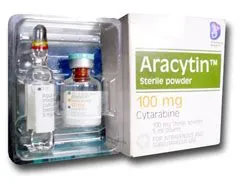
Table of Contents
- Package leaflet: Information for the user
- ARACYTIN 100 mg/5 ml powder and solvent for injectable solution, 500 mg/10 ml powder and solvent for injectable solution
- 1. What Aracytin is and what it is used for
- 2. What you should know before Aracytin is administered to you or your child
- 3. How to administer Aracytin
- 4. Possible side effects
- 5. How to store Aracytin
- 6. Package contents and other information
Package leaflet: Information for the user
ARACYTIN 100 mg/5 ml powder and solvent for injectable solution, 500 mg/10 ml powder and solvent for injectable solution
Cytarabine
Please read all of this leaflet carefully before you are given this medicine because it contains important information for you.
- Keep this leaflet. You may need to read it again.
- If you have any questions, ask your doctor or nurse.
- If you get any side effects, talk to your doctor or nurse. This includes any side effects not listed in this leaflet. See section 4.
Contents of this leaflet:
- What Aracytin is and what it is used for
- What you need to know before you are given Aracytin
- How Aracytin is given
- Possible side effects
- How to store Aracytin
- Contents of the pack and other information
1. What Aracytin is and what it is used for
Aracytin contains the active substance cytarabine, which belongs to a group of medicines called
pyrimidine analogues, used in the treatment of tumours. Pyrimidine is one of the molecules
that make up the DNA of cells.
Aracytin is used to treat acute myeloid leukaemia (a type of blood white cell cancer) in adults and children.
White blood cells are the cells responsible for the body's defence.
Aracytin is also used to treat other types of white blood cell cancers (leukaemias)
when previous treatments have not worked or have proven inadequate.
Cytarabine works by interfering with the growth of cancer cells, which are eventually destroyed.
2. What you should know before Aracytin is administered to you or your child
Aracytin must not be administered to you or your child if:
- you are allergic to cytarabine or to any of the other ingredients of this medicine (listed in section 6);
- you are taking or have recently taken medicines that cause severe suppression of bone marrow function, such as red blood cells, white blood cells, and platelets (bone marrow depression), unless your doctor decides that treatment with this medicine is the best option for you or your child (see section Other medicines and Aracytin);
- you have a severe reduction in blood cells produced by the bone marrow (red blood cells, white blood cells, platelets) due to causes unrelated to your disease (leukemia) and not caused by taking medications;
- you suffer from a brain disorder characterized primarily by progressive memory loss, loss of self-awareness and cognition, inability to concentrate, and persistent drowsiness. This condition may occur spontaneously or following treatment with drugs such as methotrexate or after exposure to ionizing radiation (radiotherapy) (see section Other medicines and Aracytin).
Warnings and precautions
Talk to your doctor or nurse before Aracytin is administered if you think any of the following conditions apply to you or your child:
- you are pregnant or think you may be pregnant, because Aracytin should not be used during pregnancy (see section Pregnancy, breastfeeding and fertility);
- you are taking or have recently taken medicines that cause severe suppression of bone marrow function (red blood cells, white blood cells, platelets). In such cases, you or your child may require close medical monitoring, and your doctor may decide that Aracytin treatment is unsuitable;
- your liver or kidneys are not functioning properly, because under these conditions administration of this medicine may more easily cause undesirable effects on the central nervous system. Therefore, your doctor may decide to use a lower dose of Aracytin;
- you have received or are scheduled to receive vaccination with so-called “live” or “attenuated” vaccines. Aracytin suppresses the immune system, and concurrent administration of these types of vaccines must be avoided, as they may lead to severe or even fatal infections. However, vaccination with “killed” or “inactivated” vaccines may be permitted, although their effectiveness might be reduced by Aracytin treatment.
Your doctor will monitor your health after Aracytin administration, as even serious adverse effects may occur (see section 4 Possible side effects).
Regular medical checks during Aracytin treatment
During treatment, your doctor will perform regular monitoring for you or your child:
- blood tests, especially to monitor white blood cell and platelet counts;
- bone marrow examinations, to assess the presence or disappearance of tumor cells;
- liver and kidney function tests (including blood tests) to ensure Aracytin is not adversely affecting these organs;
- blood tests and/or other specific tests to check for possible infections, since Aracytin increases susceptibility to infections;
- blood tests to monitor uric acid levels, because Aracytin may increase these levels.
Your doctor will evaluate your health status or that of your child and will explain in detail the risks and benefits of Aracytin treatment.
Children
The safety of Aracytin in children has not been established. Your doctor will decide whether this medicine can be administered to children based on their individual condition.
Other medicines and Aracytin
Inform your doctor if you or your child are taking, have recently taken, or might take any other medicines.
It is particularly important to inform your doctor if you or your child are taking the following medicines, because doses of these medicines or of Aracytin may need to be adjusted, or additional monitoring may be required:
- digoxin (a medicine used to treat heart conditions);
- gentamicin (an antibiotic used to treat bacterial infections);
- flucytosine (a medicine used to treat fungal infections), because concomitant use of flucytosine and Aracytin may reduce the effectiveness of flucytosine;
- methotrexate (a medicine used to treat certain chronic inflammatory diseases and some types of cancer), because concomitant use of methotrexate and Aracytin may cause headache, paralysis, coma, and stroke-like symptoms (see section 4 Possible side effects).
Special caution is required if you or your child:
- are taking or have recently taken medicines that cause severe suppression of bone marrow function (see section Warnings and precautions);
- have received or are scheduled to receive vaccination (see section Warnings and precautions).
Pregnancy, breastfeeding and fertility
If you are pregnant, suspect you may be pregnant, plan to become pregnant, or are breastfeeding, consult your doctor before receiving this medicine.
Pregnancy
Avoid becoming pregnant while being treated with Aracytin, as it may harm the unborn child (congenital abnormalities), especially if administered during the first three months of pregnancy.
If you are already pregnant, your doctor will decide whether starting Aracytin treatment is appropriate for you.
The potential risks to the unborn child are considerably reduced if Aracytin treatment is initiated during the second or third trimester of pregnancy. If Aracytin is administered during pregnancy, your newborn may present with severe suppression of bone marrow function (white blood cells, red blood cells, platelets), disturbances in blood electrolyte levels, increased levels of a specific type of white blood cell called “eosinophils” (involved in defense against germs and allergens), elevated levels of certain antibodies, very high fever, severe blood infection (sepsis), or even death.
If Aracytin is administered during pregnancy, your baby may be born prematurely.
Contraception in women of childbearing potential
Women must always use an effective method of birth control (contraception) to prevent pregnancy during treatment and for 6 months after the last dose. Speak to your doctor about the most appropriate contraceptive methods for you and your partner.
Contraception in men
Male patients with female partners of childbearing potential must always use highly effective contraceptive methods to prevent pregnancy during treatment and for 3 months after the last dose.
Breastfeeding
Aracytin must not be administered during breastfeeding, as it is unknown whether this medicine passes into breast milk. Your doctor will decide whether it is preferable for you to discontinue breastfeeding for the duration of Aracytin treatment and for at least one week after the last dose, or to discontinue Aracytin therapy.
Fertility
This medicine may cause cessation of the normal menstrual cycle in women and stop sperm production in men, especially when Aracytin is administered together with other medicines for the treatment of leukemia. The likelihood of these effects increases with higher doses and longer duration of treatment.
Furthermore, this medicine may cause chromosomal damage in sperm, thereby increasing the risk of fetal malformations or harm to the fetus.
Driving and using machines
This medicine does not alter or alters only slightly the ability to drive or operate machinery. However, it is advisable not to perform these activities during treatment with Aracytin. If in doubt, consult your doctor.
This medicine contains less than 1 mmol (23 mg) of sodium per dose, i.e., essentially ‘sodium-free’.
3. How to administer Aracytin
This medicine must be administered to you or your child under the supervision of
physicians experienced in cancer therapy with anticancer drugs.
This medicine may only be used in suitable facilities (hospitals, clinics, and nursing homes)
that ensure immediate and effective treatment of any complications, even severe ones,
caused by the disease or by therapy with Aracytin.
This medicine, if administered for prolonged periods, may cause the development of other
tumours different from your disease (leukaemia). The doctor will decide whether this medicine
is suitable for you or your child and for how long it should be administered.
Administration may be performed by injection into a vein either rapidly (intravenous route) or slowly (infusion), or by injection under the skin (subcutaneous route). The doctor will determine the duration of treatment and the dose of Aracytin to be administered to you or your child each day, and will monitor the response to treatment and your or your child's clinical condition.
The recommended dose for the treatment of acute myeloid leukaemia in combination with other anticancer medicines is 100 mg/m² per day administered as continuous intravenous infusion (for 1–7 days) or 100 mg/m² administered intravenously every 24 hours (for 1–7 days).
If you or your child have received more Aracytin than you should have
High doses of Aracytin may cause a severe reduction in cells produced by the bone marrow, such as red blood cells, white blood cells, and platelets (bone marrow suppression). In such cases, administration of antibiotics or blood transfusions may be necessary.
Very serious reactions affecting the nervous system, stomach, intestine, lungs, heart, and skin may occur, sometimes even fatal (see section 4 Possible side effects).
Complete hair loss (alopecia) and eye-related reactions may also occur.
If you are concerned that you or your child may have received an excessive dose of Aracytin, inform your doctor or another healthcare professional immediately.
If a dose of Aracytin has been missed
Since this medicine will be administered to you or your child under close medical supervision, it is unlikely that a dose will be missed. However, inform your doctor if you think a dose has been missed.
4. Possible side effects
Like all medicines, this medicine can cause side effects, although not everybody gets them. The severity of side effects depends on the dose administered, frequency, and route of administration.
Contact your doctor immediately if you or your child experience any of the following side effects, as they may be serious:
Very common (may affect more than 1 in 10 people):
- infections caused by viruses, bacteria, fungi, or parasites in any part of the body, widespread infection affecting the entire organism (sepsis), pneumonia;
- reactions affecting the brain and cerebellum, drowsiness;
- fluid accumulation in the lungs (pulmonary edema) or reduced ability of the lungs to transfer oxygen into the blood (respiratory distress);
- inability of the bone marrow to produce normal numbers of blood cells (bone marrow failure).
Common (may affect up to 1 in 10 people):
- acute inflammation of the part of the intestine called the colon (colitis), with death of cells forming the colon wall (necrotizing colitis). This condition may be accompanied by pain and discomfort, especially in the lower abdomen, and passage of stools that appear normal but contain blood not visible to the naked eye (your doctor may recommend a laboratory test to detect such hidden blood).
Not known (frequency cannot be estimated from available data):
- allergic reaction, which may mainly present as difficulty breathing, swelling of the eyelids, face, or lips, skin rash, itching, and possibly other symptoms;
- degeneration and death of stomach and intestinal tissues (gastrointestinal necrosis);
- ulceration of the intestine and stomach;
- presence of air bubbles in the intestinal wall. This condition may sometimes represent the onset of necrotizing colitis (see Common side effects above);
- inflammation of the membrane lining the inside of the abdomen, which may cause abdominal pain, sometimes severe, leading to a fetal position (peritonitis);
- heart disease (cardiomyopathy);
- collection of pus within the liver (hepatic abscess);
- personality changes;
- coma, seizures, abnormal function of peripheral nerves causing impaired movement (peripheral motor neuropathy) or altered sensation (peripheral sensory neuropathy);
- inflammation of the membrane surrounding the heart (pericarditis);
- inflammation of the pancreas (pancreatitis), which may cause sudden and/or episodic, severe and intense abdominal pain, particularly in the upper abdomen.
Other side effects that may occur:
Very common (may affect more than 1 in 10 people):
- low platelet count in the blood (thrombocytopenia), low red blood cell count (anemia), presence of immature red blood cells in the blood and bone marrow (megaloblastic anemia), low white blood cell count (leukopenia), low reticulocyte count (young red blood cells);
- low hemoglobin levels (a substance contained in red blood cells);
- inflammation of the mouth (stomatitis), mouth ulcer, anal ulcer, anal inflammation, diarrhea, vomiting, nausea, abdominal pain;
- abnormal liver function;
- patchy hair loss (alopecia), skin rash;
- cytarabine syndrome. Within 6–12 hours after administration of Aracytin, fever, muscle pain (myalgia), bone pain, chest pain, skin rash, conjunctivitis, and malaise may occur. These symptoms are generally treatable or may be prevented by administering other medicines (corticosteroids);
- fever;
- disease of the transparent front membrane of the eye (cornea).
Common (may affect up to 1 in 10 people):
- skin ulcer;
- skin peeling.
Not known (frequency cannot be estimated from available data):
- pain and inflammation of the deeper layers of skin at the injection site;
- skin swelling due to allergy (allergic edema);
- decreased appetite;
- nerve inflammation, dizziness, headache (cephalalgia);
- conjunctivitis, conjunctivitis with bleeding;
- inflammation of veins with blood clot formation (thrombophlebitis);
- sensation of difficulty breathing (dyspnea), pain inside the mouth and throat;
- esophageal ulcer, esophagitis;
- yellowing of the skin and eyes (jaundice), liver damage, elevated levels of bilirubin in the blood (a substance produced by the liver);
- redness, swelling, thickening, and peeling of the palms of the hands and soles of the feet (palmar-plantar erythrodysesthesia syndrome), hives, itching, freckles;
- kidney damage, inability of the bladder to empty (urinary retention);
- chest pain;
- slowed heart rate (bradycardia).
Reporting of side effects
If you experience any side effect, including those not listed in this leaflet, talk to your doctor or nurse. You can also report side effects directly via the website: https://www.aifa.gov.it/content/segnalazioni-reazioni-avverse. By reporting side effects, you help provide more information on the safety of this medicine.
5. How to store Aracytin
Keep this medicine out of the sight and reach of children.
Do not use this medicine after the expiry date stated on the carton and vial after "Expiry". The expiry date refers to the last day of that month.
This medicine does not require any special storage conditions.
The reconstituted solution must be used immediately. For further information, see the section intended exclusively for doctors and healthcare professionals.
6. Package contents and other information
What Aracytin contains
The active substance is cytarabine.
Each 100 mg vial contains 100 mg of cytarabine.
Each 500 mg vial contains 500 mg of cytarabine.
The other components are: hydrochloric acid for pH adjustment, sodium hydroxide for pH adjustment, water for injections (contained in the solvent ampoule).
Description of the appearance of Aracytin and package contents
Aracytin 100 mg/5 ml: 1 glass vial with rubber stopper and aluminium seal containing lyophilized powder + 1 glass ampoule of 5 ml containing the solvent.
Aracytin 500 mg/10 ml: 1 glass vial with rubber stopper and aluminium seal containing lyophilized powder + 1 glass ampoule of 10 ml containing the solvent.
Not all pack sizes may be marketed.
Marketing Authorization Holder and Manufacturer
Marketing Authorization Holder
Pfizer Italia S.r.l.
Via Isonzo, 71
04100 Latina
Italy
Manufacturer
Corden Pharma Latina S.p.A
Via Murillo, 7
04013 Sermoneta,
Latina, Italy
The following information is intended exclusively for physicians and healthcare professionals:
Instructions for opening the vial: Apply pressure with the thumb placed over the marked spot on the vial.
Information on dilution and storage of the reconstituted solution
- Do not administer the product if the reconstituted solution is not clear;
- After reconstitution, the chemical and physical stability is 24 hours at not more than 30°C and 48 hours under refrigeration (2°C–8°C). From a microbiological standpoint, the product should be used immediately. If not used immediately, the duration and conditions of use are the responsibility of the user and should normally not exceed 24 hours at a temperature between 2°C and 8°C, unless reconstitution has taken place under controlled and validated aseptic conditions.
Compatibility
Cytarabine is compatible with the following medicinal products at the concentrations indicated:
Dextrose 5% in water for eight hours
Cytarabine 0.8 mg/ml and cephalothin sodium 1.0 mg/ml
Cytarabine 0.4 mg/ml and prednisolone sodium phosphate 0.2 mg/ml
Cytarabine 16 mcg/ml and vincristine sulfate 4 mcg/ml
Cytarabine 0.4 mg/ml and methotrexate 0.2 mg/ml
Aracytin must not be mixed with medicinal products other than those listed above.
Incompatibilities
The reconstituted solution is incompatible with the following medicinal products:
Heparin
Insulin
5-fluorouracil
Penicillins (such as nafcillin, oxacillin and penicillin G)
Methylprednisolone sodium succinate
Vitamin B complex