Aprokam
Italy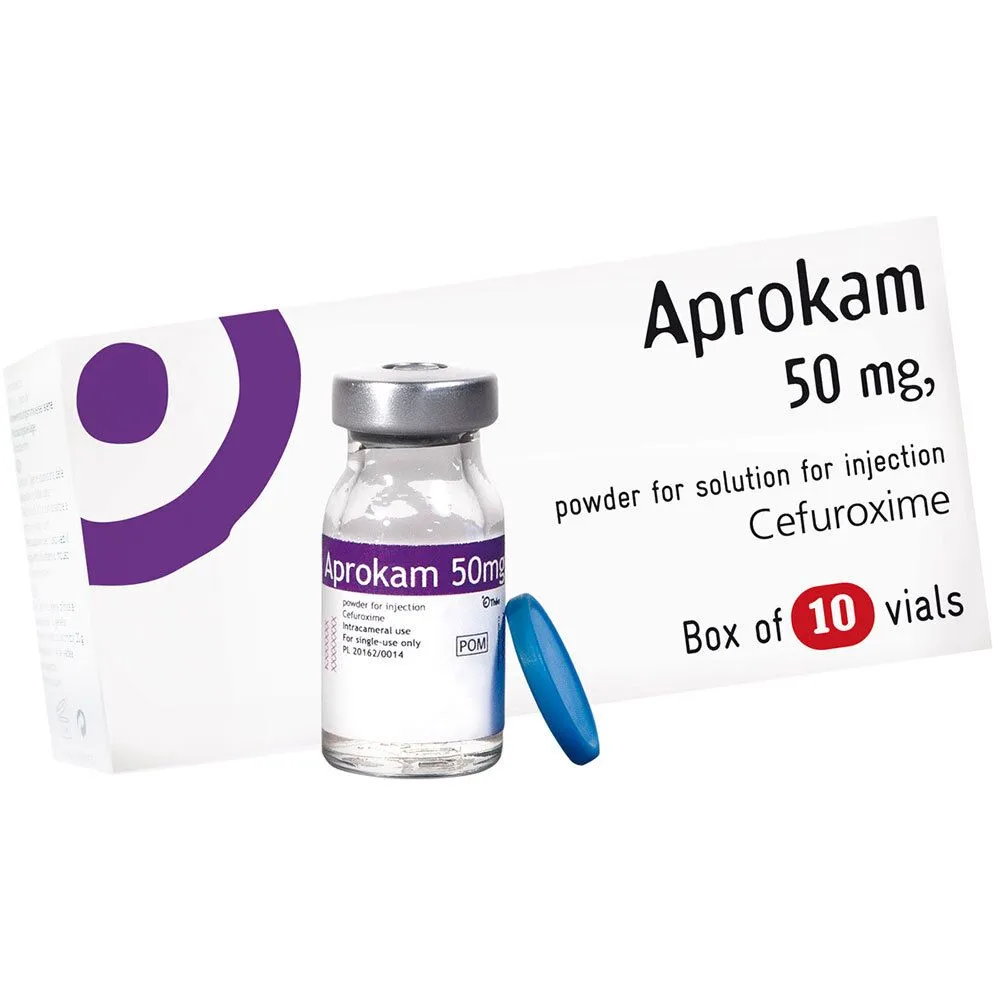
Table of Contents
Package leaflet: Information for the user
APROKAM 50 mg powder for injectable solution
Cefuroxime
Please read this leaflet carefully before using this medicine because it contains
important information for you.
- Keep this leaflet. You may need to read it again.
- If you have any questions, ask your doctor, pharmacist, or nurse.
- This medicine has been prescribed for you only. Do not give it to other people, even if they have the same symptoms as yours, because it could be harmful.
- If you experience any adverse reactions, including those not listed in this leaflet, contact your doctor, pharmacist, or nurse. See section 4.
Contents of this leaflet:
- What APROKAM is and what it is used for
- Before you use APROKAM
- How to use APROKAM
- Possible side effects
- How to store APROKAM
- Contents of the pack and other information
1. WHAT APROKAM IS AND WHAT IT IS USED FOR
- APROKAM contains an active substance, cefuroxime (in the form of cefuroxime sodium), which belongs to a group of antibiotics called cephalosporins. Antibiotics are used to kill bacteria or "germs" that cause infections.
- This medicine will be used if you are undergoing eye surgery due to cataract (clouding of the lens).
- The ophthalmic surgeon will administer this medicine by injection into the eye at the end of cataract surgery to prevent eye infection.
2. BEFORE USING APROKAM
DO NOT use APROKAM
- If you are allergic (hypersensitive) to cefuroxime or to any other antibiotic of the cephalosporin class.
Take special care with APROKAM
Inform your doctor, pharmacist, or nurse before using APROKAM:
- if you are allergic to other antibiotics such as penicillin,
- if you are at risk of infection by bacteria called Staphylococcus aureus resistant to methicillin (MRSA),
- if you are at risk of severe infection,
- if you have been diagnosed with complicated cataract,
- if combined eye surgery is planned,
- if you have a severe thyroid disease.
APROKAM is administered only by injection into the eye (intracameral injection).
APROKAM must be administered under aseptic conditions as required for cataract surgery (i.e., clean environment and absence of germs).
One vial of APROKAM must be used for only one patient.
Other medicines and APROKAM
Inform your doctor or pharmacist if you are taking, have recently taken, or might take any other medicines.
Pregnancy and Breast-feeding
- If you are pregnant or breast-feeding, think you may be pregnant, or are planning to have a baby, consult your doctor or pharmacist before taking this medicine.
- You will be given APROKAM only if the benefits outweigh the potential risks.
APROKAM contains sodium
This medicine contains less than 1 mmol (23 mg) of sodium per dose, i.e. essentially “sodium-free”.
3. HOW TO USE APROKAM
- APROKAM must be administered by an ophthalmic surgeon at the end of cataract surgery.
- APROKAM is a sterile powder to be dissolved in an injectable saline solution prior to administration.
If too much or too little APROKAM is administered
The medicine is administered by a healthcare professional. If you think a dose has been missed or if too much medicine has been given, inform the doctor or pharmacist.
If you have any doubts about the use of this medicine, consult your doctor, pharmacist, or nurse.
4. POSSIBLE SIDE EFFECTS
Like all medicines, APROKAM may cause side effects, although not everyone experiences them.
The following side effect is very rare (may affect up to 1 in 10,000 people):
- Severe allergic reaction causing difficulty in breathing or dizziness.
The following adverse reaction is reported with frequency "not known" (cannot be estimated from available data):
- Macular edema (blurred or distorted vision near or at the center of the visual field).
Reporting of side effects
If you experience any side effect, including those not listed in this leaflet, please consult your doctor, pharmacist, or nurse. You may also report side effects directly via the national reporting system at the website https://www.aifa.gov.it/content/segnalazioni-reazioni-avverse.
By reporting side effects, you can help provide more information on the safety of this medicine.
5. HOW TO STORE APROKAM
Keep this medicine out of the sight and reach of children.
Do not use APROKAM after the expiry date stated on the carton and label of the vial. The expiry date refers to the last day of the month.
Store below 25°C. Keep the vial in its outer carton to protect it from light.
For single use only.
After reconstitution: the product must be used immediately.
Medicines must not be disposed of via wastewater or household waste. Ask your pharmacist how to dispose of medicines you no longer use. This will help protect the environment.
6. PACK CONTENTS AND OTHER INFORMATION
What APROKAM contains
The active substance is cefuroxime (as cefuroxime sodium).
Each vial contains 50 mg of cefuroxime.
After reconstitution, 0.1 ml of solution contains 1 mg of cefuroxime.
There are no other excipients.
Description of the appearance of APROKAM and pack contents
APROKAM is a white or almost white powder for injectable solution, presented in a glass vial.
Each pack may contain 1 vial, or 10 vials, or 20 vials, or 10 vials with 10 sterile filter needles.
Not all pack sizes may be marketed.
Marketing Authorisation Holder and Manufacturer
Marketing Authorisation Holder:
LABORATOIRES THEA
12 rue Louis Blériot
63017 CLERMONT-FERRAND Cedex 2
France
Manufacturer:
BIOPHARMA S.R.L.
Via Delle Gerbere, 22/30 (loc. Santa Palomba)
00134 ROMA (RM)
Italy
or
LABORATOIRES THEA
12 rue Louis Blériot
63017 CLERMONT-FERRAND Cedex 2
France
This medicinal product is authorised in the European Union Member States under the following names:
Austria, Belgium, Bulgaria, Czech Republic, Denmark, Finland, France, Germany, Italy,
Iceland, Luxembourg, Netherlands, Norway, Poland, Portugal, Romania, Slovakia, Slovenia,
Sweden, United Kingdom ............................................................................................................. APROKAM
Cyprus, Greece, Spain .............................................................................................................. PROKAM
Ireland ......................................................................................................................................... APROK
This leaflet was last approved on:
More detailed information on this medicinal product is available on the website www.agenziafarmaco.it
The following information is intended exclusively for physicians or healthcare professionals
Incompatibilities
No incompatibilities have been reported in the literature with products commonly used in cataract surgery. This medicinal product must not be mixed with other medicinal products except those mentioned below [sodium chloride 9 mg/ml (0.9%) injectable solution].
How to prepare and administer APROKAM
Single-dose vial for a single intracameral administration.
After reconstitution, APROKAM must be administered by intraocular injection into the anterior chamber of the eye (intracameral injection), performed by an ophthalmic surgeon under the aseptic conditions recommended for cataract surgery.
The reconstituted solution should be inspected visually and may only be used if it appears as a clear to slightly yellow solution, free from visible particles.
The product must be used immediately after reconstitution and must not be reused thereafter.
The recommended dose of cefuroxime is 1 mg dissolved in 0.1 ml of sodium chloride 9 mg/ml (0.9%) injectable solution.
DO NOT INJECT MORE THAN THE RECOMMENDED DOSE.
Single-dose vial for single administration.
One vial must be used exclusively for a single patient. Attach the detachable vial label to the patient's medical record.
| To prepare APROKAM for intracameral administration, please follow these instructions: | |
must be disinfected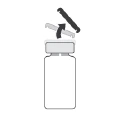 | 1. Check the integrity of the flip-off cap before removing it |
at least 0.1 ml with a 5 µm filter needle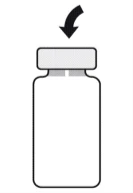 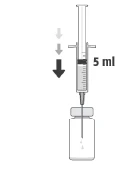 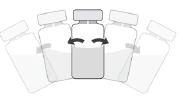 | 2. Disinfect the outer surface of the rubber stopper of the vial before proceeding to step 3. 3. Insert the needle perpendicularly into the center of the vial stopper, keeping the vial in an upright position. Then, inject 5 ml of sodium chloride 9 mg/ml (0.9%) injectable solution into the vial using aseptic technique. 4. Gently agitate until the solution is practically free of visible particles. 5. Assemble the sterile needle (18G x 1½”, 1.2 mm x 40 mm) with a 5-micron filter (acrylic copolymer membrane on non-woven nylon) to a sterile 1 ml syringe (the sterile 5-micron filter needle may be supplied with the pack). Then, insert the sterile 1 ml syringe perpendicularly into the center of the vial stopper, keeping the vial in an upright position. 6. Aseptically withdraw at least 0.1 ml of the solution. 7. Disconnect the needle from the syringe and attach the syringe to an appropriate anterior chamber cannula. 8. Carefully expel air from the syringe and adjust the dose to the 0.1 ml mark on the syringe. The syringe is now ready for injection. |
After use, discard any remaining reconstituted solution. Do not keep it for subsequent use.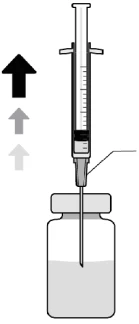 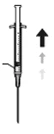 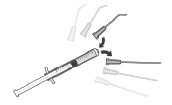 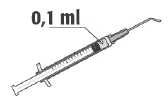 | |
Any unused medicinal product or waste material must be disposed of in accordance with current regulations.
Dispose of used needles in the designated container.