Anbinex
Italy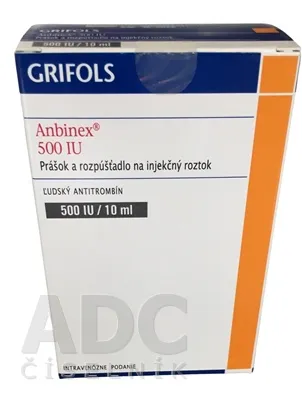
Table of Contents
- PACKAGE LEAFLET: INFORMATION FOR THE USER
- Anbinex 500 IU Powder and Solvent for Solution for Infusion, 1000 IU Powder and Solvent for Solution for Infusion
- 1. What Anbinex is and what it is used for
- 2. What you need to know before using Anbinex
- 3. How to use Anbinex
- 4. Possible side effects
- 5. How to store Anbinex
- 6. Package contents and other information
PACKAGE LEAFLET: INFORMATION FOR THE USER
Anbinex 500 IU Powder and Solvent for Solution for Infusion, 1000 IU Powder and Solvent for Solution for Infusion
Human Antithrombin
Please read this leaflet carefully before using this medicine because it contains
important information for you.
- Keep this leaflet. You may need to read it again.
- If you have any questions, ask your doctor, pharmacist or nurse.
- This medicine has been prescribed for you only. Do not give it to other people, even if their symptoms are the same as yours, as it may be harmful.
- If you experience any side effects, including those not listed in this leaflet, tell your doctor, pharmacist or nurse. See section 4.
Contents of this leaflet:
- What Anbinex is and what it is used for
- What you need to know before using Anbinex
- How to use Anbinex
- Possible side effects
- How to store Anbinex
- Contents of the pack and other information
1. What Anbinex is and what it is used for
Anbinex is an anticoagulant agent belonging to the group of medicines known as injectable anticoagulants.
Anbinex is used in congenital or acquired antithrombin deficiency for the prevention of increased risk of blood clot formation in the vessels of the lower limbs (deep vein thrombosis), or in other parts of the body (thromboembolism) during surgery or the peri-partum period, and in combination with heparin where indicated.
2. What you need to know before using Anbinex
Do not use Anbinex
- if you are allergic to human antithrombin or to any of the other ingredients of this medicine (listed in section 6).
Warnings and precautions
Talk to your doctor, pharmacist, or nurse before using Anbinex.
As with all intravenous protein-based products, allergic-type reactions may occur.
You must be closely monitored and carefully observed for any symptoms that may occur during infusion. If you notice any signs of hypersensitivity reaction such as hives, generalized redness, tightness in the chest, or wheezing (difficulty breathing), contact your doctor immediately.
Viral safety
Standard procedures adopted to prevent infections from medicines prepared from human blood and plasma include:
- careful selection of blood and plasma donors to ensure that individuals at risk of infection are excluded,
- screening of individual donations and pooled plasma for specific viral markers,
- inclusion of effective viral inactivation/removal steps during the manufacturing process.
Nevertheless, when medicines derived from human blood or plasma are administered, the possibility of transmitting infectious agents cannot be completely ruled out. This also applies to unknown or emerging viruses and other pathogens.
Standard procedures are considered effective against lipid-enveloped viruses such as Human Immunodeficiency Virus (HIV), Hepatitis B virus, and Hepatitis C virus, as well as the non-enveloped Hepatitis A virus. Measures taken may have limited effectiveness against non-enveloped viruses such as parvovirus B19. Parvovirus B19 infection may be serious for pregnant women (fetal infection) and for individuals with weakened immune systems or certain types of anemia (e.g., sickle cell anemia or hemolytic anemia).
Your doctor may recommend appropriate vaccination (hepatitis A and B) if you regularly or repeatedly receive plasma-derived antithrombin concentrates.
It is strongly recommended that each time you receive a dose of Anbinex, the name and batch number of the product are recorded, in order to maintain traceability of the batch used.
Other medicines and Anbinex
Inform your doctor or pharmacist if you are taking, have recently taken, or might take any other medicines.
Simultaneous administration of antithrombin and therapeutic doses of heparin increases the risk of bleeding. The effect of antithrombin is strongly enhanced by heparin. Concurrent administration of heparin and antithrombin to a patient with increased risk of bleeding should be monitored both clinically and biologically.
Pregnancy and breastfeeding
Anbinex should be used during pregnancy and breastfeeding in women with antithrombin deficiency only if clearly indicated, taking into account that pregnancy increases the risk of thromboembolic events in these patients.
Ask your doctor or pharmacist for advice before using this medicine.
Driving and using machines
Anbinex does not affect, or has negligible effect on, the ability to drive vehicles or operate machinery.
Anbinex contains sodium
Anbinex 500 IU contains 1.45 mmol (33.35 mg) of sodium per 10 ml of solution.
Anbinex 1000 IU contains 2.90 mmol (66.7 mg) of sodium per 20 ml of solution.
This should be taken into consideration in patients on a low-sodium diet.
3. How to use Anbinex
Use this medicine exactly as your doctor has instructed you and as described in this leaflet. If you have any doubts, consult your doctor or pharmacist.
See the last section of this leaflet for the recommended dose and preparation of the solution.
Use in children and adolescents
There are insufficient data to recommend the use of Anbinex in children under 6 years of age.
If you use more Anbinex than you should
No consequences of overdose have been reported.
Frequency of administration
Your doctor will determine the frequency and intervals at which Anbinex should be administered.
Duration of treatment
Your doctor will determine the duration of your treatment with Anbinex.
4. Possible side effects
Like all medicines, this medicine can cause side effects, although not everybody gets them.
Hypersensitivity or allergic reactions (which may include swelling of the skin and subcutaneous tissues of the mouth and face - angioedema, burning and pain at the injection site, chills, flushing and skin erythema, headache, appearance of itchy skin lesions - urticaria, decrease in blood pressure - hypotension, drowsiness, nausea, restlessness, increased heart rate - tachycardia, tightness in the chest, tingling, vomiting, respiratory noises - wheezing) have been observed with low frequency. In some cases, these reactions may progress to anaphylactic shock.
Fever has been reported rarely.
If any of these symptoms occur after administration, speak to a doctor immediately.
For information on viral safety, see section 2.
Reporting of side effects
If you get any side effects, including any not listed in this leaflet, tell your doctor, pharmacist or nurse. You can also report side effects directly via segnalare-una-sospetta-reazione-avversa.
By reporting side effects, you can help provide more information on the safety of this medicine.
5. How to store Anbinex
Keep this medicine out of the sight and reach of children.
Do not use this medicine after the expiry date stated on the label after "Exp".
The expiry date refers to the product kept unopened and properly stored.
Do not store above 30 °C. Do not freeze.
Protect from light. Store in the outer packaging.
Reconstituted product
After reconstitution, the product has been demonstrated to be chemically and physically stable for
12 hours at 25 °C. The product should be used immediately in order to avoid potential bacterial or
infectious contamination. If not used immediately, the time and conditions of storage prior to use are
the responsibility of the user and, under normal circumstances, will not exceed 24 hours at 2 - 8 °C,
unless reconstitution has been carried out under controlled and validated aseptic conditions.
The solution is generally clear or slightly opalescent. Do not use this medicine if you notice cloudiness or deposits.
Do not dispose of medicines via wastewater or household waste. Ask your pharmacist how to dispose of medicines no longer required. This will help protect the environment.
6. Package contents and other information
What Anbinex contains
- The active substance is human antithrombin. Each vial of lyophilisate contains 500 IU or 1000 IU of human antithrombin. Once reconstituted, the antithrombin concentration is 50 IU/ml (500 IU/10 ml or 1000 IU/20 ml).
- The other components are D-mannitol, sodium chloride, and sodium citrate.
- Each pre-filled syringe containing solvent contains 10 ml or 20 ml of water for injections (water for injectable preparations).
For further information on the ingredients, see also section 2.
Description of the appearance of Anbinex and package contents
Each vial contains a white, hygroscopic powder or friable solid, and a pre-filled syringe with water for injections.
Each package of Anbinex 500 IU contains one vial containing 500 IU of human antithrombin (powder for infusion) and one pre-filled syringe containing 10 ml of water for injections (solvent).
Each package of Anbinex 1000 IU contains one vial containing 1000 IU of human antithrombin (powder for infusion) and one pre-filled syringe containing 20 ml of water for injections (solvent).
The accessories supplied with Anbinex for reconstitution of the product are: vial adapter and filter.
Marketing Authorization Holder and Manufacturer
Instituto Grifols, S.A.
Can Guasc, 2 - Parets del Vallès
08150 Barcelona - SPAIN
The following information is intended exclusively for physicians or healthcare professionals:
In congenital deficiency, the dosage must be individualized for each patient, taking into account the family history of thromboembolic events, actual risk factors, and laboratory data.
In acquired deficiency, the dosage and duration of replacement therapy depend on the plasma level of antithrombin, the presence of signs of increased turnover, the underlying disease, and the severity of the clinical condition. The amount and frequency of administration should be determined on a case-by-case basis according to the clinical efficacy of treatment and individual laboratory assessments.
The number of antithrombin units administered is expressed in International Units (IU), in accordance with the current WHO standard for antithrombin. Antithrombin activity in plasma is expressed both as a percentage (relative to normal human plasma) and in International Units (relative to the International Standard for antithrombin in plasma).
One International Unit (IU) of antithrombin activity is equivalent to the amount of antithrombin present in one millilitre of normal human plasma. The calculation of the required antithrombin dosage is based on the experimental observation that one International Unit of antithrombin per kilogram of body weight increases plasma antithrombin activity by approximately 1%.
The initial dose to be administered can be calculated using the following formula:
Units required = body weight (kg) x (100 - measured antithrombin activity at the time,
expressed as a percentage) x 0.8
The desired initial antithrombin activity depends on the clinical situation. When antithrombin replacement is indicated, the dosage should be sufficient to achieve and maintain the desired activity level effectively. The dose should be determined and monitored based on laboratory-measured antithrombin activity, which must be assessed at least twice daily until the patient is stabilized, and then once daily, preferably just before the next infusion. Dose adjustments should take into account both signs of increased antithrombin turnover, as indicated by laboratory monitoring, and the clinical course. An activity level above 80% should be maintained throughout treatment, unless clinical conditions indicate a different effective level.
In congenital deficiency, the usual initial dose is 30–50 IU/kg.
Subsequently, dosage, frequency, and duration of treatment should be adjusted based on biological values and clinical status.
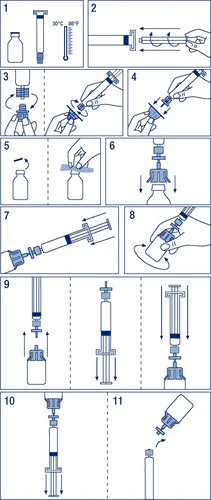
To prepare the solution:
- Warm the vial and syringe, not exceeding 30°C.
- Insert the plunger into the syringe containing the solvent.
- Remove the filter from its packaging. Remove the cap from the syringe connector and attach the syringe to the filter.
- Remove the vial adapter from its packaging and connect it to the filter on the syringe.
- Remove the plastic protector from the vial and clean the stopper with a disinfectant swab.
- Pierce the vial stopper with the needle of the adapter.
- Transfer all the solvent from the syringe into the vial.
- Gently rotate the vial without shaking until the entire product is dissolved.
- Disconnect the syringe with the filter from the vial with the adapter. Pull back the plunger to introduce an air volume equal to the solution volume. Reconnect the syringe with the filter to the vial with the adapter and inject the air.
- With the vial held upright, draw the solution into the syringe.
- Disconnect the syringe and administer the solution slowly by intravenous injection. The infusion rate must not exceed 0.08 ml/kg/min.
Any unused product must never be stored for later use.
Do not reuse administration sets.