Anagrelide Teva
Italy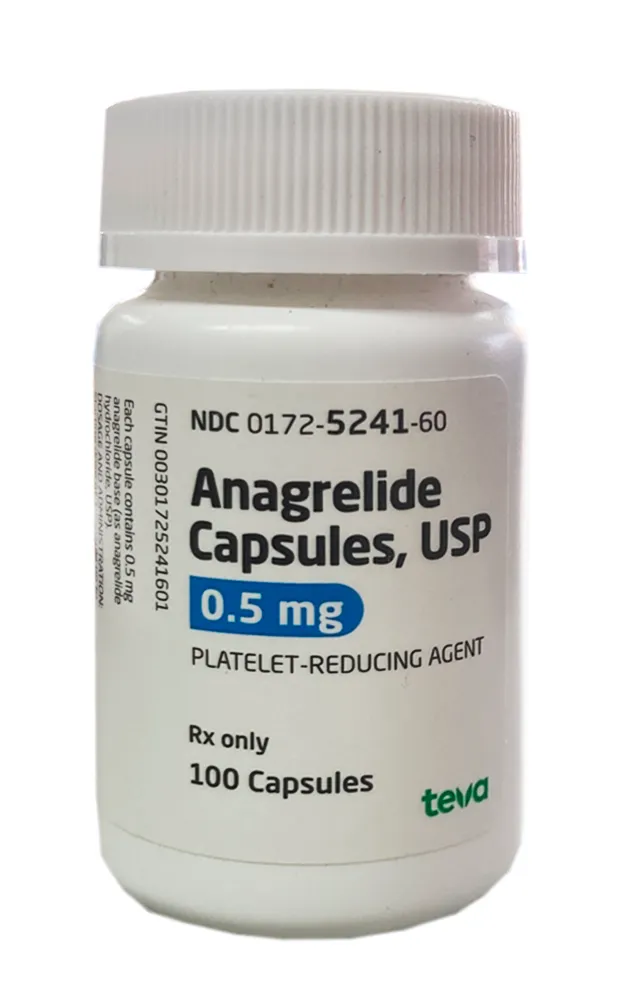
Table of Contents
- Patient Information Leaflet: Information for the patient
- Anagrelide Teva 0.5 mg Hard Capsules
- 1. What Anagrelide Teva is and what it is used for
- 2. What you need to know before taking Anagrelide Teva
- 3. How to take Anagrelide Teva
- 4. Possible side effects
- 5. How to store Anagrelide Teva
- 6. Package contents and other information
Patient Information Leaflet: Information for the patient
Anagrelide Teva 0.5 mg Hard Capsules
anagrelide
Generic medicine
Please read this leaflet carefully before taking this medicine, as it contains important information for you.
- Keep this leaflet. You may need to read it again.
- If you have any questions, ask your doctor or pharmacist.
- This medicine has been prescribed for you only. Do not give it to others, even if their symptoms are the same as yours, as it may be harmful.
- If you experience any side effect, including those not listed in this leaflet, contact your doctor or pharmacist. See section 4.
Contents of this leaflet
- What Anagrelide Teva is and what it is used for
- What you need to know before taking Anagrelide Teva
- How to take Anagrelide Teva
- Possible side effects
- How to store Anagrelide Teva
- Contents of the pack and other information
1. What Anagrelide Teva is and what it is used for
Anagrelide Teva contains the active substance anagrelide. Anagrelide Teva is a medicine that interferes with platelet development. It reduces the number of platelets produced by the bone marrow, resulting in a decrease in the number of platelets in the blood to a level closer to normal. For this reason, it is used to treat patients with essential thrombocythaemia.
Essential thrombocythaemia is a disorder that occurs when the bone marrow produces excessive amounts of blood components known as platelets. Having a high number of platelets in the blood can cause serious circulation and blood clotting problems.
2. What you need to know before taking Anagrelide Teva
DO NOT TAKE Anagrelide Teva:
- if you are allergic to anagrelide or to any of the other ingredients of this medicine (listed in section 6). Possible signs of an allergic reaction include skin rash, itching, swelling of the face or lips, and shortness of breath;
- if you have moderate or severe liver problems;
- if you have moderate or severe kidney problems.
Warnings and precautions
Talk to your doctor before taking Anagrelide Teva:
- if you have or think you may have heart problems;
- if you were born with or have a family history of QT interval prolongation (seen on an ECG, the recording of the heart's electrical activity), if you are taking other medicines that cause abnormal changes in the ECG, or if you have low levels of electrolytes, e.g. potassium, magnesium, or calcium (see section “Other medicines and Anagrelide Teva”);
- if you have liver or kidney problems.
When used together with acetylsalicylic acid (a substance found in many medicines used to relieve pain and reduce fever, as well as to prevent blood clots, also known as aspirin), there is an increased risk of major bleeding (bleeding). (See section “Other medicines and Anagrelide Teva”.)
Children and adolescents
Information on the use of Anagrelide Teva in children and adolescents is limited, and therefore this medicine should be used with caution.
Other medicines and Anagrelide Teva
Tell your doctor or pharmacist if you are taking, have recently taken, or might take any other medicines.
Inform your doctor if you are taking any of the following medicines:
- Medicines that may affect heart rhythm, such as sotalol, amiodarone;
- Fluvoxamine, used to treat depression;
- Certain types of antibiotics, such as enoxacin, used to treat infections;
- Theophylline, used to treat asthma and breathing difficulties;
- Medicines used to treat heart conditions, such as milrinone, enoximone, amrinone, olprinone, and cilostazol;
- Acetylsalicylic acid (a substance found in many medicines used to relieve pain and reduce fever, as well as to prevent blood clots, also known as aspirin);
- Other medicines used to treat platelet disorders in the blood, such as clopidogrel;
- Omeprazole, used to reduce the amount of acid produced in the stomach;
- Oral contraceptives: if you develop severe diarrhoea while taking this medicine, the effectiveness of oral contraceptives may be reduced, and you are advised to use an additional method of contraception (such as condoms). Read the package leaflet of the contraceptive pill you are taking.
The effect of Anagrelide Teva or of these other medicines may be reduced when taken together.
If you have any doubts, consult your doctor or pharmacist for advice.
Pregnancy and breastfeeding
Inform your doctor if you are pregnant or planning to become pregnant. Anagrelide Teva must not be taken by pregnant women. Women of childbearing potential must use effective contraception while taking Anagrelide Teva. Consult your doctor for advice on contraceptive methods.
Inform your doctor if you are breastfeeding or intend to breastfeed. Anagrelide Teva must not be taken by women who are breastfeeding. If you take Anagrelide Teva, you must stop breastfeeding.
Driving and using machines
Some patients taking Anagrelide Teva have reported dizziness. If you experience dizziness, do not drive and do not use machines.
Anagrelide Teva contains lactose
If your doctor has diagnosed you with an intolerance to certain sugars, contact him or her before taking this medicine.
3. How to take Anagrelide Teva
Take this medicine exactly as instructed by your doctor. If you have any doubts, consult your doctor or pharmacist.
The amount of Anagrelide Teva you need may vary from patient to patient, depending on your condition. Your doctor will prescribe the dose most suitable for you.
The usual starting dose of Anagrelide Teva is 1 mg. You should take this dose by taking one 0.5 mg capsule twice daily for at least one week. Afterwards, your doctor may increase or decrease the number of capsules you take in order to determine the most appropriate dose for you, i.e. the dose that provides the most effective treatment for your condition.
The capsules must be swallowed whole with a glass of water. Do not crush the capsules or dissolve the contents in liquid. You may take the capsules with food, after meals, or on an empty stomach.
It is recommended to take the capsule(s) at the same time each day.
Do not take more capsules than recommended by your doctor.
Your doctor will ask you to have regular blood tests to monitor the effectiveness of the medicine and to check that your liver and kidneys are functioning properly.
If you take more Anagrelide Teva than you should
If you take more Anagrelide Teva than prescribed, or if someone else has taken your medicine, inform your doctor or pharmacist immediately, showing them the Anagrelide Teva packaging.
If you forget to take Anagrelide Teva
Take the missed dose as soon as you remember. Take the next dose at your usual time. Do not take a double dose to make up for the missed dose.
4. Possible side effects
Like all medicines, this medicine can cause side effects, although not everyone gets them. If you have any doubts, speak to your doctor.
Serious side effects:
Uncommon: heart failure (symptoms include breathlessness, chest pain, swelling of the legs due to fluid accumulation), serious problems with heart rate or rhythm (ventricular tachycardia, supraventricular tachycardia or atrial fibrillation), inflammation of the pancreas causing severe abdominal and back pain (pancreatitis), vomiting blood or presence of blood in stools or black stools, severe reduction in blood cells which may cause weakness, bruising, bleeding or infections (pancytopenia), pulmonary hypertension (symptoms include shortness of breath, swelling of legs or ankles, and possible bluish discoloration of lips and skin).
Rare: kidney failure (when urine output is low or absent), heart attack.
If you notice any of these side effects, contact your doctor immediately.
Very common side effects: may affect more than 1 in 10 people
Headache.
Common side effects: may affect up to 1 in 10 people
Dizziness, tiredness, increased heart rate, irregular or strong heartbeats (palpitations), feeling unwell (nausea), diarrhoea, stomach pain, flatulence, feeling unwell (vomiting), reduction in red blood cells in the blood (anaemia), fluid retention or skin rashes.
Uncommon side effects: may affect up to 1 in 100 people
Feeling weak or unwell, high blood pressure, irregular heartbeat, fainting, chills or fever, indigestion, loss of appetite, constipation, bruising, bleeding, swelling (oedema), weight loss, muscle pain, painful joints, back pain, reduced or loss of sensation or feelings of numbness, especially of the skin, abnormal perception or sensations such as tingling, insomnia, depression, confusion, nervousness, dry mouth, memory loss, shortness of breath, nosebleeds, severe lung infection with fever, breathlessness, cough, phlegm; hair loss, skin discolouration or itching, impotence, chest pain, low platelet count in the blood, leading to increased risk of bleeding or bruising (thrombocytopenia), fluid accumulation around the lungs or increased liver enzymes. Your doctor may carry out blood tests that could reveal increased liver enzymes.
Rare side effects: may affect up to 1 in 1,000 people
Bleeding gums, weight gain, severe chest pain (angina pectoris), disease of the heart muscle (symptoms include fatigue, chest pain and palpitations), enlarged heart, fluid accumulation around the heart, loss of coordination, difficulty speaking, dry skin, migraine, vision disturbances or double vision, ringing in the ears, dizziness when standing up (especially when rising from sitting or lying down), increased need to urinate during the night, pain, flu-like symptoms, drowsiness, dilation of blood vessels, inflammation of the large intestine (symptoms include: diarrhoea, usually with blood and mucus, stomach pain, fever), inflammation of the stomach (symptoms include: pain, nausea, vomiting), areas of abnormal density in the lungs, increased levels of creatinine in the blood, which may indicate kidney problems.
The following side effects have been reported, but their frequency is unknown:
- Irregular heartbeats, potentially life-threatening (torsades de pointes);
- Inflammation of the liver, with symptoms including nausea, vomiting, itching, yellowing of the skin and eyes, change in stool and urine colour (hepatitis);
- Inflammation of the lungs (symptoms include fever, cough, breathing difficulties, wheezing, and may lead to lung scarring) (allergic alveolitis, including interstitial lung disease, pneumonia);
- Inflammation of the kidneys (tubulo-interstitial nephritis).
Reporting of side effects
If you experience any side effect, including those not listed in this leaflet, talk to your doctor or pharmacist. You can also report side effects directly via the national reporting system at www.agenziafarmaco.gov.it/content/come-segnalare-una-sospetta-reazione-avversa
By reporting side effects, you can help provide more information on the safety of this medicine.
5. How to store Anagrelide Teva
Keep this medicine out of the sight and reach of children.
Do not use this medicine after the expiry date which is stated on the carton and on the label of the
bottle after Exp. The expiry date refers to the last day of that month.
Do not store above 30°C.
Keep the medicine in its original packaging to protect it from light and moisture.
If your doctor advises you to stop taking this medicine, do not keep any remaining capsules unless
your doctor specifically tells you to do so. Do not dispose of any medicine via wastewater or household waste.
Ask your pharmacist how to dispose of medicines you no longer use. This will help protect the environment.
6. Package contents and other information
What Anagrelide Teva contains
The active substance is anagrelide. Each capsule contains 0.5 mg of anagrelide (as anagrelide hydrochloride).
The other components are:
Capsule contents: lactose monohydrate, croscarmellose sodium, povidone K 29/32, lactose, microcrystalline cellulose, and magnesium stearate (see section 2, “Anagrelide Teva contains lactose”).
Capsule shell: gelatin and titanium dioxide (E171).
Description of the appearance of Anagrelide Teva and pack sizes
Anagrelide Teva 0.5 mg is presented as white, opaque hard capsules approximately 14.3 mm in length. The capsules are supplied in bottles containing 42 and 100 hard capsules.
Not all pack sizes may be marketed.
Marketing Authorization Holder
Teva BV
Swensweg 5
2031 GA Haarlem
The Netherlands
Manufacturer
Synthon Hispania S.L., C/Castelló, n° 1, Pol. Las Salinas, Sant Boi de Llobregat, Barcelona, 08830 – Spain
Synthon BV, Microweg 22, Nijmegen, 6545CM – The Netherlands
Merckle GmbH, Ludwig-Merckle-Strasse 3, Blaubeuren, Baden-Wuerttemberg, 89143 – Germany
The reference medicinal product containing anagrelide has been granted a marketing authorization under the category “exceptional circumstances”. This means that, due to the rarity of the disease, it has not been possible to obtain complete information on this medicinal product.
The European Medicines Agency will review any new information on this medicinal product annually, and this package leaflet will be updated if necessary.