Alprostar
ItalyTable of Contents
- Package leaflet: Information for the patient
- Alprostar 20 micrograms
- 1. What Alprostar is and what it is used for
- 2. What you need to know before using Alprostar
- 3. How to use Alprostar
- 4. Possible side effects
- 5. How to store Alprostar
- 6. Package contents and other information
- The following information is intended exclusively for healthcare professionals:
Package leaflet: Information for the patient
Alprostar 20 micrograms
powder for solution for intravenous and intra-arterial infusion
Alprostar 60 micrograms
powder for solution for intravenous and intra-arterial infusion
alprostadil alfaciclodextrin
Please read this leaflet carefully before using this medicine because it contains important information for you.
- Keep this leaflet. You may need to read it again.
- If you have any questions, ask your doctor, pharmacist or nurse.
- This medicine has been prescribed for you only. Do not give it to other people, even if their symptoms are the same as yours, as it could be harmful.
- If you experience any side effect, including those not listed in this leaflet, tell your doctor, pharmacist or nurse. See section 4.
Contents of this leaflet:
- What Alprostar is and what it is used for
- What you need to know before using Alprostar
- How to use Alprostar
- Possible side effects
- How to store Alprostar
- Contents of the pack and other information
1. What Alprostar is and what it is used for
Alprostar contains the active substance alprostadil alfaciclodextrin.
It belongs to a group of medicines called "cardiac preparations, prostaglandins", which are used to treat certain blood vessel disorders.
Alprostar is used for:
- the treatment of advanced inflammation of small and medium-sized blood vessels that tend to become blocked (thromboangiitis obliterans or Buerger's disease), associated with a disease caused by obstruction of the arteries (critical ischemia) in the lower limbs when surgical intervention to restore blood flow (revascularization) is not possible
- the treatment of severe narrowing of the arteries (obliterative arterial disease, stage III), associated with a disease caused by obstruction of the arteries (critical ischemia) in the lower limbs when surgical intervention to restore blood flow (revascularization) is not possible.
2. What you need to know before using Alprostar
Do not use Alprostar
if you are allergic to the active substance or to any of the other ingredients of this medicine (listed
in section 6)
if you are pregnant or breastfeeding
if you have inadequate heart function (acute or chronic congestive heart failure)
if there is suspicion of increased blood in the lung vessels (pulmonary congestion)
if you have had a heart attack (myocardial infarction) within the last six months
if you have heart artery problems (coronary artery disease), severe disturbances in heart rhythm (cardiac arrhythmias), or heart valve problems (valvular heart disease, for example aortic or mitral stenosis)
if you have very low blood pressure (severe hypotension) or very high blood pressure (severe hypertension)
if you have severe chronic lung disease with bronchial obstruction (severe chronic obstructive pulmonary disease) or a disease causing obstruction in the pulmonary veins (pulmonary veno-occlusive disease)
if you have fluid accumulation in the lungs (pulmonary edema)
if you have widespread cellular infiltration in the lungs (disseminated pulmonary infiltrate)
if you are experiencing bleeding (haemorrhage) or conditions that increase the risk of bleeding (for
example, lesions (ulcers) or bleeding in the stomach and/or the first part of the intestine (duodenum))
if you have severe and/or acute liver disease (impaired liver function manifests as elevated transaminases or gamma-GT)
if you have had a severe stroke (cerebrovascular accident) within the last 6 months
if you have severe kidney problems with reduced urine production (oliguria)
if you have diseases for which infusion therapy is not recommended (such as congestive heart failure, pulmonary or cerebral edema, or hyperhydration)
Warnings and precautions
Talk to your doctor, pharmacist, or nurse before using Alprostar:
- if you have heart or blood vessel problems
- if your kidney function is impaired
- if you suffer from low blood pressure
- if you suffer from a condition causing a drop in blood pressure upon sudden change from a sitting or lying position to an upright position (orthostatic hypotension)
- if you have fluid accumulation in the body (peripheral edema), Alprostar Alprostar
Alprostar
Other medicines and Alprostar
Inform your doctor or pharmacist if you are taking, have recently taken, or might take any other
medicines.
Tell your doctor if you are taking any of the following medicines
because Alprostar could enhance their effects:
- medicines that dilate blood vessels (vasodilators)
- medicines that slow blood clotting (antiplatelet agents and anticoagulants)
- medicines that may lower blood pressure, such as those for high blood pressure (antihypertensives), angina (chest pain), or ischemia (severe reduction in blood flow).
No other medicines should be added to the ready-to-use solution.
Fertility, pregnancy and breastfeeding
If you are pregnant, suspect you may be pregnant, planning a pregnancy, or are breastfeeding, consult your doctor or pharmacist before using this medicine.
Alprostar must not be used during pregnancy or breastfeeding.
Alprostar must not be used by women who could become pregnant.
Driving and using machines
Alprostar may affect your reaction ability, potentially impairing your capacity to drive or operate machinery. Do not drive or operate machinery until you have determined whether this medicine affects your ability to perform these tasks.
3. How to use Alprostar
Alprostar must only be used under strict medical supervision in a hospital setting.
Use this medicine exactly as prescribed by your doctor or pharmacist. If you have any doubts, consult your doctor or pharmacist.
Your doctor will determine the treatment regimen with Alprostar based on your specific clinical condition.
Alprostar will be administered to you only by healthcare personnel via intravenous or intra-arterial infusion.
The treatment period must not exceed 4 weeks.
After 3 weeks of treatment, your doctor will decide, based on your health status, whether to continue or discontinue therapy.
Use in children
Alprostar is not recommended in children.
Patients with renal problems
If you have kidney problems, your doctor will prescribe additional tests, such as monitoring of fluid and electrolyte balance and renal function.
If you use more Alprostar than you should
Possible signs and symptoms of an Alprostar overdose include:
- loss of consciousness associated with pallor and sweating, nausea and vomiting
- pain, swelling and redness at the infusion site
- decreased blood pressure with increased heart rate
If these effects occur, treatment with Alprostar will be discontinued and the symptoms that have arisen will be treated.
4. Possible side effects
Like all medicines, Alprostar can cause side effects, although not everyone experiences them.
Regardless of the route of administration (arterial or venous), the following side effects have been observed:
Common (may affect between 1 in 100 and 1 in 1)
- headache (cephalalgia)
- pain
- hot flushes
- swelling due to fluid accumulation (edema)
- skin redness (cutaneous flushing)
- localized fluid accumulation (edema)
- sensation of warmth
- sensation of swelling
- tingling, numbness of extremities (paresthesia)
After intra-arterial administration
- sensation of warmth
- sensation of swelling
- localized fluid accumulation (edema)
- tingling, numbness of extremities (paresthesia)
Uncommon (may affect between 1 in 1,000 and 1 in 100)
- chest pain caused by reduced blood flow to the heart (angina pectoris)
- drop in blood pressure
- increased heart rate (tachycardia)
- diarrhoea, nausea and vomiting
- allergic reactions (skin rash, joint discomfort, fever, sweating and chills)
After intravenous administration
- sensation of warmth
- sensation of swelling
- localized fluid accumulation (edema)
- tingling, numbness of extremities (paresthesia)
Rare (may affect between 1 in 10,000 and 1 in 1,000)
- decrease or increase in white blood cell count (leucopenia or leucocytosis)
- decrease in platelet count (thrombocytopenia)
- confusion
- seizures
- irregular heart rhythm (arrhythmias)
- inability of the heart to pump blood effectively (heart failure)
- fluid accumulation in the lungs (pulmonary edema)
- liver abnormalities detected in blood tests
Very rare (may affect up to 1 in 10,000)
- severe and rapid allergic reaction (anaphylaxis and anaphylactoid reactions)
Not known
- stroke
- heart attack
- difficulty breathing (dyspnoea)
- skin redness (erythema during intra-arterial administration)
- phlebitis (inflammation of the vein used for infusion)
- blood clot formation at the catheter insertion site
- localized bleeding
- bleeding from stomach and/or intestine
After administration, the following have also been reported:
- abdominal pain
- weakness (asthenia)
- sudden drop in blood pressure (acute hypotension)
- irregular heartbeat (extrasystolic arrhythmias)
- difficulty breathing (dyspnoea)
- asthma
- increase in liver enzymes known as transaminases
- joint pain (arthralgia)
- agitation or reduced level of consciousness (sedation)
- increase in body temperature (hyperthermia)
- sweating
- chills
- abnormalities in certain laboratory tests (C-reactive protein and transaminases). These effects resolved upon discontinuation of treatment.
In isolated cases, the following have been observed:
- abnormal bony protrusions on long bones (exostoses), which may regress (observed only with treatments lasting more than four weeks)
Reporting of side effects
If you experience any side effect, including those not listed in this leaflet, talk to your doctor, pharmacist or nurse. You can also report side effects directly via the national reporting system at www.agenziafarmaco.gov.it/content/come-segnalare-una-sospetta-reazione-avversa By reporting side effects, you can help provide more information on the safety of this medicine.
5. How to store Alprostar
Store below 25°C and protect from light.
The infusion solution must be prepared immediately before use and must be used within 24 hours.
Keep this medicine out of the sight and reach of children.
Do not use this medicine after the expiry date which is stated on the carton after “Expiry”. The expiry date refers to the last day of that month.
Do not dispose of medicines via wastewater or household waste. Ask your pharmacist how to dispose of medicines you no longer use. This will help protect the environment.
6. Package contents and other information
What Alprostar contains
Alprostar 20 micrograms
- The active substance is alprostadil alfaciclodextrin. One vial contains 666.7 micrograms of alprostadil alfaciclodextrin (equivalent to 20.0 micrograms of alprostadil).
- The other component is anhydrous lactose. Alprostar 60 micrograms
- The active substance is alprostadil alfaciclodestrin. One vial contains 2000.0 micrograms of alprostadil alfaciclodextrin (equivalent to 60.0 micrograms of alprostadil).
- The other component is anhydrous lactose. Description of the appearance of Alprostar and contents of the pack Alprostar is a powder for solution for infusion, for intravenous or intra-arterial use. Alprostar is available in two strengths (20 micrograms and 60 micrograms), and the pack contains 1 vial for each strength.
Marketing Authorization Holder and Manufacturer
RECORDATI Industria Chimica e Farmaceutica S.p.A. – via M. Civitali, 1 – 20148 Milan, Italy.
Manufacturer
Labiana Pharmaceuticals S.L.U - Casanova, 27-31, 08757, Corbera de Llobregat (Barcelona), Spain
The following information is intended exclusively for healthcare professionals:
Precautions for use
The use of this product cannot be considered a therapeutic alternative in cases requiring urgent amputation (e.g., infected gangrene), which must not be delayed.
Patients receiving Alprostar must be closely monitored during each administration.
Frequent assessments of cardiac function, including monitoring of blood pressure, heart rate, and fluid balance, must be performed.
To avoid symptoms of fluid overload, the infusion volume of Alprostar must not exceed 50–100 ml/day (infusion pump), and the infusion time, as reported in section 4.2, must be strictly followed. Before patient discharge, stable cardiac status must be established.
Particular caution is required when treating patients with coronary artery disease, cardiac conditions with a history of heart failure or at increased risk of developing heart failure, patients with peripheral edema, or impaired renal function (serum creatinine > 1.5 mg/dl).
In these patients, careful clinical monitoring of cardiovascular function is advisable and, if necessary, appropriate monitoring including body weight, fluid and electrolyte balance, and repeated echocardiographic examinations should be implemented.
Patients with mild (GFR 60–89 ml/min/1.73m²) and moderate (GFR 30–59 ml/min/1.73m²) renal impairment must be closely monitored (with tests for fluid and electrolyte balance and renal function).
Alprostar must be administered only by physicians experienced in the treatment of peripheral arterial occlusive disease who are familiar with monitoring cardiovascular functions and who have access to adequate equipment. Alprostar must not be administered as a bolus injection.
Alprostar should also be administered with caution in patients with hypotension or underlying conditions in which a possible decrease in blood pressure could worsen the patient's clinical condition.
Orthostatic hypotension may occur in treated patients.
Do not ingest and avoid contact with the skin, where persistent painless erythema may occur.
In case of accidental contact, immediately wash with abundant water or saline solution.
Alprostar must not be administered to women who may become pregnant.
Alprostar is not recommended for use in the pediatric population.
Preparation and handling
Do not administer the product unless properly diluted (50–250 ml).
Do not add other medicinal products to the ready-to-use solution.
The infusion solution must be prepared immediately before use and must be used within 24 hours.
The vials contain a white lyophilized powder forming a compact layer at the bottom. The layer may show cracks and slight fragmentation.
If the vials are damaged, the dry content becomes moist and viscous and decreases in volume. In this case, Alprostar must not be used.
The powder dissolves immediately after addition of physiological saline solution.
Initially, the solution may appear slightly cloudy due to the presence of bubbles. These will disappear quickly and the solution will become clear.
Intra-arterial administration
Dissolve the contents of one vial of Alprostar (corresponding to 20 micrograms of alprostadil) in 50 ml of physiological saline solution.
Based on current knowledge, the following dosage regimen may be followed: as initial dose, administer half a vial of Alprostar 20 micrograms (corresponding to 10 micrograms of alprostadil) over 60–120 minutes using an infusion pump.
If necessary, particularly in the presence of necrotic lesions and if the initial dose is well tolerated, increase the dose to one full vial of Alprostar (corresponding to 20 micrograms of alprostadil), administered over 60–120 minutes.
This dose is administered once daily.
If intra-arterial infusion is to be performed via an indwelling catheter, based on product tolerability and the severity of the patient's clinical condition, a dosage of 0.1–0.6 ng/kg/min administered via infusion pump over 12 hours is recommended (this dosage is on average equivalent to 1/4 to 1 and 1/2 vials of Alprostar 20 micrograms).
Intravenous administration
When there are no particular concerns regarding fluid load in the patient, Alprostar may be administered by slow infusion via standard intravenous drip without the need for an infusion pump.
Dissolve the contents of two vials of Alprostar 20 micrograms in 50–250 ml of physiological saline solution and administer the resulting solution intravenously over 2 hours. This dose should be administered twice daily intravenously.
Alternatively, three vials of Alprostar 20 micrograms or one vial of Alprostar 60 micrograms may be dissolved in 50–250 ml of physiological saline solution and infused intravenously over 2–3 hours, once daily.
In patients with impaired renal function (serum creatinine > 1.5 mg/dl), it may be advisable to initiate treatment with a reduced dose of Alprostar (e.g., one 20 microgram vial intravenously over 2 hours, twice daily), increasing to the full recommended dose within two to three days.
When fluid load is a concern in the patient (see Precautions for use), these doses should be administered in a reduced volume (down to a minimum of 50 ml) of physiological saline solution.
When the resulting infusion rate is less than 50 ml/hour, the use of an infusion pump is recommended to ensure accurate dosing. In particular, in patients at risk of fluid overload due to concomitant conditions such as cardiac or renal disease, the infused solution volume must be limited to 50–100 ml/day (infusion/pump), and the infusion time must be strictly monitored.
N.B. As an alternative to physiological saline solution, glucose solution, fructose solution, or dextran may be used at the discretion of the treating physician.
Duration of treatment
The solution must be prepared immediately before administration.
The treatment period must not exceed 4 weeks.
However, after 3 weeks of treatment, a decision must be made, based on the patient's clinical condition, whether continuing therapy provides benefit to the patient.
If there is no therapeutic response, treatment must be discontinued.
Special populations
- Renal impairment Patients with impaired renal function (serum creatinine > 1.5 mg/dl) must be closely monitored (e.g., fluid and electrolyte balance and renal function tests).
- Pediatric population Alprostar is not recommended for use in the pediatric population.
- Women of childbearing potential Alprostar must not be administered to women who may become pregnant.
Instructions for opening the vial:
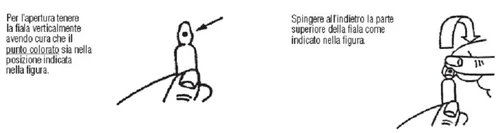
Do not ingest and avoid contact with the skin, where persistent painless erythema may occur.
In case of accidental contact, immediately wash with abundant water or saline solution.