Alfuzosin Hexal
Italy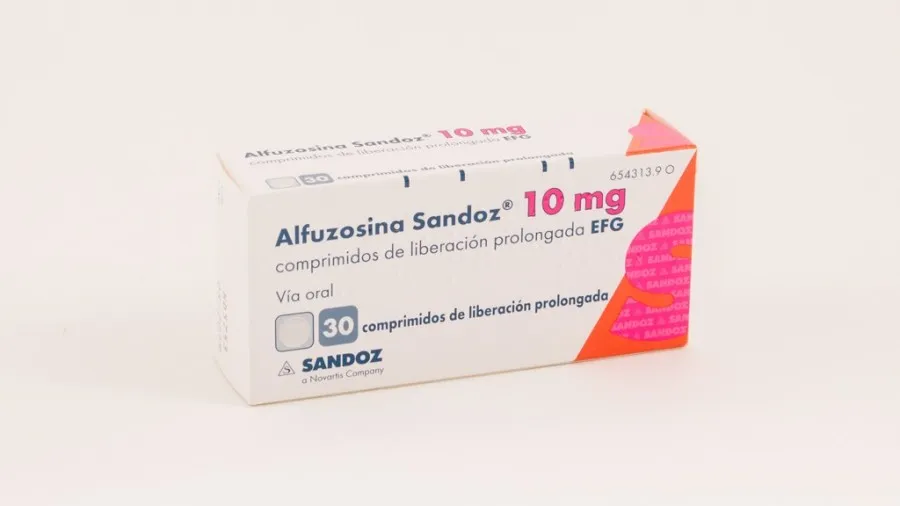
Table of Contents
- PACKAGE LEAFLET: INFORMATION FOR THE USER
- Alfuzosin Hexal 10 mg prolonged-release tablets
- 1. WHAT ALFUZOSIN HEXAL IS AND WHAT IT IS USED FOR
- 2. WHAT YOU SHOULD KNOW BEFORE TAKING ALFUZOSIN HEXAL
- 3. HOW TO TAKE ALFUZOSIN HEXAL
- 4. POSSIBLE ADVERSE REACTIONS
- 5. HOW TO STORE ALFUZOSIN HEXAL
- 6. PACK CONTENTS AND OTHER INFORMATION
PACKAGE LEAFLET: INFORMATION FOR THE USER
Alfuzosin Hexal 10 mg prolonged-release tablets
Generic medicine
Please read this leaflet carefully before taking this medicine because it contains
important information for you
- Keep this leaflet. You may need to read it again.
- If you have any questions, ask your doctor or pharmacist.
- This medicine has been prescribed for you only. Never give it to other people, even if their symptoms are the same as yours, as it may be harmful.
- If you experience any side effects, including those not listed in this leaflet, inform your doctor or pharmacist. See section 4.
Contents of this leaflet:
- What Alfuzosin Hexal is and what it is used for
- What you need to know before taking Alfuzosin Hexal
- How to take Alfuzosin Hexal
- Possible side effects
- How to store Alfuzosin Hexal
- Contents of the pack and other information
1. WHAT ALFUZOSIN HEXAL IS AND WHAT IT IS USED FOR
Alfuzosin Hexal belongs to a group of medicines called alpha-adrenergic receptor antagonists or alpha-blockers.
It is used to treat moderate to severe symptoms of an enlarged prostate, a condition also known as benign prostatic hyperplasia. An enlarged prostate can cause urinary problems such as increased frequency or difficulty in urinating, especially at night. Alpha-blockers relax the muscles of the prostate and the bladder neck. This allows urine to pass more easily from the bladder.
2. WHAT YOU SHOULD KNOW BEFORE TAKING ALFUZOSIN HEXAL
Do not take Alfuzosin Hexal
- if you are allergic to alfuzosin, to other quinazolines (for example terazosin, doxazosin, prazosin), or to any of the other ingredients of this medicine (listed in section 6).
- if you suffer from any condition causing a significant drop in blood pressure when standing up.
- if you have liver disorders.
- if you are taking other medicines belonging to the group of alpha-blockers.
Warnings and precautions
Talk to your doctor or pharmacist before taking Alfuzosin Hexal.
- if you have severe kidney problems, as the safety of Alfuzosin Hexal has not yet been established in these patients.
- if you are taking other medicines for high blood pressure. In this case, your doctor will monitor your blood pressure regularly, especially during the initial phase of treatment.
- if, within a few hours after taking Alfuzosin Hexal, you experience a sudden drop in blood pressure upon standing, accompanied by dizziness, weakness, or sweating. If you experience low blood pressure, remain lying down with your legs and feet raised until symptoms completely disappear. These effects usually last only a short time and occur at the beginning of treatment. Usually, there is no need to discontinue treatment.
- if you have heart diseases.
- if you have previously experienced significant drops in blood pressure or hypersensitivity reactions (allergy) after taking other medicines belonging to the group of alpha-blockers. In this case, your doctor will start treatment with alfuzosin at a low dose and gradually increase it.
- if you suffer from chest pain (angina) and are being treated with nitrates, as this may increase the risk of low blood pressure. If your angina returns or worsens, your doctor will decide whether to treat your angina with a nitrate-containing medicine or discontinue treatment with Alfuzosin Hexal.
- if you are scheduled for eye surgery due to cataract (clouding of the lens), inform your ophthalmologist before the operation that you are currently using or have previously used Alfuzosin Hexal. This is because Alfuzosin Hexal may cause complications during surgery, which can be managed if the specialist is informed in advance.
The tablets should be swallowed whole. Do not break, crush, or chew the tablets, otherwise an excessive amount of the active substance (alfuzosin) may reach your body too quickly. This could increase the risk of adverse effects.
Children and adolescents
Alfuzosin Hexal is not indicated for use in children and adolescents.
Other medicines and Alfuzosin Hexal
Inform your doctor or pharmacist if you are taking, have recently taken, or might take any other medicines.
Do not take Alfuzosin Hexal if you are already taking other medicines belonging to the group of alpha-blockers.
Alfuzosin Hexal may interact with certain medicines. These include:
- medicines containing ketoconazole and itraconazole (medicines used to treat fungal infections) and ritonavir (used to treat HIV).
- medicines used to lower blood pressure.
- medicines (nitrates) used to treat symptoms of chest pain (angina). Note that concomitant use of Alfuzosin Hexal with medicines used to treat high blood pressure and with nitrates used, for example, to treat heart conditions, may cause a drop in blood pressure.
- medicines administered before surgery (general anesthetics). Your blood pressure may decrease significantly. If you are undergoing surgery, inform your doctor that you are taking Alfuzosin Hexal.
- Medicines known to prolong the QT interval.
Alfuzosin Hexal with food and drink
Alfuzosin Hexal should be taken after meals.
Pregnancy and breastfeeding
This information is not relevant, as Alfuzosin Hexal is a medicine intended for male use only.
Driving and using machines
At the beginning of treatment with Alfuzosin Hexal, you may experience dizziness, lightheadedness, or weakness. Do not drive, operate machinery, or perform hazardous activities until you know how your body responds to the treatment.
Alfuzosin Hexal contains lactose.
If your doctor has diagnosed you with an intolerance to certain sugars, contact him before taking this medicine.
3. HOW TO TAKE ALFUZOSIN HEXAL
Always take Alfuzosin Hexal exactly as prescribed by your doctor. If you have any doubts, consult your doctor or pharmacist.
The recommended dose for adults, elderly patients (over 65 years of age), and those with mild to moderate renal impairment is 1 prolonged-release tablet (10 mg of alfuzosin) once daily. Take the first tablet in the evening, before going to bed. Take the tablets every day after the same meal, swallowing them whole with a sufficient amount of liquid. Do not crush, chew, or divide the tablets.
If you take more Alfuzosin Hexal than you should
If you take too high a dose of Alfuzosin Hexal, your blood pressure may drop suddenly, and you may feel dizzy or even faint. If you start feeling dizzy, sit or lie down until you feel better. If symptoms do not resolve, contact your doctor, as low blood pressure may require hospital treatment.
If you forget to take Alfuzosin Hexal
Do not take a double dose to make up for a missed tablet, as this may cause a sudden drop in blood pressure, especially if you are taking other medicines that lower blood pressure. Take the next dose as prescribed.
If you stop taking Alfuzosin Hexal
Do not stop or discontinue treatment with Alfuzosin Hexal without first consulting your doctor. If you wish to stop treatment or have any questions about the use of Alfuzosin Hexal, speak to your doctor or pharmacist.
4. POSSIBLE ADVERSE REACTIONS
Like all medicines, this medicine can cause adverse reactions, although not everyone experiences
them.
If you experience chest pain, stop taking Alfuzosin Sandoz and contact your doctor or go
immediately to the nearest hospital. Chest pain (angina) usually occurs if you have previously
suffered from angina. This adverse reaction is very rare and may affect up to 1 in 10,000 people.
If you develop symptoms such as a skin rash with redness and swelling (of the face, tongue or
throat), difficulty breathing or swallowing, stop taking Alfuzosin Sandoz and contact your doctor
immediately. These are symptoms of angioedema, which is a very rare adverse reaction that may
affect up to 1 in 10,000 people.
Other adverse reactions that may occur with Alfuzosin Hexal are:
Common (may affect up to 1 in 10 patients):
Weakness/dizziness, headache, stomach pain, feeling of heaviness in the stomach and indigestion
(dyspepsia), feeling unwell (nausea), sense of weakness.
Uncommon (may affect up to 1 in 100 patients):
Somnolence, sensation of dizziness (vertigo), loss of consciousness due to insufficient blood flow
to the brain, increased heart rate, significant drops in blood pressure when moving into an upright
position (especially when starting treatment with too high a dose or when resuming therapy), runny
nose, diarrhoea, dry mouth, skin rash, itching, fluid retention (may cause swelling of arms, ankles or
legs), facial flushing (hot flushes), chest pain, vomiting.
Not known (frequency cannot be estimated from the available data):
If you are undergoing eye surgery due to cataract and are currently taking or have previously
taken Alfuzosin Hexal, difficulties may occur during surgery (see "Warnings and precautions").
Very rapid, uncoordinated heart contractions, altered liver function (signs may include yellowing of
the skin or whites of the eyes), persistent and painful erection of the penis (priapism), decrease in
white blood cells. Low platelet count in the blood. Signs may include bleeding gums and nose,
bruising, prolonged bleeding from cuts, skin rash (red spots called petechiae).
Reporting of adverse reactions
If you experience any adverse reaction, including those not listed in this leaflet, talk to your doctor
or pharmacist. You may also report adverse reactions directly via the national reporting system at
www.agenziafarmaco.gov.it/it/responsabili.
By reporting adverse reactions, you can help provide more information on the safety of this
medicine.
5. HOW TO STORE ALFUZOSIN HEXAL
Do not store above 25°C.
Keep this medicine out of the sight and reach of children.
Do not use this medicine after the expiry date stated on the blister and packaging.
The expiry date refers to the last day of that month.
Do not dispose of medicines via wastewater or household waste. Ask your pharmacist how to
dispose of medicines you no longer use. This will help protect the environment.
6. PACK CONTENTS AND OTHER INFORMATION
What Alfuzosina Hexal contains
The active substance is alfuzosin hydrochloride.
Each prolonged-release tablet contains 10 mg of alfuzosin hydrochloride.
The excipients are monohydrate lactose, hypromellose (E464), povidone K25, magnesium stearate (E470b).
Description of the appearance of Alfuzosina Hexal and pack contents
Alfuzosina Hexal is available as white, round, bevelled-edge, uncoated tablets, approximately 10 mm in diameter.
Alfuzosina Hexal is available in blisters containing 10, 20, 30, 50, 60, 60x1, 90, 100 and 180 prolonged-release tablets.
Not all pack sizes may be marketed.
Marketing Authorization Holder
Sandoz S.p.A. – Largo U. Boccioni, 1 – 21040 Origgio (VA), Italy
Responsible manufacturer for batch release
SALUTAS Pharma GmbH - Otto-von-Guericke Allee, 1 - 39179 Barleben (Germany)
LEK SA - Ul. Domaniewska 50 c - 02-672 Warszawa (Poland)
LEK Pharmaceuticals d.d. - Verovškova 57 - 1526 Ljubljana (Slovenia)
This medicinal product has been authorised in the Member States of the European Economic Area under the following names:
Austria: Alfuzosin Hexal 10 mg – Retardtabletten
Belgium: Alfuzosine Sandoz 10 mg Tabletten met gereguleerde afgifte
Denmark: Alfuzosin Hexal
Finland: Alfuzosin Hydrochloride Sandoz 10 mg depottabletti
Ireland: Alfu 10 mg prolonged release tablets
Italy: Alfuzosina Hexal 10 mg compresse a rilascio prolungato
United Kingdom: Dazular XL 10 mg Tablets
Slovak Republic: Alfuzosin Sandoz 10mg tablety s predlženým uvolňovaním
Spain: Alfuzosina Bexal 10 mg comprimidos de liberación prolongada
Sweden: Alfuzosin Hexal
Hungary: Alfuzosin Sandoz Uno 10 mg retard tablets
This leaflet was last approved on