Aldurazyme
Italy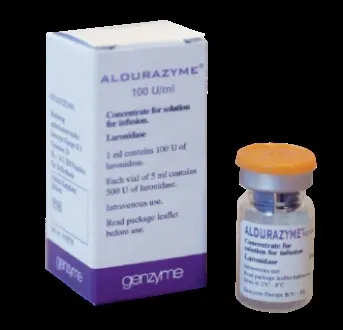
Table of Contents
- Package leaflet: Information for the user
- Aldurazyme 100 U/mL concentrate for solution for infusion
- 1. What Aldurazyme is and what it is used for
- 2. What you should know before taking Aldurazyme
- 3. How to take Aldurazyme
- 4. Possible side effects
- 5. How to store Aldurazyme
- 6. Package contents and other information
- The following information is intended exclusively for healthcare professionals:
Package leaflet: Information for the user
Aldurazyme 100 U/mL concentrate for solution for infusion
Laronidase
Please read this leaflet carefully before using this medicine because it contains important information.
- Keep this leaflet. You may need to read it again.
- If you have any questions, ask your doctor or pharmacist.
- This medicine has been prescribed for you only. Do not give it to other people, even if their symptoms are the same as yours, as it could be harmful.
- If you experience any side effects, including those not listed in this leaflet, contact your doctor or pharmacist. See section 4.
Contents of this leaflet:
- What Aldurazyme is and what it is used for
- What you need to know before taking Aldurazyme
- How to take Aldurazyme
- Possible side effects
- How to store Aldurazyme
- Contents of the pack and other information
1. What Aldurazyme is and what it is used for
Aldurazyme is used to treat patients with MPS I (Mucopolysaccharidosis I). It is administered to treat the non-neurological manifestations of the disease.
Patients affected by MPS I disease have low or absent levels of an enzyme called α-L-iduronidase, which is responsible for breaking down certain specific substances (glycosaminoglycans) in the body. As a result, these substances are not properly broken down and processed, accumulating in many tissues of the body and causing the symptoms of MPS I.
Aldurazyme is a recombinant enzyme known as laronidase, which replaces the naturally deficient enzyme in MPS I disease.
2. What you should know before taking Aldurazyme
Do not take Aldurazyme
If you are allergic (hypersensitive) to laronidase or to any of the other ingredients of this
medicine (listed in section 6).
Warnings and precautions
Talk to your doctor before using Aldurazyme.
Contact your doctor immediately if treatment with Aldurazyme causes:
- Allergic reactions, including anaphylaxis (a severe allergic reaction) – see section 4, “Possible side effects”. Some of these reactions may be life-threatening. Symptoms may include respiratory failure/breathing difficulties (inability of the lungs to function properly), stridor (high-pitched breathing sound), and other disorders due to airway obstruction, rapid breathing, excessive contraction of the airway muscles causing breathing difficulty (bronchospasm), lack of oxygen in body tissues (hypoxia), low blood pressure, slowed heart rate, or itchy skin rash (urticaria).
- Infusion-associated reactions, i.e. any adverse effect occurring during or within the day of the infusion (for symptoms, see section 4, “Possible side effects”).
If you experience these reactions, the Aldurazyme infusion must be stopped immediately; your doctor
will start appropriate treatment.
These reactions could be particularly severe in patients with a prior history of upper airway obstruction related to MPS I.
You may be given other medications to help prevent allergic-type reactions, such as antihistamines, fever-reducing medicines (e.g. paracetamol) and/or corticosteroids.
Your doctor will decide whether you can continue receiving Aldurazyme.
Other medicines and Aldurazyme
Tell your doctor if you are taking medicines containing chloroquine or procaine, due to the possible
risk of reduced effectiveness of Aldurazyme.
Tell your doctor or pharmacist if you are taking or have recently taken any other
medicines, including those without a prescription.
Pregnancy, breastfeeding and fertility
There is insufficient experience regarding the use of Aldurazyme in pregnant women. Aldurazyme should not
be used during pregnancy unless absolutely necessary.
It is not known whether Aldurazyme is excreted in human breast milk. Breastfeeding is recommended to be discontinued during treatment with Aldurazyme.
The effects of Aldurazyme on fertility are unknown.
If you are pregnant, suspect you may be pregnant, planning a pregnancy, or are breastfeeding, ask your doctor or pharmacist for advice before using this medicine.
Driving and using machines
The effects on the ability to drive and use machines have not been studied.
Aldurazyme contains sodium
This medicine contains 30 mg of sodium (a main component of table salt) per vial.
This corresponds to 1.5% of the maximum daily recommended dietary intake of sodium for an adult.
3. How to take Aldurazyme
Instructions for use, dilution, and administration
The concentrate for infusion solution must be diluted before administration and is formulated for intravenous use (see information for healthcare professionals).
Administration of Aldurazyme should be performed in an appropriate clinical setting where resuscitation equipment is immediately available in case management of a medical emergency becomes necessary.
Home infusion
Your doctor may determine that home infusion of Aldurazyme is appropriate for you if it is considered safe and convenient. If you experience a side effect during an Aldurazyme infusion, the infusion personnel may stop the infusion and initiate appropriate medical treatment.
Dosage
The recommended dosage of Aldurazyme is 100 U/kg of body weight, administered once weekly by intravenous infusion. The initial infusion rate of 2 U/kg/hour may be gradually increased every fifteen minutes, if tolerated, up to a maximum of 43 U/kg/hour. The total volume of the infusion should be administered over approximately 3–4 hours.
Use this medicine exactly as instructed by your doctor. If you have any doubts, consult your doctor.
If you miss an Aldurazyme infusion
If you have missed an infusion of Aldurazyme, consult your doctor.
If you take more Aldurazyme than you should
If the dose of Aldurazyme administered is too high or the infusion is too fast, adverse drug reactions may occur. Infusing Aldurazyme too rapidly may cause nausea, abdominal pain, headache, dizziness, and breathing difficulties (dyspnea). In such situations, the infusion must be stopped or the infusion rate immediately slowed. Your doctor will decide whether further intervention is necessary.
If you have any questions about the use of this medicine, consult your doctor or pharmacist.
4. Possible side effects
Like all medicines, this medicine can cause side effects, although not everyone gets them.
Side effects occurred mainly during or shortly after administration of the medicine (infusion-related reactions). If you experience any such reactions, you must inform your doctor immediately. The number of adverse reactions decreased as treatment with Aldurazyme continued. Most of the side effects were mild to moderate in intensity. However, a systemic allergic reaction (anaphylactic reaction) was observed in patients during or up to 3 hours after the end of Aldurazyme infusion. Some symptoms of this severe allergic reaction were potentially life-threatening and included extreme difficulty in breathing, throat swelling, low blood pressure, and low oxygen levels in the body. In a limited number of patients with a prior history of severe upper airway and lung involvement due to MPS I, serious reactions occurred, including bronchospasm, respiratory arrest, and facial swelling. The frequency of bronchospasm and respiratory arrest is unknown, while the frequencies of severe allergic reaction (anaphylactic reaction) and facial swelling are considered common, i.e. they may affect up to 1 in 10 people.
Very common side effects (may affect more than 1 in 10 people) that were not severe include:
- headache,
- nausea,
- abdominal pain,
- rash,
- joint disease,
- joint pain,
- back pain,
- pain in arms and legs,
- hot flushes, fever,
- chills,
- increased heart rate,
- increased blood pressure,
- infusion site reaction, such as swelling, redness, fluid accumulation, discomfort, itchy rash, pallor, skin color changes, or sensation of warmth
Other side effects include the following:
Common (may affect more than 1 in 10 people)
- increased body temperature
- tingling
- dizziness
- cough
- breathing difficulty
- vomiting
- diarrhoea
- rapid swelling under the skin in areas such as the face, throat, arms, and legs, which can be life-threatening if swelling of the throat blocks the airways
- hives
- itching
- hair loss
- cold sweats, excessive sweating
- muscle pain
- pallor
- cold hands or feet
- sensation of warmth, sensation of cold
- fatigue
- influenza-like illness
- injection site pain
- restlessness
Not known (frequency cannot be estimated from the available data)
- allergic reactions (hypersensitivity)
- abnormally slow heart rate
- increased or abnormally high blood pressure
- swelling of the larynx
- bluish discoloration of the skin (due to lower oxygen levels in the blood)
- rapid breathing
- skin redness
- leakage of the medicine into surrounding tissues at the injection site, which may cause tissue damage
- inability of the lungs to function properly (respiratory failure)
- throat swelling
- high-pitched breathing sounds
- airway obstruction causing breathing difficulty
- lip swelling
- tongue swelling
- swelling, particularly of the ankles and feet, due to fluid retention
- presence of drug-specific antibodies, blood proteins produced in response to the medicine
- presence of antibodies that neutralize the effect of the medicine
Reporting of side effects
If you experience any side effect, including those not listed in this leaflet, talk to your doctor or pharmacist. You can also report side effects directly via the national reporting system listed in Annex V.
By reporting side effects, you can help provide more information on the safety of this medicine.
5. How to store Aldurazyme
Keep this medicine out of the sight and reach of children.
Do not use this medicine after the expiry date stated on the label after "Exp". The expiry date refers to the last day of that month.
Sealed vials:
Store in a refrigerator (2 °C – 8 °C).
Do not dispose of any medicine via wastewater or household waste. Ask your pharmacist how to dispose of medicines you no longer use. This will help protect the environment.
6. Package contents and other information
What Aldurazyme contains
- The active substance is laronidase. One mL of solution in the vial contains 100 U of laronidase. Each 5 mL vial contains 500 U of laronidase.
- The excipients are: sodium chloride, monobasic sodium phosphate monohydrate, dibasic sodium phosphate heptahydrate, polysorbate 80, water for injections.
Description of the appearance of Aldurazyme and contents of the pack
Aldurazyme is supplied as a concentrate for solution for infusion. It is a solution ranging from clear to
slightly opalescent and from colourless to pale yellow.
Packs: 1, 10 and 25 vials. Not all pack sizes may be marketed.
Marketing Authorization Holder and Manufacturer
Marketing Authorization Holder
Sanofi B.V.
Paasheuvelweg 25
1105 BP Amsterdam
The Netherlands
Manufacturer
Genzyme Ireland Ltd, IDA Industrial Park, Old Kilmeaden Road, Waterford, Ireland
For further information about this medicinal product, please contact the local representative of the Marketing Authorization Holder:
België/Belgique/Belgien/ Magyarország
Luxembourg/Luxemburg SANOFI-AVENTIS Zrt.
Sanofi Belgium Tel: +36 1 505 0050
Tél/Tel: + 32 2 710 54 00
България Malta
Swixx Biopharma EOOD Sanofi S.r.l.
Тел.: +359 (0)2 4942 480 Tel: +39 02 39394275
Česká republika Nederland
Sanofi s.r.o. Sanofi B.V.
Tel: +420 233 086 111 Tel: +31 20 245 4000
Danmark Norge
sanofi A/S sanofi-aventis Norge AS
Tlf: +45 45 16 70 00 Tlf: + 47 67 10 71 00
Deutschland Österreich
Sanofi-Aventis Deutschland GmbH sanofi-aventis GmbH
Tel.: 0800 04 36 996 Tel: + 43 1 80 185 – 0
Tel. aus dem Ausland: +49 69 305 7013
Eesti Polska
Swixx Biopharma OÜ Sanofi Sp. z o.o.
Tel: +372 640 10 30 Tel: +48 22 280 00 00
Ελλάδα Portugal
Sanofi-Aventis Μονοπρόσωπη AEBE Sanofi – Produtos Farmacêuticos, Lda.
Τηλ: +30 210 900 1600 Tel: +351 21 35 89 400
España România
sanofi-aventis, S.A. Sanofi Romania SRL
Tel: +34 93 485 94 00 Tel: +40 (0) 21 317 31 36
France Slovenija
Sanofi Winthrop Industrie Swixx Biopharma d.o.o.
Tél: 0 800 222 555 Tel: +386 1 235 51 00
Appel depuis l’étranger: +33 1 57 63 23 23
Hrvatska Slovenská republika
Swixx Biopharma d.o.o. Swixx Biopharma s.r.o.
Tel: +385 1 2078 500 Tel: +421 2 208 33 600
Ireland Suomi/Finland
sanofi-aventis Ireland Ltd. T/A SANOFI Sanofi Oy
Tel: +353 (0) 1 403 56 00 Puh/Tel: + 358 201 200 300
Ísland Sverige
Vistor hf. Sanofi AB
Sími: +354 535 7000 Tel: +46 (0)8 634 50 00
Italia United Kingdom (Northern Ireland)
Sanofi S.r.l. sanofi-aventis Ireland Ltd. T/A SANOFI
Tel: 800536389 Tel: +44 (0) 800 035 2525
Κύπρος
C.A. Papaellinas Ltd.
Τηλ: +357 22 741741
Latvija
Swixx Biopharma SIA
Tel: +371 6 616 47 50
Lietuva
Swixx Biopharma UAB
Tel: +370 5 236 91 40
Other sources of information
More detailed information on this medicinal product is available on the website of the European Medicines Agency: http://www.ema.europa.eu. In addition, links to other websites on rare diseases and their therapeutic treatments are provided.
This leaflet is available in all languages of the European Union/European Economic Area on the website of the European Medicines Agency.
The following information is intended exclusively for healthcare professionals:
Each vial of Aldurazyme is intended for single use only. The concentrate for infusion solution must be diluted with sodium chloride 9 mg/mL (0.9%) infusion solution, using an aseptic technique. It is recommended that patients receive the diluted Aldurazyme solution via an infusion set equipped with an in-line 0.2 μm filter.
From a microbiological standpoint, the product should be used immediately. If not used immediately, storage of the diluted solution (for infusion) must not exceed 24 hours at 2 °C – 8 °C, provided that dilution has been performed under controlled and validated aseptic conditions.
Aldurazyme must not be mixed with other medicinal products in the same infusion.
Preparation of Aldurazyme Infusion (use an aseptic technique)
- Determine the number of vials to be diluted based on the patient's body weight. Remove the required number of vials from the refrigerator approximately 20 minutes before use to allow them to reach room temperature (below 30 °C).
- Before dilution, visually inspect each vial to ensure it does not contain particulate matter or show signs of discoloration. The solution, ranging from clear to slightly opalescent and from colorless to pale yellow, must not contain visible particles. Do not use vials showing particles or discoloration.
- Determine the total volume of the infusion based on the patient's body weight: 100 mL (if patient's weight is 20 kg or less) or 250 mL of sodium chloride 9 mg/mL (0.9%) infusion solution (if patient's weight exceeds 20 kg).
- Withdraw and discard a volume of sodium chloride 9 mg/mL (0.9%) infusion solution from the infusion bag equal to the total volume of Aldurazyme to be added.
- Withdraw the required volume from the Aldurazyme vials and combine the withdrawn volumes.
- Add the combined volumes of Aldurazyme to the sodium chloride 9 mg/mL (0.9%) infusion solution.
- Gently mix the infusion solution.
- Before administration, visually inspect the solution for particulate matter. Use only clear, colorless solutions free from visible particles.
Any unused medicinal product and waste materials derived from its use must be disposed of in accordance with
local regulations.