Akineton
Italy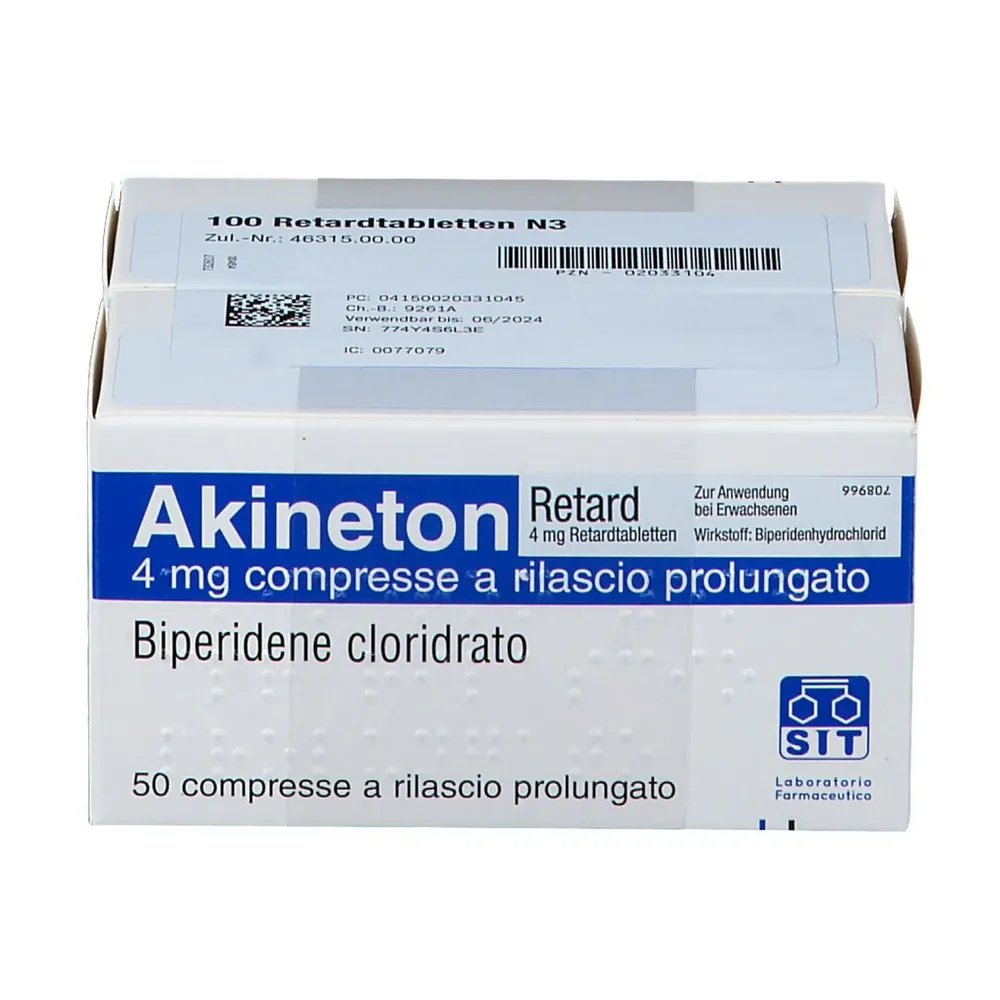
Table of Contents
- Patient Information Leaflet: Information for the patient
- Akineton 2 mg tablets, 4 mg prolonged-release tablets
- 1. What Akineton is and what it is used for
- 2. What you need to know before taking Akineton
- 3. How to take Akineton
- 4. Possible side effects
- 5. How to store Akineton
- 6. Package contents and other information
Patient Information Leaflet: Information for the patient
Akineton 2 mg tablets, 4 mg prolonged-release tablets
biperiden hydrochloride
Please read this leaflet carefully before taking this medicine because it contains
important information for you.
- Keep this leaflet. You may need to read it again.
- If you have any questions, consult your doctor or pharmacist.
- This medicine has been prescribed for you only. Do not give it to others, even if their symptoms are the same as yours, because it could be harmful.
- If you experience any side effects, including those not listed in this leaflet, consult your doctor or pharmacist. See section 4.
Contents of this leaflet:
- What Akineton is and what it is used for
- What you need to know before taking Akineton
- How to take Akineton
- Possible side effects
- How to store Akineton
- Contents of the pack and other information
1. What Akineton is and what it is used for
Akineton contains biperiden hydrochloride, which belongs to a group of medicines called
"anticholinergics".
This medicine is indicated, in combination with other therapies, for the treatment of all forms
of parkinsonism (Parkinson's disease, post-encephalitic parkinsonism, arteriosclerotic parkinsonism, and extrapyramidal syndromes due to neuroleptic drugs).
2. What you need to know before taking Akineton
Do not take Akineton
- if you are allergic to the active substance or to any of the other ingredients of this medicine (listed in section 6);
- if you have high eye pressure (glaucoma);
- if you have a blockage in the stomach or intestines, which may be characterized by abdominal cramps, vomiting, constipation (mechanical gastrointestinal obstruction or intestinal atony);
- if you have a congenital colon disorder characterized by excessive dilation of the colon (megacolon);
- if you have difficulty urinating (urinary retention).
Warnings and precautions
Talk to your doctor or pharmacist before taking Akineton:
- if you recently had a heart attack or suffer from heart rhythm disorders, as this medicine may cause an increased heart rate. Your doctor will monitor your heart rate;
- if you have a prostate condition characterized by enlargement of the gland (prostatic hypertrophy), as this medicine may cause urinary problems; in this case, your doctor may reduce your dose;
- if you are prone to seizures, as the risk of seizures may increase.
Switching from another medicine to Akineton should be done gradually and progressively, that is, by slowly reducing the dose of the previously used medicine and gradually increasing the dose of Akineton.
Children
This medicine is not recommended for children.
Other medicines and Akineton
Inform your doctor or pharmacist if you are taking, have recently taken, or might take any other medicines.
It is particularly important that you inform your doctor or pharmacist if you are taking or have recently taken:
- medicines used to treat psychiatric disorders such as anxiety, depression, mania, etc. (psychotropic medicines);
- other medicines belonging to the same group as Akineton (anticholinergic medicines);
- other medicines for Parkinson's disease, such as levodopa, as they may increase involuntary muscle movements;
- medicines used to treat involuntary muscle contractions called spasms (antispastic medicines);
- quinidine: a medicine used to treat heart rhythm disorders, as it may enhance the effect of Akineton;
- pethidine: a medicine used to treat pain, as its side effects may be intensified;
- medicines used to treat gastrointestinal disorders (e.g. metoclopramide), as their effect may be reduced when taken concomitantly with Akineton.
Akineton is incompatible with chlorprothixene and promazine.
Akineton and alcohol
Do not drink alcohol while taking this medicine.
Pregnancy and breastfeeding
Avoid taking this medicine if you are pregnant, suspect you may be pregnant, are planning a pregnancy, or are breastfeeding. Always consult your doctor or pharmacist before taking this medicine.
Driving and using machines
Do not drive and do not operate machinery requiring special attention while taking this medicine.
Akineton contains
- lactose: if your doctor has diagnosed you with an intolerance to certain sugars, consult him before taking this medicine.
3. How to take Akineton
Take this medicine exactly as directed by your doctor or pharmacist. If you have any doubts, consult your doctor or pharmacist. Your doctor will determine the most appropriate dose for you.
Akineton 2 mg tablets
The optimal dose must be determined by your doctor and ranges from: half a tablet three times daily to two tablets five times daily.
Your doctor will help you establish your optimal dose by following this procedure: treatment will start with half a tablet twice daily, then the dose will be gradually increased up to one tablet three times daily. After a few days, the dose will be further increased until no further improvement in symptoms is achieved. Subsequently, you will be asked to gradually reduce the dose until your symptoms worsen again.
Your optimal dose will be the one between the highest dose reached and the dose at which symptoms worsen again.
Akineton 4 mg prolonged-release tablets
Treatment should be initiated with Akineton 2 mg tablets, gradually increasing the dose to a more favorable dosage level as directed by your doctor. Afterwards, you may switch to Akineton 4 mg prolonged-release tablets. The usual daily dose is generally 1–2 prolonged-release tablets daily, but it may be increased up to 3 tablets daily, taken at intervals throughout the day.
Instructions for use
Take the tablets after meals. If you suffer from excessive salivation (sialorrhoea), take the tablets during meals. Taking the medicine correctly may also help reduce the occurrence of gastrointestinal disturbances.
If you take more Akineton than you should
If you have taken more Akineton than prescribed, contact your doctor immediately or go to the nearest hospital. Bring this leaflet and the medicine pack with you, even if it is empty.
If you have taken an excessive dose of this medicine, you may experience: dilated pupils or pupils that have difficulty dilating as usual, dry mouth, flushing, increased heart rate (tachycardia), intestinal obstruction, increased bladder muscle tone, elevated body temperature (especially in children), agitation, confusion, disorientation, and/or hallucinations. If the dose taken is very high, a dangerous reduction in respiratory and heart rate may occur.
If you forget to take Akineton
Do not take a double dose to make up for the forgotten dose.
If you stop taking Akineton
Do not stop treatment with Akineton without medical advice. Discontinuation of Akineton treatment must be done gradually.
If you have any questions about the use of this medicine, consult your doctor or pharmacist.
4. Possible side effects
Like all medicines, this medicine can cause side effects, although not everyone gets them.
Side effects may occur particularly at the beginning of treatment and if the dose is increased too quickly.
Rare (may affect up to 1 in 1,000 people)
- at high doses: excitement, agitation, confusion, fear, delirium (loss of awareness of the surrounding environment, confusion, detachment from reality), hallucinations (seeing or hearing things that are not there), sleep disturbances;
- fatigue, dizziness;
- memory disturbances;
- increased heart rate (tachycardia);
- dry mouth, nausea, stomach problems;
- drowsiness.
Very rare (may affect up to 1 in 10,000 people)
- Hypersensitivity (allergic reactions);
- nervousness, exaggerated sense of well-being (euphoria);
- headache;
- abnormal involuntary movements (dyskinesia); loss of muscle coordination (ataxia), difficulty in speaking, increased likelihood of epileptic seizures and convulsions;
- visual disturbances (e.g. difficulty focusing), pupil dilation (mydriasis), light sensitivity (photosensitivity), increased eye pressure (glaucoma);
- decreased heart rate;
- constipation;
- reduced sweating, allergic rash;
- muscle contractions;
- difficulty emptying the bladder (particularly in patients with prostate tumour), difficulty urinating (urinary retention).
Not known (frequency cannot be estimated from the available data)
- Inflammation of the salivary glands located near the ears (parotitis).
Reporting of side effects
If you experience any side effect, including those not listed in this leaflet, talk to your doctor or pharmacist.
You can also report side effects directly via the national reporting system at http://www.agenziafarmaco.gov.it/it/responsabili.
By reporting side effects, you can help provide more information on the safety of this medicine.
5. How to store Akineton
This medicine does not require any special storage conditions.
Keep this medicine out of the sight and reach of children.
Do not use this medicine after the expiry date stated on the carton after "Exp.". The expiry date refers to the last day of that month.
Do not dispose of any medicine via wastewater or household waste. Ask your pharmacist how to dispose of medicines no longer in use. This will help protect the environment.
6. Package contents and other information
What Akineton contains
Akineton 2 mg tablets
- The active substance is biperiden hydrochloride. One tablet contains 2 mg of biperiden hydrochloride.
- The other components are corn starch, dicalcium phosphate dihydrate, microcrystalline cellulose, copolymer of vinylpyrrolidone vinylacetate, lactose, magnesium stearate, talc.
Akineton 4 mg prolonged-release tablets
- The active substance is biperiden hydrochloride. One tablet contains 4 mg of biperiden hydrochloride.
- The other components are corn starch, microcrystalline cellulose, carnauba wax, hydroxypropylcellulose, lactose, magnesium stearate, methylhydroxypropylcellulose, yellow iron oxide (E 172), polyethylene glycol 400, polyethylene glycol 6000, povidone, anhydrous colloidal silica, sodium lauryl sulfate, talc, titanium dioxide (E 171).
Description of the appearance of Akineton and package contents
Akineton 2 mg tablets are supplied in a box containing 60 tablets in blister packs.
Akineton 4 mg prolonged-release tablets are supplied in a box containing 50 prolonged-release tablets in blister packs.
Marketing Authorization Holder and Manufacturer
Laboratorio Farmaceutico SIT S.r.l. – Via Cavour, 70 – 27035 Mede (PV)