Aimovig
Italy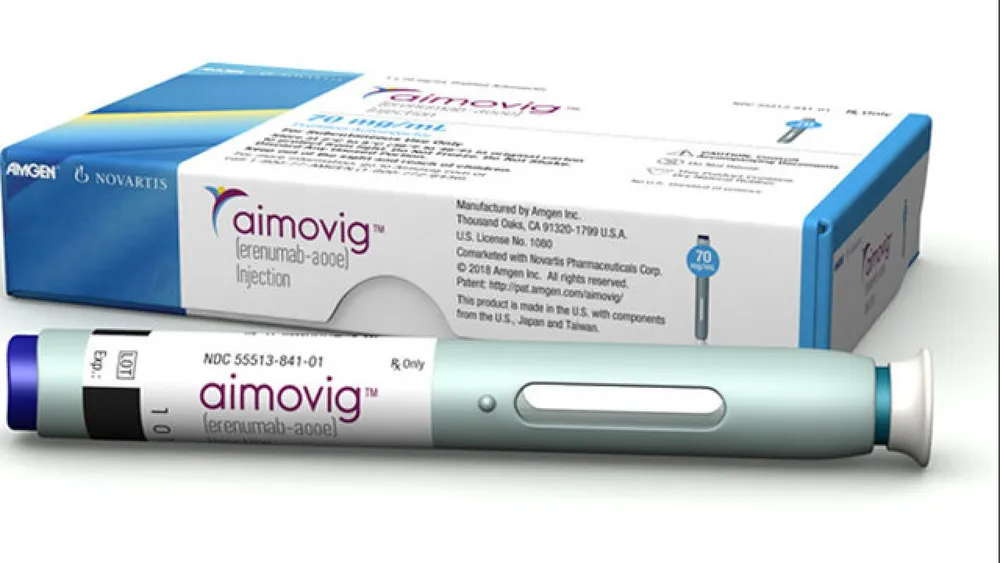
Instructions for Use
Table of Contents
- Aimovig 70 mg solution for injection in pre-filled syringe, 140 mg solution for injection in pre-filled syringe
- 1. What Aimovig is and what it is used for
- 2. What you need to know before using Aimovig
- 3. How to use Aimovig
- 4. Possible side effects
- 5. How to store Aimovig
- 6. Package contents and other information
- Instructions for Use of Aimovig Pre-filled Syringe
- Patient information leaflet
- Aimovig 70 mg solution for injection in pre-filled pen, 140 mg solution for injection in pre-filled pen
- 1. What Aimovig is and what it is used for
- 2. What you should know before using Aimovig
- 3. How to use Aimovig
- 4. Possible side effects
- 5. How to store Aimovig
- 6. Package contents and other information
- Instructions for the use of Aimovig prefilled pens
Package leaflet: Information for the patient
Aimovig 70 mg solution for injection in pre-filled syringe, 140 mg solution for injection in pre-filled syringe
erenumab
Please read all of this leaflet carefully before you start using this medicine, as it contains important information for you.
- Keep this leaflet. You may need to read it again.
- If you have any questions, ask your doctor, pharmacist or nurse.
- This medicine has been prescribed for you only. Do not give it to other people, even if their symptoms are the same as yours, as it may be harmful.
- If you experience any side effect, including those not listed in this leaflet, tell your doctor, pharmacist or nurse. See section 4.
Contents of this leaflet
- What Aimovig is and what it is used for
- What you need to know before using Aimovig
- How to use Aimovig
- Possible side effects
- How to store Aimovig
- Contents of the pack and other information
1. What Aimovig is and what it is used for
Aimovig contains the active substance erenumab. It belongs to a group of medicines known as monoclonal antibodies.
Aimovig works by blocking the activity of the CGRP molecule, which has been associated with migraine (CGRP stands for calcitonin gene-related peptide).
Aimovig is used to prevent migraine in adults who have at least 4 migraine days per month when starting treatment with Aimovig.
2. What you need to know before using Aimovig
Do not use Aimovig
- if you are allergic to erenumab or to any of the other ingredients of this medicine (listed in section 6).
Warnings and precautions
Talk to your doctor before using Aimovig:
- if you have had an allergic reaction to rubber latex. The container of this medicine contains rubber latex inside the cap.
- if you suffer from cardiovascular disease. Aimovig has not been studied in patients with certain cardiovascular diseases.
Talk to your doctor or seek immediate emergency medical help:
- if you experience any symptoms of a severe allergic reaction, such as rash or swelling usually of the face, mouth, tongue or throat; or difficulty breathing. Severe allergic reactions may occur within minutes, but some may occur more than one week after using Aimovig.
- Contact a doctor if you experience constipation and consult a doctor immediately if you develop constipation accompanied by severe or persistent abdominal pain and vomiting, abdominal distension or bloating. Constipation may occur while being treated with Aimovig. It is usually mild or moderate in severity. However, some patients treated with Aimovig have developed constipation with serious complications and have been hospitalized. Some cases required surgical intervention.
Children and adolescents
Do not administer this medicine to children or adolescents (under 18 years of age) as the use of Aimovig has not been studied in this age group.
Other medicines and Aimovig
Inform your doctor or pharmacist if you are taking, have recently taken, or might take any other medicines.
Pregnancy and breastfeeding
If you are pregnant, suspect you may be pregnant, planning to become pregnant, or are breastfeeding, consult your doctor before taking this medicine.
Pregnancy
Your doctor will decide whether you should discontinue using Aimovig during pregnancy.
Breastfeeding
It is known that monoclonal antibodies such as Aimovig pass into human milk during the first few days after birth, but after this initial period, Aimovig may be used. Talk to your doctor about using Aimovig while breastfeeding to help you decide whether you should discontinue breastfeeding or discontinue use of Aimovig.
Driving and using machines
It is unlikely that Aimovig will affect your ability to drive or operate machinery.
Aimovig contains sodium
Aimovig contains less than 1 mmol (23 mg) of sodium per dose, i.e. essentially "sodium-free".
3. How to use Aimovig
Use this medicine exactly as instructed by your doctor. If you have any doubts, consult your doctor.
If your doctor prescribes the 70 mg dose, you must inject once every 4 weeks. If your doctor prescribes the 140 mg dose, you must inject either one 140 mg dose of Aimovig or two 70 mg doses of Aimovig once every 4 weeks. If you are administering two 70 mg injections of Aimovig, the second injection must be given immediately after the first, at a different injection site. Make sure you have injected the entire contents of both syringes.
Aimovig is administered by subcutaneous injection (known as a subcutaneous injection). You or the person assisting you may give the injection in the abdomen or thigh. The outer area of the upper arm may also be used as an injection site, but only if the injection is administered by someone else. If two injections are needed, they must be given at different sites to avoid skin thickening, and must not be given in areas where the skin is painful, bruised, red, or hardened.
Your doctor or nurse will teach you or your caregiver the correct way to prepare and inject Aimovig. Do not attempt to inject Aimovig yourself until you have been properly trained.
If you have not noticed any effect from the treatment after 3 months, inform your doctor, who will decide whether you should continue treatment.
Aimovig syringes are for single use only.
For detailed instructions on how to inject Aimovig, see "Instructions for the use of Aimovig pre-filled syringe" at the end of this leaflet.
If you use more Aimovig than you should
If you have received more Aimovig than prescribed or the dose was administered earlier than scheduled, inform your doctor.
If you forget to use Aimovig
- If you forget to inject a dose of Aimovig, administer it as soon as you remember.
- Then inform your doctor, who will advise you on when to administer the next dose. Follow the new schedule exactly as directed by your doctor.
If you stop using Aimovig
Do not stop using Aimovig without first talking to your doctor. If you stop treatment, your symptoms may return.
If you have any questions about the use of this medicine, consult your doctor, pharmacist, or nurse.
4. Possible side effects
Like all medicines, this medicine can cause side effects, although not everybody gets them.
The possible side effects are listed below. Most of these side effects are mild to moderate.
Common: may affect up to 1 in 10 people
- allergic reactions such as rash, swelling, hives or breathing difficulties (see section 2)
- constipation
- itching
- muscle spasms
- reactions at the injection site such as pain, redness and swelling where the injection was given.
Not known (frequency cannot be estimated from the available data)
- Skin reactions such as rash, itching, hair loss or mouth/lip ulcers.
Reporting of side effects
If you experience any side effect, including those not listed in this leaflet, talk to your doctor, pharmacist or nurse. You can also report side effects directly through the national reporting system referred to in Annex V. By reporting side effects, you can help provide more information on the safety of this medicine.
5. How to store Aimovig
Keep this medicine out of the sight and reach of children.
Do not use this medicine after the expiry date stated on the label and packaging after EXP/Exp. The expiry date refers to the last day of that month.
Keep the syringe in the outer packaging to protect the medicine from light. Store in a refrigerator (2°C - 8°C). Do not freeze. Do not shake.
After Aimovig has been removed from the refrigerator, it must be kept at room temperature (up to 25°C) in the outer packaging and used within 7 days or must be discarded. Do not return Aimovig to the refrigerator once it has been removed.
Do not use this medicine if you notice that the solution contains particles, is cloudy, or clearly yellow.
Do not dispose of any medicine via wastewater or household waste. Ask your pharmacist how to dispose of medicines you no longer use. Local regulations may apply for disposal.
This will help protect the environment.
6. Package contents and other information
What Aimovig contains
- The active substance is erenumab.
- Aimovig 70 mg solution for injection in a pre-filled syringe contains 70 mg of erenumab.
- Aimovig 140 mg solution for injection in a pre-filled syringe contains 140 mg of erenumab.
- The other components are sucrose, polysorbate 80, sodium hydroxide, glacial acetic acid, water for injections.
Description of the appearance of Aimovig and contents of the pack
Aimovig solution for injection is a liquid, from clear to opalescent, from colourless to pale yellow and
practically free from particles.
Each pack contains one single-use pre-filled syringe.
Marketing Authorisation Holder
Novartis Europharm Limited
Vista Building
Elm Park, Merrion Road
Dublin 4
Ireland
Manufacturer
Novartis Manufacturing NV
Rijksweg 14
2870 Puurs-Sint-Amands
Belgium
Novartis Pharma GmbH
Roonstrasse 25
90429 Nuremberg
Germany
Novartis Pharma GmbH
Sophie-Germain-Strasse 10
90443 Nuremberg
Germany
For further information about this medicinal product, please contact the local representative of the Marketing Authorisation Holder:
België/Belgique/Belgien Lietuva
Novartis Pharma N.V. SIA Novartis Baltics Lietuvos filialas
Tél/Tel: +32 2 246 16 11 Tel: +370 5 269 16 50
България Luxembourg/Luxemburg
Novartis Bulgaria EOOD Novartis Pharma N.V.
Тел: +359 2 489 98 28 Tél/Tel: +32 2 246 16 11
Česká republika Magyarország
Novartis s.r.o. Novartis Hungária Kft.
Tel: +420 225 775 111 Tel.: +36 1 457 65 00
Danmark Malta
Novartis Healthcare A/S Novartis Pharma Services Inc.
Tlf: +45 39 16 84 00 Tel: +356 2122 2872
Deutschland Nederland
Novartis Pharma GmbH Novartis Pharma B.V.
Tel: +49 911 273 0 Tel: +31 88 04 52 111
Eesti Norge
SIA Novartis Baltics Eesti filiaal Novartis Norge AS
Tel: +372 66 30 810 Tlf: +47 23 05 20 00
Ελλάδα Österreich
Novartis (Hellas) A.E.B.E. Novartis Pharma GmbH
Τηλ: +30 210 281 17 12 Tel: +43 1 86 6570
España Polska
Novartis Farmacéutica, S.A. Novartis Poland Sp. z o.o.
Tel: +34 93 306 42 00 Tel.: +48 22 375 4888
France Portugal
Novartis Pharma S.A.S. Novartis Farma - Produtos Farmacêuticos, S.A.
Tél: +33 1 55 47 66 00 Tel: +351 21 000 8600
Hrvatska România
Novartis Hrvatska d.o.o. Novartis Pharma Services Romania SRL
Tel. +385 1 6274 220 Tel: +40 21 31299 01
Ireland Slovenija
Novartis Ireland Limited Novartis Pharma Services Inc.
Tel: +353 1 260 12 55 Tel: +386 1 300 75 50
Ísland Slovenská republika
Vistor hf. Novartis Slovakia s.r.o.
Sími: +354 535 7000 Tel: +421 2 5542 5439
Italia Suomi/Finland
Novartis Farma S.p.A. Novartis Finland Oy
Tel: +39 02 96 54 1 Puh/Tel: +358 (0)10 6133 200
Κύπρος Sverige
Novartis Pharma Services Inc. Novartis Sverige AB
Τηλ: +357 22 690 690 Tel: +46 8 732 32 00
Latvija
SIA Novartis Baltics
Tel: +371 67 887 070
Further sources of information
More detailed information on this medicinal product is available on the website of the European Medicines Agency: http://www.ema.europa.eu
Instructions for Use of Aimovig Pre-filled Syringe
Image of the syringe
Before use After use
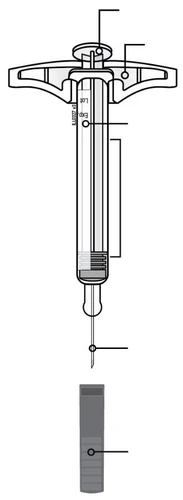
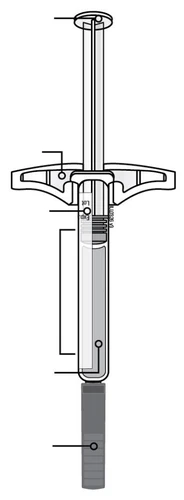
Used plunger
Plunger
Flange
Label and expiry
date
Flange
Syringe barrel
Label and expiry
date used
Barrel
Used needle
Solution
Grey needle cap
grey needle cap
inserted removed
(needle inside)
Note: the needle is inside the grey needle cap.
General
Before using the Aimovig pre-filled syringe, read these important instructions:
Step 1: Preparation
Note: The prescribed dose of Aimovig is 70 mg or 140 mg. This means that for the 70 mg dose, you must inject the contents of one single-use 70 mg syringe. For the 140 mg dose, you must inject the contents of one single-use 140 mg syringe, or two single-use 70 mg syringes, one injection after the other.
(A)
Remove the Aimovig pre-filled syringe from the carton by holding the syringe barrel. You may need to use one or two syringes depending on the dose prescribed to you. Do not shake.
To avoid discomfort at the injection site, allow the syringe to reach room temperature for at least 30 minutes before injection.
Note: Do not attempt to warm the syringe using a heat source such as hot water or microwave.
(B)
Inspect the syringe (syringes). Ensure that the solution inside the syringe is clear and colourless to slightly yellow.
Note:
- Do not use the syringe if any part appears cracked or broken.
- Do not use the syringe if it has been dropped.
- Do not use the syringe if the needle cap is missing or not securely attached.
In any of the above cases, use a new syringe and, if in doubt, contact your doctor or pharmacist.
(C)
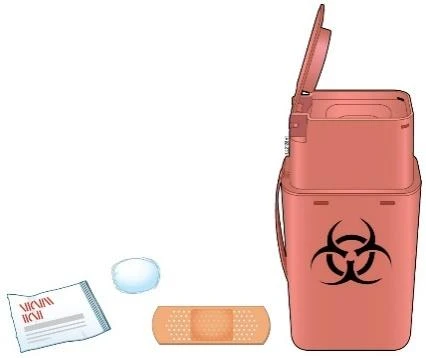
Prepare all materials needed
for the injection:
Wash your hands thoroughly with
soap and water.
On a clean, well-lit work surface, place:
- New syringe (new syringes)
- Alcohol swabs
- Cotton balls or gauze pads
- Adhesive bandages
- Sharps disposal container
(D)
Prepare and clean the injection site.
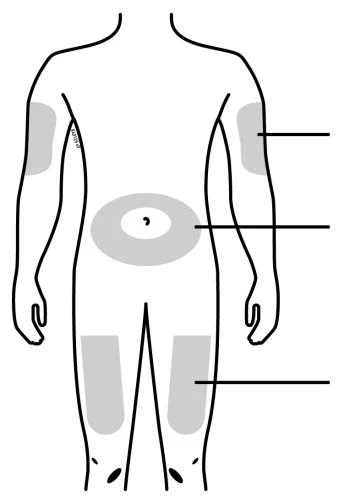
Upper arm
Abdominal area
(stomach)
Thigh
Use only the following injection sites:
- Thigh
- Abdominal area (stomach) (except for the 5 cm area around the navel)
- Outer area of the upper arm (only if the injection is administered by someone else)
Clean the injection site with an alcohol swab and allow the skin to dry.
Choose a different site each time you give an injection. If you need to use the same general area, make sure it is not exactly the same spot used previously.
Note:
- After cleaning, do not touch the area again before injection.
- Do not choose an area where the skin is tender, bruised, red, or hardened. Avoid injecting in areas with scars or stretch marks.
Step 2: Immediately before injection
(E)
Pull the grey needle cap straight off and away from the syringe only when you are ready to administer the injection. The injection must be given within 5 minutes. It is normal to see a drop of liquid at the tip of the needle.
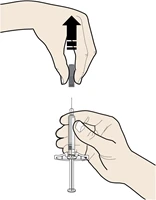
Note:
- Do not leave the syringe without the grey needle cap for more than 5 minutes. This may dry out the medicine.
- Do not twist or bend the grey needle cap.
- Do not reattach the grey needle cap to the syringe once it has been removed.
(F)
Form a skin fold by firmly pinching the skin at the injection site.
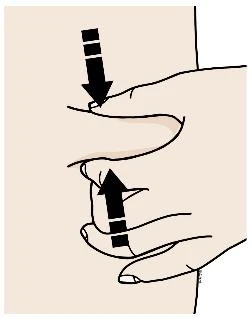
Note: Maintain the skin fold throughout the entire injection.
Step 3: Injection
(G)
While holding the skin fold, insert the syringe needle into the skin at an angle of 45 to 90 degrees.
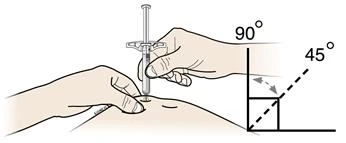
Do not place your finger on the plunger while inserting the needle.
(H)
Using slow and steady pressure, push the plunger all the way down until it stops.
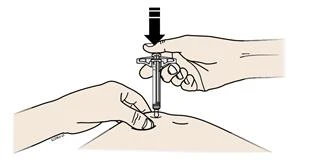
(I)
At the end of the injection, lift your thumb from the plunger and gently withdraw the needle by lifting the syringe away from the skin, then release the skin fold.
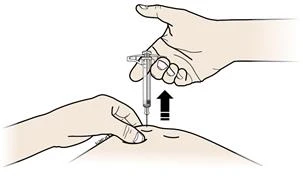
Note: When removing the syringe, if it appears that there is still medicine in the syringe barrel, this means you did not receive a full dose. Contact your doctor.
Step 4: Completion
(J)
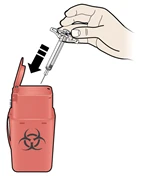
Dispose of the used syringe and the grey needle cap.
Place the used syringe immediately into a sharps disposal container after use. Talk to your doctor or pharmacist about proper disposal. There may be local laws regarding disposal.
Note:
- Do not reuse the syringe.
- Do not recycle the syringe or the sharps disposal container. Always keep the sharps disposal container out of the reach of children.
(K)
Examine the injection site.
If there is blood on the skin, press a cotton ball or gauze pad over the injection site. Do not rub the injection site. Apply an adhesive bandage if needed.

If the dose is 140 mg and you are using two 70 mg Aimovig syringes, repeat
Steps 1(D) to 4 with the second syringe to administer the full dose.
Patient information leaflet
Aimovig 70 mg solution for injection in pre-filled pen, 140 mg solution for injection in pre-filled pen
erenumab
Please read this leaflet carefully before using this medicine because it contains important information for you.
- Keep this leaflet. You may need to read it again.
- If you have any questions, ask your doctor, pharmacist, or nurse.
- This medicine has been prescribed for you only. Do not give it to other people, even if they have the same symptoms as you, because it may be harmful.
- If you experience any side effect, including those not listed in this leaflet, talk to your doctor, pharmacist, or nurse. See section 4.
Contents of this leaflet
- What Aimovig is and what it is used for
- What you need to know before using Aimovig
- How to use Aimovig
- Possible side effects
- How to store Aimovig
- Contents of the pack and other information
1. What Aimovig is and what it is used for
Aimovig contains the active substance erenumab. It belongs to a group of medicines known as monoclonal antibodies.
Aimovig works by blocking the activity of the CGRP molecule, which has been associated with migraine (CGRP stands for calcitonin gene-related peptide).
Aimovig is used to prevent migraine in adults who have at least 4 migraine days per month when starting treatment with Aimovig.
2. What you should know before using Aimovig
Do not use Aimovig
- if you are allergic to erenumab or to any of the other ingredients of this medicine (listed in section 6).
Warnings and precautions
Talk to your doctor before using Aimovig:
- if you have had an allergic reaction to rubber latex. This medicine's container contains rubber latex inside the cap.
- if you suffer from cardiovascular disease. Aimovig has not been studied in patients with certain cardiovascular diseases.
Contact your doctor or seek immediate emergency medical help:
- if you experience any symptoms of a severe allergic reaction, such as rash or swelling, usually of the face, mouth, tongue or throat; or difficulty breathing. Severe allergic reactions may occur within minutes, but some may occur more than a week after using Aimovig.
- Contact a doctor if you develop constipation, and consult a doctor immediately if you experience constipation accompanied by severe or persistent abdominal pain and vomiting, abdominal distension or bloating. Constipation may occur while being treated with Aimovig. It is usually mild or moderate in severity. However, some patients treated with Aimovig have developed constipation with serious complications and have been hospitalized. Some cases required surgical intervention.
Children and adolescents
Do not administer this medicine to children or adolescents (under 18 years of age) as the use of Aimovig has not been studied in this age group.
Other medicines and Aimovig
Inform your doctor or pharmacist if you are taking, have recently taken, or might take any other medicines.
Pregnancy and breastfeeding
If you are pregnant, think you might be pregnant, planning a pregnancy, or breastfeeding, consult your doctor before taking this medicine.
Pregnancy
Your doctor will decide whether you should stop using Aimovig during pregnancy.
Breastfeeding
It is known that monoclonal antibodies such as Aimovig pass into human milk during the first few days after birth. After this initial period, Aimovig may be used. Talk to your doctor about using Aimovig while breastfeeding to help you decide whether you should stop breastfeeding or stop using Aimovig.
Driving and using machines
It is unlikely that Aimovig will affect your ability to drive or operate machinery.
Aimovig contains sodium
Aimovig contains less than 1 mmol (23 mg) of sodium per dose, i.e. essentially "sodium-free".
3. How to use Aimovig
Use this medicine exactly as instructed by your doctor. If you have any doubts, consult your doctor.
If your doctor prescribes the 70 mg dose, you must administer one injection every 4 weeks. If your doctor prescribes the 140 mg dose, you must administer one 140 mg injection of Aimovig or two 70 mg injections of Aimovig once every 4 weeks. If you are administering two 70 mg injections of Aimovig, the second injection must be given immediately after the first, at a different injection site. Make sure you have injected the full contents of both pens.
Aimovig is administered as an injection under the skin (known as a subcutaneous injection). You or the person assisting you may administer the injection into the abdomen or thigh. The outer area of the upper arm may also be used as an injection site, but only if the injection is given by someone else. If two injections are needed, they must be administered at different sites to avoid skin hardening and must not be given in areas where the skin is painful, bruised, red, or hardened.
Your doctor or nurse will teach you or your helper the correct way to prepare and inject Aimovig. Do not attempt to inject Aimovig yourself until you have been properly trained.
If you have not noticed any effect from the treatment after 3 months, inform your doctor, who will decide whether you should continue treatment.
Aimovig pens are for single use only.
For detailed instructions on how to inject Aimovig, see "Instructions for using the Aimovig pre-filled pen" at the end of this leaflet.
If you use more Aimovig than you should
If you have received more Aimovig than prescribed or the dose was administered earlier than scheduled, inform your doctor.
If you forget to use Aimovig
- If you forget to inject a dose of Aimovig, administer it as soon as you remember.
- Then inform your doctor, who will advise you on when to administer the next dose. Follow the new schedule exactly as instructed by your doctor.
If you stop using Aimovig
Do not stop using Aimovig without first discussing it with your doctor. If you stop treatment, your symptoms may return.
If you have any questions about the use of this medicine, consult your doctor, pharmacist, or nurse.
4. Possible side effects
Like all medicines, this medicine can cause side effects, although not everybody gets them.
The possible side effects are listed below. Most of these side effects are mild to moderate.
Common: may affect up to 1 in 10 people
- allergic reactions such as rash, swelling, urticaria or breathing difficulties (see section 2)
- constipation
- itching
- muscle spasms
- injection site reactions such as pain, redness and swelling at the site where the injection was given.
Not known (frequency cannot be estimated from the available data)
- Skin reactions such as rash, itching, hair loss or mouth/lip ulcers.
Reporting of side effects
If you get any side effects, including those not listed in this leaflet, talk to your doctor, pharmacist or nurse.
You can also report side effects directly via the national reporting system referred to in Annex V. By reporting side effects, you can help provide more information on the safety of this medicine.
5. How to store Aimovig
Keep this medicine out of the sight and reach of children.
Do not use this medicine after the expiry date which is stated on the label and packaging after EXP/Exp. The expiry date refers to the last day of that month.
Keep the pen in the outer packaging to protect the medicine from light. Store in a refrigerator (2°C - 8°C). Do not freeze. Do not shake.
After Aimovig has been removed from the refrigerator, it must be kept at room temperature (up to 25°C) in the outer packaging and used within 7 days or must be discarded. Do not put Aimovig back into the refrigerator once it has been removed.
Do not use this medicine if you notice that the solution contains particles, is cloudy, or is clearly yellow.
Do not dispose of any medicine via wastewater or household waste. Ask your pharmacist how to dispose of medicines no longer required. Local regulations may apply for disposal.
This will help protect the environment.
6. Package contents and other information
What Aimovig contains
- The active substance is erenumab.
- Aimovig 70 mg solution for injection in pre-filled pen contains 70 mg of erenumab.
- Aimovig 140 mg solution for injection in pre-filled pen contains 140 mg of erenumab.
- The other components are sucrose, polysorbate 80, sodium hydroxide, glacial acetic acid, water for injections.
Description of the appearance of Aimovig and contents of the pack
Aimovig solution for injection is a liquid, from clear to opalescent, colourless to slightly yellow, and practically free from particles.
Aimovig is available in packs containing one single-use pre-filled pen and in multiple packs containing 3 (3x1) pre-filled pens.
Not all pack sizes may be marketed.
Marketing Authorisation Holder
Novartis Europharm Limited
Vista Building
Elm Park, Merrion Road
Dublin 4
Ireland
Manufacturer
Sandoz GmbH
Biochemiestrasse 10
6336 Langkampfen
Austria
Novartis Pharma GmbH
Roonstrasse 25
90429 Nuremberg
Germany
Novartis Pharmaceutical Manufacturing GmbH
Biochemiestrasse 10
6336 Langkampfen
Austria
Novartis Pharma GmbH
Sophie-Germain-Strasse 10
90443 Nuremberg
Germany
For further information on this medicinal product, please contact the local representative of the Marketing Authorisation Holder:
België/Belgique/Belgien Lietuva
Novartis Pharma N.V. SIA Novartis Baltics Lietuvos filialas
Tél/Tel: +32 2 246 16 11 Tel: +370 5 269 16 50
България Luxembourg/Luxemburg
Novartis Bulgaria EOOD Novartis Pharma N.V.
Тел: +359 2 489 98 28 Tél/Tel: +32 2 246 16 11
Česká republika Magyarország
Novartis s.r.o. Novartis Hungária Kft.
Tel: +420 225 775 111 Tel.: +36 1 457 65 00
Danmark Malta
Novartis Healthcare A/S Novartis Pharma Services Inc.
Tlf: +45 39 16 84 00 Tel: +356 2122 2872
Deutschland Nederland
Novartis Pharma GmbH Novartis Pharma B.V.
Tel: +49 911 273 0 Tel: +31 88 04 52 111
Eesti Norge
SIA Novartis Baltics Eesti filiaal Novartis Norge AS
Tel: +372 66 30 810 Tlf: +47 23 05 20 00
Ελλάδα Österreich
Novartis (Hellas) A.E.B.E. Novartis Pharma GmbH
Τηλ: +30 210 281 17 12 Tel: +43 1 86 6570
España Polska
Novartis Farmacéutica, S.A. Novartis Poland Sp. z o.o.
Tel: +34 93 306 42 00 Tel.: +48 22 375 4888
France Portugal
Novartis Pharma S.A.S. Novartis Farma - Produtos Farmacêuticos, S.A.
Tél: +33 1 55 47 66 00 Tel: +351 21 000 8600
Hrvatska România
Novartis Hrvatska d.o.o. Novartis Pharma Services Romania SRL
Tel. +385 1 6274 220 Tel: +40 21 31299 01
Ireland Slovenija
Novartis Ireland Limited Novartis Pharma Services Inc.
Tel: +353 1 260 12 55 Tel: +386 1 300 75 50
Ísland Slovenská republika
Vistor hf. Novartis Slovakia s.r.o.
Sími: +354 535 7000 Tel: +421 2 5542 5439
Italia Suomi/Finland
Novartis Farma S.p.A. Novartis Finland Oy
Tel: +39 02 96 54 1 Puh/Tel: +358 (0)10 6133 200
Κύπρος Sverige
Novartis Pharma Services Inc. Novartis Sverige AB
Τηλ: +357 22 690 690 Tel: +46 8 732 32 00
Latvija
SIA Novartis Baltics
Tel: +371 67 887 070
Other sources of information
More detailed information on this medicinal product is available on the website of the European Medicines Agency, http://www.ema.europa.eu
Instructions for the use of Aimovig prefilled pens
Image of the 70 mg Aimovig pen (with light blue body, purple start button, white cap, and
green safety device)
Before use After use

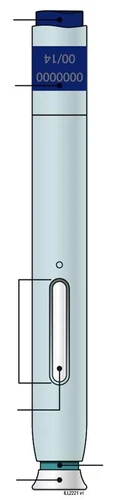
Purple start button
Expiry date
Expiry date
Yellow window
Window (complete injection)
Solution
Green safety
Green safety device
White cap
device
(needle inside)
inserted
(needle inside)
White cap
removed
Note: The needle is inside the green safety device.
Image of the 140 mg Aimovig pen (with dark blue body, grey start button, orange cap, and
yellow safety device)
Before use After use
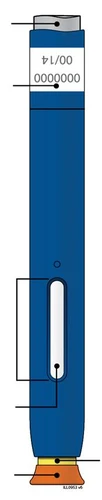

Grey start button
Expiry date
Expiry date
Yellow window
Window (complete injection)
Solution
Orange cap
Yellow safety device
inserted
(needle inside)
Yellow safety device
(needle inside)
Orange cap
removed
Note: The needle is inside the yellow safety device.
General
Before using the Aimovig prefilled pen, read
these instructions.
Step 1: Preparation
Note: The prescribed dose of Aimovig is 70 mg or 140 mg. This means that for the 70 mg dose, you must inject the contents of one single-use 70 mg pen. For the 140 mg dose, you must inject the contents of one single-use 140 mg pen, or two single-use 70 mg pens, one after the other.
(A)
Carefully remove the Aimovig prefilled pen(s) from the box. You may need to use one or two pens depending on the dose prescribed to you. Do not shake.
To avoid discomfort at the injection site, allow the pen to reach room temperature for at least 30 minutes before injection.
Note: Do not attempt to warm the pen using a heat source such as hot water or a microwave.
(B)
Inspect the pen(s). Make sure the solution visible in the window is clear and colorless to light yellow.
Note:
- Do not use the pen(s) if any part appears cracked or broken.
- Do not use a pen that has been dropped.
- Do not use the pen if the cap is missing or not securely attached.
In any of the above cases, use a new pen and, if in doubt, contact your doctor or pharmacist.
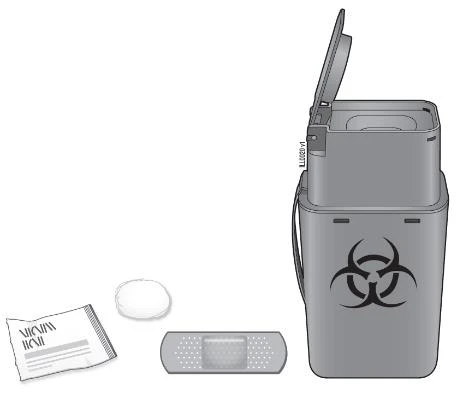

(C)
Prepare all materials
required for the injection(s).
Wash your hands thoroughly with
soap and water.
On a clean, well-lit surface, place:
- New pen(s)
- Alcohol swab(s)
- Cotton ball(s) or gauze pad(s)
- Plaster(s)
- Sharps disposal container
(D)
Prepare and clean the injection site.
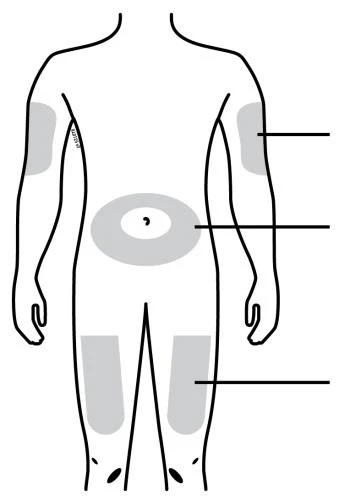
Upper arm
Stomach area
(abdomen)
Thigh
Use only the following injection sites:
- Thigh
- Stomach area (abdomen) (except for the area within 5 cm of the navel)
- Outer area of the upper arm (only if the injection is administered by another person)
Clean the injection site with an alcohol swab and allow the skin to dry.
Choose a different site each time an injection is given. If you need to use the same general area, ensure it is not exactly the same spot used previously.
Note:
- After cleaning the area, do not touch it again before the injection.
- Do not select an area where the skin is tender, bruised, red, or hardened. Avoid injecting into areas with scars or stretch marks.
Step 2: Immediately before injection
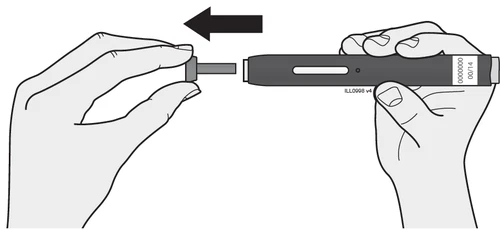
(E)
Remove the cap only when ready to inject. The injection must be administered within 5 minutes. It is normal to see a drop of liquid at the tip of the needle or safety device.
Note:
- Do not leave the pen without the cap for more than 5 minutes. This may dry out the medication.
- Do not twist or bend the cap.
- Do not reattach the cap to the pen once it has been removed.
- Do not place fingers into the safety device.
(F)
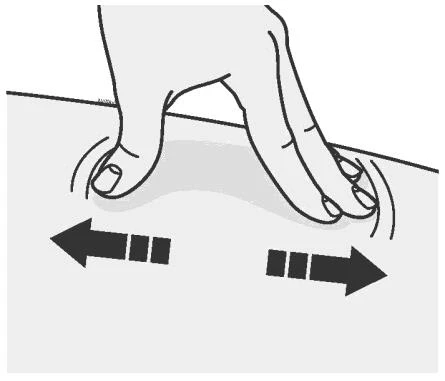
Create a stable surface at the selected injection site (thigh, stomach, or outer upper arm) using either the stretch method or the skin fold method.
Stretch method
Firmly stretch the skin by moving the thumb and fingers in opposite directions to create an area approximately five cm wide.

Skin fold method
Firmly pinch the skin between the thumb and fingers to create an area approximately five cm wide.
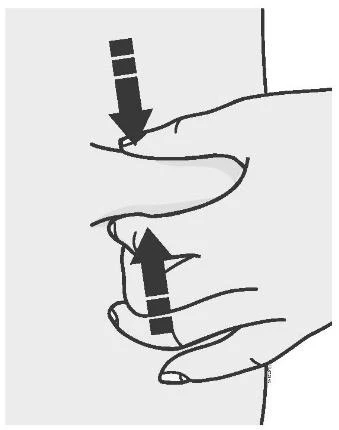
Note: It is important to keep the skin stretched or the skin fold maintained during the injection.
Step 3: Injection
(G)
Continue to keep the skin stretched or the skin fold held throughout the injection. With the cap removed, place the pen’s safety device against the skin at a 90-degree angle.
The needle is inside the safety device.
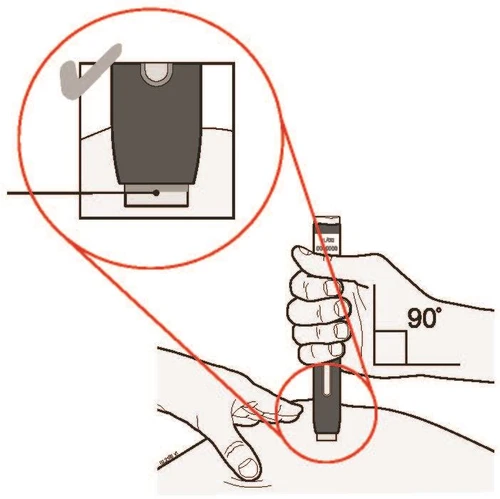
Safety device (needle
inside)
Note: Do not press the start button yet.
(H)
Firmly press the pen against the skin until it stops.
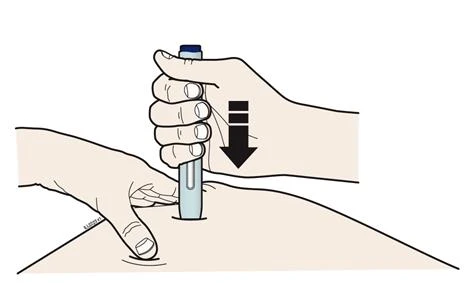
Push downward
Note: You must push all the way down, but do not press the start button until you are ready to administer the injection.
(I)
Press the start button. You will hear a clicking sound.
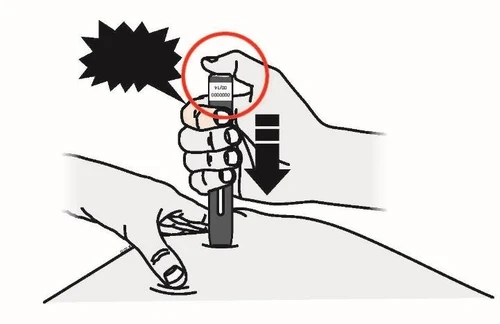
(J)
Remove your thumb from the button but continue to press down on the skin. The injection may take approximately 15 seconds.
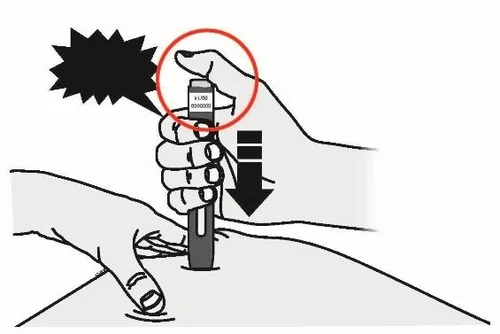
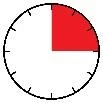
15 seconds
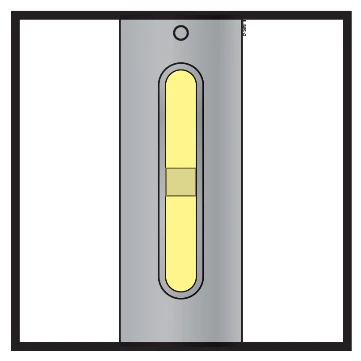
Note: When the injection is complete, the window will change from clear to yellow and you may hear a second click.
Note:
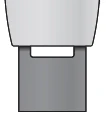
- After removing the pen from the skin, the needle will be automatically covered by the safety device.
- When removing the pen, if the window has not turned yellow or if it appears that some medication remains to be injected, this means you have not received the full dose. Contact your doctor immediately.
Step 4: Completion
(K)
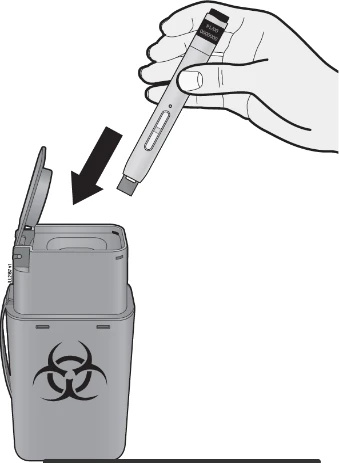
Dispose of the used pen and cap.
Place the used pen immediately into a dedicated sharps disposal container after use. Speak with your doctor or pharmacist about proper disposal. Local regulations may apply.
Note:
- Do not reuse the pen.
- Do not recycle the pen or the sharps disposal container.
- Always keep the sharps disposal container out of reach of children.
(L)
Examine the injection site.
If there is blood on the skin, press a cotton ball or gauze pad over the injection site. Do not rub the injection site. Apply a plaster if necessary.

If the dose is 140 mg and you are using two 70 mg Aimovig pens, repeat steps 1(D) to 4 with the second pen to administer the full dose.
This page has been machine-translated and may contain inaccuracies. The original data is available in the manufacturing country's language.
Last data check: May 11, 2026 · Data source: Agenzia Italiana del Farmaco (AIFA)