Adzynma
Italy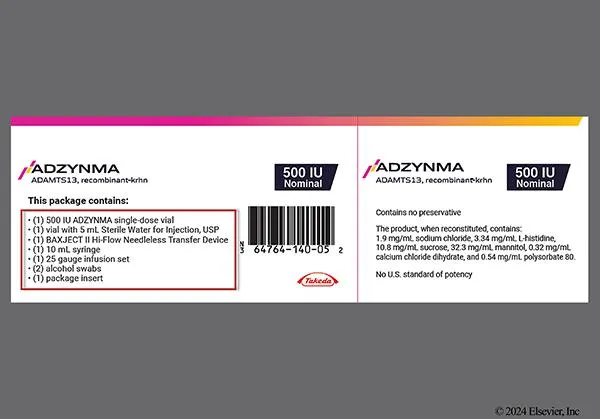
Table of Contents
- Package leaflet: Information for the user
- ADZYNMA 500 IU powder and solvent for solution for injection, 1 500 IU powder and solvent for solution for injection
- 1. What ADZYNMA is and what it is used for
- 2. What you need to know before using ADZYNMA
- 3. How to use ADZYNMA
- 4. Possible side effects
- 5. How to store ADZYNMA
- 6. Package contents and other information
- 7. Instructions for Use
Package leaflet: Information for the user
ADZYNMA 500 IU powder and solvent for solution for injection, 1 500 IU powder and solvent for solution for injection
rADAMTS13
This medicinal product is subject to additional monitoring. This will allow for rapid identification of new safety information. You can help by reporting any side effects you experience while taking this medicine. See the end of section 4 for information on how to report side effects.
Please read all of this leaflet carefully before you start taking this medicine because it contains important information for you.
- Keep this leaflet. You may need to read it again.
- If you have any questions, ask your doctor, pharmacist, or nurse.
- This medicine has been prescribed for you only. Do not give it to others, even if their symptoms are the same as yours, as it could be harmful.
- If you experience any side effect, including those not listed in this leaflet, contact your doctor, pharmacist, or nurse. See section 4.
Contents of this leaflet
- What ADZYNMA is and what it is used for
- What you need to know before you use ADZYNMA
- How to use ADZYNMA
- Possible side effects
- How to store ADZYNMA
- Contents of the pack and other information
- Instructions for use
1. What ADZYNMA is and what it is used for
ADZYNMA contains the active substance rADAMTS13, which is an artificial copy of the natural enzyme (protein) ADAMTS13. This enzyme is missing in people with congenital thrombotic thrombocytopenic purpura (cTTP).
Congenital TTP is a very rare inherited blood disorder that causes blood clots to form in the small blood vessels throughout the body. These clots can block the flow of blood and oxygen to organs, resulting in a lower-than-normal number of platelets (components that help blood to clot) in the blood.
Congenital TTP is caused by the absence of the ADAMTS13 enzyme in the blood. ADAMTS13 helps prevent blood clot formation by breaking down large molecules called von Willebrand factor (VWF). When VWF molecules are too large, they can cause dangerous blood clots. ADZYNMA is used to restore the missing ADAMTS13 enzyme levels, thereby enabling the breakdown of these large molecules into smaller ones, reducing the likelihood of blood clot formation and potentially preventing low platelet counts in patients with cTTP.
2. What you need to know before using ADZYNMA
Do not use ADZYNMA
- if you have had severe or potentially life-threatening allergic reactions to rADAMTS13 or to any of the other components of this medicine (listed in section 6).
Warnings and precautions
Talk to your doctor, pharmacist, or nurse before using ADZYNMA.
Allergic reactions
There is a risk that you may experience an allergic-type hypersensitivity reaction to ADZYNMA.
Your doctor should inform you about the early signs of severe allergic reactions such as:
- increased heart rate
- chest tightness
- wheezing and/or sudden onset of breathing difficulties
- low blood pressure
- hives, skin rash, and itchy skin
- runny nose or nasal congestion
- red eyes
- sneezing
- rapid swelling under the skin in areas such as the face, throat, arms, and legs
- fatigue
- nausea (feeling unwell)
- vomiting
- numbness, burning, and tingling sensations
- restlessness
- anaphylaxis (a severe allergic reaction that may cause difficulty swallowing and/or breathing, and redness or swelling of the face and/or hands).
If any of these symptoms occur, your doctor will decide whether treatment with ADZYNMA should be discontinued and will administer appropriate medications to treat the allergic reaction. Severe symptoms, including breathing difficulties and dizziness, require immediate emergency treatment.
Inhibitors
Some patients treated with ADZYNMA may develop neutralizing antibodies (called inhibitors). These inhibitors may potentially prevent the treatment from working properly.
Inform your doctor if you think the medicine is not working for you.
Other medicines and ADZYNMA
Tell your doctor or pharmacist if you are taking, have recently taken, or might take any other medicines.
Pregnancy and breastfeeding
If you are pregnant, think you might be pregnant, planning to become pregnant, or breastfeeding, ask your doctor or pharmacist for advice before taking this medicine.
You should not receive ADZYNMA during pregnancy unless specifically recommended by your doctor. If you are breastfeeding, you and your doctor will need to decide whether you can use ADZYNMA.
Driving and using machines
This medicine may have a minor effect on the ability to drive and use machines. Dizziness and drowsiness may occur after using ADZYNMA.
Traceability
To improve the traceability of biological medicines, the name and batch number of the medicine should be clearly recorded.
ADZYNMA contains sodium
This medicine contains less than 1 mmol (23 mg) of sodium per vial, i.e., essentially “sodium-free”.
ADZYNMA contains polysorbate 80
This medicine contains 2.7 mg of polysorbate 80 per vial of ADZYNMA 500 or ADZYNMA 1 500, equivalent to up to 0.216 mg/kg. Polysorbates may cause allergic reactions. Inform your doctor if you have known allergies.
3. How to use ADZYNMA
Treatment with ADZYNMA will be administered under the supervision of a physician experienced in
the treatment of patients with blood disorders.
ADZYNMA is given by intravenous injection (into a vein). It is supplied to your doctor as a powder,
which will be dissolved (reconstituted) before administration with the provided solvent (a liquid capable of dissolving the powder).
The dose is calculated based on body weight.
Taking the medicine at home
If you tolerate the injections well, your doctor may consider that you can use ADZYNMA at home.
Once you are able to self-administer ADZYNMA (or have it administered by a caregiver) following adequate training by your treating physician and/or nurse, your doctor will continue to monitor your response to treatment. If you experience adverse effects while taking the medicine at home, you must stop the injection immediately and contact a healthcare professional.
Recommended dose
Prophylactic enzyme replacement therapy
The usual dose is 40 UI per kg of body weight, administered on alternate weeks.
If ADZYNMA on alternate weeks is not effective for you, your doctor may adjust the frequency to once weekly.
On-demand enzyme replacement therapy for sudden episodes of TTP
If you develop a sudden episode of thrombotic thrombocytopenic purpura (TTP), the recommended dose of ADZYNMA is as follows:
- 40 UI/kg body weight on Day 1.
- 20 UI/kg body weight on Day 2.
- 15 UI/kg body weight starting on Day 3, once daily until two days after resolution of the sudden TTP episode.
If you use more ADZYNMA than you should
Overdosing on this medicine may cause bleeding.
If you forget to use ADZYNMA
If you have missed an injection of ADZYNMA, inform your doctor as soon as possible. Do not use a double dose to make up for the missed dose.
If you stop using ADZYNMA
If you wish to discontinue treatment with ADZYNMA, consult your doctor. If you stop treatment, your disease symptoms may worsen.
If you have any questions about the use of this medicine, consult your doctor, pharmacist, or nurse.
4. Possible side effects
Like all medicines, this medicine can cause side effects, although not everybody gets them.
The following side effects have been reported with ADZYNMA:
Very common (may affect more than 1 in 10 people)
- infection of the nose and throat
- headache
- dizziness
- migraine
- diarrhoea
- nausea
Common (may affect up to 1 in 10 people)
- high number of platelets in the blood (thrombocytosis)
- somnolence
- constipation
- bloated stomach (abdominal distension)
- weakness (asthenia)
- feeling of warmth
- abnormal ADAMTS13 activity
Reporting of side effects
If you experience any side effect, including those not listed in this leaflet, talk to your doctor, pharmacist or nurse.
You can also report side effects directly via the national reporting system listed in Annex V. By reporting side effects, you can help provide more information on the safety of this medicine.
5. How to store ADZYNMA
Keep this medicine out of the sight and reach of children.
Do not use this medicine after the expiry date which is stated on the label and on the carton after
Exp. The expiry date refers to the last day of that month.
Unopened vials
Store in the refrigerator (2 °C − 8 °C).
Do not freeze.
Keep in the original packaging to protect the medicine from light.
Unopened ADZYNMA vials may be stored at room temperature (up to 30 °C) for a maximum period of 6 months, without exceeding the expiry date. Do not return ADZYNMA to the refrigerator after storage at room temperature. Record on the carton the date when ADZYNMA was removed from the refrigerator.
After reconstitution
Discard any unused reconstituted product after 3 hours.
Do not use this medicine if it appears not clear and colourless.
Do not dispose of medicines via wastewater or household waste. Ask your pharmacist how to dispose of medicines you no longer use. This will help protect the environment.
6. Package contents and other information
What ADZYNMA contains
- The active substance, rADAMTS13, is a purified recombinant human "A-disintegrin and metalloproteinase with thrombospondin type 1 repeat 13". Each vial of powder contains 500 or 1,500 IU of nominal rADAMTS13 activity.
- The solvent vial contains 5 mL of water for injections.
- The other excipients are sodium chloride, calcium chloride dihydrate, L-histidine, mannitol, sucrose and polysorbate 80 (E433). See section 2 “ADZYNMA contains sodium” and “ADZYNMA contains polysorbate 80”.
Description of the appearance of ADZYNMA and contents of the pack
ADZYNMA is supplied as a powder and solvent for solution for injection. The powder is a white lyophilized powder. The solvent is clear and colourless.
Each pack contains one vial of powder, one vial of solvent, a reconstitution device (BAXJECT II Hi-Flow), a single-use syringe, an infusion set, and two alcohol-impregnated swabs.
Marketing Authorisation Holder and Manufacturer
Takeda Manufacturing Austria AG
Industriestrasse 67
1221 Vienna
Austria
For further information about this medicinal product, please contact the local representative of the Marketing Authorisation Holder:
België/Belgique/Belgien Lietuva
Takeda Belgium NV Takeda, UAB
Tél/Tel: +32 2 464 06 11 Tel: +370 521 09 070
[email protected] [email protected]
България Luxembourg/Luxemburg
Такеда България ЕООД Takeda Belgium NV
Тел.: +359 2 958 27 36 Tél/Tel: +32 2 464 06 11
[email protected] [email protected]
Česká republika Magyarország
Takeda Pharmaceuticals Czech Republic s.r.o. Takeda Pharma Kft.
Tel: +420 234 722 722 Tel.: +36 1 270 7030
[email protected] [email protected]
Danmark Malta
Takeda Pharma A/S Τakeda HELLAS S.A.
Tlf.: +45 46 77 10 10 Tel: +30 210 6387800
[email protected] [email protected]
Deutschland Nederland
Takeda GmbH Takeda Nederland B.V.
Tel: +49 (0)800 825 3325 Tel: +31 20 203 5492
[email protected] [email protected]
Eesti Norge
Takeda Pharma OÜ Takeda AS
Tel: +372 6177 669 Tlf: +47 800 800 30
[email protected] [email protected]
Ελλάδα Österreich
Τakeda ΕΛΛΑΣ Α.Ε. Takeda Pharma Ges.m.b.H.
Tηλ: +30 210 6387800 Tel: +43 (0) 800-20 80 50
[email protected] [email protected]
España Polska
Takeda Farmacéutica España, S.A. Takeda Pharma Sp. z o.o.
Tel: +34 917 90 42 22 Tel.: +48223062447
[email protected] [email protected]
France Portugal
Takeda France SAS Takeda Farmacêuticos Portugal, Lda.
Tél: +33 1 40 67 33 00 Tel: +351 21 120 1457
[email protected] [email protected]
Hrvatska România
Takeda Pharmaceuticals Croatia d.o.o. Takeda Pharmaceuticals SRL
Tel: +385 1 377 88 96 Tel: +40 21 335 03 91
[email protected] [email protected]
Ireland Slovenija
Takeda Products Ireland Ltd Takeda Pharmaceuticals farmacevtska družba d.o.o.
Tel: 1800 937 970 Tel: +386 (0) 59 082 480
[email protected] [email protected]
Ísland Slovenská republika
Vistor hf. Takeda Pharmaceuticals Slovakia s.r.o.
Sími: +354 535 7000 Tel: +421 (2) 20 602 600
[email protected] [email protected]
Italia Suomi/Finland
Takeda Italia S.p.A. Takeda Oy
Tel: +39 06 502601 Puh/Tel: 0800 774 051
[email protected] [email protected]
Κύπρος Sverige
Τakeda ΕΛΛΑΣ Α.Ε. Takeda Pharma AB
Τηλ: +30 210 6387800 Tel: 020 795 079
[email protected] [email protected]
Latvija
Takeda Latvia SIA
Tel: +371 67840082
[email protected]
This medicinal product has been authorised under “exceptional circumstances”. This means that, because the disease is rare, it has not been possible to obtain complete information about this medicinal product.
The European Medicines Agency will review any new information on this medicinal product annually, and this patient information leaflet will be updated if necessary.
Further information
More detailed information on this medicinal product is available on the European Medicines Agency website: https://www.ema.europa.eu. Links to other websites on rare diseases and their treatments are also provided.
7. Instructions for Use
These instructions for use contain information on how to reconstitute and infuse ADZYNMA.
These instructions for use are intended for healthcare professionals and for patients/caregivers who will
administer ADZYNMA at home after receiving adequate training from a healthcare professional.
Treatment with ADZYNMA must be prescribed and supervised by a healthcare professional experienced in managing patients with blood disorders.
Important:
- For intravenous injection only after reconstitution.
- Use aseptic technique throughout the entire procedure.
- Check the product’s expiration date before use.
- Do not use ADZYNMA if the expiration date has been exceeded.
- If the patient requires more than one vial of ADZYNMA per injection, reconstitute each vial according to the instructions provided in the “Reconstitution” section.
- Before administration, inspect the reconstituted ADZYNMA solution for the presence of particles and discoloration. The solution should appear clear and colorless.
- Do not administer if particles or discoloration are observed.
- Use ADZYNMA within 3 hours after reconstitution if stored at room temperature.
- Do not administer ADZYNMA through the same line or in the same container simultaneously with other infusion medicines.
Reconstitution
- Prepare a clean, flat surface and gather all materials required for reconstitution and administration ( Figure A ).
Figure A
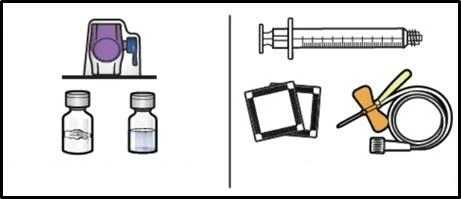
Materials for Reconstitution Materials for Administration
- Allow the ADZYNMA vials and diluent to reach room temperature before use.
- Wash and thoroughly dry hands.
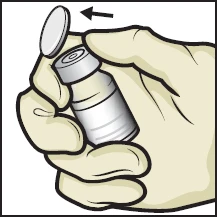
- Remove the plastic caps from the ADZYNMA and diluent vials and place the vials on a flat surface ( Figure B ).
Figure B
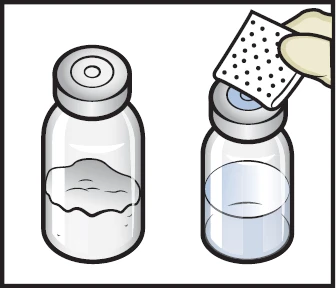
- Wipe the rubber stoppers with an alcohol-impregnated cotton swab and allow them to air dry before use ( Figure C ).
Figure C
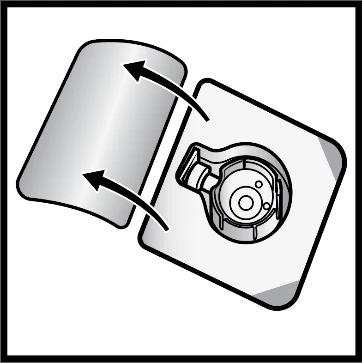
- Open the BAXJECT II Hi-Flow device package by removing the lid, taking care not to touch the inside ( Figure D ).
- Do not remove the BAXJECT II Hi-Flow device from the package.
- Do not touch the transparent plastic activator.
Figure D
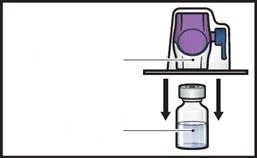
- Invert the package containing the BAXJECT II Hi-Flow device and place it over the diluent vial. Press down until the transparent plastic activator pierces the stopper of the diluent vial ( Figure E ).
Figure E
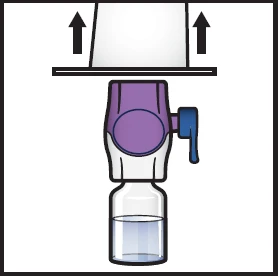
- Holding the BAXJECT II Hi-Flow device package by the edge, remove the packaging from the device ( Figure F ).
- Do not remove the blue cap from the BAXJECT II Hi-Flow device.
- Do not touch the exposed purple plastic activator.
Figure F
- Invert the system so that the diluent vial is now on top. Press the BAXJECT II Hi-Flow device down until the purple plastic activator pierces the stopper of the ADZYNMA powder vial ( Figure G ). The vacuum will draw the diluent into the ADZYNMA powder vial.
- Bubbles or foaming may be observed: this is normal and should disappear shortly.
Figure G
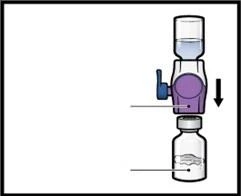
Purple plastic
Powder
- Gently and continuously swirl the connected vials until the powder is completely dissolved ( Figure H ).
- Do not shake the vial.
Figure H
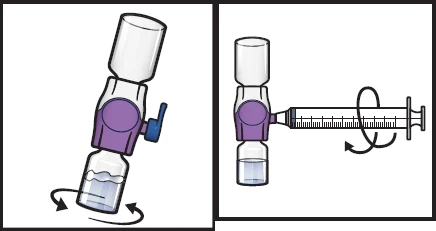
- Visually inspect the reconstituted solution for the presence of particles before administration.
- Do not use the product if particles or discoloration are observed.
- If the required dose requires more than one ADZYNMA vial, reconstitute each vial following the steps above.
- Use a separate BAXJECT II Hi-Flow device to reconstitute each ADZYNMA and diluent vial.
Administration of ADZYNMA
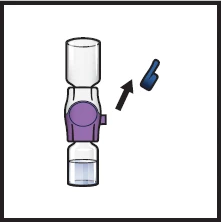
- Remove the blue cap from the BAXJECT II Hi-Flow device ( Figure I ). Attach a Luer-Lock syringe ( Figure J ).
- Do not inject air into the system. Figure I Figure J
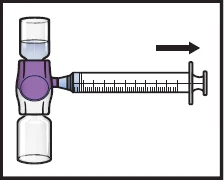
- Invert the system (now the ADZYNMA vial is on top). Slowly draw the reconstituted solution into the syringe by pulling back the plunger slowly ( Figure K ).
Figure K
- If a patient is to receive more than one ADZYNMA vial, the contents of multiple vials may be drawn into the same syringe. Repeat this procedure for all reconstituted ADZYNMA vials until the total required volume is reached.
- Disconnect the syringe and attach a suitable injection needle or infusion set.
- Point the needle upward and remove any air bubbles by gently tapping the syringe with the finger and slowly and carefully expelling the air from the syringe and needle.
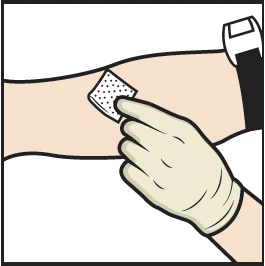
- Apply a tourniquet and clean the selected injection site with an alcohol-impregnated swab ( Figure L ).
Figure L
- Insert the needle into the vein and remove the tourniquet.
- Infuse the reconstituted ADZYNMA slowly at a rate of 2–4 mL per minute ( Figure M ).
- To control the infusion rate, a syringe pump may be used.
Figure M
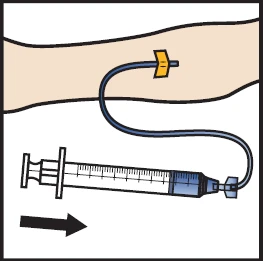
- Remove the needle from the vein and apply pressure to the injection site for several minutes.
- Do not recap the needle.
Storage of ADZYNMA
- Store ADZYNMA in the refrigerator (2 °C – 8 °C) or at room temperature (up to 30 °C) for a maximum of 6 months.
- Do not return ADZYNMA to the refrigerator after it has been stored at room temperature.
- Record on the carton the date when ADZYNMA was removed from the refrigerator.
- Do not freeze.
- Keep in the original packaging to protect from light.
- Do not use after the expiration date stated on the label and carton after Exp.
- Use ADZYNMA within 3 hours after reconstitution. Dispose of any reconstituted product not used within 3 hours of reconstitution.
Disposal of ADZYNMA
- The vials are for single use only.
- Dispose of used needles, syringes, and empty vials in a puncture-resistant sharps container.
- Do not dispose of medicines via wastewater or household waste. Ask your pharmacist how to dispose of medicines no longer in use. This will help protect the environment.