Acvybra
ItalyTable of Contents
- Package leaflet: Information for the patient
- Acvybra 60 mg solution for injection in pre-filled syringe
- 1. What Acvybra is and what it is used for
- 2. What you need to know before using Acvybra
- 3. How to use Acvybra
- 4. Possible side effects
- 5. How to store Acvybra
- 6. Package contents and other information
- Instructions for use:
Package leaflet: Information for the patient
Acvybra 60 mg solution for injection in pre-filled syringe
denosumab
This medicinal product is subject to additional monitoring. This will allow rapid identification of new safety information. You can help by reporting any side effects you experience while taking this medicine. See the end of section 4 for information on how to report side effects.
Please read all of this leaflet carefully before taking this medicine, because it contains
important information for you.
- Keep this leaflet. You may need to read it again.
- If you have any questions, ask your doctor or pharmacist.
- This medicine has been prescribed for you only. Do not give it to other people, even if they have the same symptoms as yours, because it could be harmful.
- If you experience any side effect, including those not listed in this leaflet, talk to your doctor or pharmacist. See section 4.
- Your doctor will give you a patient reminder card containing important safety information that you must know before and during treatment with Acvybra.
Contents of this leaflet
- What Acvybra is and what it is used for
- What you need to know before using Acvybra
- How to use Acvybra
- Possible side effects
- How to store Acvybra
- Contents of the pack and other information
1. What Acvybra is and what it is used for
What Acvybra is and how it works
Acvybra contains denosumab, a protein (monoclonal antibody) that interferes with the action of another protein, for the treatment of bone loss and osteoporosis. Treatment with Acvybra makes bones stronger and less prone to fractures.
Bone is a living tissue that is constantly being renewed. Oestrogens help maintain healthy bones. After menopause, reduced oestrogen levels can cause bones to become thin and fragile, which may lead to the development of a condition called osteoporosis. Osteoporosis can also occur in men due to various causes, including ageing and/or low levels of the male hormone testosterone. It may also occur in patients receiving glucocorticoids. Many patients with osteoporosis do not have symptoms, but are still at risk of bone fractures, particularly in the spine, hip, and wrists.
Surgical procedures or medications that suppress the production of oestrogen or testosterone, used in the treatment of patients with breast or prostate cancer, can also cause bone loss. As a result, bones become more fragile and more likely to fracture.
For what type of treatment is Acvybra used
Acvybra is used for the treatment of:
- osteoporosis in postmenopausal women (postmenopausal osteoporosis) and in men who have an increased risk of fractures (broken bones), to reduce the risk of vertebral, non-vertebral, and hip fractures.
- bone loss in men resulting from reduced hormone levels (testosterone) due to surgery or pharmacological therapy in patients with prostate cancer.
- bone loss due to long-term glucocorticoid therapy in patients at increased risk of fracture.
2. What you need to know before using Acvybra
Do not use Acvybra
- if you have low levels of calcium in your blood (hypocalcemia).
- if you are allergic to denosumab or to any of the other ingredients of this medicine (listed in section 6).
Warnings and precautions
Talk to your doctor or pharmacist before using Acvybra.
While being treated with Acvybra, you may develop a skin infection with symptoms such as swelling, redness, most commonly in the lower leg, with a feeling of warmth and pain (cellulitis), and possibly fever. Inform your doctor immediately if you experience any of these symptoms.
While being treated with Acvybra, you must also take calcium and vitamin D supplements. Your doctor will discuss this with you.
While being treated with Acvybra, you may have low levels of calcium in your blood. Inform your doctor immediately if you notice any of the following symptoms: muscle spasms, twitching or cramps, and/or numbness or tingling in your fingers, toes or around your mouth, and/or seizures, confusion or loss of consciousness.
In rare cases, severe low levels of calcium in the blood have been reported, leading to hospitalization and even life-threatening reactions. Therefore, your blood calcium levels will be monitored (through a blood test) before each dose and in patients at risk of developing hypocalcemia, within two weeks after the initial dose.
Inform your doctor if you have or have ever had severe kidney problems, impaired kidney function, if you are on dialysis, or if you are taking medicines called glucocorticoids (such as prednisolone or dexamethasone), as these may increase your risk of low blood calcium levels if you do not take calcium supplements.
Problems with mouth, teeth or jaw
A rare side effect called osteonecrosis of the jaw (severe deterioration of the jawbone) has been reported (may occur in up to 1 in 1,000 patients) in patients receiving denosumab for osteoporosis. The risk of osteonecrosis of the jaw increases in patients treated for a long period (may occur in up to 1 in 200 patients if treated for 10 years). Osteonecrosis of the jaw may also occur after stopping treatment. It is important to try to prevent the development of osteonecrosis of the jaw, as it is a painful condition that can be difficult to treat. To reduce the risk of developing osteonecrosis of the jaw, take the following precautions:
Before receiving treatment, inform your doctor or nurse (healthcare provider) if you:
- have any mouth or dental problems, such as poor dental hygiene, gum disorders, or if you are scheduled for a tooth extraction;
- do not regularly receive dental care or have not had a dental check-up for a long time;
- are a smoker (as this may increase the risk of dental problems);
- have previously been treated with a bisphosphonate (used to treat or prevent bone disorders);
- are taking medicines called corticosteroids (such as prednisolone or dexamethasone);
- have cancer.
Your doctor may ask you to have a dental examination (by a dentist) before starting treatment with Acvybra.
While being treated, it is important to maintain good oral hygiene and have regular dental check-ups. If you wear dentures, make sure they fit properly. If you are undergoing dental treatment or are scheduled for dental surgery (e.g., tooth extractions), inform your doctor about the dental treatment and inform your dentist that you are being treated with Acvybra.
Contact your doctor and dentist immediately if you notice any new problems with your mouth or teeth, such as loose teeth, pain or swelling, or failure of mouth sores to heal, or discharge, as these could be signs of a side effect called osteonecrosis of the jaw (ONJ).
Atypical femoral fractures
Some people have developed atypical fractures of the femur during treatment with denosumab. Contact your doctor if you experience new or unusual pain in your hip, groin or thigh.
Children and adolescents
Acvybra must not be used in children and adolescents under 18 years of age.
Other medicines and Acvybra
Inform your doctor or pharmacist if you are taking, have recently taken, or might take any other medicines. It is particularly important that you inform your doctor if you are taking other medicines containing denosumab.
You must not take Acvybra together with other medicines containing denosumab.
Pregnancy and breastfeeding
Denosumab has not been studied in pregnant women. It is important that you inform your doctor if you are pregnant, think you may be pregnant, or are planning a pregnancy. The use of Acvybra is not recommended during pregnancy. Women of childbearing potential must use effective contraception while taking Acvybra and for at least 5 months after stopping treatment with Acvybra.
If you become pregnant during treatment with Acvybra or within 5 months after stopping treatment with Acvybra, please inform your doctor.
It is not known whether denosumab passes into breast milk. It is important that you inform your doctor if you are breastfeeding or planning to breastfeed. Your doctor will then help you decide whether to stop breastfeeding or stop taking Acvybra, taking into account the benefits of breastfeeding for the child and the benefits of taking Acvybra for the mother.
If you are breastfeeding during treatment with Acvybra, inform your doctor.
Ask your doctor or pharmacist for advice before using this medicine.
Driving and using machines
Denosumab does not affect or has a negligible effect on the ability to drive or use machines.
3. How to use Acvybra
The recommended dose is one 60 mg pre-filled syringe administered once every 6 months as a single subcutaneous injection. The most suitable injection sites are the upper thighs and the abdomen. If an injection is being administered by a caregiver, the upper outer arm may also be used. Consult your doctor regarding the date of your next possible injection. You will be provided with a reminder card, which can be used to keep track of the date of your next injection.
During treatment with Acvybra, you must also take calcium and vitamin D supplements. Your doctor will discuss this with you.
Your doctor will decide whether it is preferable for you or your caregiver to administer the Acvybra injection. Your doctor or nursing staff will show you or your caregiver how to use Acvybra. For instructions on how to inject Acvybra, refer to the section at the end of this leaflet.
Do not shake.
If you forget to take Acvybra
If you have missed a dose of Acvybra, the injection should be given as soon as possible.
Afterwards, injections should be administered every 6 months from the date of the last injection.
If you stop treatment with Acvybra
To achieve the maximum benefit from treatment in reducing the risk of fractures, it is important to take Acvybra for the entire duration prescribed by your doctor. Do not stop treatment without consulting your doctor.
4. Possible side effects
Like all medicines, this medicine can cause side effects, although not everybody gets them.
Patients treated with denosumab may uncommonly develop skin infections (especially cellulitis). Inform your doctor immediately if any of the following symptoms occur while you are taking Acvybra: redness and swelling of the skin, most commonly in the lower leg, with a sensation of warmth and pain, possibly accompanied by fever.
Rarely, patients treated with denosumab may develop pain in the mouth and/or jaw, swelling or non-healing lesions in the mouth or jaw, discharge, numbness or heaviness in the jaw, or loose teeth. These could be signs of severe bone damage in the jaw (osteonecrosis). Inform your doctor and dentist immediately if you experience any of these symptoms during or after treatment with Acvybra.
Rarely, patients treated with denosumab may develop low levels of calcium in the blood (hypocalcaemia). Severely low calcium levels can lead to hospitalisation and may even be life-threatening. Symptoms include muscle spasms, twitching or cramps, and/or numbness or tingling in the fingers, toes or around the mouth, and/or seizures, confusion, or loss of consciousness. Inform your doctor immediately if any of these symptoms occur. Low calcium levels may also cause changes in heart rhythm known as QT interval prolongation, which can be detected by an electrocardiogram (ECG).
Rarely, atypical femoral fractures may occur in patients treated with denosumab. Contact your doctor if you develop new or unusual pain in the hip, groin or thigh, as this may be an early sign of a possible femoral fracture.
Rarely, allergic reactions may occur in patients treated with denosumab. Symptoms include swelling of the face, lips, tongue, throat or other body parts; rash, itching, hives, wheezing or difficulty breathing. Inform your doctor if you experience any of these symptoms during treatment with Acvybra.
Very common side effects (may occur in more than 1 in 10 people):
- bone, joint and/or muscle pain, sometimes severe,
- pain in arms or legs (limb pain).
Common side effects (may occur in up to 1 in 10 people):
- frequent and painful need to urinate, blood in urine, urinary incontinence,
- upper respiratory tract infections,
- pain, tingling or numbness radiating to the lower limbs (sciatica),
- constipation,
- abdominal discomfort,
- rash,
- itching, redness and/or dryness of the skin (eczema),
- hair loss (alopecia).
Uncommon side effects (may occur in up to 1 in 100 people):
- fever, vomiting, abdominal pain or abdominal disorders (diverticulitis),
- ear infections,
- skin rash or mouth ulcers (drug-induced lichenoid eruptions).
Very rare side effects (may occur in up to 1 in 10,000 people):
- allergic reaction that may damage blood vessels, mainly in the skin (e.g. purple or red-brown spots, hives or skin ulcers) (hypersensitivity vasculitis).
Not known (frequency cannot be estimated from the available data):
- inform your doctor if you experience ear pain, discharge from the ear, and/or ear infection. These may be signs of damage to the ear bone.
Reporting of side effects
If you experience any side effect, including those not listed in this leaflet, talk to your doctor, pharmacist or nurse. You can also report side effects directly through the national reporting system referred to in Annex V. By reporting side effects, you can help provide more information on the safety of this medicine.
5. How to store Acvybra
Keep this medicine out of the sight and reach of children.
Do not use this medicine after the expiry date which is stated on the label and the carton after
Exp. The expiry date refers to the last day of that month.
Store in a refrigerator (2 °C – 8 °C).
Do not freeze.
Keep the pre-filled syringe in the outer packaging to protect the medicine from light.
The pre-filled syringe may be removed from the refrigerator and allowed to reach room temperature (up to 25 °C) before injection. This will make the injection more comfortable.
Once the syringe has reached room temperature (up to 25 °C), it must be used within 30 days.
Do not dispose of any medicine via wastewater or household waste. Ask your pharmacist how to dispose of medicines no longer required. This will help protect the environment.
6. Package contents and other information
What Acvybra contains
- The active substance is denosumab. Each 1 mL pre-filled syringe contains 60 mg of denosumab (60 mg/mL).
- The other components are L-histidine, L-histidine monohydrochloride monohydrate, sucrose, poloxamer 188 and water for injections.
Description of the appearance of Acvybra and contents of the pack
Acvybra is a clear, colourless to slightly yellow solution for injection in a ready-to-use pre-filled syringe.
Each pack contains one pre-filled syringe with needle protection.
Marketing Authorisation Holder
Reddy Holding GmbH
Kobelweg 95
86156 Augsburg
Germany
Manufacturer
Alvotech hf
Sæmundargata 15-19
102 Reykjavik
Iceland
For further information about this medicinal product, please contact the local representative of the Marketing Authorisation Holder:
België/Belgique/Belgien Lietuva
betapharm Arzneimittel GmbH betapharm Arzneimittel GmbH
Tél/Tel: + 49 821 74881 0 Tel: + 49 821 74881 0
[email protected] [email protected]
България Luxembourg/Luxemburg
betapharm Arzneimittel GmbH betapharm Arzneimittel GmbH
Teл.: +49 821 74881 0 Tél/Tel: + 49 821 74881 0
[email protected] [email protected]
Česká republika Magyarország
betapharm Arzneimittel GmbH betapharm Arzneimittel GmbH
Tel: +49 821 74881 0 Tel.: + 49 821 74881 0
[email protected] [email protected]
Danmark Malta
betapharm Arzneimittel GmbH betapharm Arzneimittel GmbH
Tlf: + 49 821 74881 0 Tel: + 49 821 74881 0
[email protected] [email protected]
Deutschland Nederland
betapharm Arzneimittel GmbH betapharm Arzneimittel GmbH
Kobelweg 95 Tel: + 49 821 74881 0
86156 Augsburg [email protected]
Tel: + 49 821 74881 0
Eesti Norge
betapharm Arzneimittel GmbH betapharm Arzneimittel GmbH
Tel: + 49 821 74881 0 Tlf: + 49 821 74881 0
[email protected] [email protected]
Ελλάδα Österreich
betapharm Arzneimittel GmbH betapharm Arzneimittel GmbH
Τηλ: + 49 821 74881 0 Tel: + 49 821 74881 0
[email protected] [email protected]
España Polska
Reddy Pharma Iberia S.A.U. betapharm Arzneimittel GmbH
Avenida Josep Tarradellas nº 38 Tel.: + 49 821 74881 0
E-08029 Barcelona [email protected]
Tel: + 34 93 355 49 16
[email protected]
France Portugal
Reddy Pharma SAS betapharm Arzneimittel GmbH
9 avenue Edouard Belin Tel: + 49 821 74881 0
F-92500 Rueil-Malmaison [email protected]
Tél: + 33 1 85 78 17 34
[email protected]
Hrvatska România
betapharm Arzneimittel GmbH Dr. Reddy´s Laboratories Romania SRL
Tel: + 49 821 74881 0 Tel: + 4021 224 0032
[email protected] [email protected]
Ireland Slovenija
betapharm Arzneimittel GmbH betapharm Arzneimittel GmbH
Tel: + 49 821 74881 0 Tel: + 49 821 74881 0
[email protected] [email protected]
Ísland Slovenská republika
betapharm Arzneimittel GmbH betapharm Arzneimittel GmbH
Sími: + 49 821 74881 0 Tel: + 49 821 74881 0
[email protected] [email protected]
Italia Suomi/Finland
Dr. Reddy’s S.r.l. betapharm Arzneimittel GmbH
Piazza Santa Maria Beltrade, 1 Puh/Tel: + 49 821 74881 0
I-20123 Milano [email protected]
Tel: + 39(0)2 70106808
[email protected]
Κύπρος Sverige
betapharm Arzneimittel GmbH betapharm Arzneimittel GmbH
Τηλ: + 49 821 74881 0 Tel: + 49 821 74881 0
[email protected] [email protected]
Latvija
betapharm Arzneimittel GmbH
Tel: + 49 821 74881 0
[email protected]
Other sources of information
More detailed information on this medicinal product is available on the website of the European Medicines Agency: https://www.ema.europa.eu/
Instructions for use:
Parts guide
Before use After use
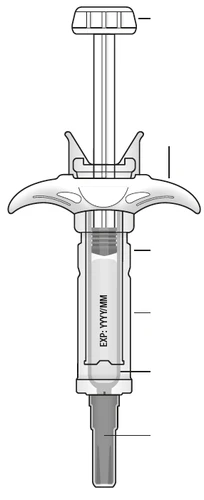
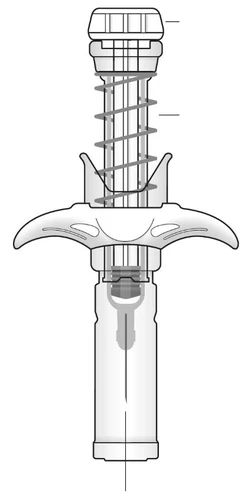
Plunger
The plunger locks
Do not grasp or pull the
plunger at any
time
The safety spring is
activated
Finger grip
Transparent safety
shield
| Expiry date on the label |
Syringe barrel
Grey protective cap
Important: keep the grey
protective cap in place
The needle retracts into the
until you are ready to perform
transparent safety shield
the injection
Important
Before using a pre-filled syringe of • Acvybra with automatic needle safety,
read these important instructions:
- It is important that you do not attempt to perform the injection unless you have received adequate instructions from your doctor or healthcare professional.
- Acvybra is administered as an injection into the tissue just beneath the skin (subcutaneous injection). Do not remove the grey needle cap from the pre-filled syringe until you are ready for
the injection.
Do not use the pre-filled syringe if it has been dropped on a hard surface. Use a new pre-filled syringe
and contact your doctor or healthcare professional.
Do not attempt to activate the pre-filled syringe before the injection.
Do not attempt to remove the transparent safety shield from the pre-filled syringe.
Contact your doctor or healthcare professional if you have any questions.
| Step 1: Preparation | |
| A | Remove the prefilled syringe from its packaging and prepare the necessary materials for injection: alcohol swabs, a cotton ball or gauze, a bandage, and a sharps disposal container (not included). |
| For a more comfortable injection, allow the prefilled syringe to reach room temperature for about 30 minutes before injecting. Wash your hands thoroughly with soap and water. Place the new prefilled syringe and other required materials on a clean, well-lit work surface. Do not attempt to warm the syringe using a heat source such as hot water or a microwave. Do not expose the prefilled syringe to direct sunlight. Do not shake the prefilled syringe excessively. • Keep the prefilled syringe out of sight and reach of children. | |
B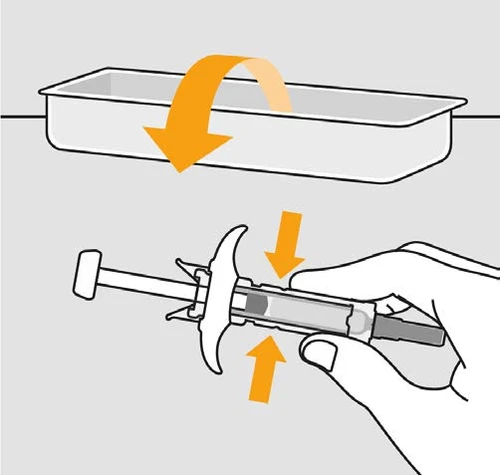 | Open the wrapper by tearing off the cover. Grasp the safety shield of the prefilled syringe to remove the syringe from the packaging. |
| For safety: Do not grasp the plunger. Do not grasp the gray needle cap. Grasp here | |
| C | Inspect the medicine and the prefilled syringe.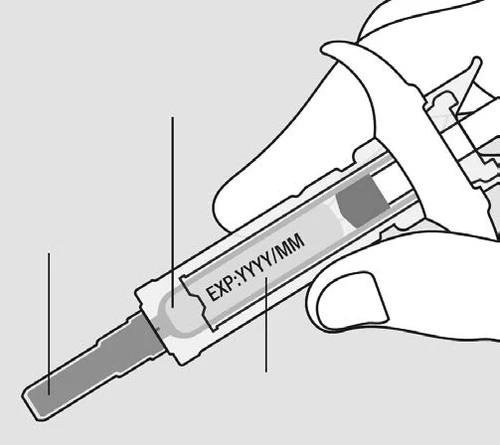 |
| Do not use the prefilled syringe if: • The medicine is cloudy or contains particles. It should be a clear, colorless to slightly yellow solution. • Any parts appear cracked or broken. • The gray needle cap is missing or not securely attached. • The expiration date printed on the label has passed the last day of the month indicated. In any of these cases, contact your doctor or healthcare provider. Gray needle cap Medicine Label and expiration date | |
| Step 2: Preparation | |
A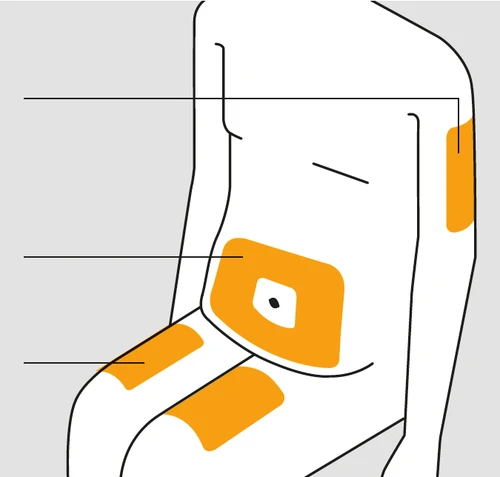 | Wash your hands thoroughly. Prepare and clean the injection site. |
| You may use: • The upper thigh. • The abdomen, except for an area of 5 centimeters around the navel. • The outer upper arm (only if someone else is administering the injection). Clean the injection site with an alcohol swab. Let the skin dry completely. Outer upper arm Abdomen Upper thigh | |
| Do not touch the injection site before injecting. Do not inject into areas where the skin is tender, injured, red, or hardened. Avoid injecting into areas with scars or stretch marks. | |
B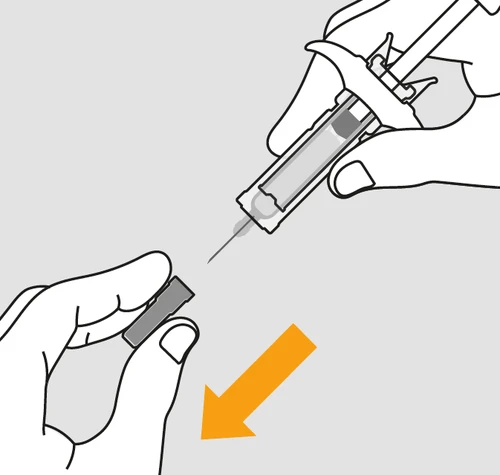 | Carefully remove the gray needle cap by pulling it straight out and away from the body. |
C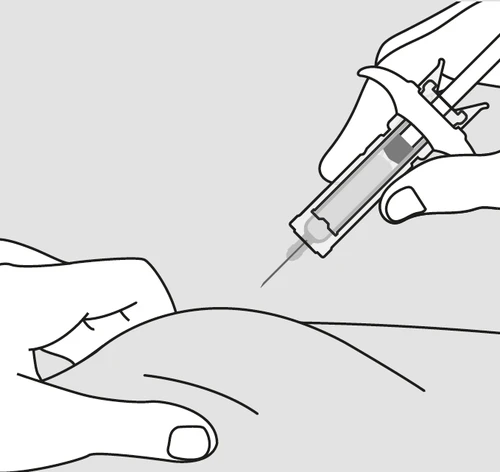 | Lift the injection site to create a stable surface. |
| It is important to keep the skin lifted during the injection. | |
| Step 3: Injection | |
A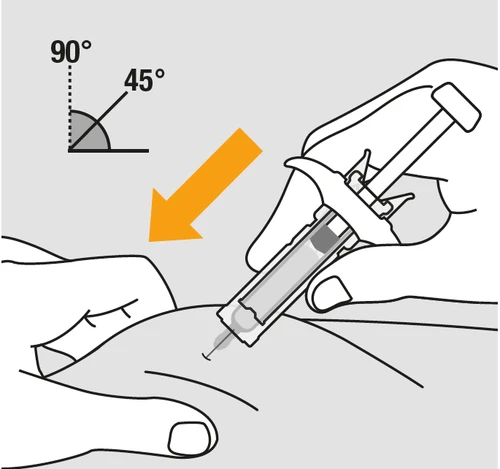 | Keep the skin lifted. INSERT the needle into the skin. |
| Do not touch the cleaned area of skin. | |
B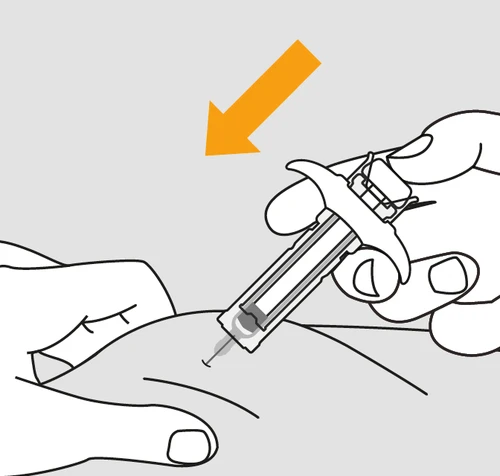 | PUSH the plunger slowly and steadily until it reaches the bottom. |
C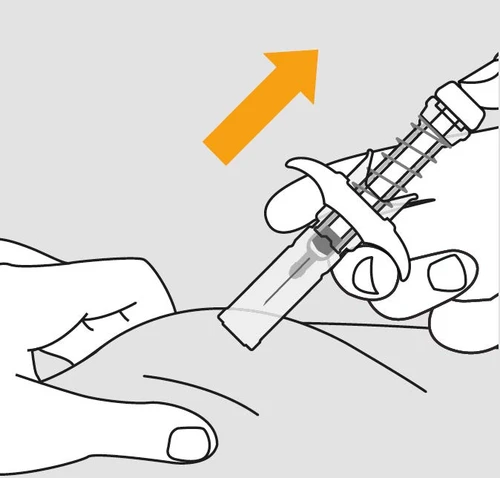 | RELEASE your thumb. Then REMOVE the syringe from the skin. |
| After releasing the plunger, the safety shield of the prefilled syringe will automatically cover the injection needle safely. Do not recap the used prefilled syringes with the gray needle cap. | |
| Step 4: Completion | |
| A | Dispose of the used prefilled syringe and other materials in a sharps disposal container.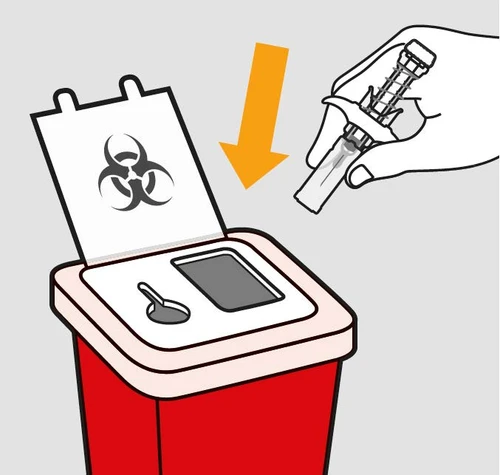 |
| Medicines must be disposed of in accordance with local regulations. Ask your pharmacist how to properly dispose of unused medicines. These measures will help protect the environment. Keep the syringe and sharps disposal container out of sight and reach of children. Do not reuse the prefilled syringe. Do not recycle prefilled syringes or dispose of them in household waste. | |
| B | Examine the injection site. |
| If you see blood, press a cotton ball or gauze pad against the injection site. Do not rub the injection site. Apply a bandage if needed. | |