Acetylsalicylic acid L.F.M.
Italy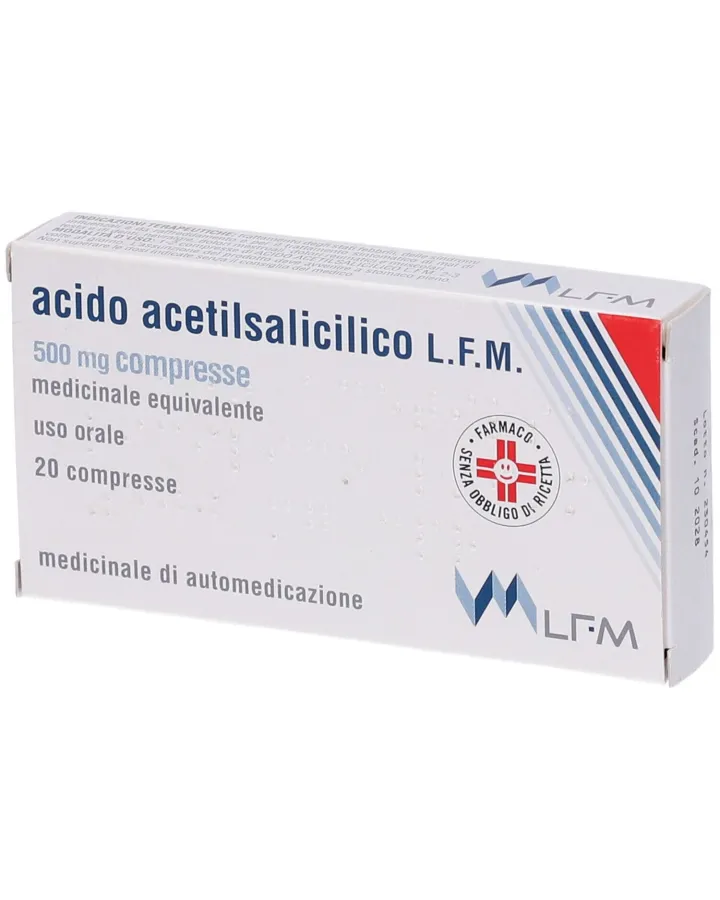
Table of Contents
- Patient Information Leaflet
- ACETYLSALICYLIC ACID L.F.M. 500 mg tablets
- 1. What ACIDO ACETILSALICILICO L.F.M. is and what it is used for
- 2. What you should know before taking ACIDO ACETILSALICILICO L.F.M.
- 3. How to take ACIDO ACETILSALICILICO L.F.M.
- 4. Possible side effects
- 5. How to store ACETYLSALICYLIC ACID L.F.M.
- 6. Package contents and other information
Patient Information Leaflet
ACETYLSALICYLIC ACID L.F.M. 500 mg tablets
Read this entire leaflet carefully before taking this medicine, as it contains important information for you.
Always take this medicine exactly as described in this leaflet or as your doctor or pharmacist has instructed you.
- Keep this leaflet. You may need to read it again.
- If you need more information or advice, consult your pharmacist.
- If you experience any side effects, including those not listed in this leaflet, contact your doctor or pharmacist. See section 4.
- Consult your doctor if you do not notice any improvement or if your symptoms worsen after 3–5 days.
Contents of this leaflet:
- What ACETYLSALICYLIC ACID L.F.M. is and what it is used for
- What you need to know before taking ACETYLSALICYLIC ACID L.F.M.
- How to take ACETYLSALICYLIC ACID L.F.M.
- Possible side effects
- How to store ACETYLSALICYLIC ACID L.F.M.
- Contents of the pack and other information
1. What ACIDO ACETILSALICILICO L.F.M. is and what it is used for
ACIDO ACETILSALICILICO L.F.M. is an analgesic (pain reliever: reduces pain), anti-inflammatory, and antipyretic (fever reducer: reduces fever).
ACIDO ACETILSALICILICO L.F.M. is used for the symptomatic treatment of feverish conditions and influenza-like syndromes as well as colds, and for the symptomatic relief of headache, toothache, neuralgia, menstrual pain, rheumatic pain, and muscular pain.
This product is intended for use by adults only.
Consult your doctor if you do not feel better or if you notice worsening of symptoms after 3-5 days.
2. What you should know before taking ACIDO ACETILSALICILICO L.F.M.
Do not take ACIDO ACETILSALICILICO L.F.M.
- if you are allergic to acetylsalicylic acid, to other analgesics (painkillers) / antipyretics (fever reducers) / non-steroidal anti-inflammatory drugs (NSAIDs), or to any of the other components of this medicine (listed in section 6);
- if you suffer from gastroduodenal ulcer (ulcer of the stomach or the first part of the intestine);
- if you suffer from haemorrhagic diathesis (tendency to bleed);
- if you suffer from severe renal (reduced kidney function), hepatic (liver), or cardiac (heart) insufficiency;
- if you have glucose-6-phosphate dehydrogenase deficiency (an enzyme deficiency, genetically determined, which leads to a disease characterized by reduced survival of red blood cells);
- if you are already taking methotrexate (at doses of 15 mg per week or more), or warfarin (see section “Other medicines and ACIDO ACETILSALICILICO L.F.M.”);
- if you have previously suffered from aspirin-induced asthma after administration of salicylates or substances with similar activity, particularly non-steroidal anti-inflammatory drugs (NSAIDs);
- if you are in the last trimester of pregnancy or if you are breastfeeding (see “Pregnancy, breastfeeding and fertility”);
- if you are under 16 years of age (see “Children and adolescents”).
Warnings and precautions
Talk to your doctor or pharmacist before taking ACIDO ACETILSALICILICO L.F.M.
Take the medicine only with food.
Before administering any medicine, you should take all necessary precautions to prevent unwanted reactions:
- rule out any history of allergic reactions to this or other medicines;
- rule out the presence of other contraindications or conditions that may expose you to the risk of potentially serious adverse effects. If in doubt, consult your doctor or pharmacist;
- do not use acetylsalicylic acid together with another NSAID or, in any case, do not use more than one NSAID at a time.
Allergic reactions
Acetylsalicylic acid and other NSAIDs may cause allergic reactions [including asthma attacks, rhinitis (runny nose), angioedema (swelling of the skin and mucous membranes), or urticaria (small skin rashes accompanied by itching)].
The risk is higher in individuals who have previously experienced an allergic reaction after using this type of medicine (see “Do not take ACIDO ACETILSALICILICO L.F.M.”) and in those who have allergic reactions (e.g. skin reactions, itching, urticaria) to other substances.
In patients with asthma and/or rhinitis (with or without nasal polyps) and/or urticaria, reactions may be more frequent and severe.
Inform your doctor if:
- you are scheduled for surgery (even minor procedures such as tooth extraction), since preoperative use of this medicine may make it more difficult to stop bleeding during the procedure (intraoperative haemostasis);
- you need to undergo testing for occult blood, as acetylsalicylic acid may cause gastrointestinal bleeding.
Your doctor will prescribe this medicine only after careful assessment of the risk/benefit ratio in the following cases:
- if you have an increased risk of allergic reactions, for example if you suffer from asthma and/or rhinitis (with or without nasal polyps) and/or urticaria;
- if you have an increased risk of gastrointestinal injury, since acetylsalicylic acid and other NSAIDs can cause serious gastrointestinal adverse effects (bleeding, ulceration, perforation); for this reason, these medicines should not be used in patients who suffer or have previously suffered from gastrointestinal ulcers or gastrointestinal bleeding (see “Do not take ACIDO ACETILSALICILICO L.F.M.”) or who consume large amounts of alcohol or high doses of acetylsalicylic acid (dose-dependent effect);
- if you have blood coagulation disorders or are undergoing treatment with anticoagulant medicines (used to slow down or inhibit blood clotting);
- if you have impaired kidney, heart, or liver function;
- if you suffer from asthma;
- if you have hyperuricaemia/gout (elevated levels of uric acid in the blood).
You should also consult your doctor if any of the above conditions have occurred in the past.
- if you are taking medicines not recommended or requiring special precautions or dosage adjustments (see “Other medicines and ACIDO ACETILSALICILICO L.F.M.”);
- if you are over 70 years of age, especially if you are taking other concomitant therapies;
- if you are in the first or second trimester of pregnancy (see “Pregnancy, breastfeeding and fertility”).
Children and adolescents
This medicine must not be taken by children or adolescents under 16 years of age.
Elderly
The risk of serious adverse effects is higher in elderly patients.
If you are over 70 years of age, consult your doctor before taking this medicine.
Other medicines and ACIDO ACETILSALICILICO L.F.M.
Inform your doctor or pharmacist if you are taking, have recently taken, or might take any other medicine.
Do not take ACIDO ACETILSALICILICO L.F.M. together with the following medicines (see “Do not take ACIDO ACETILSALICILICO L.F.M.”):
- Methotrexate (used in certain cancers and rheumatoid arthritis) (doses greater than or equal to 15 mg per week);
- Warfarin [used to make the blood less likely to clot (anticoagulant)].
Take ACIDO ACETILSALICILICO L.F.M. together with these medicines only on prescription and under medical supervision:
- Selective Serotonin Re-uptake Inhibitors (SSRIs) (used for depression);
- ACE inhibitors (used for high blood pressure);
- Acetazolamide (used in certain types of oedema (swelling));
- Valproic acid (used in epilepsy);
- Other NSAIDs (excluding those for local use);
- Antacids (used for digestive disorders);
- Antiplatelet agents (used for prevention and treatment of blood clots in arteries);
- Thrombolytics (used to dissolve blood clots) or anticoagulants (used to slow down or inhibit blood clotting) taken orally or by injection;
- Antidiabetics, e.g. insulin and oral hypoglycaemics (used to stimulate insulin production by the pancreas);
- Digoxin (used in heart failure);
- Diuretics (used to increase urine production);
- Phenytoin (used in epilepsy);
- Corticosteroids (excluding those for local use and those used in replacement therapy for adrenal insufficiency);
- Metoclopramide (used for vomiting);
- Methotrexate (doses less than 15 mg/week);
- Uricosuric agents, e.g. probenecid, benzbromarone (used to increase excretion of uric acid);
- Zafirlukast (used for the treatment of asthma).
Do not take other oral medicines within 1 or 2 hours of taking this medicine.
Metamizole (a substance used to reduce pain and fever) may reduce the effect of acetylsalicylic acid on platelet aggregation (blood cells that clump together to form a blood clot) when taken simultaneously. Therefore, this combination should be used with caution in patients taking low-dose acetylsalicylic acid for cardioprotection.
ACIDO ACETILSALICILICO L.F.M. and alcohol
The combined effects of alcohol and acetylsalicylic acid increase the risk of gastrointestinal bleeding.
Pregnancy, breastfeeding and fertility
If you are pregnant, think you may be pregnant, are planning to become pregnant, or are breastfeeding, consult your doctor or pharmacist before taking this medicine.
Pregnancy
Pregnancy – last trimester
Do not take ACIDO ACETILSALICILICO L.F.M. during the last 3 months of pregnancy, as it may harm the fetus or cause problems during delivery. It may cause kidney and heart problems in the fetus. It may affect your and your baby’s tendency to bleed and delay or prolong labour beyond the expected duration.
Pregnancy – first and second trimester
You should not take ACIDO ACETILSALICILICO L.F.M. during the first 6 months of pregnancy unless absolutely necessary and under medical advice. If treatment is required during this period or during attempts to conceive, the lowest possible dose for the shortest possible time should be used.
From the 20th week of pregnancy, ACIDO ACETILSALICILICO L.F.M. may cause kidney problems in the fetus if taken for more than a few days, thereby reducing the levels of amniotic fluid surrounding the baby (oligohydramnios), or cause narrowing of a blood vessel (ductus arteriosus) in the baby’s heart. If treatment is required for more than a few days, your doctor may recommend additional monitoring.
Breastfeeding
Do not take this medicine if you are breastfeeding.
Fertility
If you are a woman with fertility problems or undergoing fertility investigations, note that the use of ACIDO ACETILSALICILICO L.F.M., like any medicine that inhibits prostaglandin synthesis and cyclooxygenase, may interfere with fertility.
Driving and using machines
Due to the possible occurrence of headache or dizziness, this medicine may impair your ability to drive or operate machinery.
3. How to take ACIDO ACETILSALICILICO L.F.M.
Take this medicine exactly as stated in this leaflet or as directed by your
doctor or pharmacist. If you have any doubts, consult your doctor or pharmacist.
The recommended dose is 1 or 2 tablets as a single dose, repeated, if necessary, at intervals
of 4–8 hours, up to 2–3 times daily.
Take the tablets preferably after main meals or, in any case, with a full stomach, always with
water, tea, lemonade, etc.
Warning: Do not exceed the stated doses without medical advice. Elderly patients should adhere to
the lowest doses indicated above.
Always take the lowest effective dose and increase it only if it is not sufficient to relieve symptoms
(pain and fever).
Patients at higher risk of serious adverse effects, who may use the medicine only if prescribed by a doctor, must strictly follow the doctor's instructions.
Take this medicine for the shortest possible time and, in any case, for no longer than 3–5 days without
medical advice. Consult your doctor if symptoms persist. Use the medicine for the shortest time possible.
Consult your doctor if the condition recurs frequently or if you have noticed any recent change
in its characteristics.
If you take more ACIDO ACETILSALICILICO L.F.M. than you should
In case of accidental overdose of ACIDO ACETILSALICILICO L.F.M., contact your doctor immediately
or go to the nearest hospital.
Salicylate toxicity (a dosage exceeding 100 mg per kg of body weight per day for two consecutive
days may cause toxicity: for example, in a 70 kg individual, salicylate toxicity may occur with
intake of more than 7 g of acetylsalicylic acid per day, equivalent to more than 14 tablets of ACIDO
ACETILSALICILICO L.F.M.) may result from chronic ingestion of excessive doses or from acute
overdose, which can be potentially life-threatening and includes accidental ingestion in children.
Chronic intoxication (repeated use of considerable doses): symptoms include dizziness, vertigo,
tinnitus (ringing or buzzing in the ear), hearing loss, sweating, nausea and vomiting, headache, and confusion.
These symptoms may be controlled by reducing the dose.
Acute intoxication:
signs, symptoms, and results of biochemical and instrumental investigations may include:
- Signs and symptoms of mild/moderate overdose: tachypnea (rapid breathing), hyperventilation (excessively deep breathing), respiratory alkalosis (disturbance of acid-base balance due to altered breathing), sweating, nausea, vomiting, headache, dizziness.
- Signs and symptoms of moderate/severe overdose: respiratory alkalosis with compensatory metabolic acidosis (disturbance of acid-base balance due to altered breathing and accumulation of acids in the body), fever, hyperventilation, pulmonary edema (fluid in the lungs), respiratory failure, asphyxia, arrhythmias (abnormal heart rhythms), hypotension (low blood pressure), cardiac arrest, dehydration, oliguria (reduced urine output) progressing to renal failure (reduced kidney function), ketosis ("acetone"), hyperglycemia (increased blood sugar levels), severe hypoglycemia (severe drop in blood sugar levels), tinnitus, hearing loss, gastrointestinal bleeding, gastric ulcer, coagulopathy (impaired blood clotting), iron deficiency anemia, encephalopathy (brain dysfunction), and depression of the central nervous system with manifestations ranging from lethargy (extreme drowsiness) and confusion to coma and convulsions, cerebral edema (swelling of brain tissue), liver damage.
- At high doses, disturbances in taste and skin eruptions (acneiform, erythematous, scarlatiniform, eczematoid, desquamative, bullous, purpuric) may also occur, as well as pruritus (itching).
- Other signs and symptoms: conjunctivitis, anorexia (loss of appetite), reduced visual acuity (reduced ability to see objects clearly), drowsiness.
- Rarely observed may be: aplastic anemia (failure to produce red blood cells), agranulocytosis (absence of granulocytes in the blood), disseminated intravascular coagulation (widespread formation of blood clots), pancytopenia (deficiency of all types of blood cells), leucopenia (low white blood cell count), thrombocytopenia (low platelet count), eosinopenia (low eosinophil count), purpura (reddish skin patches), eosinophilia (increased eosinophils) associated with drug-induced hepatotoxicity, renal toxicity (allergic tubulo-interstitial nephritis), hematuria (presence of blood in urine).
Acute allergic reactions following acetylsalicylic acid intake may be treated, if necessary,
with administration of adrenaline, corticosteroids, and antihistamines.
If you forget to take ACIDO ACETILSALICILICO L.F.M.
Continue treatment as per the recommended dose. Do not take a double dose to make up for a missed dose.
If you stop taking ACIDO ACETILSALICILICO L.F.M.
Discontinuation of treatment does not cause any effects.
If you have any doubts about the use of this medicine, consult your doctor or pharmacist.
4. Possible side effects
Like all medicines, this medicine can cause side effects, although not everyone experiences them.
The most frequently observed side effects involve the gastrointestinal system.
These disturbances may be partially relieved by taking the medicine with food. Most side effects depend on both the dose and the duration of treatment.
The side effects observed with acetylsalicylic acid are generally common to other NSAIDs.
The following side effects may occur:
Effects on blood
- Prolongation of bleeding time,
- Anemia due to gastrointestinal hemorrhage,
- Reduced platelet count (thrombocytopenia) in extremely rare cases. Following hemorrhage, acute and chronic post-hemorrhagic/iron-deficiency (sideropenic) anemia (due, for example, to occult microbleeding) may occur, with associated laboratory parameter changes and corresponding clinical signs and symptoms such as asthenia (weakness), pallor, and hypoperfusion (reduced blood supply to tissues).
Effects on the nervous system
- Headache,
- Dizziness. Rarely, the following may occur:
- Reye's syndrome (*), an acute illness affecting the brain and liver, potentially fatal, which affects almost exclusively children. From rare to very rare:
- Cerebral hemorrhage, especially in patients with uncontrolled hypertension (high blood pressure) and/or undergoing anticoagulant therapy (medicines used to slow down or inhibit blood coagulation), which in isolated cases may be potentially lethal.
Effects on the ear
- Tinnitus (ringing, buzzing, or hissing in the ear).
Effects on the respiratory system
- Asthma,
- Respiratory disease exacerbated by acetylsalicylic acid,
- Rhinitis (runny nose),
- Nasal congestion (stuffy nose) (associated with allergic reactions),
- Epistaxis (nosebleeds).
Effects on the heart
- Cardiorespiratory distress (severe and acute respiratory failure) (associated with allergic reactions).
Effects on the eye
- Conjunctivitis (associated with allergic reactions).
Effects on the gastrointestinal system
- Gastrointestinal hemorrhage (occult),
- Gastrointestinal disturbances,
- Pyrosis (heartburn),
- Gastrointestinal pain,
- Gingival bleeding,
- Vomiting,
- Diarrhea,
- Nausea,
- Abdominal pain (associated with allergic reactions). Rarely, the following may occur:
- Gastrointestinal inflammation,
- Gastrointestinal erosion,
- Gastrointestinal ulcer,
- Hematemesis (vomiting blood or "coffee-ground" material),
- Melena (passage of black, tarry stools),
- Esophagitis (inflammation of the esophagus). Very rarely:
- Hemorrhage from gastrointestinal ulcer and/or gastrointestinal perforation, with corresponding clinical signs and symptoms and laboratory parameter changes. May occur with unknown frequency (especially during long-term treatment):
- Intestinal diaphragm disease.
Effects on the liver
- Rarely: hepatotoxicity (hepatic cell damage, usually mild and asymptomatic), manifesting as increased transaminase levels.
Effects on the skin
- Skin rash,
- Edema (swelling),
- Urticaria,
- Pruritus (itching),
- Erythema (redness),
- Angioedema (associated with allergic reactions).
Effects on the kidneys and urinary tract
- Impaired renal function and acute kidney injury (in the presence of conditions involving altered blood circulation in the kidneys),
- Urogenital hemorrhages (of the urinary and genital systems).
Effects on the whole organism
- Procedural hemorrhage (immediately before, during, and immediately after surgical intervention),
- Hematoma (collection of blood outside blood vessels).
Effects on the immune system
- Rarely: anaphylactic shock (severe, potentially life-threatening allergic reaction), with associated laboratory parameter changes and clinical manifestations.
Other possible side effects include:
- Delayed labor.
(*) Reye's syndrome (RS)
RS initially presents with vomiting (persistent or recurrent) and other signs of varying degrees of encephalopathy: from lethargy, drowsiness, or personality changes (irritability or aggressiveness) to disorientation, confusion, or delirium, up to seizures or loss of consciousness. The clinical picture may vary: vomiting may even be absent or replaced by diarrhea.
If these symptoms occur in the days immediately following an episode of influenza (or influenza-like illness, chickenpox, or another viral infection) during which acetylsalicylic acid or other medicines containing salicylates were administered, physicians should immediately consider the possibility of RS.
Reporting of side effects
If you experience any side effect, including those not listed in this leaflet, talk to your doctor or pharmacist. You may also report side effects directly via the national reporting system at the following website: https://www.aifa.gov.it/content/segnalazioni-reazioni-avverse. By reporting side effects, you can help provide more information on the safety of this medicine.
5. How to store ACETYLSALICYLIC ACID L.F.M.
Store below 25 °C.
Keep this medicine out of the sight and reach of children.
Do not use this medicine after the expiry date which is stated on the packaging after “Exp.”.
The expiry date refers to the last day of that month.
Do not dispose of any medicine via wastewater or household waste. Ask your pharmacist how to dispose of medicines you no longer use. This will help protect the environment.
6. Package contents and other information
What ACIDO ACETILSALICILICO L.F.M. contains
- The active substance is acetylsalicylic acid. Each tablet contains 500 mg of acetylsalicylic acid.
- The other components are: microcrystalline cellulose, maize starch, talc.
Description of the appearance of ACIDO ACETILSALICILICO L.F.M. and contents of the pack
Pack containing 20 tablets of 500 mg.
Marketing Authorization Holder
Laboratorio Farmacologico Milanese S.r.l.
Via Monterosso, 273 - 21042 Caronno Pertusella (VA)
Italy
Manufacturer
Laboratorio Farmacologico Milanese S.r.l.
Via Monterosso, 273 - 21042 Caronno Pertusella (VA)
Italy