Zinnat 500 mg granules for oral suspension
Spain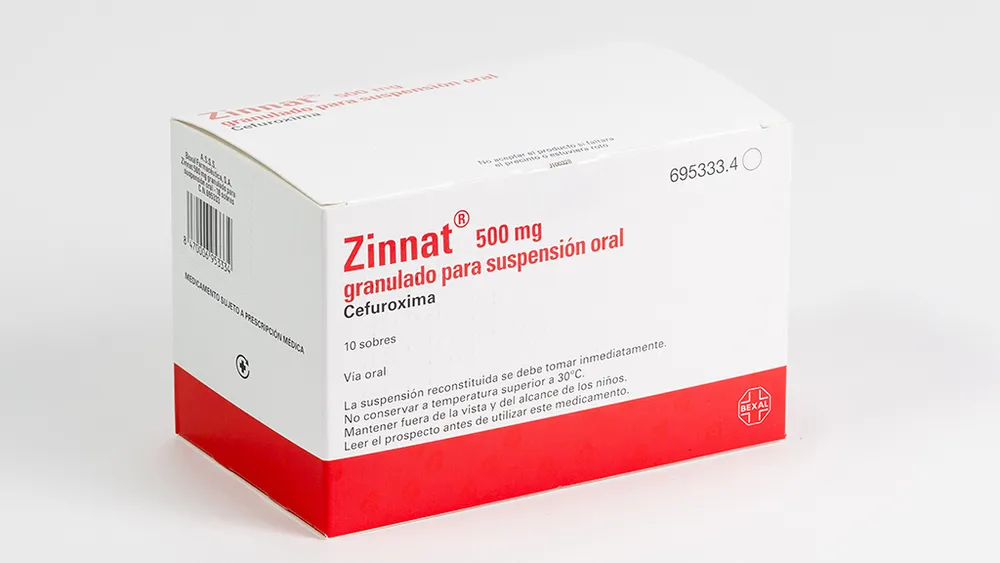
Table of Contents
Package leaflet: Information for the user
Introduction
Package leaflet: information for the user
Zinnat 500 mg granules for oral suspension
cefuroxime
Read the entire leaflet carefully before you start taking this medicine because it contains important information for you.
- Keep this leaflet as you may need to read it again.
- If you have any questions, ask your doctor, pharmacist, or nurse.
- This medicine has been prescribed for you only; do not give it to others, even if they have the same symptoms as you, because it could harm them.
- If you experience any adverse effects, consult your doctor, pharmacist, or nurse, even if the effects are not listed in this leaflet. See section 4.
Leaflet contents
- What Zinnat is and what it is used for
- What you need to know before taking Zinnat
- How to take Zinnat
- Possible side effects
- How to store Zinnat
- Contents of the pack and other information
1. What Zinnat is and what it is used for
Zinnat is an antibiotic used in both adults and children. It works by killing the bacteria that cause infections. It belongs to a group of medicines called cephalosporins.
Antibiotics are used to treat bacterial infections and are not effective against viral infections such as influenza or the common cold. It is important to follow your doctor's instructions regarding dosage, administration, and duration of treatment. Do not keep or reuse this medicine. If you have any antibiotic left over after completing treatment, return it to the pharmacy for proper disposal. Medicines must not be disposed of down the sink or in household waste. |
Zinnat is used to treat infections of:
- the throat
- the sinuses
- the middle ear
- the lungs or chest
- the urinary tract
- the skin and soft tissues
Zinnat may also be used to:
- treat Lyme disease (an infection transmitted by ticks).
Your doctor may identify the type of bacteria causing your infection and monitor whether the bacteria remain sensitive to Zinnat during treatment.
2. What you need to know before taking Zinnat
Do not take Zinnat:
-
if you are allergic to cefuroxime (as axetil) or to any cephalosporin antibiotic, or to any of the other ingredients of this medicine (listed in section 6)
-
if you have ever had a severe allergic (hypersensitivity) reaction to any other type of beta-lactam antibiotic (penicillins, monobactams, and carbapenem derivatives)
-
if you have ever developed a severe skin rash or peeling skin, blisters and/or mouth ulcers after treatment with cefuroxime or any other cephalosporin antibiotic.
-
if you consider any of the above applies to you, do not take Zinnat until you have consulted your doctor.
Take special care with Zinnat:
Severe skin reactions, including Stevens-Johnson syndrome, toxic epidermal necrolysis, drug reaction with eosinophilia and systemic symptoms (DRESS), have been reported with cefuroxime therapy. Seek immediate medical attention if you notice any symptoms related to these severe skin reactions described in section 4.
Warnings and precautions
Talk to your doctor or pharmacist before taking Zinnat.
Children
Zinnat is not recommended for children under 3 months of age, as safety and efficacy have not been established in this age group.
Be alert for certain symptoms such as allergic reactions, fungal infections (such as Candida), and severe diarrhoea (pseudomembranous colitis) while taking Zinnat. This will help reduce the risk of possible complications. See “Symptoms to be aware of” in section 4.
If you need a blood test
Zinnat may affect blood test results for blood sugar levels or the Coombs test. If you need a blood test:
- Inform the person performing the test that you are taking Zinnat.
Other medicines and Zinnat
Tell your doctor or pharmacist if you are taking, have recently taken, or might need to take any other medicines.
Medicines used to reduce stomach acidity (e.g., antacids for treating heartburn) may affect the action of Zinnat.
Probenecid
Oral anticoagulants
- Inform your doctor or pharmacist if you are taking any of these medicines.
Pregnancy, breastfeeding, and fertility
If you are pregnant or breastfeeding, think you may be pregnant, or are planning to become pregnant, consult your doctor or pharmacist before using this medicine.
Driving and using machines
Zinnat may cause dizziness and other adverse effects that could impair your ability to remain alert.
- Do not drive or operate machinery if you do not feel well.
Zinnat 500 mg granules for oral suspension contains aspartame (E951), sucrose, propylene glycol (E1520), and benzyl alcohol (E1519).
This medicine contains 12.2 g of sucrose per sachet, which should be taken into account in patients with diabetes mellitus. If your doctor has diagnosed you with an intolerance to certain sugars, consult him before taking this medicine.
Patients with hereditary fructose intolerance, glucose-galactose malabsorption, or sucrase-isomaltase deficiency must not take this medicine.
This medicine contains 0.084 g of aspartame (E951) per sachet. Aspartame is a source of phenylalanine, which may be harmful if you have phenylketonuria (PKU), a rare genetic disorder in which phenylalanine accumulates because the body cannot eliminate it properly.
This medicine contains 18 mg of benzyl alcohol (E1519) per sachet.
Benzyl alcohol may cause allergic reactions.
Consult your doctor or pharmacist if you have liver or kidney disease, or if you are pregnant or breastfeeding. This is because high amounts of benzyl alcohol may accumulate in the body and cause adverse effects (metabolic acidosis).
This product should not be used for more than one week in children under 3 years of age unless directed by your doctor or pharmacist.
This medicine contains 24 mg of propylene glycol (E1520) per sachet.
? Check with your doctor that Zinnat is suitable for you.
3. How to take Zinnat
Follow exactly the instructions for administration of this medicine as given by your doctor or pharmacist. If in doubt, consult your doctor or pharmacist again.
Take Zinnat after meals. This will help make the treatment more effective.
To prepare Zinnat powder for oral suspension in sachets, follow the reconstitution instructions step by step in the section Instructions for reconstitution, at the end of this leaflet.
Recommended dose
Adults and children weighing 40 kg or more
The recommended dose of Zinnat is 250 mg to 500 mg twice daily, depending on the severity and type of infection.
Children weighing less than 40 kg
Children weighing less than 40 kg should preferably be treated with Zinnat granules for oral suspension in bottles or sachets.
The recommended dose of Zinnat is 10 mg/kg body weight (up to a maximum of 250 mg) to 15 mg/kg body weight (up to a maximum of 250 mg) twice daily, depending on:
- the severity and type of infection
- the child's weight and age, up to a maximum of 500 mg per day.
Zinnat is not recommended for children under 3 months of age, as the safety and efficacy in this patient group are unknown.
Depending on the illness and how you or your child responds to treatment, the initial dose may be adjusted or it may be necessary to administer more than one course of treatment.
Patients with kidney problems
If you have kidney problems, your doctor may adjust your dose.
- Consult your doctor if you are affected by this condition.
If you take more Zinnat than you should
If you take too much Zinnat, you may experience neurological disturbances, particularly an increased risk of epileptic seizures (convulsions).
- Do not delay. Contact your doctor immediately or go to the nearest hospital emergency department. If possible, show them the Zinnat packaging.
In case of overdose or accidental ingestion, contact your doctor or pharmacist immediately or call the Toxicology Information Service at: 91 562 04 20, indicating the medicine and the amount ingested.
If you forget to take Zinnat
Do not take a double dose to make up for forgotten doses. Simply continue with the next dose as usual.
If you stop taking Zinnat
Do not stop treatment with Zinnat without prior advice.
It is important that you complete the full course of Zinnat treatment. Do not stop unless instructed by your doctor, even if you start to feel better. If you do not complete the treatment course, the infection may recur.
If you have any further questions about the use of this medicine, ask your doctor or pharmacist.
4. Possible adverse effects
Like all medicines, this medicine can cause adverse effects, although not everyone will experience them.
Symptoms to be aware of
A small number of people who took Zinnat experienced an allergic reaction or a potentially serious skin reaction. Symptoms of these reactions include:
- Severe allergic reaction. Signs include skin rash with itching, swelling, sometimes of the face or mouth, causing difficulty breathing
- Widespread rash, high body temperature, and enlarged lymph nodes (DRESS syndrome or drug hypersensitivity syndrome)
- Chest pain in the context of allergic reactions, which may be a symptom of allergy-triggered heart attack (Kounis syndrome)
- Skin rash, which may cause blisters, appearing as small targets (a dark spot in the center surrounded by a lighter area, with a dark ring around the edge)
- Widespread skin rash with blisters and peeling of the skin. (These may be symptoms of Stevens-Johnson syndrome or toxic epidermal necrolysis)
Other symptoms to be aware of while taking Zinnat:
-
Fungal infections. Medicines like Zinnat can cause an overgrowth of fungi (Candida) in the body, leading to fungal infections (such as thrush). This side effect is more likely if Zinnat has been taken for a prolonged period
-
Severe diarrhoea (pseudomembranous colitis). Medicines like Zinnat can cause inflammation of the colon (large intestine), resulting in severe diarrhoea, usually accompanied by blood and mucus, stomach pain, and fever
-
Jarisch-Herxheimer reaction. Some patients may experience an increase in body temperature (fever), chills, headache, muscle pain, and skin rash while taking Zinnat to treat Lyme disease. This is known as Jarisch-Herxheimer reaction. Symptoms usually last from several hours to one day.
-
Contact a doctor or nurse immediately if you experience any of these symptoms.
Common adverse effects
May affect up to 1 in 10 people:
- fungal infection (such as Candida)
- headache
- dizziness
- diarrhoea
- nausea
- stomach pain
Common adverse effects that may appear in blood tests:
- increase in the count of a type of white blood cells (eosinophilia)
- increased levels of liver enzymes
Uncommon adverse effects
May affect up to 1 in 100 people:
- vomiting
- skin rashes
Uncommon adverse effects that may appear in blood tests:
- decrease in the number of blood platelets (cells that help blood to clot)
- decrease in the number of white blood cells
- positive Coombs test
Other adverse effects
Other adverse effects have occurred in a very small number of people, but their exact frequency is unknown:
- severe diarrhoea (pseudomembranous colitis)
- allergic reactions
- skin rashes (which may be severe)
- high fever
- yellowing of the whites of the eyes or skin
- inflammation of the liver (hepatitis)
Adverse effects that may appear in blood tests:
- rapid destruction of red blood cells (haemolytic anaemia)
Reporting of adverse effects
If you experience any type of adverse effect, consult your doctor or pharmacist, even if it is a possible adverse effect not listed in this leaflet. You can also report them directly via the Spanish Pharmacovigilance System for Human Medicines: https://www.notificaram.es. By reporting adverse effects, you can help provide more information on the safety of this medicine.
5. Storage of Zinnat
Keep this medicine out of the sight and reach of children.
Store in the original packaging. Do not store above 30°C.
The reconstituted suspension should be taken immediately.
Do not take Zinnat if it shows any visible signs of deterioration.
Do not use this medicine after the expiry date stated on the container after the letters CAD/EXP. The expiry date refers to the last day of the month indicated.
Medicines must not be disposed of via wastewater or household waste. Dispose of unused containers and medicines at the SIGRE collection point at your pharmacy. If you are unsure, ask your pharmacist how to properly dispose of unused containers and medicines. This will help protect the environment.
6. Contents of the pack and other information
Composition of Zinnat
- The active substance is 500 mg of cefuroxime (as cefuroxime axetil) per sachet.
- The other components are: aspartame (E951), xanthan gum, acesulfame potassium (E950), povidone K30, stearic acid, sucrose, tutti-frutti flavouring (containing propylene glycol (E1520) and benzyl alcohol (E1519)), and purified water.
See section 2 for important information on some of the components of Zinnat.
Appearance of the product and contents of the pack
Zinnat 500 mg granules for oral suspension are supplied in sachets. The sachets are contained in a cardboard pack.
Only certain pack sizes may be marketed.
Marketing Authorisation Holder and Manufacturer
Marketing Authorisation Holder
BEXAL FARMACÉUTICA, S.A.
Centro Empresarial Parque Norte
Edificio Roble
C/ Serrano Galvache, 56
28033 Madrid
Spain
Manufacturer
GlaxoSmithKline Trading Services Limited
12 Riverwalk
Citywest Business Campus
Dublin 24
D24 YK11
Ireland
or
Lek Pharmaceuticals d. d.
Verovškova ulica 57
Ljubljana, 1526
Slovenia
Date of the most recent review of this leaflet: September 2023.
Detailed information on this medicinal product is available on the website of the Spanish Agency of Medicines and Health Products (AEMPS) http://www.aemps.gob.es
Reconstitution instructions
Instructions for preparing the suspension from the sachets
- Empty the granular contents of the sachet into a glass.
- Add a small amount of cold water.
- Stir well and drink immediately.
- Do not mix the suspension or granules with hot beverages.