Zanipress 10 mg/10 mg film-coated tablets
Spain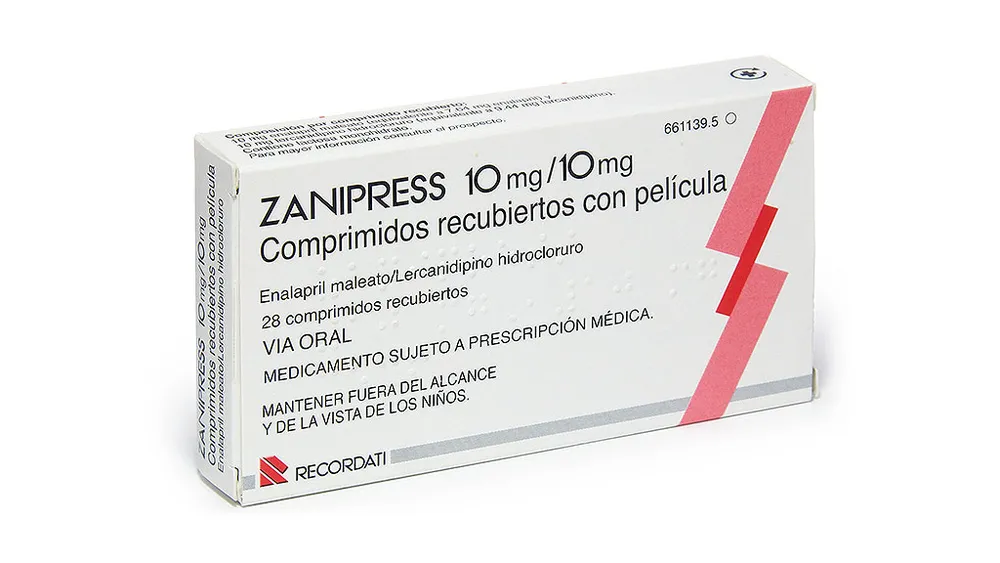
Instructions for Use
Package leaflet: Information for the user
Introduction
Package leaflet: information for the user
Zanipress 10 mg/10 mg film-coated tablets
enalapril maleate/lercanidipine hydrochloride
Read the entire leaflet carefully before you start taking this medicine, because it contains important information for you.
- Keep this leaflet, as you may need to read it again.
- If you have any questions, ask your doctor or pharmacist.
- This medicine has been prescribed for you only, and you should not give it to other people, even if they have the same symptoms as you, because it may harm them.
- If you experience any adverse reactions, consult your doctor or pharmacist, even if they are adverse reactions not listed in this leaflet. See section 4.
Leaflet contents:
- What Zanipress is and what it is used for
- What you need to know before taking Zanipress
- How to take Zanipress
- Possible adverse effects
- How to store Zanipress
- Contents of the pack and other information
1. What Zanipress is and what it is used for
Zanipress is a fixed combination of an ACE inhibitor (enalapril) and a calcium channel blocker (lercanidipine), two medicines that reduce blood pressure.
Zanipress is used to treat high blood pressure (hypertension) in adult patients whose blood pressure is not adequately controlled by lercanidipine 10 mg alone. Zanipress should not be used for the initial treatment of hypertension.
2. What you need to know before taking Zanipress
Do not take Zanipress:
- If you are allergic to enalapril maleate or lercanidipine hydrochloride, or to any of the other components of this medicine (listed in section 6).
- If you have ever had an allergic reaction to a medicine similar to those contained in Zanipress, i.e., medicines called ACE inhibitors or calcium channel blockers.
- If you have ever experienced swelling of the face, lips, mouth, tongue, or throat causing difficulty in swallowing or breathing (angioedema) after taking a medicine called an ACE inhibitor, or if the cause of the reaction was unknown or due to a hereditary condition.
- If you have taken or are currently taking sacubitril/valsartan, a medicine used to treat chronic heart failure in adults, as this increases the risk of developing angioedema (rapid swelling of the throat).
- If you have diabetes or impaired kidney function and are being treated with a blood pressure-lowering medicine containing aliskiren.
- If you are more than 3 months pregnant (use of Zanipress is also not recommended at the beginning of pregnancy; see Pregnancy section).
- If you have certain heart conditions:
- obstruction of blood flow out of the heart
- untreated heart failure
- unstable angina (chest discomfort occurring at rest or progressively worsening)
- within the first month after a heart attack (myocardial infarction).
- If you have severe liver problems.
- If you have severe kidney problems or are undergoing dialysis.
- If you are taking drugs that inhibit liver metabolism, such as:
- antifungals (e.g., ketoconazole or itraconazole).
- macrolide antibiotics (e.g., erythromycin, troleandomycin, or clarithromycin).
- antivirals (e.g., ritonavir).
- If you are taking another medicine called cyclosporine (used after organ transplantation to prevent organ rejection).
- Together with grapefruit or grapefruit juice.
Warnings and precautions
Talk to your doctor or pharmacist before taking Zanipress:
- If you have low blood pressure (which may cause dizziness or fainting, especially when standing up).
- If you have been severely ill (with excessive vomiting) or have recently had diarrhea.
- If you are on a salt-restricted diet.
- If you have a heart condition.
- If you have a disorder affecting the blood vessels in the brain.
- If you have kidney problems (including kidney transplant). This may lead to high levels of potassium in the blood, which can be serious. Your doctor may need to adjust your enalapril dose or monitor your potassium levels.
- If you have liver problems.
- If you have blood disorders, such as low or absent white blood cells (leucopenia, agranulocytosis), low platelet count (thrombocytopenia), or reduced red blood cells (anemia).
- If you have a collagen vascular disease (e.g., systemic lupus erythematosus, rheumatoid arthritis, or scleroderma), are on immunosuppressive therapy, or are taking allopurinol or procainamide, or a combination of these medicines.
- If you are of Black race, you should be aware that such patients have a higher risk of allergic reactions with swelling of the face, lips, tongue, or throat, accompanied by difficulty in swallowing or breathing, when taking ACE inhibitors.
- If you are diabetic, you should monitor your blood glucose levels, especially during the first month of treatment, as they may be low. Blood potassium levels may also be elevated.
- If you are taking potassium supplements, potassium-sparing agents, or salt substitutes containing potassium.
- If you are over 70 years of age.
- If you have intolerance to certain sugars (lactose).
The risk of angioedema may be increased if you are taking any of the following medicines:
- Racecadotril, a medicine used to treat diarrhea.
- Medicines used to prevent organ transplant rejection or to treat cancer (e.g., temsirolimus, sirolimus, everolimus).
- Vildagliptin, a medicine used to treat diabetes.
If you are taking any of the following medicines for high blood pressure:
- an angiotensin II receptor blocker (ARB) (also known as sartans, such as valsartan, telmisartan, or irbesartan), particularly if you have kidney problems related to diabetes.
- aliskiren.
Your doctor may need to regularly check your kidney function, blood pressure, and levels of electrolytes (e.g., potassium) in your blood.
Also refer to the information under the section “Do not take Zanipress”.
If you are about to undergo surgery or certain treatments
If you are about to undergo any of the following procedures, inform your doctor that you are taking Zanipress:
- any surgical procedure or administration of anesthetic (including at the dentist’s office)
- a treatment to remove cholesterol from your blood known as “LDL apheresis”
- a desensitization treatment to reduce the effect of an allergy to bees or wasps.
You must inform your doctor if you think you are (or could be) pregnant or if you are breastfeeding (see section Pregnancy, breastfeeding, and fertility).
Children and adolescents
The safety and efficacy of Zanipress have not been established in children under 18 years of age.
Other medicines and Zanipress
Zanipress must not be taken with certain medicines.
Tell your doctor or pharmacist if you are taking, have recently taken, or might need to take any other medicines, including those available without a prescription. This is because taking Zanipress with other medicines may alter the effect of Zanipress or the other medicines, or certain side effects may occur more frequently.
Specifically, inform your doctor or pharmacist if you are taking any of the following medicines:
- other medicines that lower blood pressure
- potassium supplements (including dietary salt substitutes), potassium-sparing diuretics, and other medicines that may increase potassium levels in blood (e.g., trimethoprim and sulfamethoxazole for bacterial infections; cyclosporine, an immunosuppressant used to prevent organ rejection; heparin, a medicine used as an anticoagulant to prevent blood clots). See section “Do not take Zanipress”
- lithium (a medicine used to treat a certain type of depression)
- antidepressant medicines called "tricyclic antidepressants"
- medicines for mental disorders, called "antipsychotics"
- non-steroidal anti-inflammatory drugs, including COX-2 inhibitors (medicines that reduce inflammation and may be used to relieve pain)
- certain medicines for pain or arthritis, including gold therapy
- certain cough and cold medicines, and weight-reducing medicines containing a substance called "sympathomimetic agent"
- medicines for diabetes (including oral antidiabetic medicines and insulin)
- astemizole or terfenadine (medicines for allergies)
- amiodarone, quinidine, or sotalol (medicines for fast heartbeat)
- phenytoin, phenobarbital, or carbamazepine (medicines for epilepsy)
- rifampicin (a medicine for tuberculosis)
- digoxin (a medicine for heart problems)
- midazolam (a medicine to help you sleep)
- beta-blockers, e.g., metoprolol (medicines that treat high blood pressure, heart failure, and abnormal heart rhythm)
- cimetidine (when taken at daily doses exceeding 800 mg, a medicine for ulcers, indigestion, or heartburn)
Do not take Zanipress if you have taken or are currently taking sacubitril/valsartan, a medicine used to treat chronic heart failure in adults, as this increases the risk of angioedema (rapid swelling under the skin, such as in the throat).
The risk of angioedema may be increased if you are taking any of the following medicines:
- Racecadotril, a medicine used to treat diarrhea.
- Medicines used to prevent organ transplant rejection or to treat cancer (e.g., temsirolimus, sirolimus, everolimus).
- Vildagliptin, a medicine used to treat diabetes.
Your doctor may need to adjust your dose and/or take other precautions:
- If you are taking an angiotensin II receptor blocker (ARB) or aliskiren (see also information under sections “Do not take Zanipress” and “Warnings and precautions”).
Taking Zanipress with food, drinks, and alcohol
- Zanipress should be taken at least 15 minutes before meals.
- A high-fat meal significantly increases the levels of the medicine in the blood.
- Alcohol may enhance the effect of Zanipress. Alcohol should not be consumed during treatment with Zanipress.
- Zanipress must not be taken with grapefruit or grapefruit juice, as this may increase its antihypertensive effect (see “Do not take Zanipress”).
Pregnancy, breastfeeding, and fertility
Pregnancy and fertility
Inform your doctor if you think you are (or might be) pregnant. Your doctor will usually advise you to stop taking Zanipress before becoming pregnant or as soon as you know you are pregnant and will recommend an alternative medicine. Use of Zanipress is not recommended in women who may become pregnant or during early pregnancy, and must not be taken if you are more than 3 months pregnant, as it may seriously harm the fetus if used after the third month of pregnancy.
Breastfeeding
Zanipress must not be taken during breastfeeding.
Driving and using machines
If you experience dizziness, weakness, or drowsiness with this medicine, you must not drive or operate machinery.
Zanipress contains lactose and sodium
If your doctor has informed you that you have an intolerance to certain sugars, consult your doctor before taking this medicine.
This medicine contains less than 23 mg of sodium (1 mmol) per tablet; this is essentially “sodium-free”.
3. How to take Zanipress
Follow exactly the instructions for use of this medicine as given by your doctor. If in doubt, consult your doctor or pharmacist again.
Adults: unless your doctor tells you otherwise, the recommended dose is one tablet once daily, at the same time each day. The tablet should preferably be taken in the morning, at least 15 minutes before breakfast. Tablets must be swallowed whole with water. See "Taking Zanipress with food, drinks and alcohol".
Patients with kidney problems/elderly patients: your doctor will decide the dose of the medicine you should take, based on how well your kidneys are functioning.
If you take more Zanipress than you should
Do not exceed the prescribed dose. If you have taken more than you should, or in case of overdose, contact your doctor or pharmacist immediately, call the Toxicology Information Service at telephone number (91) 562 04 20, or go immediately to hospital. Take the medicine’s packaging and leaflet with you to show the healthcare professional. A dose higher than correct may cause an excessive drop in blood pressure and your heart may beat irregularly or faster.
If you forget to take Zanipress
- If you forget to take your tablet, do not take the missed dose.
- Take the next dose according to your regular schedule.
- Do not take a double dose to make up for forgotten doses.
If you stop taking Zanipress
- Do not stop taking your medicine unless your doctor tells you to.
- If you have any further questions about the use of this medicine, ask your doctor or pharmacist.
4. Possible adverse effects
Like all medicines, this medicine can cause adverse effects, although not everyone will experience them. This medicine may cause the following adverse effects:
Some adverse effects may be serious.
Inform your doctor immediately if you notice any of the following adverse effects:
- An allergic reaction accompanied by swelling of the face, lips, tongue or throat, which may cause difficulty breathing or swallowing;
When you start taking Zanipress, you may feel weak or dizzy, or notice blurred vision; this is caused by a sudden drop in blood pressure, and if it occurs, lying down may be helpful. If you are concerned, consult your doctor.
Adverse effects observed with Zanipress
Frequent (may affect up to 1 in 10 people)
Cough, dizziness, headache.
Uncommon (may affect up to 1 in 100 people)
Changes in blood test parameters, such as decreased platelet count, increased blood potassium concentration, nervousness (anxiety), dizziness upon standing, vertigo, rapid heartbeat, rapid or irregular heartbeat (palpitations), sudden redness of the face, neck, or upper chest (erythema), low blood pressure, abdominal pain, constipation, feeling sick (nausea), increased liver enzyme levels, skin redness, joint pain, increased frequency of urination, feeling of weakness, fatigue, sensation of warmth, swelling of the ankles.
Rare (may affect up to 1 in 1,000 people)
Anaemia, allergic reactions, ringing in the ears (tinnitus), fainting, dry throat, sore throat, indigestion, salty taste in the mouth, diarrhoea, dry mouth, gum swelling, allergic reaction with swelling of the face, lips, tongue or throat causing difficulty swallowing or breathing, skin rash, urticaria, nocturia, production of large amounts of urine, impotence.
Additional adverse effects observed with enalapril or lercanidipine alone
Enalapril
Very frequent (affects more than 1 in 10 people)
Blurred vision, dizziness, weakness or discomfort, and cough.
Frequent (affects less than 1 in 10 people)
Depression, headache, fainting (syncope), chest pain, dizziness due to low blood pressure, changes in heart rate, rapid heartbeats, angina, dyspnoea, disturbances in taste, increased blood creatinine levels (usually detected by blood test), elevated blood potassium levels, diarrhoea, abdominal pain, tiredness (fatigue), rash, allergic reaction with swelling of the face, lips, tongue or throat with difficulty swallowing or breathing.
Uncommon (affects less than 1 in 100 people)
Anaemia (including aplastic and haemolytic anaemia), sudden drop in blood pressure, confusion, nervousness, drowsiness or insomnia, skin tingling or numbness, myocardial infarction (possibly caused by very low blood pressure in certain high-risk patients, including those with impaired blood supply to the heart or brain), stroke (possibly due to very low blood pressure in high-risk patients), runny nose, sore throat and hoarseness, asthma associated with chest tightness, slowing of food movement through the intestine (ileus), pancreatitis, feeling sick (vomiting), indigestion, constipation, irritated stomach (gastric irritation), dry mouth, ulcer, anorexia, itching or urticaria, hair loss, impaired kidney function, kidney failure, increased sweating, high levels of protein in urine (measured by urine test), muscle cramps, general feeling of malaise, high temperature (fever), low blood sugar or sodium levels, high blood urea levels (all measured by blood test), redness, rapid or irregular heartbeats (palpitations), vertigo (dizziness), ringing in the ears (tinnitus), impotence.
Rare (affects less than 1 in 1,000 people)
Changes in blood test parameters, such as decreased white blood cell count, bone marrow suppression, autoimmune disorders, unusual dreams or sleep disturbances, Raynaud's phenomenon (in which hands and feet may become intensely cold and turn white due to reduced blood flow), nasal inflammation, pneumonia, liver problems such as decreased liver function, liver inflammation, jaundice (yellowing of the skin or eyes), increased levels of liver enzymes or bilirubin (measured by blood test), erythema multiforme (red spots of various shapes appearing on the skin), Stevens-Johnson syndrome and toxic epidermal necrolysis (a serious skin condition involving redness, scaling, blistering or open sores), exfoliative dermatitis/erythroderma (severe skin rash with peeling or shedding of the skin), pemphigus (small fluid-filled blisters on the skin), decreased urine production, breast gland enlargement in men (gynaecomastia), swollen glands in the neck, armpits or groin, accumulation of fluid or other substances in the lungs (as seen on X-ray), swelling of cheeks, gums, tongue, lips and throat.
Very rare (affects less than 1 in 10,000 people)
Intestinal inflammation (intestinal angioedema).
Frequency not known (cannot be estimated from available data)
Excessive production of antidiuretic hormone causing fluid retention, leading to weakness, fatigue or confusion.
A group of symptoms has been reported, which may include one or more of the following: fever, inflammation of blood vessels (serositis, vasculitis), muscle pain (myalgia, myositis), joint pain (arthralgia/arthritis). Skin rash, photosensitivity or other skin manifestations may also occur.
Lercanidipine
Some of these adverse effects may be serious. If you experience any of these adverse effects, consult your doctor.
Rare (affects less than 1 in 1,000 people)
Chest pain due to reduced blood supply to the heart (angina), allergic reactions (with symptoms such as itching, rash, urticaria), fainting.
Patients with pre-existing angina may experience an increase in frequency, duration or severity of attacks associated with treatment with the class of medicines to which lercanidipine belongs. Isolated cases of myocardial infarction may be observed.
Other possible adverse effects:
Frequent (may affect up to 1 in 10 people): headache, rapid or irregular heartbeats (palpitations), sudden redness of the face, neck or upper chest, swelling of the ankles.
Uncommon (may affect up to 1 in 100 people): dizziness, drop in blood pressure, heartburn, discomfort, stomach pain, skin rash, itching, muscle pain, increased amount of urine, weakness or fatigue.
Rare (may affect up to 1 in 1,000 people): drowsiness, vomiting, diarrhoea, urticaria, increased frequency of urination, chest pain.
Frequency not known (cannot be estimated from available data): gum swelling, changes in liver function (detected in blood tests), cloudy fluid (during haemodialysis through a tube inside the abdomen), swelling of the face, lips, tongue or throat that may cause difficulty breathing or swallowing.
If any of the adverse effects worsen, or if you experience any adverse effect not listed in this leaflet, inform your doctor or pharmacist. You may consult your doctor or pharmacist for further information about adverse effects, as both have access to a more complete list.
Reporting of adverse effects
If you experience any adverse effect, talk to your doctor or pharmacist, even if it is a possible adverse effect not listed in this leaflet. You can also report them directly via the Spanish Pharmacovigilance System for Human Medicines: www.notificaRAM.es. By reporting adverse effects, you can help provide more information on the safety of this medicine.
5. Storage of Zanipress
Keep this medicine out of the sight and reach of children.
Do not use this medicine after the expiry date which is stated on the blister and on the outer packaging following the word EXP. The expiry date refers to the last day of the month indicated.
Store in the original packaging to protect from light and moisture. Do not store above 25°C.
Medicines must not be disposed of via wastewater or household waste. Return unused medicines and their packaging to the SIGRE collection point at your pharmacy. Ask your pharmacist how to dispose of medicines and packaging you no longer need. This will help protect the environment.
6. Contents of the pack and other information
Composition of Zanipress
The active substances are enalapril maleate and lercanidipine hydrochloride.
Each film-coated tablet contains: 10 mg of enalapril maleate (equivalent to 7.64 mg of enalapril) and 10 mg of lercanidipine hydrochloride (equivalent to 9.44 mg of lercanidipine).
The other components are:
Core: monohydrate lactose, microcrystalline cellulose, sodium starch glycolate type A, povidone K30, sodium bicarbonate and magnesium stearate.
Film coating: hypromellose 5 cP, titanium dioxide (E171), talc and macrogol 6000.
Appearance of the product and contents of the pack
Zanipress 10 mg/10 mg tablets are 8.5 mm, white, circular, biconvex, film-coated tablets.
Zanipress 10 mg/10 mg is available in packs of 7, 14, 28, 30, 35, 42, 50, 56, 90, 98 and 100 tablets.
Only certain pack sizes may be marketed.
Marketing Authorization Holder and Manufacturer
Marketing Authorization Holder
Casen Recordati, S.L. Autovía de Logroño, km. 13,300. 50180 Utebo (Zaragoza), Spain.
Manufacturer
RECORDATI Industria Chimica e Farmaceutica S.p.A. – Via Matteo Civitali 1 – I-20148 Milan, Italy
Doppel Farmaceutici S.r.l., Via Volturno 48, Quinto de’Stampi, 20089 Rozzano (MI), Italy
This medicinal product is authorized in the EEA Member States under the following brand names:
Austria Zanipril 10 mg/10 mg Filmtabletten
Belgium Zanicombo
Bulgaria Lercapril
Cyprus Zaneril
Denmark Zanipress
Estonia Lercaril
Finland Zanipress
France Zanextra
Germany Zanipress
Greece Lercaprel
Hungary Coripren
Iceland Zanipress
Ireland Lercaril
Italy Zanipril
Latvia Lercaprel
Lithuania Lercaprel 10 mg/10 mg tablets
Luxembourg Zanicombo
Malta Zanipress
Netherlands Lertec
Norway Zanipress
Poland Lercaprel
Portugal Zanipress
Romania Lercaril 10 mg/10 mg
Slovenia Lercaprel 10 mg/10 mg
Spain Zanipress
Sweden Zanitek
United Kingdom (IN) Zaneril
Date of the most recent revision of this leaflet: 07/2021
Detailed and up-to-date information on this medicinal product is available on the website of the Spanish Agency for Medicines and Health Products (AEMPS) http://www.aemps.gob.es/
Similar Medications
-
Coripren 10 mg/10 mg film-coated tablets
Form: tablets, film-coated
Active substance Dosage LERCANIDIPINE HYDROCHLORide 10 mg ENALAPRIL MALEATE 10 mg Manufacturer: Recordati Ireland Limited
-
Coripren 20 mg/10 mg film-coated tablets
Form: tablets, film-coated
Active substance Dosage LERCANIDIPINE HYDROCHLORide 10 mg ENALAPRIL MALEATE 20 mg Manufacturer: Recordati Ireland Limited
-
Enalapril/lercanidipine CINFA 10 mg/10 mg film-coated tablets EFG
Form: tablets, film-coated
Active substance Dosage ENALAPRIL MALEATE 10 mg LERCANIDIPINE HYDROCHLORide 10 mg Manufacturer: Laboratorios Cinfa S.A.
-
Enalapril/lercanidipine Cinfa 20 mg/10 mg film-coated tablets EFG
Form: tablets, film-coated
Active substance Dosage ENALAPRIL MALEATE 20 mg LERCANIDIPINE HYDROCHLORide 10 mg Manufacturer: Laboratorios Cinfa S.A.
-
Enalapril/lercanidipine Krka 10 mg/10 mg film-coated tablets EFG
Form: tablets, film-coated
Active substance Dosage LERCANIDIPINE HYDROCHLORide 10,00 mg ENALAPRIL MALEATE 10,00 mg Manufacturer: Krka D.D. Novo Mesto
-
Enalapril/lercanidipine Krka 20 mg/10 mg film-coated tablets EFG
Form: tablets, film-coated
Active substance Dosage ENALAPRIL MALEATE 20,00 mg LERCANIDIPINE HYDROCHLORide 10,00 mg Manufacturer: Krka D.D. Novo Mesto
-
Enalapril/lercanidipine Ratiopharm 20 mg/10 mg film-coated tablets EFG
Form: tablets, film-coated
Active substance Dosage ENALAPRIL MALEATE 20 mg LERCANIDIPINE HYDROCHLORide 10 mg Manufacturer: Teva Pharma S.L.U.
-
Enalapril/lercanidipine Tecnigen 20 mg/10 mg film-coated tablets EFG
Form: tablets, film-coated
Active substance Dosage LERCANIDIPINE HYDROCHLORide 10 mg ENALAPRIL MALEATE 20 mg Manufacturer: Tecnimede Espana Industria Farmaceutica S.A.
-
Enalapril/lercanidipine Teva-Ratiopharm 10 mg/10 mg film-coated tablets EFG
Form: tablets, film-coated
Active substance Dosage LERCANIDIPINE HYDROCHLORide 10 mg ENALAPRIL MALEATE 10 mg Manufacturer: Teva Pharma S.L.U.
-
Enalapril/lercanidipine Teva-Ratiopharm 20 mg/10 mg film-coated tablets EFG
Form: tablets, film-coated
Active substance Dosage ENALAPRIL MALEATE 20 mg LERCANIDIPINE HYDROCHLORide 10 mg Manufacturer: Teva Pharma S.L.U.
-
Enalapril/lercanidipine Teva-Ratiopharm 20 mg/20 mg film-coated tablets EFG
Form: tablets, film-coated
Active substance Dosage ENALAPRIL MALEATE 20 mg LERCANIDIPINE HYDROCHLORide 20 mg Manufacturer: Teva Pharma S.L.U.
-
Lercapress 10 mg/10 mg film-coated tablets
Form: tablets, film-coated
Active substance Dosage LERCANIDIPINE HYDROCHLORide 10 mg ENALAPRIL MALEATE 10 mg Manufacturer: Recordati Ireland Limited
This page has been machine-translated and may contain inaccuracies. The original data is available in the manufacturing country's language.
Last data check: May 18, 2026 · Data source: CIMA — AEMPS