Yesintek 45 mg solution for injection in pre-filled syringe
Spain
Table of Contents
Package leaflet: Information for the user
Introduction
Package leaflet: information for the patient
Yesintek 45 mg solution for injection in pre-filled syringe
ustekinumab
This medicinal product is subject to additional monitoring, which will allow quicker identification of new safety information. You can help by reporting any side effects you may experience. Information on how to report side effects is included at the end of section 4.
Read the entire leaflet carefully before starting to use this medicine, as it contains important information for you.
This leaflet has been written for the person using the medicine. If you are a parent or caregiver administering Yesintek to a child, please read this information carefully.
- Keep this leaflet, as you may need to refer to it again.
- If you have any questions, consult your doctor or pharmacist.
- This medicine has been prescribed for you only. Do not give it to others, even if they have the same symptoms as you, since it may harm them.
- If you experience any side effects, talk to your doctor or pharmacist, even if they are side effects not listed in this leaflet. See section 4.
Leaflet contents
- What Yesintek is and what it is used for
- What you need to know before using Yesintek
- How to use Yesintek
- Possible side effects
- How to store Yesintek
- Contents of the pack and other information
1. What Yesintek is and what it is used for
What Yesintek is
Yesintek contains the active substance “ustekinumab”, a monoclonal antibody. Monoclonal antibodies are proteins that specifically recognize and bind to certain proteins in the body.
Yesintek belongs to a group of medicines called “immunosuppressants”. These medicines work by weakening part of the immune system.
What Yesintek is used for
Yesintek is used to treat the following inflammatory diseases:
- Plaque psoriasis – in adults and children aged 6 years and older
- Psoriatic arthritis – in adults
- Moderate to severe Crohn’s disease – in adults
Plaque psoriasis
Plaque psoriasis is a skin disease causing inflammation that affects the skin and nails. Yesintek reduces inflammation and other signs of the disease.
Yesintek is used in adults with moderate to severe plaque psoriasis who cannot use cyclosporine, methotrexate, or phototherapy, or when these treatments are ineffective.
Yesintek is used in children and adolescents aged 6 years and older with moderate to severe plaque psoriasis who are unable to tolerate phototherapy or other systemic therapies, or when these treatments are ineffective.
Psoriatic arthritis
Psoriatic arthritis is an inflammatory joint disease, which usually occurs alongside psoriasis. If you have active psoriatic arthritis, you will first be given other medications. If you do not respond adequately to these medications, you may be treated with Yesintek to:
- Reduce the signs and symptoms of your disease.
- Improve your physical function.
- Reduce joint damage.
Crohn’s disease
Crohn’s disease is an inflammatory bowel disease. If you have Crohn’s disease, you will first be given other medications. If you do not respond adequately or cannot tolerate these medications, you may be given Yesintek to reduce the signs and symptoms of your disease.
2. What you need to know before using Yesintek
Do not use Yesintek
- If you are allergic to ustekinumab or to any of the other ingredients of this medicine (listed in section 6).
- If you have an active infection that your doctor considers significant.
If you are unsure whether any of the above apply to you, speak with your doctor or pharmacist before using Yesintek.
Warnings and precautions
Talk to your doctor or pharmacist before starting treatment with Yesintek. Your doctor will assess your condition before each treatment. Make sure to inform your doctor about any illness you may have before each treatment. Also inform your doctor if you have recently been in contact with someone who may have tuberculosis. Your doctor will examine you and perform a test for tuberculosis before you start using Yesintek. If your doctor believes you are at risk of tuberculosis, they may prescribe medication to treat it.
Watch for serious adverse effects
Yesintek may cause serious adverse effects, including allergic reactions and infections. You should be aware of certain signs of illness while using Yesintek. See the complete list of these adverse effects in section 4 under “Serious adverse effects”.
Before using Yesintek, tell your doctor:
- If you have ever had an allergic reaction to Yesintek. Consult your doctor if you are unsure.
- If you have ever had any type of cancer – because immunosuppressants like Yesintek weaken part of the immune system. This may increase the risk of developing cancer.
- If you have previously been treated for psoriasis with other biologics (a medicine produced from a biological source, usually administered by injection) – the risk of developing cancer may be higher.
- If you currently have or have recently had an infection.
- If you have any new skin lesions or changes in existing lesions, either within the psoriasis-affected area or on intact skin.
- If you are receiving any other treatment for psoriasis and/or psoriatic arthritis, such as other immunosuppressants or phototherapy (when your body is treated with a type of ultraviolet (UV) light). These treatments may also weaken part of the immune system. The combined use of these treatments with Yesintek has not been studied. However, this could increase the likelihood of developing diseases related to a weakened immune system.
- If you are receiving or have ever received allergy shots (immunotherapy) – it is unknown whether Yesintek may affect these treatments.
- If you are 65 years of age or older – you may be more likely to develop infections.
If you are unsure whether you have any of these conditions, speak with your doctor or pharmacist before using Yesintek.
Some patients have experienced lupus-like reactions during treatment with ustekinumab, including cutaneous lupus or lupus-like syndrome. Contact your doctor immediately if you develop a red, raised, scaly rash, sometimes with a darker border, in sun-exposed areas of skin, or if it is accompanied by joint pain.
Heart attacks and strokes
Heart attacks and strokes have been observed in a study of patients with psoriasis treated with Yesintek. Your doctor will periodically check your risk factors for heart disease and stroke to ensure they are properly managed. Seek immediate medical attention if you experience chest pain, weakness or unusual sensations on one side of the body, facial paralysis, or speech or vision disturbances.
Children and adolescents
Yesintek is not recommended for children under 6 years of age with psoriasis or for children under 18 years of age with psoriatic arthritis or Crohn’s disease, as it has not been studied in these age groups.
Use of Yesintek with other medicines and vaccines
Inform your doctor or pharmacist:
- If you are currently taking, have recently taken, or might take any other medicines.
- If you have recently been vaccinated or are scheduled to receive a vaccine. Certain types of vaccines (live vaccines) must not be administered while you are receiving Yesintek.
- If you received Yesintek during pregnancy, inform your infant’s doctor about your Yesintek treatment before your infant receives any vaccine, including live vaccines such as the BCG vaccine (used to prevent tuberculosis). Live vaccines are not recommended for your infant during the first twelve months after birth if you received Yesintek during pregnancy, unless your infant’s doctor advises otherwise.
Pregnancy and breastfeeding
- If you are pregnant, think you may be pregnant, or plan to become pregnant, consult your doctor before using this medicine.
- No increased risk of birth defects has been observed in babies exposed to Yesintek in the womb. However, experience with Yesintek in pregnant women is limited. Therefore, it is preferable to avoid using Yesintek during pregnancy.
- Women of childbearing potential are advised to avoid becoming pregnant and to use adequate contraception while receiving Yesintek and for at least 15 weeks after the last dose.
- Yesintek can cross the placenta to the fetus. If you received Yesintek during pregnancy, your infant may have an increased risk of infection. It is important to inform your infant’s doctors and other healthcare professionals that you received Yesintek during pregnancy before your infant receives any vaccine. Live vaccines, such as the BCG vaccine (used to prevent tuberculosis), are not recommended for your infant during the first twelve months after birth if you received Yesintek during pregnancy, unless your infant’s doctor recommends otherwise.
- Ustekinumab may be excreted in breast milk in very small amounts. Inform your doctor if you are breastfeeding or plan to breastfeed. You and your doctor will decide whether to breastfeed or use Yesintek. Do not do both simultaneously.
Driving and using machines
The effect of Yesintek on the ability to drive and operate machinery is negligible or none.
Yesintek contains polysorbate 80 (E 433)
This medicine contains 0.02 mg of polysorbate 80 (E 433) per 45 mg/0.5 mL vial (JPC), equivalent to 0.02 mg/0.5 mL (0.0003 mg/kg per day). Polysorbates may cause allergic reactions. Inform your doctor if you or your children have allergies.
3. How to use Yesintek
Yesintek should be used under the guidance and supervision of a physician experienced in the treatment of the conditions for which Yesintek is indicated.
Always follow exactly the administration instructions for this medicine provided by your doctor. If in doubt, consult your doctor. Ask your doctor when your injections should be given and about follow-up appointments.
How much Yesintek is administered
Your doctor will decide the amount of Yesintek you need to use and the duration of treatment.
Adults aged 18 years and older
Psoriasis or psoriatic arthritis
- The recommended starting dose is 45 mg of Yesintek. Patients weighing more than 100 kilograms (kg) may start with a dose of 90 mg instead of 45 mg.
- After the initial dose, you will receive the next dose 4 weeks later, and subsequently every 12 weeks. The following doses are usually the same as the starting dose.
Crohn’s disease
- During treatment, your doctor will administer the first dose of approximately 6 mg/kg of Yesintek as an intravenous infusion (a drip into a vein in the arm). After the initial dose, you will receive the next dose of 90 mg of Yesintek 8 weeks later, and then every 12 weeks, by subcutaneous injection (under the skin).
- In some patients, after the first subcutaneous injection, 90 mg of Yesintek will be administered every 8 weeks. Your doctor will decide when you should receive the next dose.
Children and adolescents aged 6 years and older
Psoriasis
- Your doctor will determine the correct dose for you, including the amount (volume) of Yesintek to inject to deliver the correct dose. The appropriate dose for you will depend on your body weight at the time each dose is given.
- A 45 mg vial is available for children who need to receive less than the total 45 mg dose.
- If you weigh less than 60 kg, the recommended dose is 0.75 mg of Yesintek per kg of body weight.
- If you weigh between 60 kg and 100 kg, the recommended dose is 45 mg of Yesintek.
- If you weigh more than 100 kg, the recommended dose is 90 mg of Yesintek.
- After the initial dose, you will receive the next dose 4 weeks later, and then every 12 weeks.
How Yesintek is administered
- Yesintek is administered by subcutaneous injection (under the skin). At the beginning of your treatment, medical or nursing staff may administer the injection for you.
- However, you and your doctor may decide that you can self-inject Yesintek. In this case, you will be trained in how to inject Yesintek yourself.
- For instructions on how to inject Yesintek, see “Administration instructions” at the end of this leaflet.
Consult your doctor if you have any questions about self-injection.
If you use more Yesintek than you should
If you have used or have been given too much Yesintek, speak immediately with your doctor or pharmacist. Always carry the medicine carton with you, even if it is empty.
If you forget to use Yesintek
If you miss a dose, speak with your doctor or pharmacist. Do not take a double dose to make up for missed doses.
If you stop using Yesintek
Stopping the use of Yesintek is not dangerous. However, if you discontinue treatment, your symptoms may return.
If you have any further questions about the use of this medicine, ask your doctor or pharmacist.
4. Possible adverse effects
Like all medicines, this medicine can cause adverse effects, although not everyone will experience them.
Serious adverse effects
Some patients may experience serious adverse effects that may require urgent treatment.
Allergic reactions – these may require urgent treatment. Contact your doctor or seek immediate medical help if you notice any of the following signs.
-
Severe allergic reactions ("anaphylaxis") are rare in the population using Yesintek (may affect up to 1 in 1,000 people). Signs include:
-
difficulty breathing and swallowing
-
low blood pressure, which may cause dizziness or mild headaches
-
swelling of the face, lips, mouth, or throat.
-
Common signs of an allergic reaction include rash and hives (these may affect up to 1 in 100 people).
In rare cases, lung allergic reactions and lung inflammation have been reported in patients treated with ustekinumab. Inform your doctor immediately if you experience symptoms such as cough, difficulty breathing, and fever.
If you have a severe allergic reaction, your doctor may decide that you should no longer use Yesintek.
Infections – these may require urgent treatment. Contact your doctor immediately if you notice any of these signs.
- Nasal or throat infections and the common cold are common (may affect up to 1 in 10 people).
- Chest infections are uncommon (may affect up to 1 in 100 people).
- Inflammation of the tissues beneath the skin ("cellulitis") is uncommon (may affect up to 1 in 100 people).
- Herpes (a type of painful blistering rash) is uncommon (may affect up to 1 in 100 people).
Yesintek may affect your ability to fight infections. Some of these infections could become serious and may be caused by viruses, fungi, bacteria (including tuberculosis), or parasites. They include infections that mainly occur in people with weakened immune systems (opportunistic infections). Opportunistic infections of the brain (encephalitis, meningitis), lungs, and eyes have been reported in patients receiving ustekinumab treatment.
You should monitor for signs of infection while using Yesintek. These include:
- fever, flu-like symptoms, night sweats, weight loss
- feeling tired or having difficulty breathing; persistent cough
- skin that feels hot, red, and painful, or a painful blistering skin rash
- burning sensation when urinating
- diarrhea
- visual deterioration or vision loss
- headache, neck stiffness, photosensitivity, nausea, or confusion.
Contact your doctor immediately if you notice any of these signs of infection, as they may indicate serious infections such as chest infections, skin infections, herpes, or opportunistic infections that could lead to severe complications. You should also inform your doctor if you have any infection that does not go away or keeps recurring. Your doctor may decide that you should not use Yesintek until the infection resolves. Also contact your doctor if you have any open cuts or ulcers that could become infected.
Skin peeling – increased redness and peeling of the skin over a large area of the body may be symptoms of erythrodermic psoriasis or exfoliative dermatitis, which are serious skin disorders. If you notice any of these symptoms, you must inform your doctor immediately.
Other adverse effects
Common adverse effects (may affect up to 1 in 10 people):
- Diarrhea
- Nausea
- Vomiting
- Feeling tired
- Dizziness
- Headache
- Itching ("pruritus")
- Back, muscle, or joint pain
- Sore throat
- Redness and pain at the injection site
- Sinusitis
Uncommon adverse effects (may affect up to 1 in 100 people):
- Dental infections
- Vaginal yeast infections
- Depression
- Nasal blockage or congestion
- Bleeding, bruising, hardening, swelling, and itching at the injection site
- Feeling weak
- Drooping eyelid and sinking of the muscles on one side of the face ("facial paralysis" or "Bell's palsy"), which is usually temporary
- A change in psoriasis with redness and new small yellow or white blisters, sometimes accompanied by fever (pustular psoriasis)
- Skin peeling (skin exfoliation)
- Acne
Rare adverse effects (may affect up to 1 in 1,000 people):
- Redness and peeling of the skin over a large area of the body, which may cause itching or pain (exfoliative dermatitis). Similar symptoms may develop as a natural change in psoriasis symptoms (erythrodermic psoriasis)
- Inflammation of small blood vessels, which may cause a skin rash with small red or purple raised spots, fever, or joint pain (vasculitis)
Very rare adverse effects (may affect up to 1 in 10,000 people)
- Blisters on the skin, which may be red and cause itching and pain (bullous pemphigoid).
- Cutaneous lupus or lupus-like syndrome (a red, raised, scaly rash in areas of skin exposed to sunlight, possibly accompanied by joint pain).
Reporting of adverse effects
If you experience any adverse effect, talk to your doctor or pharmacist, even if it is a possible adverse effect not listed in this leaflet. You can also report them directly through the national reporting system included in Appendix V. By reporting adverse effects, you can help provide more information on the safety of this medicine.
5. Storage of Yesintek
- Keep this medicine out of the sight and reach of children.
- Store in a refrigerator (2 °C – 8 °C). Do not freeze.
- Keep the pre-filled syringe in the outer packaging to protect it from light.
- If necessary, individual pre-filled syringes of Yesintek may also be stored at room temperature up to 30°C for a maximum single period of up to 30 days in their original carton to protect them from light. Write the date when the pre-filled syringe is first removed from the refrigerator and the date when it must be discarded in the designated space on the outer packaging. The discard date must not exceed the original expiry date printed on the carton. Once a syringe has been stored at room temperature (up to a maximum of 30°C), it must not be returned to the refrigerator. Discard the syringe if it is not used within 30 days of storage at room temperature or after the original expiry date, whichever occurs first.
- Do not shake the pre-filled syringes of Yesintek. Prolonged vigorous shaking may damage the product.
Do not use this medicine:
- After the expiry date stated on the label and packaging following “EXP”. The expiry date refers to the last day of the month indicated.
- After the recorded expiry date indicated on the packaging once the product has been stored at room temperature; i.e., more than 30 days at a maximum of 30°C.
- If the liquid changes colour, becomes cloudy, or contains foreign particles floating in it (see section 6 “Description of the product and contents of the container”).
- If you know or suspect it has been exposed to extreme temperatures (such as accidental overheating or freezing).
- If the product has been shaken vigorously.
Yesintek is for single use only. Any unused product remaining in the syringe must be discarded. Medicines should not be disposed of via wastewater or household waste. Ask your pharmacist how to dispose of medicines and containers you no longer need. This will help protect the environment.
6. Contents of the pack and other information
Composition of Yesintek
- The active substance is ustekinumab. Each pre-filled syringe contains 45 mg of ustekinumab in 0.5 ml.
- The other components are L-histidine, L-histidine monohydrochloride monohydrate, polysorbate 80 (E433), sucrose, sodium hydroxide (to adjust pH), hydrochloric acid (to adjust pH), and water for injections.
- This medicine contains 0.02 mg of polysorbate 80 (E 433) in each 45 mg/0.5 ml pre-filled syringe, equivalent to 0.02 mg/0.5 ml (0.0003 mg/kg/day). Polysorbates may cause allergic reactions. Inform your doctor if you or your children have allergies.
Appearance of the product and contents of the pack
Yesintek is a concentrate for solution for infusion, a clear, pale yellow to colourless liquid. It is supplied in a pack containing 1 single-dose glass pre-filled syringe of 1 ml. Each pre-filled syringe contains 45 mg of ustekinumab in 0.5 ml of injectable solution.
Marketing Authorisation Holder
Biosimilar Collaborations Ireland Limited
Unit 35/36 Grange
Parade,
Baldoyle Industrial Estate,
Dublin 13, DUBLIN
Ireland, D13 R20R
Manufacturer
Biosimilar Collaborations Ireland Limited
Block B, The Crescent Building, Santry Demesne
Dublin
D09 C6X8
Ireland
More information about this medicine is available upon request by contacting the local representative of the Marketing Authorisation Holder:
Belgium/Belgium/Belgium Biocon Biologics Belgium BV Tel/Tel: 0080008250910 | Lithuania Biosimilar Collaborations Ireland Limited Tel: 0080008250910 |
| Luxembourg/Luxembourg Biocon Biologics France S.A.S Tel/Tel: 0080008250910 (Belgium/Belgium) |
Czech Republic Biocon Biologics Germany GmbH Tel: 0080008250910 | Hungary Biosimilar Collaborations Ireland Limited Tel.: 0080008250910 |
Denmark Biocon Biologics Finland OY Tlf: 0080008250910 | Malta Biosimilar Collaborations Ireland Limited Tel.: 0080008250910 |
Germany Biocon Biologics Germany GmbH Tel: 0080008250910 | Netherlands Biocon Biologics France S.A.S Tel: 0080008250910 |
Estonia Biosimilar Collaborations Ireland Limited Tel: 0080008250910 | Norway Biocon Biologics Finland OY Tlf: +47 800 62 671 |
Greece Biocon Biologics Greece MONOPROSOPIKI I.K.E Tel.: 0080008250910 | Austria Biocon Biologics Germany GmbH Tel: 0080008250910 |
Spain Biocon Biologics Spain S.L. Tel: 0080008250910 | Poland Biosimilar Collaborations Ireland Limited Tel: 0080008250910 |
France Biocon Biologics France S.A.S Tel: 0080008250910 | Portugal Biocon Biologics Spain S.L. Tel: 0080008250910 |
Croatia Biocon Biologics Germany GmbH Tel: 0080008250910 | Romania Biosimilar Collaborations Ireland Limited Tel: 0080008250910 |
Ireland Biosimilar Collaborations Ireland Limited Tel: 1800 777 794 | Slovenia Biosimilar Collaborations Ireland Limited Tel: 0080008250910 |
Iceland Biocon Biologics Finland OY Sími: +345 800 4316 | Slovakia Biocon Biologics Germany GmbH Tel: 0080008250910 |
Italy Biocon Biologics Spain S.L. Tel: 0080008250910 | Finland/Suomi Biocon Biologics Finland OY Puh/Tel: 99980008250910 |
Cyprus Biosimilar Collaborations Ireland Limited Tel: 0080008250910 | Sweden Biocon Biologics Finland OY Tel: 0080008250910 |
Latvia Biosimilar Collaborations Ireland Limited Tel: 0080008250910 |
Date of the most recent review of this leaflet
Other sources of information
Detailed information on this medicine is available on the European Medicines Agency website: https://www.ema.europa.eu.
Administration instructions
Figure 1 shows what the pre-filled syringe looks like.
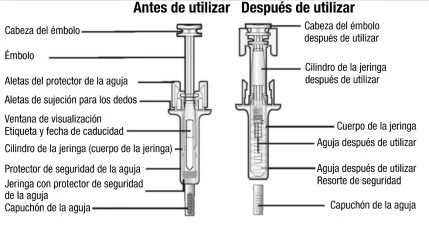
Instructions for administering Yesintek injection
At the beginning of treatment, a healthcare professional will assist you with your first injection. However, you and your doctor may decide that you can self-inject Yesintek. In this case, you will be trained on how to administer Yesintek injections.
Talk to your doctor if you have any questions about administering the injections.
- Do not mix Yesintek with other injectable liquids.
- Do not shake the pre-filled syringes. The medicine may deteriorate if shaken vigorously. Do not use the medicine if it has been shaken vigorously.
- Check the number of pre-filled syringes and prepare materials:
Preparation for using the pre-filled syringe
- Remove the pre-filled syringe(s) from the refrigerator. Leave the pre-filled syringe outside the carton for 30 minutes. This allows the liquid to reach a comfortable temperature for administration (room temperature). Do not remove the needle cap while waiting for the syringe to reach room temperature.
- Hold the pre-filled syringe by the barrel with the needle cap pointing upward.
- Do not hold the syringe by the plunger head, plunger, wings of the needle shield, or needle cap.
- Do not pull out the plunger at any time.
- Do not remove the safety shield from the pre-filled syringe.
- Do not remove the needle cap until instructed to do so.
- Check the pre-filled syringe(s) to ensure:
- The number of pre-filled syringes and concentration are correct.
- If your dose is 45 mg, you will have one 45 mg pre-filled syringe of Yesintek.
- If your dose is 90 mg, you will have two 45 mg pre-filled syringes of Yesintek and will need to administer two injections. Choose two different injection sites (e.g., one in the right thigh and one in the left thigh), and administer one immediately after the other.
- It is the correct medicine.
- The expiration date has not passed.
- The pre-filled syringe is not damaged.
- The solution in the pre-filled syringe is clear, colorless to pale yellow.
- The solution does not have an abnormal color, is not cloudy, and does not contain foreign particles.
- The solution in the pre-filled syringe has not been frozen.
- Place all necessary items on a clean, flat, and well-lit surface. Include antiseptic wipes, cotton wool or gauze, and a sharps container.
Storage
Yesintek pre-filled syringes must be stored at 2 °C to 8 °C (36 °F to 46 °F) in the original packaging to protect from light until ready for use.
- Do not freeze. Do not shake.
- If necessary, individual pre-filled syringes may be stored at room temperature up to 30 °C (86 °F) for a maximum of 30 days in the original packaging to protect from light.
- Once the syringe has been kept at room temperature, it must not be returned to the refrigerator.
- Discard the syringe if not used within 30 days when stored at room temperature.
Prepare necessary items
Place all necessary items on a clean, flat, and well-lit surface. This includes:
- antiseptic wipes
- cotton wool or gauze
- sharps container
- Your prescribed dose of Yesintek injection (See Figure 2)
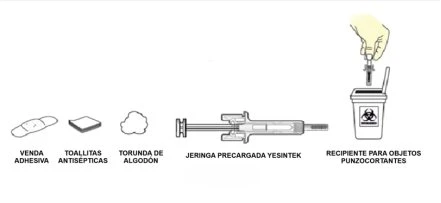
Figure 2
- Choose and prepare the injection site:
Choose the injection site (see Figure 3).
- Yesintek is administered by injection under the skin (subcutaneously).
- Suitable injection sites include the upper thigh or the abdominal area (abdomen), at least 5 cm away from the navel.
- Whenever possible, avoid areas of skin showing signs of psoriasis.
- If someone else is administering the injection, the upper arm may also be used as an injection site.
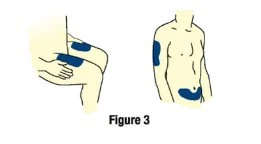
*Blue areas represent recommended injection sites.
Prepare the injection site
- Choose a clean, flat, and well-lit surface.
- Wash your hands thoroughly with soap and lukewarm water.
- Clean the skin at the injection site with an antiseptic wipe.
- Do not touch this area again before administering the injection. Allow the skin to dry before injecting.
- Remove the pre-filled syringe from the carton.
- Open the tray by removing the cover. Hold the needle safety shield (as shown in Figure 4) to remove the pre-filled syringe from the tray.
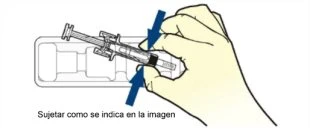
Figure 4
- Hold the pre-filled syringe without removing the needle safety shield, with the needle pointing upward.
- Remove the needle cap (see Figure 5):
- The needle cap should not be removed until you are ready to inject.
- Hold the pre-filled syringe and grasp the barrel with one hand.
- Remove and discard the needle cap. Do not press the plunger while doing this.
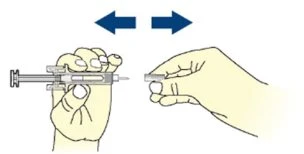
Figure 5
- You may see an air bubble in the pre-filled syringe or a drop of liquid at the tip of the needle. Both are normal and do not need to be removed.
- Do not touch the needle or allow it to touch any surface.
- Do not use the pre-filled syringe if it has been dropped without the needle cap. If this happens, inform your doctor or pharmacist.
- Inject the dose immediately after removing the needle cap.
- Administer the dose:
- Hold the pre-filled syringe in one hand between the index and middle fingers, place your thumb on the plunger head, and with the other hand gently pinch a fold of disinfected skin with your thumb and index finger. Do not squeeze tightly.
- Do not press too hard.
- Do not pull out the plunger at any time.
- In one quick motion, insert the needle through the skin as far as it will go (see Figure 6).
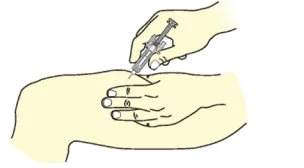
Figure 6
Inject all the medicine by pushing the plunger until the plunger head is completely within the wings of the needle shield (see Figure 7).
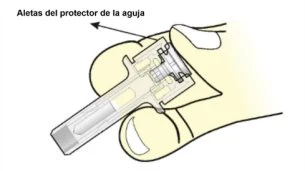
Figure 7
After pushing the plunger as far as it will go, maintain pressure on the plunger head, withdraw the needle, and release the skin (see Figure 8).
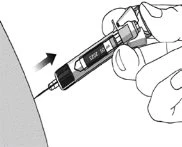
Figure 8
Slowly remove your thumb from the plunger head so that the empty syringe advances until the needle is fully covered by the needle shield, as shown in Figure 9:
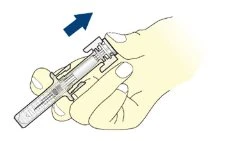
Figure 9
- After the injection:
- Press the injection site with an antiseptic wipe for a few seconds after the injection.
- A small amount of blood or liquid may appear at the injection site. This is normal.
- You may press cotton wool or gauze against the injection site and hold for 10 seconds.
- Do not rub the skin at the injection site. You may cover the injection site with a plaster if needed.
- Disposal:
- Used syringes must be placed in a puncture-resistant container, such as a sharps container (see Figure 10). For your safety, health, and the safety of others, never reuse the syringe. Dispose of your sharps container according to local regulations.
- Antiseptic wipes and other materials may be discarded in the trash.
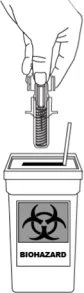
Figure 10
Manufactured by:
Biosimilar Collaborations Ireland Limited
Block B, The Crescent Building, Santry Demesne
Dublin
D09 C6X8
Ireland
Marketed by:
Biosimilar Collaborations Ireland Limited
Unit 35/36 Grange Parade,
Baldoyle Industrial Estate,
Dublin 13, DUBLIN
Ireland, D13 R20R
Reviewed: MM/YYYY