Xorox 30 mg/g ophthalmic ointment
Spain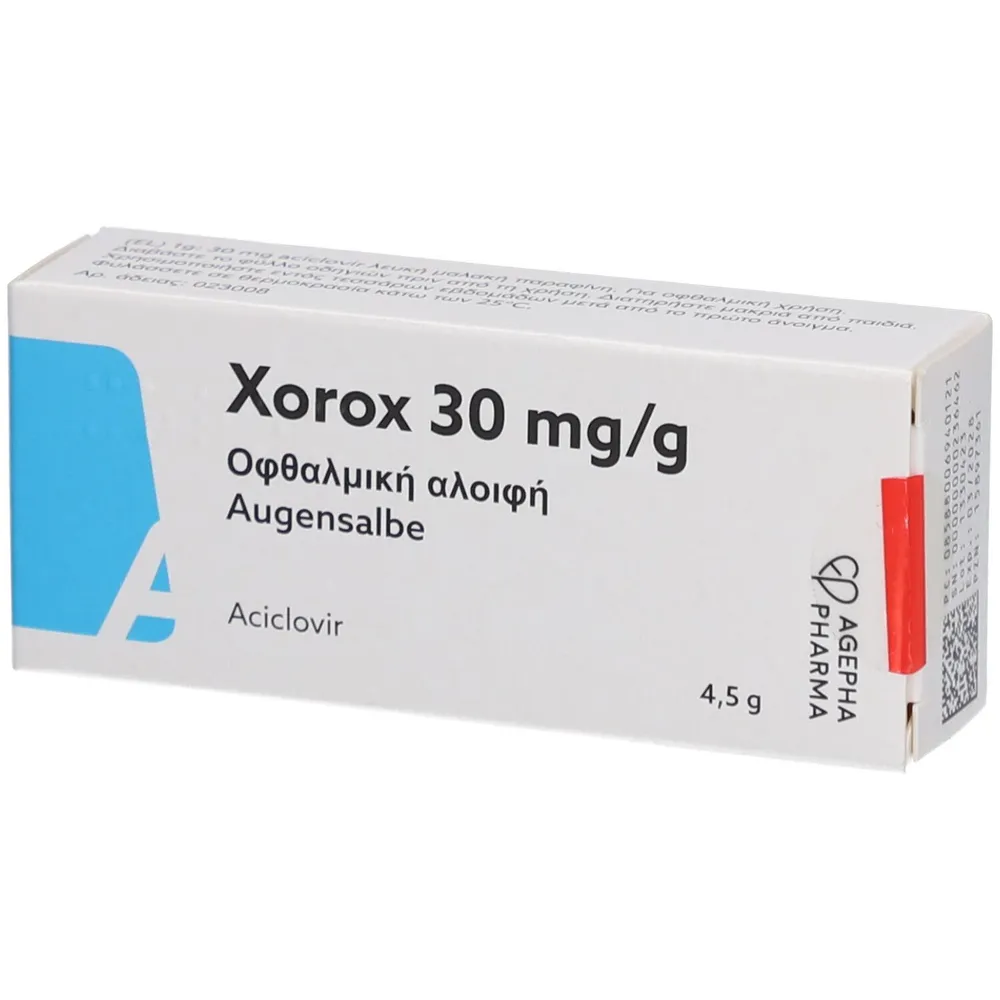
Table of Contents
Package leaflet: Information for the user
Introduction
Package leaflet: information for the patient
Xorox 30 mg/g ophthalmic ointment
Active substance: Aciclovir
Read this entire leaflet carefully before you start using this medicine, as it contains important information for you.
- Keep this leaflet. You may need to read it again.
- If you have any questions, ask your doctor or pharmacist.
- This medicine has been prescribed for you only. Do not pass it on to other people. It may be harmful even if others have the same symptoms as you.
- If you experience any adverse effects, consult your doctor or pharmacist. This includes possible side effects not listed in this leaflet. See section 4.
Contents of the leaflet
- What Xorox is and what it is used for
- What you need to know before using Xorox
- How to use Xorox
- Possible side effects
- How to store Xorox
- Contents of the pack and other information
1. What Xorox is and what it is used for
This medicine contains a drug called aciclovir, which belongs to a group of medicines known as antivirals.
It is used to treat eye infections caused by the Herpes simplex virus. It works by killing or stopping the growth of the virus in the front part of the eyeball (cornea).
2. What you need to know before using Xorox
Do not use Xorox,
- If you are allergic to aciclovir or valaciclovir, or to any of the other ingredients of this medicine (listed in Section 6).
Warnings and precautions
Talk to your doctor or pharmacist before using this medicine
- Use this medicine only in the eyes.
- You may experience a mild burning or stinging sensation immediately after application.
- Immediate hypersensitivity reactions may occur, including angioedema, facial swelling, etc. Contact a doctor immediately if you experience these hypersensitivity reactions.
- If you experience allergic reactions such as eyelid itching, swelling, or eye redness, stop treatment with this medicine and consult a doctor.
- Contact a doctor immediately for advice if any of the symptoms worsen or recur.
During treatment with this medicine, contact lenses must not be used.
Children and adolescents
As in adults.
Other medicines and Xorox
Inform your doctor or pharmacist if you are taking, have recently taken, or might take any other medicines.
No significant interactions have been observed so far when this medicine is applied locally to the eyes.
However, there is insufficient information regarding the simultaneous use of this medicine with ophthalmic medications containing corticosteroids. Your doctor will decide whether it is appropriate for you.
Pregnancy and breastfeeding
If you are pregnant or breastfeeding, think you may be pregnant, or are planning to become pregnant, consult your doctor or pharmacist before using this medicine.
This medicine may be used during pregnancy and breastfeeding, as with the recommended doses, no adverse effects are expected during pregnancy, or for the fetus or newborn.
Driving and using machines
Due to its characteristics, this medicine may cause blurred vision immediately after application. Do not drive or operate machinery until this effect has disappeared. Therefore, special caution is required when driving, working at hazardous locations, or operating machinery.
3. How to use Xorox
Instructions for Use
For ophthalmic use (eyes)
Always use this medicine exactly as directed by your doctor. If you are unsure, consult your doctor or pharmacist.
Unless otherwise directed by your doctor, the recommended dose is:
Apply a 1-cm strip of ointment inside the lower conjunctival sac 5 times daily (every 4 hours). Suggested times are: 7:00, 11:00, 15:00, 19:00, and 23:00.
Pull the lower eyelid downward and place the strip of ointment inside the lower conjunctival sac. Close the eyelids and move the eyeball around to help distribute the ointment evenly.
It is very important to apply this medicine during the day at regular 4-hour intervals to ensure successful treatment. Once corneal inflammation has healed, you should continue treatment for at least 3 more days.
Use in children and adolescents
Same as in adults.
If you use more Xorox than you should
This medicine is for ocular use. If you accidentally swallow some, consult your doctor or pharmacist. In case of overdose or accidental ingestion, consult your doctor or pharmacist or call the Toxicology Information Service at telephone number: 91 562 04 20, indicating the medicine and the amount ingested.
If you forget to use Xorox
If you forget to use this medicine, use it as soon as you remember. However, if it is almost time for the next dose, skip the missed dose. Do not use a double dose to make up for the forgotten dose.
If you stop using Xorox
If you have any further questions about the use of this medicine, consult your doctor or pharmacist.
4. Possible adverse effects
Like all medicines, this medicine can cause side effects, although not everyone experiences them.
Immediately after applying the ointment to the eye, a mild, transient sensation of itching or burning may occur. If you experience swelling of the face, angioedema, etc., stop using this medicine and consult your doctor immediately.
Very rare allergic reactions (may affect fewer than 1 in 10,000 people)
If you have an allergic reaction or acute hypersensitivity reactions, stop using this medicine and consult your doctor immediately.
Symptoms may include:
? skin rash, itching or hives
? swelling of the face, lips, tongue or other parts of the body
? difficulty breathing, wheezing or trouble breathing
? Fever (high temperature) without explanation and feeling weak, especially when standing.
Other side effects include:
Very common (may affect more than 1 in 10 people):
burning or irritation, photophobia/light sensitivity or sensation of having something in the eye (punctate superficial keratopathy)
This usually does not require discontinuation of treatment and improves immediately.
Uncommon (may affect more than 1 in 100 people):
mild burning or stinging sensation occurring immediately after application
swollen eyes, watery eyes (conjunctivitis)
Rare (may affect more than 1 in 1,000 people):
swollen, red, irritated eyes, eyelid itching (blepharitis)
If any of these effects worsen, or if you notice any side effects not listed in this leaflet, consult your doctor or pharmacist.
Reporting of adverse effects
If you experience any type of adverse effect, consult your doctor or pharmacist, even if it is a possible adverse effect not listed in this leaflet. You may also report it directly via the Spanish Pharmacovigilance System for Human Medicines: www.notificaRAM.es
By reporting adverse effects, you can help provide more information on the safety of this medicine.
5. Storage of Xorox
Store below 25 °C.
Keep this medicine out of the sight and reach of children.
Do not use this medicine after the expiry date stated on the label and packaging. The expiry date refers to the last day of the month indicated.
Do not use for more than 4 weeks after first opening.
Medicines must not be disposed of via wastewater or household waste. Dispose of unused medicines and their containers at a SIGRE collection point at your pharmacy. If you are unsure, please ask your pharmacist how to dispose of unused medicines and containers. This will help protect the environment.
6. Contents of the pack and other information
What Xorox contains:
- The active substance is aciclovir. 1 g of ointment contains 30 mg of aciclovir. The excipient is white soft paraffin.
What Xorox looks like and contents of the pack
1 pack contains an aluminium tube with an applicator nozzle (tip) and a white polyethylene cap, containing 4.5 g of white to greyish-white ointment.
Marketing Authorization Holder and Manufacturer
AGEPHA Pharma s.r.o.
Dialnicná cesta 5
Senec
903 01
Slovakia
This patient information leaflet was last reviewed in: March 2019
Detailed and up-to-date information on this medicine is available on the website of the Spanish Agency for Medicines and Health Products (AEMPS) http://www.aemps.gob.es/