Water for injection B. Braun solvent for parenteral use
Spain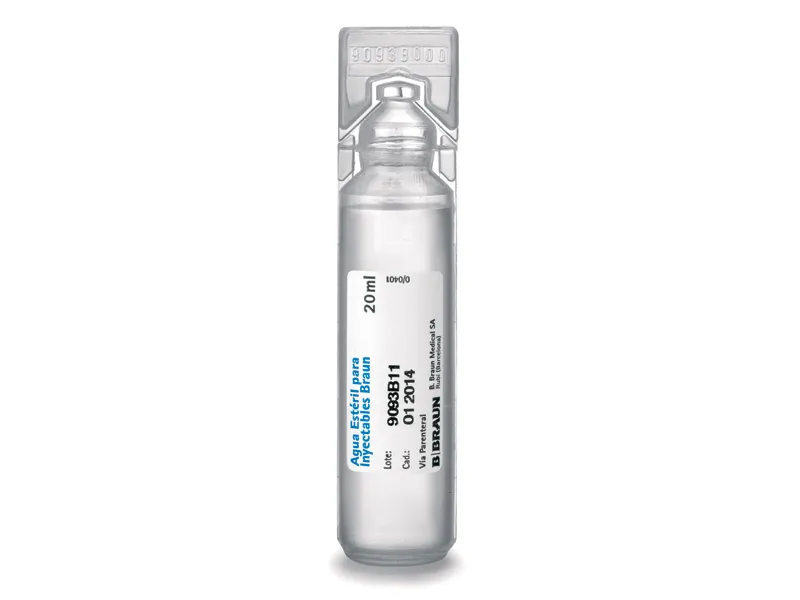
Table of Contents
- Package leaflet: Information for the user
- Introduction
- 1. What Agua para preparaciones inyectables B.Braun is and what it is used for
- 2. What you need to know before using Water for Injections B. Braun
- 3. How to use Water for Injections B. Braun
- 4. Possible adverse effects
- 5. Storage of Water for Injectable Preparations B. Braun
- 6. Contents of the pack and other information
Package leaflet: Information for the user
Introduction
Package leaflet: information for the user
Water for Injections B. Braun
solvent for parenteral use
Read all of this leaflet carefully before you start using this medicine because it contains important information for you.
- Keep this leaflet, as you may need to read it again.
- If you have any questions, ask your doctor or pharmacist.
- If you experience any adverse reactions, consult your doctor or pharmacist, even if they are adverse reactions not listed in this leaflet. See section 4.
Leaflet contents
- What Water for Injections B. Braun is and what it is used for
- What you need to know before you start using Water for Injections B. Braun
- How to use Water for Injections B. Braun
- Possible side effects
- How to store Water for Injections B. Braun
- Contents of the pack and other information
1. What Agua para preparaciones inyectables B.Braun is and what it is used for
Agua para preparaciones inyectables B.Braun is sterile water for injection preparations.
It is used for the preparation and dilution of medicines that will be administered into the vein (parenteral route).
2. What you need to know before using Water for Injections B. Braun
Do not use Water for Injections B. Braun.
There are no known situations in which Water for Injections B. Braun should not be used.
Warnings and precautions
Water for Injections B. Braun must not be used alone. Your doctor will dissolve or dilute another medicinal product in the Water for Injections before administering the prepared medication to you.
Use of Water for Injections B. Braun with other medicines
Inform your doctor or pharmacist if you are taking, have recently taken, or might need to take any other medicines.
There are no known interactions with other medicinal products. Any potential interactions will depend on the medicines dissolved in the Water for Injections.
Use of Water for Injections B. Braun with food and drink
There are no known interactions with food or drink.
Pregnancy and breastfeeding
If you are pregnant or breastfeeding, think you may be pregnant, or are planning to become pregnant, consult your doctor or pharmacist before using this medicinal product.
Potential interactions will depend on the medicines dissolved in the Water for Injections.
Water for Injections B. Braun may be used during pregnancy and breastfeeding.
Driving and using machines
Water for Injections B. Braun has no influence on the ability to drive or operate machinery.
3. How to use Water for Injections B. Braun
This medicine will be administered by a doctor or healthcare professional.
The route of administration depends on the instructions provided for the medicine to be dissolved or diluted. The medicine must be reconstituted or diluted immediately before use.
The dose of Water for Injections B. Braun and the duration of administration follow the instructions for the medicine to be dissolved or diluted.
Before dissolving a medicine, it is necessary to verify that it is soluble and compatible with water for injections.
If you use more Water for Injections B. Braun than you should
An overdose is highly unlikely, as this medicine is only used for the preparation and dilution of parenteral preparations.
If you use more Water for Injections B. Braun than you should, hemolysis (breakdown of red blood cells) may occur.
The signs and symptoms of an overdose may also be related to the nature of the added medicine.
If you have any further questions about the use of this medicine, ask your doctor or pharmacist.
4. Possible adverse effects
Like all medicines, Agua para preparaciones inyectables B.Braun may cause adverse effects, although not everyone will experience them.
Intravenous administration of Agua para preparaciones inyectables B.Braun may cause haemolysis (destruction of red blood cells) if it is administered alone.
The nature of the medicinal product added to the water for injections will determine the likelihood of any other adverse reaction occurring.
Reporting of adverse effects
If you experience any type of adverse effect, consult your doctor or pharmacist, even if it is a possible adverse effect not listed in this leaflet. You may also report them directly via the Spanish Pharmacovigilance System for Human Medicinal Products: www.notificaRAM.es. By reporting adverse effects, you can help provide more information on the safety of this medicine.
5. Storage of Water for Injectable Preparations B. Braun
Keep this medicine out of the sight and reach of children.
Store below 25°C.
Do not use this medicine if you notice that the packaging is damaged or if the liquid is not clear and has discoloration. Do not use this medicine after the expiry date stated on the container and outer packaging following EXP. The expiry date refers to the last day of the month indicated.
For single use only. After use, discard any unused contents.
Medicines should not be disposed of via wastewater or household waste. Dispose of containers and unused medicines at the SIGRE collection point at your pharmacy. Ask your pharmacist how to properly dispose of containers and medicines you no longer need. This will help protect the environment.
6. Contents of the pack and other information
Composition of Water for Injections B. Braun
- The active substance is water for injections.
Each 1 ml contains 1 ml of water for injections.
Appearance of the medicinal product and contents of the pack
Water for Injections B. Braun is a clear, colourless solution presented in:
- Plastic ampoules (Miniplasco Classic) containing 5, 10 and 20 ml of water for injections. Packaged in containers containing 1 ampoule, 20 ampoules or 100 ampoules.
- Plastic ampoules (Miniplasco Basic) containing 5 ml, 10 ml and 20 ml, in packs containing 20, 50 or 100 ampoules.
- Plastic ampoules (Miniplasco Classic) containing 5 ml, in a pack containing 500 ampoules.
- Plastic ampoules (MiniPlasco Connect) containing 5 ml, 10 ml and 20 ml, in boxes of 1 and 20 units.
- Plastic bottles (Ecoflac plus) containing 100 ml of water for injections. Packaged in containers containing 1 bottle or 20 bottles.
Only certain pack sizes may be marketed.
Marketing Authorization Holder:
- Braun Medical, S.A.
Ctra. de Terrassa, 121
08191-Rubí (Barcelona)
Spain
Date of the most recent review of this leaflet: 11/2019
Detailed information on this medicinal product is available on the website of the Spanish Agency of Medicines and Health Products (AEMPS) http://www.aemps.gob.es/.
This information is intended for healthcare professionals only:
Single-use containers.
Once the container has been opened, the product must be used immediately.
Any unused residual contents should be discarded after completion of the infusion.
The solution should only be used if the container closure is undamaged and the solution is clear.
Before mixing this solution with other medicinal products, possible incompatibilities must be considered.
When used as a solvent for medicinal products and/or as a diluent for parenteral solutions, the osmolarity of the final solution should be checked before administration and, whenever possible, adjusted to ensure isotonicity with plasma.
Disposal of unused medicinal product and of all materials that have come into contact with it must be carried out in accordance with local regulations.
Do not inject Water for Injections without mixing with other medicinal products.
After preparation of the ready-to-use medicinal product
From a microbiological standpoint, ready-to-use preparations should be used immediately. If not used immediately, the storage times and conditions prior to use are the responsibility of the user and should not exceed 24 hours between 2 and 8 °C, unless the dilution was carried out under controlled and validated aseptic conditions.
When preparing parenteral solutions, standard hygiene precautions must be observed to maintain sterility.