Verzenios 100 mg film-coated tablets
Spain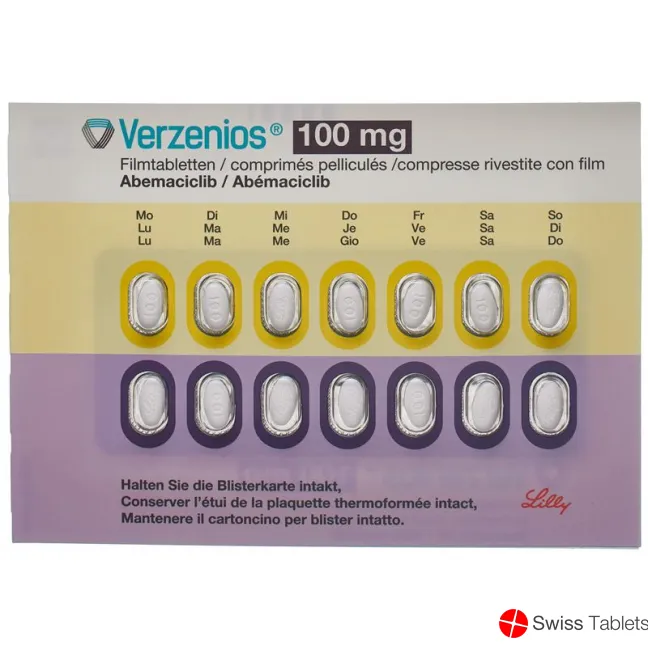
Table of Contents
Package leaflet: Information for the user
Introduction
Package leaflet: information for the patient
Verzenios 50 mg film-coated tablets
Verzenios 100 mg film-coated tablets
Verzenios 150 mg film-coated tablets
abemaciclib
Read the entire leaflet carefully before you start taking this medicine, because it contains important information for you.
- Keep this leaflet, as you may need to read it again.
- If you have any questions, ask your doctor, pharmacist or nurse.
- This medicine has been prescribed for you only, and you should not give it to other people, even if they have the same symptoms as you, because it may harm them.
- If you experience any adverse effects, consult your doctor, pharmacist or nurse, even if they are adverse effects not listed in this leaflet. See section 4.
Contents of the leaflet
- What Verzenios is and what it is used for
- What you need to know before taking Verzenios
- How to take Verzenios
- Possible side effects
- How to store Verzenios
- Contents of the pack and other information
1. What Verzenios is and what it is used for
Verzenios is a cancer treatment medicine that contains the active substance abemaciclib.
Abemaciclib blocks the effects of certain proteins called cyclin-dependent kinases 4 and 6. These proteins are abnormally active in some cancer cells, causing them to grow uncontrollably. By inhibiting the activity of these proteins, abemaciclib can slow down the growth of cancer cells, reduce tumour size, and delay cancer progression.
Verzenios is used to treat certain types of breast cancer (hormone receptor-positive (HR+) and human epidermal growth factor receptor 2-negative (HER2-)) that:
- have spread to the lymph nodes in the armpit, have been surgically removed, show no detectable spread to other parts of the body, and have certain features that increase the risk of cancer recurrence. Treatment is given in combination with hormonal therapy, such as aromatase inhibitors or tamoxifen, to prevent cancer recurrence after surgery (treatment after surgery is called adjuvant therapy)
- have spread beyond the original tumour and/or to other organs. It is given together with hormonal therapies, such as aromatase inhibitors or fulvestrant.
2. What you need to know before starting Verzenios
Do not take Verzenios:
- if you are allergic to abemaciclib or to any of the other ingredients of this medicine (listed in section 6).
Warnings and precautions
Verzenios may:
- reduce the number of your white blood cells, increasing your risk of developing an infection. Serious infections, such as lung infections, may be life-threatening;
- cause blood clots in the veins;
- cause severe or life-threatening inflammation of the lungs;
- affect how your liver works;
- cause diarrhea. At the first sign of diarrhea, start treatment with antidiarrheal agents such as loperamide. Drink plenty of fluids;
- cause blood clots in the arteries in patients also receiving hormonal therapies.
See section 4 “Possible side effects” and inform your doctor if you experience any symptoms.
What your doctor will check before and during your treatment
You will have periodic blood tests before and during treatment to monitor whether Verzenios is affecting your blood (white blood cells, red blood cells, and platelets) or the concentration of liver enzymes in your blood.
Children and adolescents
Verzenios must not be used in children and adolescents under 18 years of age.
Other medicines and Verzenios
Inform your doctor or pharmacist if you are taking, have recently taken, or might need to take any other medicines.
In particular, inform your doctor or pharmacist before taking Verzenios if you are taking the following:
- medicines that may increase the concentration of Verzenios in the blood:
- Clarithromycin (an antibiotic used to treat bacterial infections)
- Itraconazole, ketoconazole, posaconazole, voriconazole (used to treat fungal infections)
- Lopinavir/ritonavir (used to treat HIV/AIDS)
- Digoxin (used to treat heart conditions)
- Dabigatran etexilate (used to reduce the risk of stroke and blood clots)
- medicines that may reduce the effectiveness of Verzenios:
- Carbamazepine (an antiepileptic used to treat seizures or fits)
- Rifampicin (used to treat tuberculosis (TB))
- Phenytoin (used to treat seizures)
- St. John’s wort (a herbal remedy used to treat mild depression and anxiety)
Verzenios with food and drink
Avoid grapefruit or grapefruit juice while taking this medicine, as it may increase the concentration of Verzenios in the blood.
Pregnancy, breastfeeding, and fertility
If you are pregnant, think you might be pregnant, or plan to become pregnant, consult your doctor or pharmacist before taking this medicine.
Pregnancy
You must not take Verzenios if you are pregnant.
Avoid becoming pregnant while taking Verzenios.
If you are of childbearing age, you must use adequate contraceptive measures (e.g., dual barrier contraception such as condom and diaphragm) during treatment and for at least 3 weeks after stopping treatment. Discuss contraceptive methods with your doctor if there is any possibility you could become pregnant.
Inform your doctor if you become pregnant.
Breastfeeding
You must not breastfeed while taking Verzenios. It is unknown whether Verzenios passes into breast milk.
Fertility
Verzenios may reduce fertility in men. Talk to your doctor for advice on fertility before starting treatment.
Driving and use of machines
Fatigue and dizziness are very common side effects. If you feel unusually tired or dizzy, take special care when driving or operating machinery.
Verzenios contains lactose
If your doctor has informed you of an intolerance to certain sugars, consult him before taking this medicine.
Verzenios contains sodium
This medicine contains less than 1 mmol (23 mg) of sodium per tablet; this is essentially “sodium-free.”
3. How to take Verzenios
Recommended dose
Follow exactly the instructions provided by your doctor or pharmacist for taking this medicine. If in doubt, consult your doctor or pharmacist again.
The recommended dose of Verzenios when administered with hormonal therapy for the treatment of your breast cancer is 150 mg taken orally twice daily.
If you experience certain adverse effects while taking Verzenios, your doctor may reduce your dose or interrupt treatment, either temporarily or permanently.
When and how to take Verzenios
Take Verzenios twice daily, approximately at the same time each day, preferably in the morning and at night, to maintain the appropriate amount of medicine in your body throughout treatment.
You may take the tablets with or without food, but avoid grapefruit and grapefruit juice (see section 2, "Verzenios with food and drink").
Swallow the tablet whole with a glass of water. Do not chew, crush, or split the tablets before swallowing.
How long to take Verzenios
Take Verzenios continuously for as long as your doctor directs. If you are taking Verzenios for the treatment of early breast cancer, you should take it for up to 2 years.
If you take more Verzenios than you should
If you take too many tablets, or if someone else takes your medicine, contact your doctor or go to a hospital immediately. Show the Verzenios packaging and this leaflet. You may require medical treatment.
If you forget to take Verzenios
If you vomit after taking a dose or forget to take a dose, take your next dose at the usual scheduled time. Do not take a double dose to make up for the missed or vomited dose.
If you stop taking Verzenios
Do not stop treatment with Verzenios unless your doctor tells you to do so.
If you have any further questions about the use of this medicine, ask your doctor or pharmacist.
4. Possible side effects
Like all medicines, this medicine can cause side effects, although not everyone gets them. Contact your doctor immediately if you experience any of the following:
- Symptoms such as chills or fever. These may be a sign of a low white blood cell count (which may affect more than 1 in 10 people) and must be treated immediately. If you have cough, fever, difficulty breathing, or chest pain, this may be a sign of a lung infection. Serious or life-threatening infections are uncommon (may affect up to 1 in 100 people).
- Painful swelling of the leg, chest pain, difficulty breathing, rapid breathing, or rapid heartbeat, as these may be signs of blood clots in the vein (which may affect more than 1 in 10 people).
- Diarrhea (which may affect more than 1 in 10 people).
See section 2 for more information about any of the possible side effects described above.
Other side effects of Verzenios may include:
Very common side effects (may affect more than 1 in 10 people)
- Infections
- Reduction in the number of white blood cells, red blood cells, and platelets
- Nausea (feeling unwell), vomiting
- Inflammation or ulcers in the mouth
- Decreased appetite
- Headache
- Altered sense of taste
- Hair loss
- Tiredness
- Dizziness
- Itching
- Rash
- Liver abnormalities in blood tests
Common side effects (may affect up to 1 in 10 people)
- Watery eyes
- Muscle weakness
- Dry skin
- Lung inflammation causing shortness of breath, cough, and increased temperature
- Indigestion or stomach pain
- Nail changes, such as breaking or brittle nails
Uncommon side effects (may affect up to 1 in 100 people)
- Low white blood cell levels with fever
- Perception of flashes of light or floaters in vision
- Keratitis (inflammation of the cornea)
Rare side effects (may affect up to 1 in 1000 people)
- A skin reaction causing red spots or patches on the skin, which may look like targets or "bull's eye" lesions with a dark red center surrounded by paler red rings (erythema multiforme).
Reporting of side effects
If you experience any side effect, talk to your doctor, pharmacist, or nurse, even if it is a side effect not listed in this leaflet. You can also report them directly through the national reporting system included in Appendix V. By reporting side effects, you can help provide more information on the safety of this medicine.
5. Storage of Verzenios
Keep this medicine out of sight and reach of children.
Do not use this medicine after the expiry date stated on the blister and carton after "EXP". The expiry date refers to the last day of the month indicated.
This medicine does not require any special storage conditions.
Do not take this medicine if you notice any damage to the packaging or any signs of tampering.
Medicines must not be disposed of via wastewater or household waste. Ask your pharmacist how to dispose of medicines and packaging that you no longer need. This will help protect the environment.
6. Contents of the pack and other information
Composition of Verzenios
-
The active substance is abemaciclib. Verzenios film-coated tablets are available in different strengths:
-
Verzenios 50 mg film-coated tablets: each tablet contains 50 mg of abemaciclib.
-
Verzenios 100 mg film-coated tablets: each tablet contains 100 mg of abemaciclib.
-
Verzenios 150 mg film-coated tablets: each tablet contains 150 mg of abemaciclib.
-
The other components in this medicine are:
-
Tablet core: colloidal hydrated silica, sodium croscarmellose, lactose monohydrate, microcrystalline cellulose, sodium stearyl fumarate (for further information see section 2 “Verzenios contains lactose” and “Verzenios contains sodium”).
-
Film coating: titanium dioxide (E171), talc (E553b), polyvinyl alcohol (E1203), macrogol 3350 (E1521), yellow iron oxide (E172) [only in the 50 mg and 150 mg tablets], red iron oxide (E172) [only in the 50 mg tablets].
Appearance of the product and contents of the pack
- Verzenios 50 mg film-coated tablets are beige, oval-shaped tablets, engraved with “Lilly” on one side and “50” on the other.
- Verzenios 100 mg film-coated tablets are white, oval-shaped tablets, engraved with “Lilly” on one side and “100” on the other.
- Verzenios 150 mg film-coated tablets are yellow, oval-shaped tablets, engraved with “Lilly” on one side and “150” on the other.
Verzenios is available in calendar packs of 14, 28, 42, 56, 70 and 168 film-coated tablets in blister packs, and in single-dose precut blisters of 28 x 1 film-coated tablet.
Only certain pack sizes may be marketed.
Marketing Authorisation Holder
Eli Lilly Nederland B.V., Orteliuslaan 1000, 3528 BD Utrecht, The Netherlands
Manufacturer
Lilly S.A., Avda. de la Industria 30, 28108 Alcobendas, Madrid, Spain
For further information about this medicine, please contact the local representative of the Marketing Authorisation Holder:
Belgium/Belgium/Belgium Eli Lilly Benelux S.A./N.V. Tel/Tel: + 32-(0)2 548 84 84 | Lithuania Eli Lilly Lithuania Tel.: +370 (5) 2649600 |
| Luxembourg/Luxembourg Eli Lilly Benelux S.A./N.V. Tél/Tel: + 32-(0)2 548 84 84 |
Czech Republic ELI LILLY CR, s.r.o. Tel: + 420 234 664 111 | Hungary Lilly Hungária Kft. Tel.: + 36 1 328 5100 |
Denmark Eli Lilly Danmark A/S Tlf.: +45 45 26 60 00 | Malta Charles de Giorgio Ltd. Tel: + 356 25600 500 |
Germany Lilly Deutschland GmbH Tel: + 49-(0) 6172 273 2222 | Netherlands Eli Lilly Nederland B.V. Tel: + 31-(0) 30 60 25 800 |
Estonia Eli Lilly Nederland B.V. Tel: +372 6 817 280 | Norway Eli Lilly Norge A.S. Tlf: + 47 22 88 18 00 |
Greece PHARMASERV-LILLY S.A. Tel: +30 210 629 4600 | Austria Eli Lilly Ges.m.b.H. Tel: + 43-(0) 1 711 780 |
Spain Lilly S.A. Tel: + 34-91 663 50 00 | Poland Eli Lilly Polska Sp. z o.o. Tel.: +48 22 440 33 00 |
France Lilly France Tél: +33-(0) 1 55 49 34 34 | Portugal Lilly Portugal Produtos Farmacêuticos, Lda Tel: + 351-21-4126600 |
Croatia Eli Lilly Hrvatska d.o.o. Tel: +385 1 2350 999 | Romania Eli Lilly România S.R.L. Tel: + 40 21 4023000 |
Ireland Eli Lilly and Company (Ireland) Limited Tel: + 353-(0) 1 661 4377 | Slovenia Eli Lilly farmacevtska družba, d.o.o. Tel: +386 (0)1 580 00 10 |
Iceland Icepharma hf. Sími: + 354 540 8000 | Slovakia Eli Lilly Slovakia s.r.o. Tel: + 421 220 663 111 |
Italy Eli Lilly Italia S.p.A. Tel: + 39- 055 42571 | Finland Oy Eli Lilly Finland Ab Puh/Tel: + 358-(0) 9 85 45 250 |
Cyprus Phadisco Ltd Tel: +357 22 715000 | Sweden Eli Lilly Sweden AB Tel: + 46-(0) 8 7378800 |
Latvia Eli Lilly (Suisse) S.A. Representative Office Latvia Tel: +371 67364000 |
Date of the most recent review of this leaflet:
Other sources of information
Detailed information on this medicinal product is available on the website of the European Medicines Agency: https://www.ema.euopa.eu/, and on the website of the Spanish Agency for Medicines and Health Products (AEMPS): (https://www.aemps.gob.es/).