Vasonase 30 mg hard capsules
Spain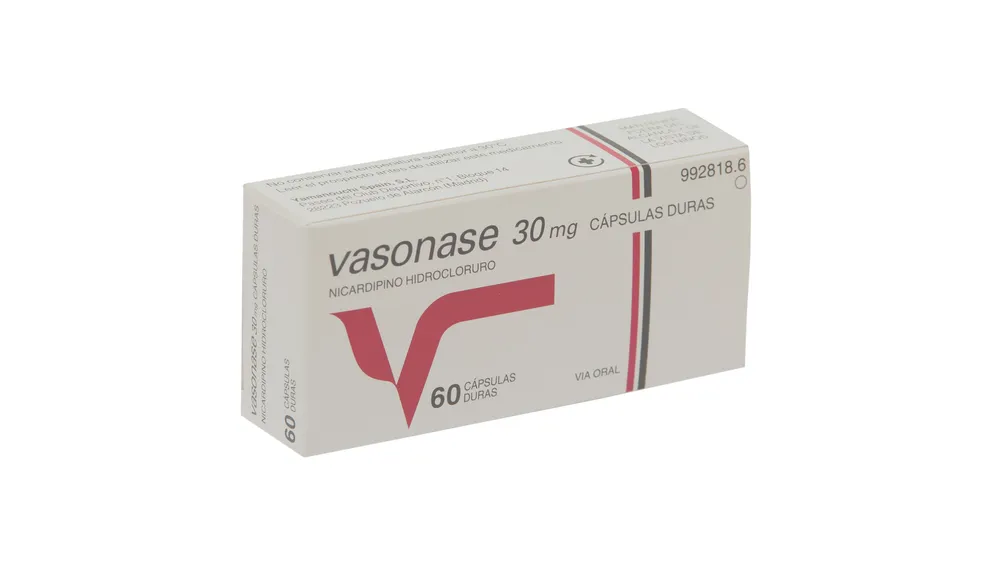
Table of Contents
- Package leaflet: Information for the user
- Introduction
- 1. What VASONASE 30 mg Hard Capsules is and what it is used for
- 2. What you need to know before taking VASONASE 30 mg Hard Capsules
- 3. How to take VASONASE 30 mg Hard Capsules
- 4. Possible adverse effects
- 5. Storage of VASONASE 30 mg Hard Capsules
- 6. Contents of the pack and other information
Package leaflet: Information for the user
Introduction
Package leaflet: information for the user
VASONASE 30 mg Hard capsules
Nicardipine hydrochloride
Read the entire leaflet carefully before you start taking this medicine because it contains important information for you.
- Keep this leaflet as you may need to read it again.
- If you have any questions, ask your doctor or pharmacist.
- This medicine has been prescribed for you only and must not be given to other people, even if they have the same symptoms as you, because it may harm them.
- If you experience any side effects, talk to your doctor or pharmacist, even if it is a side effect not listed in this leaflet. See section 4.
Contents of the leaflet
- What VASONASE 30 mg Hard capsules is and what it is used for
- What you need to know before taking VASONASE 30 mg Hard capsules
- How to take VASONASE 30 mg Hard capsules
- Possible side effects
- How to store VASONASE 30 mg Hard capsules
- Contents of the pack and other information
1. What VASONASE 30 mg Hard Capsules is and what it is used for
Nicardipine hydrochloride is the active substance in VASONASE 30 mg Hard Capsules, a medicinal product belonging to the dihydropyridine class that acts on blood vessels by relaxing smooth muscle. It also increases blood flow at the cerebral level.
VASONASE 30 mg Hard Capsules is used for:
- Treatment of mild to moderate essential hypertension
- Prevention and treatment of cerebral infarction ischemia and its sequelae
- Prevention and treatment of neurological impairment caused by cerebral vasospasm secondary to subarachnoid hemorrhage
- Treatment of chronic stable angina.
2. What you need to know before taking VASONASE 30 mg Hard Capsules
Do not take VASONASE 30 mg Hard Capsules
- If you are allergic to nicardipine hydrochloride or to any of the other ingredients of this medicine (listed in section 6).
- If you are a patient with severe valvular aortic stenosis.
Warnings and precautions
Talk to your doctor or pharmacist before taking VASONASE 30 mg Hard Capsules:
- If you have renal or hepatic impairment.
- If nicardipine is prescribed for you, caution is required to avoid excessive lowering of blood pressure.
- If nicardipine is prescribed to replace beta-blocker therapy, beta-blockers must not be stopped abruptly; their dose should be gradually reduced over 8–10 days.
- If you experience chest pain, inform your doctor. Rarely, an increase in chest pain or its frequency may occur. If you experience this, inform your doctor promptly.
- If you have congestive heart failure or limited cardiac reserve.
This medicine may cause low oxygen levels or breathing difficulties when administered intravenously, especially in patients with lung problems or other conditions affecting respiration. Your doctor will monitor your oxygen levels during treatment.
Use of VASONASE 30 mg Hard Capsules with other medicines
Inform your doctor, pharmacist, or nurse if you are taking, have recently taken, or might need to take any other medicines.
Taking this medicine together with others may require dose adjustments, especially with cimetidine, carbamazepine, cyclosporine, tacrolimus, sirolimus, everolimus, digoxin, fentanyl, or beta-blockers.
In particular, inform your doctor if you are taking other medicines that affect the body's immune system, such as cyclosporine, tacrolimus, or sirolimus.
Use of VASONASE 30 mg Hard Capsules with food and drink
Nicardipine levels may increase if you take Vasonase together with grapefruit juice.
Pregnancy, breast-feeding, and fertility
If you are pregnant or breast-feeding, think you may be pregnant, or are planning to become pregnant, consult your doctor or pharmacist before taking this medicine.
This medicine is not recommended during pregnancy.
This medicine passes into breast milk. Therefore, it should not be used during breast-feeding.
There are no data available on fertility.
Driving and using machines
VASONASE 30 mg Hard Capsules is a hypotensive medicine that should be used with caution in patients whose activities require alertness and who have experienced dizziness during treatment with this medicine.
3. How to take VASONASE 30 mg Hard Capsules
Follow exactly the instructions for use of this medicine as given by your doctor. If in doubt, consult your doctor or pharmacist again.
The recommended dose ranges from 10 to 40 mg three times daily, depending on the type of pathology being treated.
VASONASE 30 mg capsules should be taken with liquid and must be swallowed whole.
Lower doses are recommended in elderly patients and in patients with renal or hepatic impairment.
Use in the elderly
Elderly patients should use VASONASE 30 mg Hard Capsules with caution.
Use in children and adolescents
VASONASE 30 mg Hard Capsules must not be administered to children under 18 years of age, as safety and efficacy have not been established in this age group.
If you take more VASONASE 30 mg Hard Capsules than you should
In case of overdose, hypotension, bradycardia, palpitations, flushing, dizziness, confusion, and slurred speech may occur.
In the event of overdose, cardiac and respiratory functions should be monitored, and you must seek immediate medical attention.
If you have taken more than the prescribed amount, contact your doctor, pharmacist, or call the Toxicology Information Service at Telephone (91) 562 04 20, indicating the medicine and the amount taken.
If you forget to take VASONASE 30 mg Hard Capsules
Do not take a double dose to make up for the missed dose.
If you stop taking VASONASE 30 mg Hard Capsules
Do not discontinue treatment without first consulting your doctor.
If you have any further questions about the use of this medicine, ask your doctor or pharmacist.
4. Possible adverse effects
Like all medicines, this medicine can cause adverse effects, although not everyone experiences them.
These effects occur more frequently at the beginning of treatment, are usually not serious, and disappear soon after treatment is discontinued.
Common adverse effects (may affect up to 1 in 10 people)
- swelling of the legs (edema),
- headaches,
- a sensation of warmth in the face,
- dizziness and palpitations.
Uncommon adverse effects (may affect up to 1 in 1,000 people)
- heart rhythm disorders,
- a drop in blood pressure,
- sudden loss of consciousness (syncope),
- gastrointestinal disturbances (nausea, vomiting),
- a decrease in the number of blood platelets,
- an increase in gum size. These effects usually resolve when treatment is stopped and require careful oral hygiene.
Rare adverse effects (may affect up to 1 in 10,000 people)
- disorders associated with stiffness, tremors, and/or abnormal movements,
- abnormal liver function which may lead to inflammation of the liver (hepatitis).
The following adverse effects occur with unknown frequency (cannot be estimated from available data)
- Cases of acute pulmonary edema have been reported, especially when nicardipine is used in pregnant women to reduce uterine contractions.
- Discomfort due to a sudden drop in blood pressure, especially when moving from a lying/sitting position to a standing position.
- Fatigue.
- Sensation of warmth.
- Increased liver enzymes.
- Chest, jaw, and back pain, which may frequently occur at the beginning of treatment in patients with ischemic heart disease.
- Severe and sudden allergic reaction with difficulty breathing.
- Skin redness and itching.
Patients with pre-existing angina may experience an increased frequency, duration, or severity of angina attacks with the nicardipine group of medicines.
Reporting of adverse effects
If you experience any adverse effects, consult your doctor or pharmacist, even if they are possible adverse effects not listed in this leaflet. You may also report them directly via the Spanish Pharmacovigilance System for Human Medicines: www.notificaram.es. By reporting adverse effects, you can help provide more information on the safety of this medicine.
5. Storage of VASONASE 30 mg Hard Capsules
Do not store above 30°C.
Keep the medicine in the original packaging.
Keep this medicine out of the sight and reach of children.
The shelf life of VASONASE 30 mg Hard Capsules is 2 years.
Do not use this medicine after the expiry date stated on the container after EXP. The expiry date refers to the last day of the month indicated.
Medicines should not be disposed of via wastewater or household waste. Dispose of unused medicines and their containers at a SIGRE point in your pharmacy. If you have any doubts, ask your pharmacist how to dispose of medicines and containers you no longer need. This will help protect the environment.
6. Contents of the pack and other information
Composition of VASONASE 30 mg Hard capsules
- The active substance is nicardipine hydrochloride.
- The other components are pregelatinized starch and magnesium stearate.
The capsule shell contains: indigotine (E132), titanium dioxide (E171) and gelatin.
Appearance of the product and contents of the pack
Blue capsules containing yellow powder.
VASONASE 30 mg Hard capsules are available in packs of 60 capsules.
Marketing Authorization Holder and Manufacturer
Marketing Authorization Holder:
Laboratoire X.O
170 Bureaux de la Colline
92213 Saint-Cloud Cedex
France
Manufacturer:
Farmasierra Manufacturing S.L.
Carretera de Irún, Km. 26,200
San Sebastián de los Reyes
28706 Madrid
Spain
For further information about this medicinal product, please contact the local representative of the Marketing Authorization Holder:
Beatriz López Pascual
Tel: +34 626 028 201
Mail: [email protected]
Date of the latest revision of this leaflet: April 2026
Detailed information on this medicinal product is available on the website of the Spanish Agency for Medicines and Health Products (AEMPS) http://www.aemps.gob.es/