Tuscalman 3 mg/ml syrup
Spain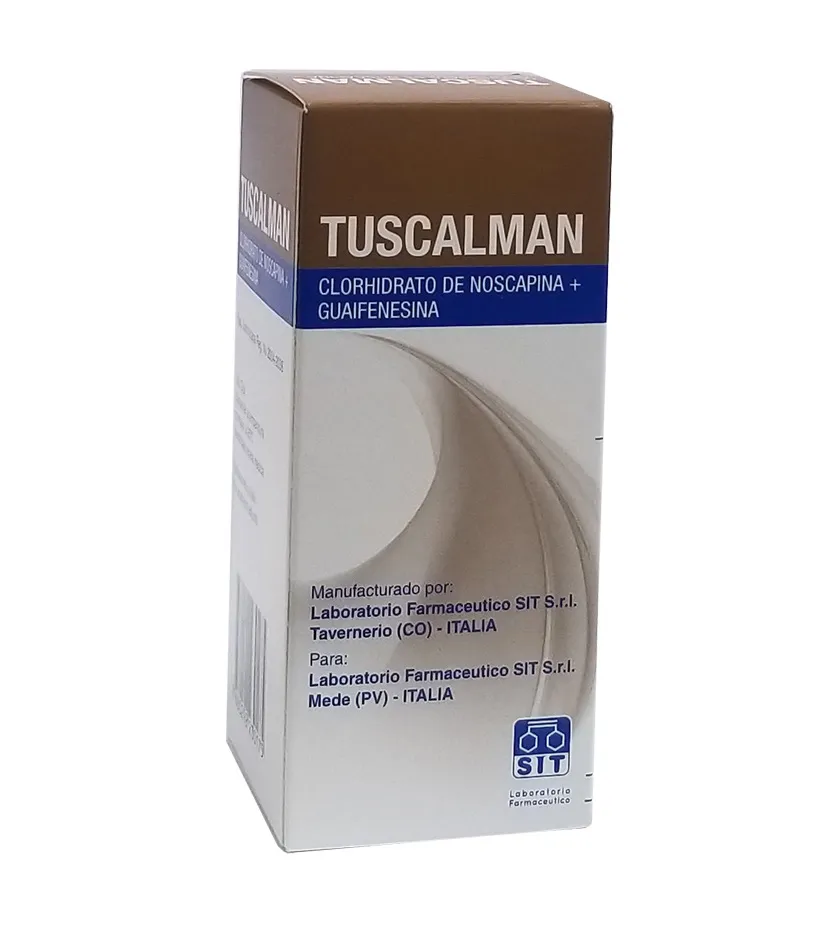
Table of Contents
Package leaflet: Information for the user
Introduction
Package leaflet: information for the patient
Tuscalman 3 mg/ml Syrup
Noscapine hydrochloride
Read this entire leaflet carefully before you start taking this medicine, because it contains important information for you.
- Keep this leaflet, as you may need to read it again.
- If you have any questions, consult your doctor or pharmacist.
- This medicine has been prescribed for you only and must not be given to other people, even if they have the same symptoms as you, since it could harm them.
- If you experience any adverse effects, consult your doctor or pharmacist, even if they are adverse effects not listed in this leaflet. See section 4.
Leaflet contents:
- What Tuscalman is and what it is used for.
- What you need to know before taking Tuscalman
- How to take Tuscalman
- Possible side effects.
- How to store Tuscalman
Pack contents and other information
1. What Tuscalman is and what it is used for
Noscapine is a centrally-acting antitussive that works by temporarily reducing the cough impulse.
Tuscalman is indicated for the symptomatic treatment of all forms of non-productive cough (dry cough).
2. What you need to know before taking Tuscalman
Do not take Tuscalman
- if you are allergic to the active substance or to any of the other ingredients of this medicine (listed in section 6).
- in children under 2 years of age.
Warnings and precautions
Talk to your doctor or pharmacist before starting to take Tuscalman. This medicine may cause drowsiness.
It may enhance the effects of alcohol; therefore, it is advisable to avoid drinking alcoholic beverages during treatment.
Inform your doctor about your current and past medical conditions, especially diabetes and any allergies you may have.
Taking Tuscalman with other medicines
Inform your doctor or pharmacist if you are currently taking, have recently taken, or might need to take any other medicines.
Concomitant use of Tuscalman and sedative medicines such as benzodiazepines or related drugs increases the risk of drowsiness, breathing difficulties (respiratory depression), coma, and may be potentially fatal. For this reason, concomitant use should only be considered when no other treatment options are available.
However, if your doctor prescribes Tuscalman together with sedative medicines, your doctor should limit the dose and duration of concomitant treatment.
Inform your doctor about all sedative medicines you are taking and carefully follow your doctor's instructions regarding dosage. It may be helpful to inform friends or family members so they are aware of the signs and symptoms mentioned above. Contact your doctor if you experience such symptoms.
Pregnancy and breastfeeding
If you are pregnant or breastfeeding, think you may be pregnant, or are planning to become pregnant, consult your doctor or pharmacist before using this medicine.
Since there are insufficient data to confirm its safety, as a precaution, it is not advisable to take this medicine during pregnancy.
There are no data on the passage of Tuscalman into breast milk; therefore, its use is not recommended during breastfeeding.
Driving and using machines
Since this medicine may impair reaction ability, special caution is recommended when driving vehicles or operating dangerous machinery. Do not exceed the daily dose recommended by your doctor.
Tuscalman contains sucrose, sorbitol, and sodium benzoate
This medicine contains sucrose. If your doctor has informed you of an intolerance to certain sugars, consult him before taking this medicine.
Patients with diabetes mellitus should be aware that this medicine contains 5.130 g of sucrose per 10 ml.
This medicine contains 87.15 mg of sorbitol in each ml.
Sorbitol is a source of fructose. If your doctor has informed you (or your child) that you have an intolerance to certain sugars, or if you (or your child) have been diagnosed with hereditary fructose intolerance (HFI), a rare genetic disorder in which the patient cannot break down fructose, consult your doctor before taking this medicine.
This medicine contains 1 mg of sodium benzoate in each ml.
3. How to take Tuscalman
Follow exactly the instructions for use of this medicine provided by your doctor or pharmacist. If in doubt, consult your doctor or pharmacist again.
Remember to take your medicine.
Your doctor will tell you how long to continue treatment with Tuscalman.
Do not stop treatment early, as symptoms may return.
This medicine and its dosage form have been prescribed exclusively for you. Never give it to other people, and do not use it for other types of disorders.
Tuscalman should preferably be taken after meals.
The recommended dose is:
Adults: The recommended dose is 2 dessertspoons (2 × 5 ml) every 5–6 hours.
Use in children and adolescents:
Children 2 to 6 years: Half a dessertspoon (2.5 ml) every 5–6 hours.
Children 6 to 12 years: 1 dessertspoon (5 ml) every 5–6 hours.
If you take more Tuscalman than you should
The most common symptom in case of overdose is excessive drowsiness.
Treatment of overdose consists of inducing vomiting using emetics or gastric lavage.
In case of overdose or accidental ingestion, contact your doctor or pharmacist immediately or call the Toxicology Information Service at 91 562 04 20, indicating the medicine and the amount ingested.
If you forget to take Tuscalman
Do not take a double dose to make up for forgotten doses. Simply take the next dose as usual.
4. Possible adverse effects
Like all medicines, this medicine may produce adverse effects, although not everyone experiences them.
The most frequent adverse effects are: somnolence, headache, nausea, and allergic-type reactions such as inflammation of the nasal mucosa, redness of the eyes, skin rash, and skin itching.
These effects are generally mild and are not usually of significant concern.
Reporting of adverse effects
If you experience any type of adverse effect, consult your doctor or pharmacist, even if it is a possible adverse effect not listed in this leaflet. You may also report them directly through the Spanish Pharmacovigilance System for Human Medicinal Products: www.notificaRAM.es. By reporting adverse effects, you can help provide more information on the safety of this medicine.
5. Storage of Tuscalman
Keep this medicine out of the sight and reach of children.
Store in the original packaging to protect it from light.
Once the container is opened, it expires after 6 months.
Do not use this medicine after the expiry date stated on the packaging after EXP. The expiry date refers to the last day of the month indicated.
Medicines must not be disposed of via wastewater drains or household waste. Dispose of unused medicines and their containers at a SIGRE collection point at your pharmacy. If you have any doubts, ask your pharmacist how to properly dispose of unused medicines and their containers. This will help protect the environment.
6. Package contents and additional information
Composition of Tuscalman
- The active substance is noscapine hydrochloride. Each ml contains 3 mg of noscapine hydrochloride.
- The other components are sucrose, crystallized liquid sorbitol, elderberry syrup, sodium benzoate, citric acid, peppermint flavor, cherry flavor, and water.
Appearance of the product and contents of the pack
Tuscalman is presented as a dark yellow solution.
Each container contains 150 ml.
Marketing Authorization Holder and Manufacturer
Marketing Authorization Holder
Laboratorio Farmaceutico SIT, S.r.l.
Via Cavour 70
27035 Mede (Pavia)
Italy
Manufacturer
Laboratorio Farmaceutico S.I.T. Specialità Igienico Terapeutichi S.r.l
Via Provinciale per Lecco, 78
22038 Tavernerio (Como)
Italy
More information about this medicinal product can be requested from the local representative of the Marketing Authorization Holder:
DESMA Laboratorio Farmacéutico SL
Paseo de la Castellana 121, escalera Izquierda 3ºB
28046 Madrid, Spain
The last revision of this leaflet was in: May 2024
Other sources of information
Detailed and up-to-date information on this medicinal product is available on the website of the Spanish Agency for Medicines and Health Products (AEMPS):
http://www.aemps.gob.es/