Tepadina 15 mg powder for concentrate for infusion solution
Spain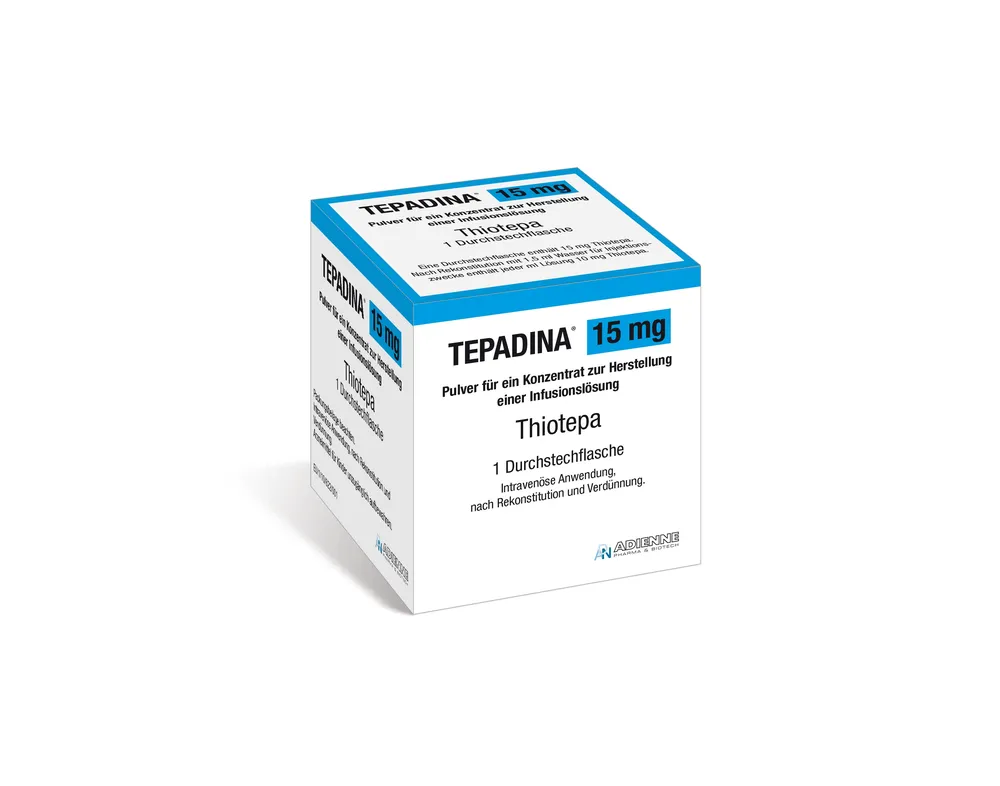
Table of Contents
Package leaflet: Information for the user
Introduction
Package leaflet: Information for the user
TEPADINA 15 mg powder for concentrate for solution for infusion
tiotepa
Read the entire leaflet carefully before you start using this medicine because it contains important information for you.
- Keep this leaflet; you may need to read it again.
- If you have any questions, ask your doctor.
- If you experience any adverse reactions, consult your doctor, even if they are not listed in this leaflet. See section 4.
Leaflet contents
- What TEPADINA is and what it is used for
- What you need to know before using TEPADINA
- How to use TEPADINA
- Possible adverse effects
- How to store TEPADINA
- Contents of the pack and other information
1. What TEPADINA is and what it is used for
TEPADINA contains the active substance tiotepa, a medicine belonging to the group of alkylating agents.
TEPADINA is used to prepare the patient for a bone marrow transplant. It works by destroying bone marrow cells, thereby enabling the patient to receive a transplant of new bone marrow cells (hematopoietic stem cells), which in turn allow the body to produce healthy blood cells.
TEPADINA can be used in adults, children, and adolescents.
2. What you need to know before starting TEPADINA
Do not use TEPADINA
- if you are allergic to thiotepa,
- if you are pregnant or think you may be pregnant,
- if you are breastfeeding,
- if you are due to receive the yellow fever vaccine or other live virus or bacterial vaccines.
Warnings and precautions
Tell your doctor if you have:
- liver or kidney problems,
- heart or lung problems,
- seizures or epilepsy, or have had them in the past (especially if you have been treated with phenytoin or fosphenytoin).
Since TEPADINA destroys bone marrow cells responsible for producing blood cells, you will need periodic blood tests during treatment to monitor your blood cell counts.
To prevent and treat infections, you will be given anti-infective agents.
TEPADINA may cause another type of cancer in the future. Your doctor will explain this risk to you.
Use of TEPADINA with other medicines
Tell your doctor if you are taking, have recently taken, or might need to take any other medicines.
Pregnancy, breastfeeding and fertility
Tell your doctor if you are pregnant or think you may be pregnant before receiving TEPADINA. You must not use TEPADINA during pregnancy.
Both women and men receiving TEPADINA must use effective contraception during treatment.
It is unknown whether this medicine is excreted in human milk. As a precaution, women should not breastfeed during treatment with TEPADINA.
TEPADINA may affect male and female fertility. Male patients should consider sperm preservation before starting treatment and must not father a child during treatment and for one year after treatment has ended.
Driving and using machines
Some adverse reactions of thiotepa, such as dizziness, headache and blurred vision, may affect your ability to drive or operate machinery.
3. How to use TEPADINA
The physician will calculate the dose based on your body surface area or body weight and your condition.
How TEPADINA is administered
TEPADINA must be administered by a qualified healthcare professional as an intravenous infusion (a drip into a vein) after dilution of each vial. Each infusion lasts 2-4 hours.
Frequency of administration
You will receive infusions every 12 or 24 hours. The treatment may last up to 5 days. The frequency of administration and duration of treatment will depend on your condition.
4. Possible adverse effects
Like all medicines, TEPADINA may cause adverse effects, although not everyone will experience them.
Some more serious side effects of treatment with TEPADINA or of the transplant procedure are:
- decrease in circulating blood cell counts (an expected effect of the medication as preparation for your transplant)
- infection
- liver problems, such as hepatic vein occlusion
- graft attack against your body (graft-versus-host disease)
- respiratory complications
Your doctor will monitor your blood cell counts and liver enzymes periodically to detect and treat these events.
Adverse effects of TEPADINA occur at certain frequencies, defined as follows:
Very common adverse effects (may affect more than 1 in 10 people)
- increased susceptibility to infections
- generalized inflammation (septicemia)
- decreased counts of white blood cells, platelets, and red blood cells (anemia)
- attack by transplanted cells against your body (graft-versus-host disease)
- dizziness, headache, blurred vision
- uncontrolled body tremors (seizures)
- tingling, prickling, or numbness sensation (paresthesia)
- partial loss of mobility
- cardiac arrest
- nausea, vomiting, diarrhea
- inflammation of the oral mucosa (mucositis)
- stomach, esophagus, or intestinal irritation
- inflammation of the colon
- anorexia, loss of appetite
- elevated blood glucose
- rash, pruritus, desquamation
- skin coloration changes (should not be confused with jaundice – see below)
- redness of the skin (erythema)
- hair loss
- back and abdominal pain, pain
- muscle and joint pain
- abnormal electrical activity in the heart (arrhythmia)
- inflammation of lung tissue
- enlarged liver
- impaired function of certain organs
- hepatic vein occlusion (veno-occlusive disease, VOD)
- yellowing of the skin and eyes (jaundice)
- hearing deterioration
- lymphatic obstruction
- high blood pressure
- enlarged liver, elevated renal and digestive enzymes
- abnormal blood electrolyte values
- weight gain
- fever, general weakness, chills
- bleeding (hemorrhage)
- nosebleeds
- generalized swelling due to fluid retention (edema)
- pain or inflammation at the injection site
- eye infection (conjunctivitis)
- decreased sperm count
- vaginal bleeding
- absence of menstrual periods (amenorrhea)
- memory loss
- delayed weight and height gain
- bladder problems
- insufficient testosterone production
- insufficient thyroid hormone production
- reduced pituitary activity
- confusion
Common adverse effects (may affect up to 1 in 10 people)
- anxiety, confusion
- abnormal dilation of an artery in the brain (intracranial aneurysm)
- elevated creatinine
- allergic reactions
- blockage of a blood vessel (embolism)
- altered heart rhythm
- heart failure
- cardiovascular insufficiency
- oxygen deficiency
- fluid accumulation in the lungs (pulmonary edema)
- pulmonary hemorrhage
- respiratory arrest
- blood in urine (hematuria) and moderate renal failure
- inflammation of the urinary bladder
- discomfort during urination and reduced urine output (dysuria and oliguria)
- increased levels of nitrogen components in blood (elevated BUN)
- cataracts
- liver failure
- cerebral hemorrhage
- cough
- constipation and gastric discomfort
- intestinal obstruction
- stomach perforation
- changes in muscle tone
- general lack of coordination of muscular movements
- bruising associated with low platelet count
- menopausal symptoms
- cancer (secondary primary neoplasms)
- impaired brain function
- male and female infertility
Uncommon adverse effects (may affect up to 1 in 100 people)
- inflammation and peeling of the skin (erythrodermic psoriasis)
- delirium, nervousness, hallucinations, agitation
- gastrointestinal ulcer
- inflammation of the heart muscle tissue (myocarditis)
- abnormal heart disease (cardiomyopathy)
Frequency not known: frequency cannot be estimated from available data
- increased blood pressure in the arteries (blood vessels) of the lungs (pulmonary arterial hypertension)
- severe skin damage (e.g., severe lesions, bullae, etc.) that may affect the entire body surface, which can even be fatal
- damage to a component of the brain (so-called white matter) that may even be potentially fatal (leukoencephalopathy).
Reporting of adverse effects
If you experience any adverse effect, consult your doctor or nurse, even if it is a possible adverse effect not listed in this leaflet. You may also report them directly through the national reporting system listed in Appendix V. By reporting adverse effects, you can help provide more information on the safety of this medicine.
5. Storage of TEPADINA
Keep out of sight and reach of children.
Do not use TEPADINA after the expiry date stated on the container after "EXP". The expiry date refers to the last day of the month indicated.
Store and transport refrigerated (2°C-8°C).
Do not freeze.
After reconstitution, the medicinal product remains stable for 8 hours when stored at 2°C-8°C.
After dilution, the medicinal product remains stable for 24 hours when stored at 2°C-8°C and for 4 hours when stored at 25°C. From a microbiological standpoint, the product should be used immediately.
Any unused medicine and materials that have been in contact with it should be disposed of in accordance with local regulations.
6. Contents of the pack and other information
Composition of TEPADINA
- The active substance is thiotepa. One vial contains 15 mg of thiotepa. After reconstitution, each ml contains 10 mg of thiotepa (10 mg/ml).
- TEPADINA does not contain any other components.
Appearance of the product and contents of the pack
TEPADINA is a white crystalline powder supplied in a glass vial containing 15 mg of thiotepa.
Each carton contains 1 vial.
Marketing Authorization Holder and Manufacturer
ADIENNE S.r.l. S.U.
Via Galileo Galilei, 19
20867 Caponago (MB) Italy
Tel: +39 02 40700445
Further information on this medicinal product is available upon request by contacting the local representative of the Marketing Authorization Holder:
Belgium/Belgium/Belgium Accord Healthcare bvba Tel/Tel: +32 51 79 40 12 | Lithuania Accord Healthcare AB Tel: +46 8 624 00 25 | |
Poland Accord Healthcare Polska Sp. z o.o. Tel: +48 22 577 28 00 | Luxembourg/Luxembourg Accord Healthcare bvba Tel/Tel: +32 51 79 40 12 | |
Czech Republic Accord Healthcare Polska Sp. z o.o. Tel: +48 22 577 28 00 |
|
Denmark
Immedica Pharma AB
Tlf: +46 (0)8 533 39 500
Malta
Accord Healthcare Ireland Ltd
Tel: +44 (0) 208 901 3370
Germany
Accord Healthcare GmbH
Tel: +49 89 700 9951 0
Netherlands
Accord Healthcare B.V.
Tel: +31 30 850 6014
Estonia
Accord Healthcare AB
Tel: +46 8 624 00 25
Norway
Immedica Pharma AB
Tlf: +46 (0)8 533 39 500
Greece
aVIPHARMA International S.A.
Tel: +30-210 6194 170
Austria
Accord Healthcare GmbH
Tel: +43 (0)662 424899-0
Spain
Accord Healthcare S.L.U.
Tel: +34 93 301 00 64
Poland
Accord Healthcare Polska Sp. z o.o.
Tel.: +48 22 577 28 00
France
Accord Healthcare France SAS
Tél: +33 (0)320 401 770
Portugal
Accord Healthcare, Unipessoal Lda
Tel: +351 214 697 835
Croatia
Accord Healthcare Polska Sp. z o.o.
Tel: +48 22 577 28 00
Romania
Accord Healthcare Polska Sp. z o.o.
Tel: +48 22 577 28 00
Ireland
Accord Healthcare Ireland Ltd
Tel: +44 (0)1271 385257
Slovenia
Accord Healthcare Polska Sp. z o.o.
Tel: +48 22 577 28 00
Iceland
Immedica Pharma AB
Sími: +46 (0)8 533 39 500
Slovakia
Accord Healthcare Polska Sp. z o.o.
Tel: +48 22 577 28 00
Italy
Accord Healthcare Italia Srl
Tel: +39 02 943 23 700
Finland/Sweden
Immedica Pharma AB
Puh/Tel: +46 (0)8 533 39 500
Cyprus
aVIPHARMA International S.A.
Tel: +30-210 6194 170
Sweden
Immedica Pharma AB
Tel: +46 (0)8 533 39 500
Latvia
Accord Healthcare AB
Tel: +46 8 624 00 25
United Kingdom
Accord-UK Ltd
Tel: +44 (0)1271 385257
Date of the most recent review of this leaflet:
Other sources of information
Detailed information on this medicine is available on the European Medicines Agency website: http://www.ema.europa.eu/.
This information is intended for healthcare professionals only:
PREPARATION GUIDE
TEPADINA 15 mg powder for concentrate for solution for infusion Tiotepa
Read this guide before preparing and administering TEPADINA.
- PRESENTATION
TEPADINA is supplied as 15 mg of powder for concentrate for solution for infusion.
TEPADINA must be reconstituted and diluted before administration.
- SPECIAL PRECAUTIONS FOR DISPOSAL AND OTHER HANDLING
General
Appropriate procedures for handling and disposal of antineoplastic medicinal products must be followed. All transfer procedures must strictly comply with aseptic techniques, preferably using a vertical laminar flow safety cabinet. As with other cytotoxic compounds, extreme caution should be taken during handling and preparation of TEPADINA solutions to avoid accidental contact with skin or mucous membranes. Topical reactions may occur following accidental exposure to tiotepa. Therefore, the use of gloves is recommended during the preparation of the infusion solution. If tiotepa solution comes into accidental contact with the skin, wash thoroughly with water and soap immediately. If tiotepa comes into accidental contact with mucous membranes, rinse thoroughly with water.
Dosage calculation of TEPADINA
TEPADINA is administered at various doses and in combination with other chemotherapeutic agents to patients undergoing conventional hematopoietic stem cell transplantation (HSCT) due to hematological diseases or solid tumors.
The recommended dosage of TEPADINA in adult and pediatric patients depends on the type of HSCT (autologous or allogeneic) and the disease.
Dosage in adults
AUTologous HSCT
Hematological diseases
The recommended dose in hematological diseases ranges from 125 mg/m²/day (3.38 mg/kg/day) to 300 mg/m²/day (8.10 mg/kg/day) as a single daily infusion administered for 2 to 4 consecutive days prior to autologous HSCT, depending on combination with other chemotherapeutic agents, without exceeding a maximum cumulative total dose of 900 mg/m² (24.32 mg/kg) throughout the conditioning regimen.
LYMPHOMA
The recommended dose in hematological diseases ranges from 125 mg/m²/day (3.38 mg/kg/day) to 300 mg/m²/day (8.10 mg/kg/day) as a single daily infusion administered for 2 to 4 consecutive days prior to autologous HSCT, depending on combination with other chemotherapeutic agents, without exceeding a maximum cumulative total dose of 900 mg/m² (24.32 mg/kg) throughout the conditioning regimen.
CENTRAL NERVOUS SYSTEM (CNS) LYMPHOMA
The recommended dose is 185 mg/m²/day (5 mg/kg/day) as a single daily infusion administered for 2 consecutive days prior to autologous HSCT, without exceeding a maximum cumulative total dose of 370 mg/m² (10 mg/kg) throughout the conditioning regimen.
MULTIPLE MYELOMA
The recommended dose ranges from 150 mg/m²/day (4.05 mg/kg/day) to 250 mg/m²/day (6.76 mg/kg/day) as a single daily infusion administered for 3 consecutive days prior to autologous HSCT, depending on combination with other chemotherapeutic agents, without exceeding a maximum cumulative total dose of 750 mg/m² (20.27 mg/kg) throughout the conditioning regimen.
Solid tumors
The recommended dose in solid tumors ranges from 120 mg/m²/day (3.24 mg/kg/day) to 250 mg/m²/day (6.76 mg/kg/day), divided into one or two daily infusions administered for 2 to 5 consecutive days prior to autologous HSCT, depending on combination with other chemotherapeutic agents, without exceeding a maximum cumulative total dose of 800 mg/m² (21.62 mg/kg) throughout the conditioning regimen.
BREAST CANCER
The recommended dose ranges from 120 mg/m²/day (3.24 mg/kg/day) to 250 mg/m²/day (6.76 mg/kg/day) as a single daily infusion administered for 3 to 5 consecutive days prior to autologous HSCT, depending on combination with other chemotherapeutic agents, without exceeding a maximum cumulative total dose of 800 mg/m² (21.62 mg/kg) throughout the conditioning regimen.
CNS TUMORS
The recommended dose ranges from 125 mg/m²/day (3.38 mg/kg/day) to 250 mg/m²/day (6.76 mg/kg/day), divided into one or two daily infusions administered for 3 to 4 consecutive days prior to autologous HSCT, depending on combination with other chemotherapeutic agents, without exceeding a maximum cumulative total dose of 750 mg/m² (20.27 mg/kg) throughout the conditioning regimen.
OVARIAN CANCER
The recommended dose is 250 mg/m²/day (6.76 mg/kg/day) as a single daily infusion administered for 2 consecutive days prior to autologous HSCT, without exceeding a maximum cumulative total dose of 500 mg/m² (13.51 mg/kg) throughout the conditioning regimen.
GERM CELL TUMORS
The recommended dose ranges from 150 mg/m²/day (4.05 mg/kg/day) to 250 mg/m²/day (6.76 mg/kg/day) as a single daily infusion administered for 3 consecutive days prior to autologous HSCT, depending on combination with other chemotherapeutic agents, without exceeding a maximum cumulative total dose of 750 mg/m² (20.27 mg/kg) throughout the conditioning regimen.
ALLOGENEIC HSCT
Hematological diseases
The recommended dose in hematological diseases ranges from 185 mg/m²/day (5 mg/kg/day) to 481 mg/m²/day (13 mg/kg/day), divided into one or two daily infusions administered for 1 to 3 consecutive days prior to allogeneic HSCT, depending on combination with other chemotherapeutic agents, without exceeding a maximum cumulative total dose of 555 mg/m² (15 mg/kg) throughout the conditioning regimen.
LYMPHOMA
The recommended dose is 370 mg/m²/day (10 mg/kg/day), divided into two daily infusions prior to allogeneic HSCT, without exceeding a maximum cumulative total dose of 370 mg/m² (10 mg/kg) throughout the conditioning regimen.
MULTIPLE MYELOMA
The recommended dose is 185 mg/m²/day (5 mg/kg/day) as a single daily infusion prior to allogeneic HSCT, without exceeding a maximum cumulative total dose of 185 mg/m² (5 mg/kg) throughout the conditioning regimen.
LEUKEMIA
The recommended dose ranges from 185 mg/m²/day (5 mg/kg/day) to 481 mg/m²/day (13 mg/kg/day), divided into one or two daily infusions administered for 1 or 2 consecutive days prior to allogeneic HSCT, depending on combination with other chemotherapeutic agents, without exceeding a maximum cumulative total dose of 555 mg/m² (15 mg/kg) throughout the conditioning regimen.
THALASSEMIA
The recommended dose is 370 mg/m²/day (10 mg/kg/day), divided into two daily infusions administered prior to allogeneic HSCT, without exceeding a maximum cumulative total dose of 370 mg/m² (10 mg/kg) throughout the conditioning regimen.
Dosage in pediatric patients
AUTologous HSCT
Solid tumors
The recommended dose in hematological diseases ranges from 150 mg/m²/day (6 mg/kg/day) to 350 mg/m²/day (14 mg/kg/day) as a single daily infusion administered for 2 to 3 consecutive days prior to autologous HSCT, depending on combination with other chemotherapeutic agents, without exceeding a maximum cumulative total dose of 1,050 mg/m² (42 mg/kg) throughout the conditioning regimen.
CNS TUMORS
The recommended dose ranges from 250 mg/m²/day (10 mg/kg/day) to 350 mg/m²/day (14 mg/kg/day) as a single daily infusion administered for 3 consecutive days prior to autologous HSCT, depending on combination with other chemotherapeutic agents, without exceeding a maximum cumulative total dose of 1,050 mg/m² (42 mg/kg) throughout the conditioning regimen.
ALLOGENEIC HSCT
Hematological diseases
The recommended dose in hematological diseases ranges from 125 mg/m²/day (5 mg/kg/day) to 250 mg/m²/day (10 mg/kg/day), divided into one or two daily infusions administered for 1 to 3 consecutive days prior to allogeneic HSCT, depending on combination with other chemotherapeutic agents, without exceeding a maximum cumulative total dose of 375 mg/m² (15 mg/kg) throughout the conditioning regimen.
LEUKEMIA
The recommended dose is 250 mg/m²/day (10 mg/kg/day), divided into two daily infusions administered prior to allogeneic HSCT, without exceeding a maximum cumulative total dose of 250 mg/m² (10 mg/kg) throughout the conditioning regimen.
THALASSEMIA
The recommended dose ranges from 200 mg/m²/day (8 mg/kg/day) to 250 mg/m²/day (10 mg/kg/day), divided into two daily infusions administered prior to allogeneic HSCT, without exceeding a maximum cumulative total dose of 250 mg/m² (10 mg/kg) throughout the conditioning regimen.
REFRACTORY CYTOPENIA
The recommended dose is 125 mg/m²/day (5 mg/kg/day) as a single daily infusion administered for 3 consecutive days prior to allogeneic HSCT, without exceeding a maximum cumulative total dose of 375 mg/m² (15 mg/kg) throughout the conditioning regimen.
GENETIC DISORDERS
The recommended dose is 125 mg/m²/day (5 mg/kg/day) as a single daily infusion administered for 2 consecutive days prior to allogeneic HSCT, without exceeding a maximum cumulative total dose of 250 mg/m² (10 mg/kg) throughout the conditioning regimen.
SICKLE CELL ANEMIA
The recommended dose is 250 mg/m²/day (10 mg/kg/day), divided into two daily infusions administered prior to allogeneic HSCT, without exceeding a maximum cumulative total dose of 250 mg/m² (10 mg/kg) throughout the conditioning regimen.
Reconstitution
TEPADINA must be reconstituted with 1.5 ml of sterile water for injections.
Using a syringe fitted with a needle, withdraw 1.5 ml of sterile water for injections under aseptic conditions.
Inject the contents of the syringe into the vial by piercing the rubber stopper.
Remove the syringe and needle and mix manually by repeated inversion of the vial.
Only clear, particle-free solutions should be used. Reconstituted solutions may occasionally show opalescence; such solutions may still be administered.
Further dilution in the infusion bag
The reconstituted solution is hypotonic and must be diluted before administration with 500 ml of 9 mg/ml (0.9%) sodium chloride solution for injection (1000 ml if the dose exceeds 500 mg), or with an appropriate volume of 9 mg/ml (0.9%) sodium chloride solution to achieve a final TEPADINA concentration between 0.5 and 1 mg/ml.
Administration
TEPADINA solution for infusion must be visually inspected for the presence of particles before administration. Solutions containing precipitates should be discarded.
The infusion solution must be administered to patients using an infusion set equipped with an in-line 0.2 µm filter. Filtration does not alter the potency of the solution.
TEPADINA must be administered under aseptic conditions as an infusion over 2–4 hours at room temperature (approximately 25 °C) and under normal lighting conditions.
Before and after each infusion, the indwelling catheter should be flushed with approximately 5 ml of 9 mg/ml (0.9%) sodium chloride solution for injection.
Disposal
TEPADINA is for single use only.
Any unused medicinal product and all materials that have been in contact with it must be disposed of in accordance with local regulations.