Tamsulosin Mabo 0.4 mg prolonged-release tablets EFG
Spain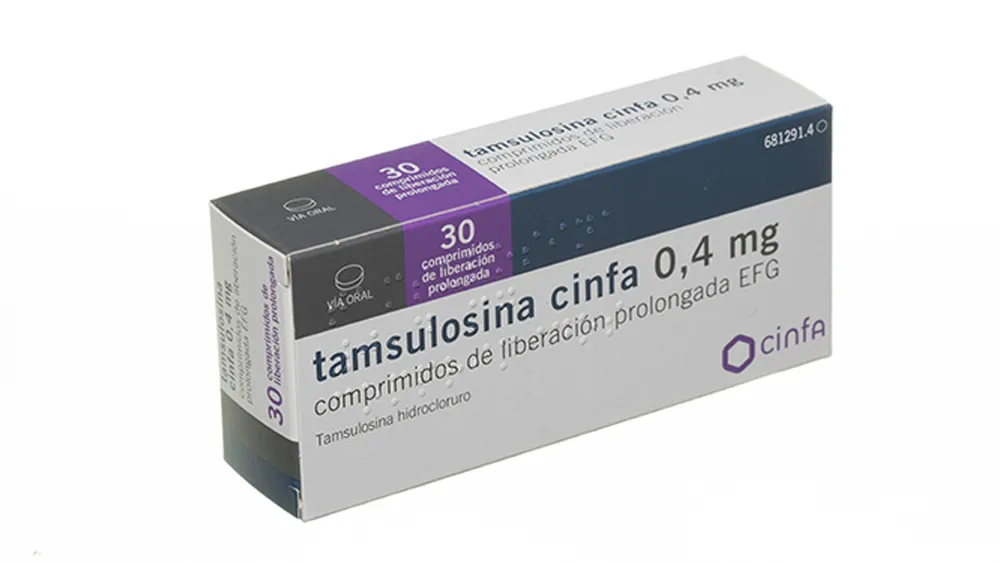
Table of Contents
Package leaflet: Information for the user
Introduction
PACKAGE LEAFLET: INFORMATION FOR THE USER
Tamsulosina Mabo 0.4 mg prolonged-release tablets EFG
Tamsulosin hydrochloride
Read the entire leaflet carefully before you start taking this medicine.
- Keep this leaflet, as you may need to read it again.
- If you have any questions, ask your doctor or pharmacist.
- This medicine has been prescribed for you only and must not be given to other people, even if they have the same symptoms as you, because it may harm them.
- If you consider any of the side effects you experience to be serious, or if you notice any side effects not listed in this leaflet, inform your doctor or pharmacist.
Leaflet contents:
- What Tamsulosina Mabo is and what it is used for
- Before you take Tamsulosina Mabo
- How to take Tamsulosina Mabo
- Possible side effects
- How to store Tamsulosina Mabo
- Further information
1. What Tamsulosin Mabo is and what it is used for
The active substance is tamsulosin. It belongs to a group of medicines called selective α1A/1D-adrenergic receptor antagonists. It reduces the tension of the smooth muscles in the prostate and urethra, allowing urine to pass more easily through the urethra and facilitating urination. In addition, it reduces the sensation of urgency.
Tamsulosin Mabo is used in men for the treatment of lower urinary tract symptoms associated with an enlarged prostate gland (benign prostatic hyperplasia). These are symptoms such as: difficulty urinating (weak urine stream), dribbling, urgency to urinate, and the need to urinate frequently both during the day and at night.
2. BEFORE TAKING Tamsulosina Mabo
Do not take Tamsulosina Mabo
- If you are allergic (hypersensitive) to tamsulosin or to any of the other components of this medicine.
Hypersensitivity may present as sudden localized swelling of soft body tissues (e.g. throat or tongue), difficulty breathing, and/or itching and skin rash (angioedema).
- If you have severe liver problems.
- If you suffer from dizziness due to a drop in blood pressure when changing position (sitting or standing up).
Take special care with Tamsulosina Mabo
-
Periodic medical examinations are necessary to monitor the progression of the condition being treated.
-
Fainting episodes may rarely occur during treatment with tamsulosin, as with other medicines of this type. At the first signs of dizziness or weakness, you should sit or lie down until symptoms have resolved.
-
If you have severe kidney problems, consult your doctor.
-
If you are scheduled to undergo eye surgery due to lens opacity (cataracts), please inform your ophthalmologist if you are currently taking or have previously taken tamsulosin. The specialist can then take appropriate precautions regarding medication and surgical techniques. Consult your doctor about whether you should delay or temporarily discontinue this medicine prior to such surgery.
Taking other medicines
Taking Tamsulosina Mabo together with other medicines of the same class (alpha1-adrenergic receptor blockers) may cause an undesirable drop in blood pressure.
Inform your doctor or pharmacist if you are taking or have recently taken any other medicines, including those obtained without a prescription.
Taking Tamsulosina Mabo with food and drink
Tamsulosina Mabo can be taken with or without food.
Pregnancy and breastfeeding
This section does not apply, as Tamsulosina Mabo is indicated only for male patients.
Driving and using machines
There is no evidence that Tamsulosina Mabo affects the ability to drive or operate tools or machinery. However, you should bear in mind that dizziness may occur; in such a case, you should not perform activities requiring alertness.
3. How to TAKE Tamsulosina Mabo
Follow exactly the administration instructions for Tamsulosina Mabo provided by your doctor. Consult your doctor or pharmacist if you have any doubts.
The usual dose is one tablet daily, taken orally, with or without food, preferably at the same time each day.
The tablet must be swallowed whole and must not be broken or chewed.
Tamsulosina Mabo is a specially designed tablet that gradually releases the active substance after the tablet has been swallowed. You may notice a residue of the tablet in your stools. There is no risk of loss of efficacy, as the active substance has already been released.
Tamsulosina Mabo is usually prescribed for long periods. The effects on the bladder and urination are maintained during long-term treatment with Tamsulosina Mabo.
If you feel that the effect of Tamsulosina Mabo is too strong or too weak, inform your doctor or pharmacist.
If you take more Tamsulosina Mabo than you should
Taking too many Tamsulosina Mabo tablets may lead to an undesirable drop in blood pressure and an increased heart rate, accompanied by a feeling of fainting.
In case of overdose or accidental ingestion, contact your doctor or pharmacist immediately or call the Toxicology Information Service at 91 562 04 20, indicating the medication and the amount ingested.
If you forget to take Tamsulosina Mabo
If you forget to take Tamsulosina Mabo as prescribed, you may take your daily dose later on the same day. If you have missed a day's dose, you may simply continue taking your daily tablet as prescribed.
Do not take a double dose to make up for forgotten doses.
If you stop taking Tamsulosina Mabo
If treatment with Tamsulosina Mabo is stopped prematurely, your original symptoms may return. Therefore, take Tamsulosina Mabo for as long as your doctor has prescribed, even if your symptoms have disappeared. Always consult your doctor if you decide to discontinue treatment.
If you have any further questions about the use of this product, consult your doctor or pharmacist.
4. Possible adverse effects
Like all medicines, Tamsulosin Mabo may cause adverse effects, although not everyone experiences them.
Common adverse effects (may affect between 1 and 10 out of 100 patients): dizziness, especially when sitting down or standing up, abnormal ejaculation. The latter means that semen does not exit through the urethra, but remains in the bladder. This phenomenon is harmless.
Uncommon adverse effects (may affect between 1 and 10 out of 1,000 patients): headache, palpitations (heartbeats that are faster than normal and noticeable), reduction in blood pressure, for example when standing up quickly after sitting or lying down, sometimes associated with dizziness, nasal dripping or nasal obstruction (rhinitis), diarrhoea, nausea and vomiting, constipation, weakness (asthenia), skin rash, itching and hives (urticaria).
Rare adverse effects (may affect between 1 and 10 out of 10,000 patients): fainting and sudden localized swelling of soft body tissues (such as the throat or tongue), breathing difficulty and/or itching and skin rash, often as an allergic reaction (angioedema).
Very rare adverse effects (may affect less than 1 out of 10,000 patients): priapism (unwanted, prolonged and painful erection requiring immediate medical treatment), Stevens-Johnson syndrome.
Adverse effects of unknown frequency: Dry mouth
If you are undergoing eye surgery due to lens opacity (cataract), and you are currently taking or have recently taken tamsulosin, your pupil may dilate poorly and the iris (the coloured circular part of the eye) may become floppy during surgery.
Reporting of adverse effects
If you experience any type of adverse effect, consult your doctor, pharmacist, or nurse, even if it is a possible adverse effect not listed in this leaflet. You can also report them directly via the Spanish Pharmacovigilance System for Human Medicines: https://www.notificaram.es. By reporting adverse effects, you can help provide more information on the safety of this medicine.
5. Storage of Tamsulosina Mabo
Keep out of the reach and sight of children.
Do not use Tamsulosina Mabo after the expiry date stated on the carton and blister after EXP. The expiry date refers to the last day of the month indicated.
Store in the original packaging to protect from light.
Medicines must not be disposed of via wastewater or household waste. Dispose of unused medicines and their containers at the SIGRE collection point at your pharmacy. If you have any doubts, ask your pharmacist how to dispose of medicines and containers you no longer need. This will help protect the environment.
6. ADDITIONAL INFORMATION
Composition of Tamsulosina Mabo
The active substance is tamsulosin hydrochloride. Each tablet contains 0.4 mg of tamsulosin hydrochloride.
The other components are: microcrystalline cellulose, hypromellose, anhydrous colloidal silica, carbomer, magnesium stearate and red iron oxide (E172).
Appearance of the product and contents of the pack
The tablets are round, white in colour, with the imprint “T9SL” on one side and 0.4 on the other.
Each pack contains 30 prolonged-release tablets.
Marketing Authorisation Holder and Manufacturer
Marketing Authorisation Holder
MABO-FARMA S.A.
Calle Vía de los Poblados, 3, Edificio 6
28033 Madrid,
Spain.
Manufacturer
Synthon BV
Microweg, 22
P.O Box 7071
NL-6545 (Nijmegen)
or
Synthon Hispania, S.L.
Castelló, 1
Polígono Las Salinas
08830 Sant Boi de Llobregat
This leaflet was last approved in November 2013
Detailed and up-to-date information on this medicine is available on the website of the Spanish Agency of Medicines and Health Products (AEMPS) http://www.aemps.gob.es/