SindiAr 2 mg hard capsules
Spain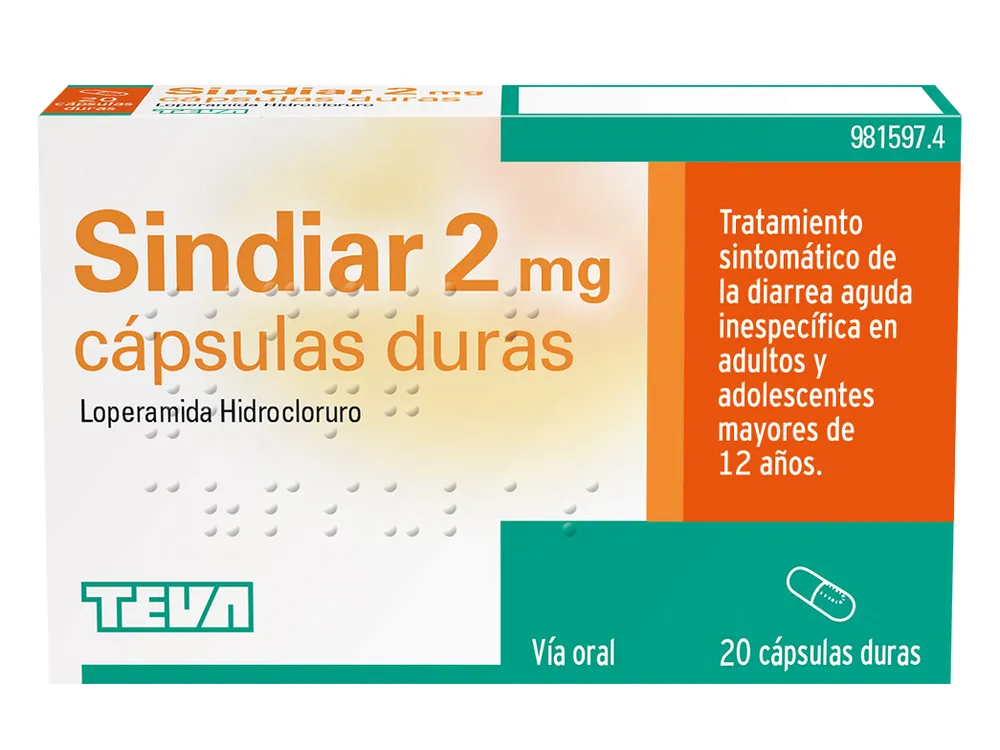
Table of Contents
- Package Leaflet: Information for the User
- Introduction
- 1. What Sindiar is and what it is used for
- 2. What you need to know before starting to take Sindiar
- **Pregnancy and breastfeeding**
- 3. How to take Sindiar
- 4. Possible adverse effects
- 5. Storage of Sindiar
- 6. Contents of the container and additional information
- - The other components (excipients) are: mannitol, magnesium stearate, and talc.
Package Leaflet: Information for the User
Introduction
Package Leaflet: Information for the Patient
Sindiar 2 mg Hard Capsules
Loperamide Hydrochloride
Read all of this leaflet carefully before you start taking this medicine, because it contains important information for you.
Follow exactly the instructions for use of this medicine as described in this leaflet or as directed by your doctor or pharmacist.
-
Keep this leaflet, as you may need to read it again.
-
If you need advice or more information, consult your pharmacist.
-
If you experience any adverse effects, consult your doctor or pharmacist, even if they are adverse effects not listed in this leaflet. See section 4.
-
You should consult a doctor if you worsen or do not improve after 2 days of treatment.
Contents of this leaflet:
- What Sindiar is and what it is used for
- What you need to know before taking Sindiar
- How to take Sindiar
- Possible side effects
- How to store Sindiar
- Contents of the pack and other information
1. What Sindiar is and what it is used for
Loperamide is an antidiarrheal that reduces intestinal movements and secretions, resulting in a decrease in liquid stools.
This medicine is indicated for the symptomatic treatment of acute nonspecific diarrhea in adults and children over 12 years of age.
You should consult a doctor if symptoms worsen or do not improve after 2 days.
2. What you need to know before starting to take Sindiar
Do not take Sindiar:
- if you are allergic to loperamide or to any of the other components of this medicine (listed in section 6).
Treatment of diarrhea with Sindiar is only symptomatic and should not be used in the following cases:
- Presence of blood in stools and high fever (above 38°C).
- Patients diagnosed with acute ulcerative colitis or pseudomembranous colitis associated with treatment with broad-spectrum antibiotics.
Its use is not recommended in children under 12 years of age without consulting a doctor.
Warnings and precautions
Consult your doctor or pharmacist before starting to take Sindiar.
If you do not observe clinical improvement within 48 hours, or if fever, constipation, or other symptoms appear, stop treatment and consult your doctor.
Patients with diarrhea should drink plenty of fluids to prevent dehydration, which may manifest as: dry mouth, excessive thirst, reduced urine output, wrinkled skin, dizziness, or lightheadedness. This is especially important in children and elderly patients.
Do not use this medicine for any purpose other than that indicated (see section 1), and never take more than the recommended dose (see section 3). Serious heart problems (with symptoms including rapid or irregular heartbeat) have been reported in patients who have taken excessive amounts of loperamide, the active substance in Sindiar.
Taking Sindiar with other medicines:
Inform your doctor or pharmacist if you are using or have recently used any other medicines, including those obtained without a prescription.
If you are taking any antibiotic or narcotic-type painkiller, you should consult your doctor or pharmacist before taking this medicine, as it may interact with them.
Pregnancy and breastfeeding
If you are pregnant or breastfeeding, think you may be pregnant, or are planning to become pregnant, consult your doctor or pharmacist before using this medicine.
The safety of this medicine in pregnant women has not been established.
Women who are breastfeeding should not use this medicine without consulting their doctor.
Driving and use of machinery
Although effects in this regard are not expected, if you experience fatigue, dizziness, or drowsiness, it is advisable not to drive or operate machinery.
3. How to take Sindiar
Follow exactly the instructions for use provided in this leaflet or those given by your doctor or pharmacist. If in doubt, consult your doctor or pharmacist.
The recommended dose is:
Adults
2 capsules (4 mg) as the initial dose, followed by 1 capsule (2 mg) after each diarrheal bowel movement. Do not take more than 8 capsules (16 mg) per day.
Adolescents over 12 years of age
1 capsule (2 mg) as the initial dose, followed by 1 capsule (2 mg) after each diarrheal bowel movement. In children, the maximum daily dose should be related to body weight:
Child's weight | Maximum number of capsules per day |
Starting from 27 kg | Maximum 4 capsules |
Starting from 34 kg | Maximum 5 capsules |
Starting from 40 kg | Maximum 6 capsules |
Starting from 47 kg | Maximum 7 capsules |
.
Elderly patients
Dose adjustment is not required.
Patients with renal impairment
Dose adjustment is not required.
Patients with hepatic impairment
They must consult their doctor before taking this medicine.
The maximum duration of treatment is 2 days.
Method of administration
This medicine is administered orally.
Take the capsule without chewing or biting, with a sufficient amount of water (a glass of water).
Do not exceed the recommended dose.
If you feel that the effect of Sindiar is too strong or too weak, inform your doctor or pharmacist.
If you take more Sindiar than you should
If you have taken too much Sindiar, contact a doctor or hospital for assistance as soon as possible. Symptoms may include: increased heart rate, irregular heartbeat, disturbances in heart rhythm (these symptoms may have potentially serious and life-threatening consequences), muscle stiffness, uncoordinated movements, drowsiness, difficulty urinating, or weak breathing.
Children react more severely to high doses of Sindiar than adults. If a child takes an excessive amount or shows any of the above symptoms, contact a doctor immediately.
If you have taken more Sindiar than you should, consult your doctor or contact the Toxicology Information Service. Telephone: 91 562 04 20, indicating the medicine and the amount ingested.
If you forget to take Sindiar
Do not take a double dose to make up for missed doses.
If you have any further questions about the use of this medicine, ask your doctor or pharmacist.
4. Possible adverse effects
Like all medicines, this medicine may cause adverse effects, although not everyone will experience them.
The described adverse effects are:
- Uncommon (less than 1 in 100 but more than 1 in 1,000): hypersensitivity reactions (skin rashes), urinary retention.
- Very rare (less than 1 in 10,000): toxic megacolon (constipation, abdominal distension, nausea and vomiting), paralytic ileus (persistent constipation), particularly when the established recommendations have not been followed.
- Frequency not known (cannot be estimated from the available data): upper abdominal pain, abdominal pain radiating to the back, abdominal tenderness, fever, rapid pulse, nausea, vomiting, which may be symptoms of inflammation of the pancreas (acute pancreatitis).
Also, discomforts that are normally difficult to differentiate from symptoms of diarrhoea, such as: abdominal pain and/or abdominal distension, nausea and vomiting, fatigue, drowsiness or dizziness, and dry mouth.
If you consider any of the adverse effects you experience to be severe, or if you notice any adverse effects not listed in this leaflet, inform your doctor or pharmacist.
Reporting of adverse effects
If you experience any type of adverse effect, consult your doctor or pharmacist, even if it is a possible adverse effect not listed in this leaflet. You may also report them directly through the Spanish Pharmacovigilance System for Human Medicinal Products: https://www.notificaram.es
By reporting adverse effects, you can help provide more information on the safety of this medicine.
5. Storage of Sindiar
Keep out of the sight and reach of children.
Store below 30°C.
Do not use this medicine after the expiry date stated on the carton after EXP. The expiry date refers to the last day of the month indicated.
Medicines should not be disposed of via wastewater drains or household waste. Dispose of unused medicines and their packaging at the SIGRE collection point at your pharmacy. If in doubt, ask your pharmacist how to properly dispose of unused medicines and their packaging. This will help protect the environment.
6. Contents of the container and additional information
Composition of Sindiar
- The active substance is loperamide hydrochloride. Each capsule contains loperamide (hydrochloride) 2 mg.
- The other components (excipients) are: mannitol, magnesium stearate, and talc.
Appearance of the medicinal product and contents of the pack
Sindiar is available in packs containing 10 and 20 hard capsules.
Marketing Authorization Holder and Manufacturer
Marketing Authorization Holder
TEVA PHARMA S.L.U.
C/ Anabel Segura 11
Edificio Albatros B, 1st floor
28108 Alcobendas, Madrid (Spain)
Manufacturer
Teva Pharma S.L.U.
Polígono Industrial Malpica, c/C nº 4,
50016 Zaragoza.
Spain
This leaflet was approved in May 2022
Detailed and up-to-date information on this medicinal product is available on the website of the Spanish Agency of Medicines and Medical Devices (AEMPS) http://www.aemps.gob.es/