Silks 3 micrograms/g ointment
Spain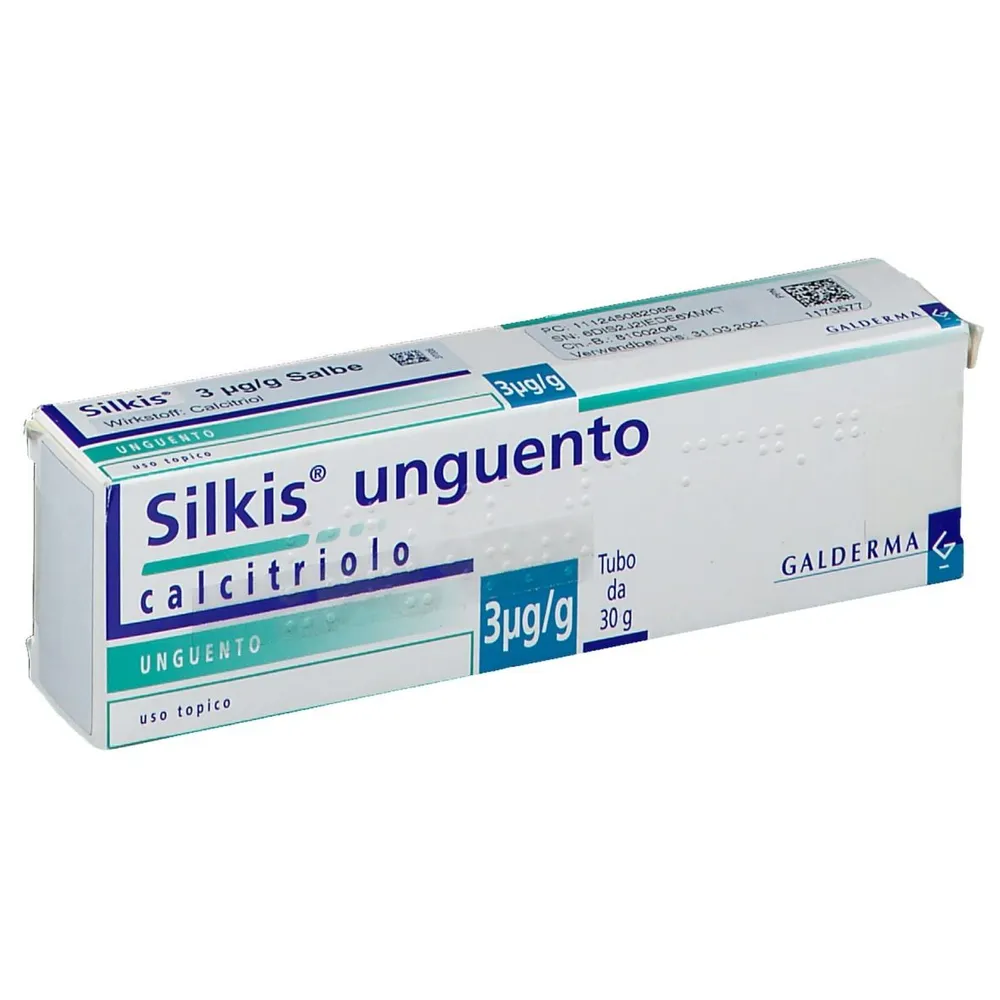
Table of Contents
Package leaflet: Information for the user
Introduction
Package leaflet: Information for the patient
SILKIS 3 micrograms/g Ointment
Calcitriol
Read this entire leaflet carefully before you start using this medicine, because it contains important information for you.
- Keep this leaflet, as you may need to read it again.
- If you have any questions, ask your doctor or pharmacist.
- This medicine has been prescribed for you only, and you must not give it to other people, even if they have the same symptoms as you, because it could harm them.
- If you experience any adverse reactions, consult your doctor or pharmacist, even if they are adverse reactions not listed in this leaflet. See section 4.
Leaflet contents:
- What Silkis is and what it is used for
- What you need to know before using Silkis
- How to use Silkis
- Possible side effects
- How to store Silkis
- Contents of the pack and other information
1. What Silkis is and what it is used for
Silkis is used for the topical treatment of mild to moderately severe plaque psoriasis, affecting up to one-third of the body surface area.
It contains the active substance calcitriol (a vitamin D derivative), which inhibits and normalizes the excessive cell growth in psoriatic skin.
2. What you need to know before starting to use Silkis
Do not use Silkis:
- if you are being treated systemically (orally) for calcium deficiency.
- if you have any kidney or liver disease.
- if you have high levels of calcium in your blood or suffer from abnormal calcium metabolism.
- if you are allergic to calcitriol or to any of the other ingredients of this medicine listed in section 6.
Warnings and precautions:
Talk to your doctor or pharmacist before starting to use Silkis
- Apply the ointment carefully to the face, as there is a higher risk of irritation in this area. Avoid contact with the eyes.
- After using the ointment, wash your hands to prevent accidentally transferring the ointment to unaffected areas.
- Due to a potential risk to calcium metabolism, the ointment must not be applied under occlusive dressings.
- If severe irritation or an allergic reaction occurs, treatment must be discontinued and you should contact your doctor.
- Although clinically significant hypercalcemia (high calcium levels in blood) was not observed in clinical trials with this ointment, some absorption of calcitriol through the skin does occur. This may lead to a risk of increased calcium levels in blood or urine. This risk is minimal if you follow your doctor's instructions.
Children
There is limited data on the use of this medicine in children. Therefore, use in children should be avoided.
Other medicines and Silkis:
Silkis may interfere with other medicines such as:
- Thiazide diuretics, as their use together with this medicine could increase your blood calcium levels.
- Medicines whose action may be affected by changes in blood calcium levels, such as digoxin.
- Calcium supplements or high doses of vitamin D.
- Exfoliating agents, astringents, or irritant agents, as they may cause additional irritation.
Inform your doctor about any other topical treatments you have used or are currently using for your psoriasis lesions before starting this treatment.
Tell your doctor or pharmacist if you are using, have recently used, or might need to use any other medicines.
Pregnancy and breastfeeding:
If you are pregnant or breastfeeding, think you may be pregnant, or are planning to become pregnant, consult your doctor or pharmacist before using this medicine.
Silkis must not be used during breastfeeding.
Driving and using machines:
This treatment does not affect your ability to drive or operate machinery.
3. How to use Silkis
Silkis is an ointment for use on the skin only (cutaneous).
Follow exactly the administration instructions for this medicine as indicated by your doctor. If in doubt, consult your doctor or pharmacist again.
Instructions for application
- First, wash and dry the affected areas of your skin.
- Apply a thin layer of Silkis to the affected areas to be treated twice daily, in the morning and at night before going to bed, or as directed by your doctor.
- Wash your hands thoroughly after each application to avoid any contact with uninjured areas of skin.
- Do not use more than 30 g of ointment per day, and do not apply the ointment to more than one-third of your body surface area (approximately one entire arm and one entire leg).
This medicine is for use on the skin only. Do not swallow it. If you accidentally swallow it, seek immediate medical attention.
Remember to monitor your treatment regularly, strictly following your doctor's instructions.
If you feel that the effect of this medicine is too strong or too weak, inform your doctor or pharmacist.
If you use more Silkis than you should:
- If the medicine is applied excessively, better or faster results will not occur, and instead it may cause intense redness, peeling, or skin irritation.
- Always contact your doctor to determine whether you should continue or interrupt treatment if you have used too much Silkis.
- After excessive use of calcitriol, symptoms such as hypotonia (reduced muscle tone), nausea, vomiting, loss of appetite, constipation, and depression may occur. Therefore, if these symptoms occur, contact your doctor.
If you forget to use Silkis:
Do not take a double dose to make up for missed doses.
4. Possible adverse effects
Like all medicines, this medicine may cause adverse effects, although not everyone experiences them.
If you experience severe irritation or allergic contact dermatitis (redness and itching), treatment with Silkis must be discontinued and you should consult your doctor. If an allergic reaction is confirmed, treatment should be stopped.
This medicine may occasionally cause unwanted adverse effects at the application site, such as:
- Common adverse effects (may affect up to 1 in 10 people)
Pruritus (skin itching)
Skin discomfort
Skin irritation
Erythema (redness of the skin)
- Uncommon adverse effects (may affect up to 1 in 100 people)
Skin dryness
Worsening of psoriasis
- Adverse effects with unknown frequency (cannot be estimated from available data)
Cutaneous edema
Contact dermatitis
Reporting of adverse effects
If you experience any type of adverse effect, consult your doctor or pharmacist, even if it is a possible adverse effect not listed in this leaflet. You may also report them directly through the Spanish Pharmacovigilance System for Human Medicinal Products: https://www.notificaram.es. By reporting adverse effects, you can help provide more information on the safety of this medicine.
5. Storage of Silkis
- Keep out of the sight and reach of children.
- Discard the tube 8 weeks after first opening.
- Do not use this medicine after the expiry date stated on the carton. The expiry date is the last day of the month indicated.
- No special storage conditions are required.
Medicines should not be disposed of via wastewater or household waste. Ask your pharmacist how to dispose of medicines and packaging once they are no longer needed. This will help protect the environment.
6. Contents of the pack and other information
Composition of Silkis
The active substance is calcitriol (3 micrograms per gram).
The other components are liquid paraffin, light liquid paraffin, and alpha-tocopherol.
Appearance of the product and contents of the pack
Silkis is a white, translucent ointment.
This ointment is available by prescription from your doctor in tubes containing 15 g, 30 g or 100 g of ointment. (Not all pack sizes may be marketed.)
Marketing Authorisation Holder and Manufacturer:
Marketing Authorisation Holder
Laboratorios Galderma, S.A.
Serrano Galvache, 56
28033 Madrid
Spain
Manufacturer
Laboratoires Galderma
Z.I.- Montdésir
74540, Alby-sur-Chéran
France
or
Galderma Laboratorium GmbH
Toulouser Allee 23a, 40211 Düsseldorf
Germany
Date of the most recent revision of this leaflet:
Detailed and up-to-date information on this medicine is available on the website of the Spanish Agency of Medicines and Health Products (AEMPS) http://www.aemps.gob.es/