Salcedol effervescent powder
Spain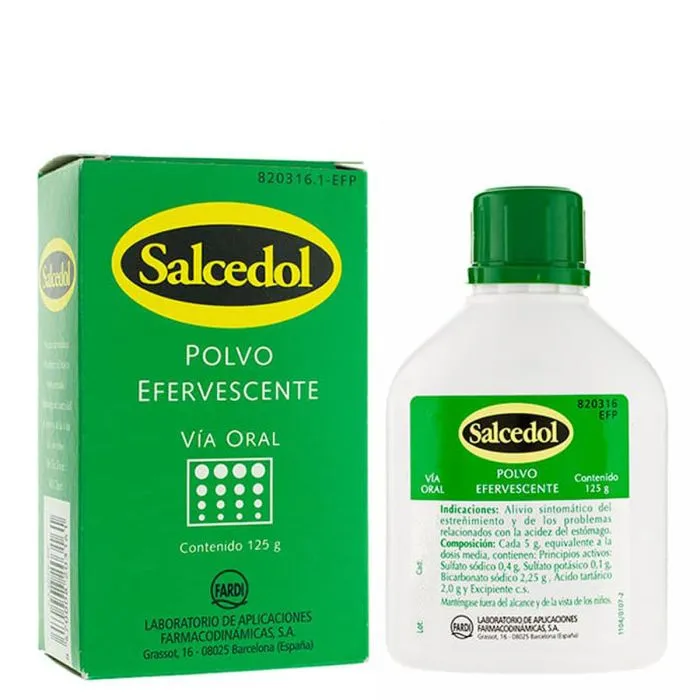
Table of Contents
Patient Information Leaflet
Introduction
Patient Information Leaflet
Salcedol effervescent powder
sodium hydrogen carbonate, tartaric acid, sodium sulfate and potassium sulfate
Read the entire leaflet carefully before you start taking this medicine because it contains important information for you. Follow exactly the instructions for use provided in this leaflet or those given by your doctor or pharmacist.
|
Package leaflet contents:
- What Salcedol is and what it is used for
- What you need to know before taking Salcedol
- How to take Salcedol
- Possible side effects
- Storage of Salcedol
- Contents of the pack and other information
1. What Salcedol is and what it is used for
Salcedol is indicated in adults and adolescents over 12 years of age for the treatment of symptoms related to digestive disorders:
- Heartburn and acid reflux.
- Constipation, when a diet high in water and daily physical exercise has not provided satisfactory results.
2. What you need to know before taking Salcedol
Do not take Salcedol:
- If you are allergic to the active substances or to any of the other components of this medicine (listed in section 6).
- If you have severe kidney or heart failure.
- If you have alkalosis (reduced acidity of blood and tissues).
- If you are on a low-sodium diet due to high blood pressure or heart failure.
- If you have appendicitis or any of its symptoms (abdominal pain associated with cramps, nausea, and vomiting).
- If you have a bloated abdomen.
- If you have intestinal obstruction or inflammation, Crohn's disease, ulcerative colitis, or toxic megacolon.
Warnings and precautions:
Consult your doctor or pharmacist before taking this medicine if any of the following apply to you:
If you have bloody stools, a tendency to retain water (edema), or if you are being treated with diuretics (medicines that increase urine production and elimination).
If you have kidney failure.
If you have heart failure.
If you have a colostomy.
If you have an electrolyte imbalance.
Prolonged or excessive use may lead to metabolic alkalosis (reduced acidity of blood and tissues); therefore, you must not exceed the recommended dose.
Do not use for more than 7 consecutive days, or if symptoms persist or worsen, without consulting your doctor.
Children
Do not give this medicine to children under 12 years of age.
Other medicines and Salcedol
Inform your doctor or pharmacist if you are taking, have recently taken, or might need to take any other medicines.
Before taking Salcedol, inform your doctor if you are taking any of the following medicines:
- Oral anticoagulants (medicines used to prevent blood clotting).
- Phenytoin (a medicine used for epilepsy).
- Diazepam (a medicine used for anxiety and insomnia).
- Digitalis glycosides (heart medications).
- Iron salts (used to treat certain anemias).
- Antibiotics (tetracyclines, quinolones) (used to treat certain infections).
- Cimetidine and ranitidine (medicines for stomach ulcers).
- Amphetamines (central nervous system stimulants).
- Quinine (used for malaria).
- Ephedrine (used in asthma medicines or as a nasal decongestant in some cold remedies).
The administration of Salcedol should be spaced at least 2 hours apart from these medicines.
Interference with diagnostic tests:
This medicine interferes with tests for gastric acid secretion. Therefore, you should not take it on the day diagnostic tests are performed.
Taking Salcedol with food, drinks, and alcohol
Do not take this medicine with milk or dairy products or with calcium supplements. Consumption of milk and dairy products should occur at different times from when you take the medicine.
Do not take this medicine when your stomach is overly full of food or drink.
Pregnancy, breastfeeding, and fertility
If you are pregnant or breastfeeding, think you may be pregnant, or are planning to become pregnant, consult your doctor or pharmacist before using this medicine.
Pregnancy
Caution should be exercised when administering this medicine during pregnancy.
Breastfeeding
Women who are breastfeeding should consult their doctor before taking this medicine.
Driving and use of machines
This medicine does not affect the ability to drive or operate machinery.
This medicine contains sodium, potassium, and tartrazine
Salcedol contains 754.1 mg of sodium (the main component of table/cooking salt) per dose unit (5 g). This corresponds to 38% of the maximum recommended daily sodium intake for an adult.
Salcedol contains 44.9 mg of potassium per dose unit (5 g), which should be taken into account in patients with renal impairment or those on potassium-restricted diets.
Salcedol contains tartrazine, which may cause allergic-type reactions.
3. How to take Salcedol
Follow exactly the instructions for administering this medicine as described in this leaflet or as directed by your doctor or pharmacist. If in doubt, consult your doctor or pharmacist.
The recommended dose is as follows:
Adults:
Indigestion (acid reflux): The recommended dose is half to one dessertspoon (2.5 – 5 g) dissolved in a glass of water.
Administer 20 minutes to 1 hour after main meals or at the time symptoms occur.
Do not take more than twice a day.
Laxative: The recommended dose is one to two dessertspoons (5 – 10 g) dissolved in a glass of water, taken at bedtime, and the same dose the following morning on an empty stomach, resting for a few minutes if possible.
In case of resistant constipation, take two dessertspoons dissolved in half a glass of water on an empty stomach, and repeat the same dose after one hour.
Adolescents and children over 12 years of age:
Indigestion (acid reflux): The recommended dose is half a dessertspoon (2.5 g), dissolved in a glass of water.
Administer 20 minutes to 1 hour after main meals or at the time symptoms occur.
Do not take more than twice a day.
Laxative: The recommended dose is half to one dessertspoon (2.5 – 5 g), dissolved in a glass of water, taken at bedtime, and the same dose the following morning on an empty stomach, resting for a few minutes if possible.
In case of resistant constipation, take one dessertspoon dissolved in a glass of water on an empty stomach, and repeat the same dose after one hour.
Use in children
Administration of this medicine is not recommended for children under 12 years of age.
Method of administration
Oral use.
Dissolve the dose in a glass of water and stir until effervescence stops. Once dissolved, the solution should be taken immediately.
If you take more Salcedol than you should
The main symptoms of overdose are metabolic alkalosis (headache, dizziness, tinnitus, blurred vision, drowsiness, sweating, nausea, vomiting, occasionally diarrhea, hyperirritability, and tetany (involuntary muscle contractions)) and difficulty breathing.
In case of overdose or accidental ingestion, consult your doctor or pharmacist immediately, go to a medical center immediately, or call the Toxicology Information Service at telephone: 91 562 04 20, indicating the medicine and the amount ingested.
If you forget to take Salcedol
Do not take a double dose to make up for missed doses.
If you have any further questions about the use of this medicine, ask your doctor or pharmacist.
4. Possible adverse effects
Like all medicines, Salcedol may cause adverse effects, although not everyone experiences them.
When used at the recommended doses, no adverse effects have been reported.
During the period of use of this medicine, the following adverse effects may occur, listed with their associated frequency:
Frequency not known (frequency cannot be estimated from the available data):
- Flatulence (gas in the stomach or intestine), belching, vomiting, stomach cramps, stomach distension (bloating), and rebound effect (increase in acidity caused by the medicine itself).
- Hypernatraemia (increased blood sodium levels).
- Gastric perforation due to gas production caused by sodium hydrogen carbonate.
Very rare (may affect up to 1 in 10,000 patients):
- If used continuously or at high doses, it may cause systemic alkalosis, whose symptoms include difficulty breathing, muscle weakness, increased muscle tone, spasms, and tetany (involuntary muscle contractions).
If used continuously or at high doses, it may cause hypertension (increased blood pressure) and oedema (fluid retention).
If you consider any of the adverse effects you experience to be severe, or if you notice any adverse effects not listed in this leaflet, consult your doctor or pharmacist.
Reporting of adverse effects
If you experience any type of adverse effect, consult your doctor or pharmacist, even if it is a possible adverse effect not listed in this leaflet. You may also report them directly via the Spanish Pharmacovigilance System for Human Medicinal Products: https://www.notificaram.es. By reporting adverse effects, you can help provide more information on the safety of this medicine.
5. Storage of Salcedol
Keep the container tightly closed to protect it from moisture.
Keep this medicine out of the sight and reach of children.
Do not use this medicine after the expiry date stated on the packaging after EXP. The expiry date refers to the last day of the month indicated.
Do not use this medicine if you notice any change in colour or if it is clumped.
Medicines must not be disposed of via wastewater drains or household waste. Unused medicines and their containers should be taken to the SIGRE point at your pharmacy. If in doubt, ask your pharmacist how to dispose of unused medicines and containers. This helps protect the environment.
6. Contents of the pack and other information
Composition of Salcedol
One 5 g effervescent powder dose contains:
- As active ingredients: 0.4 g of sodium sulfate, 0.1 g of potassium sulfate, 2.25 g of sodium hydrogen carbonate, and 2.0 g of tartaric acid.
- Other components (excipients): sodium carboxymethylcellulose, sodium saccharin, and lemon flavor (corn maltodextrin, modified corn starch, tartrazine (E102)).
Appearance of the product and contents of the container
Salcedol is an effervescent powder, yellowish-white in color, with a lemon scent.
It is presented in a bottle containing 125 g of effervescent powder.
Marketing Authorization Holder and Manufacturer
Laboratorio de Aplicaciones Farmacodinámicas, S.A.
Grassot, 16 – 08025 Barcelona
Spain.
Date of the most recent review of this leaflet: July 2025
Detailed information on this medicinal product is available on the website of the Spanish Agency of Medicines and Medical Devices (AEMPS) http://www.aemps.gob.es