Salagen 5 mg film-coated tablets
Spain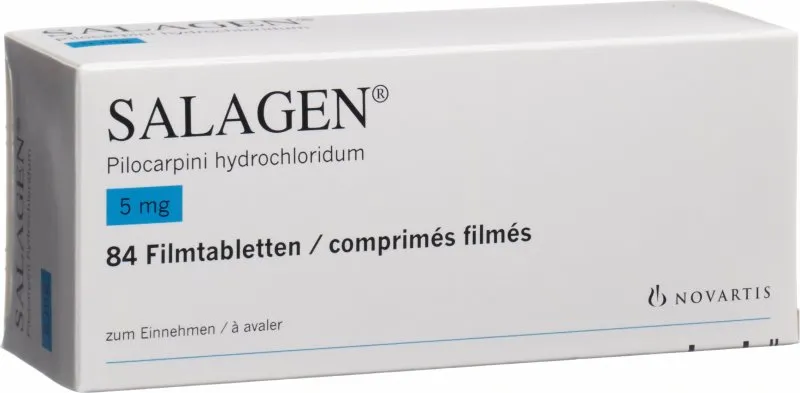
Table of Contents
Patient Information Leaflet
Introduction
Patient Information Leaflet
Salagen 5 mg film-coated tablets
pilocarpine hydrochloride
Read the entire leaflet carefully before you start taking this medicine, as it contains important information for you.
- Keep this leaflet, as you may need to read it again.
- If you have any questions, ask your doctor or pharmacist.
- This medicine has been prescribed for you only and must not be given to other people, even if they have the same symptoms as you, because it may harm them.
- If you experience any adverse effects, consult your doctor or pharmacist, even if they are adverse effects not listed in this leaflet. See section 4.
Leaflet contents:
- What Salagen is and what it is used for
- What you need to know before taking Salagen
- How to take Salagen
- Possible side effects
- How to store Salagen
- Contents of the pack and other information
1. What Salagen is and what it is used for
Salagen contains the active substance pilocarpine hydrochloride, which belongs to a group of medicines called parasympathomimetic agents or cholinergic agents.
Salagen stimulates certain nerves and glands in your body. After taking Salagen, your body will produce more saliva, tears, sweat, gastric juices, and mucous secretions.
Salagen is used
- when you have received radiotherapy for head or neck cancer and experience dry mouth
- when you have been diagnosed with a condition known as Sjögren's syndrome and have dry eyes and/or dry mouth
If you have any doubts about how Salagen works or why this medicine has been prescribed for you, ask your doctor.
2. What you need to know before taking Salagen
Do not take Salagen
- if you are allergic to pilocarpine hydrochloride or any of the other ingredients of this medicine (listed in section 6)
- if you have uncontrolled asthma
- if you have uncontrolled heart or kidney disease
- if you have a chronic condition that could worsen due to treatment with a medicine that acts like Salagen. Consult your doctor if you have any doubts.
- if you have any disorder that requires you to avoid constriction of the eye's pupil (for example, acute inflammation of the iris), or if you have inflammation of the iris (iritis)
If any of the above conditions apply to you, inform your doctor before taking Salagen.
Warnings and precautions
Consult your doctor or pharmacist before starting to take Salagen.
Inform your doctor before taking Salagen if you have any of the following conditions:
- lung problems (for example, asthma, chronic bronchitis and/or chronic obstructive pulmonary disease)
- serious heart problems (for example, heart failure, irregular pulse)
- gallbladder or bile duct problems (for example, gallstones in the bile ducts)
- stomach or intestinal problems (for example, ulcers)
- cognitive problems (difficulties with learning, memory, perception, and problem-solving) or mental health problems
- kidney problems (for example, renal failure or kidney stones)
- eye problems (for example, narrow-angle glaucoma)
Excessive sweating
If you sweat excessively during treatment with Salagen, drink more fluids. If you are unable to drink enough fluids, consult your doctor, as continued fluid loss may lead to dehydration and organ damage.
Children and adolescents
This medicine must not be given to children or adolescents under 18 years of age.
Other medicines and Salagen
Inform your doctor or pharmacist if you are taking, have recently taken, or might need to take any other medicines.
It is especially important that you inform your doctor if you are taking any of the following medicines:
- beta-blockers (medicines used to treat high blood pressure, heart problems, or eye problems)
- medicines for diarrhea (for example, atropine)
- medicines for asthma (for example, ipratropium inhalers)
- medicines that activate the so-called parasympathetic nervous system (for example, some medicines for glaucoma, nervous system disorders or mental illnesses, Alzheimer's disease, or medicines used to speed up intestinal transit)
- medicines metabolized by a liver enzyme called CYP2A6, for example, the blood pressure-lowering medicine irbesartan or medicines used to prevent blood clotting (warfarin, dicumarol).
If you are unsure whether any of your medicines belong to this list, ask your doctor or pharmacist.
Pregnancy, breastfeeding, and fertility
If you are pregnant or breastfeeding, think you might be pregnant, or are planning to become pregnant, consult your doctor before taking this medicine.
Pregnancy
Salagen must not be used during pregnancy unless your doctor has specifically recommended it.
If you are of childbearing age, you must use an effective contraceptive method to prevent pregnancy while taking this medicine. Seek advice from your doctor.
Breastfeeding
It is unknown whether pilocarpine is excreted in human milk. Your doctor will advise you whether you should discontinue treatment with Salagen or discontinue breastfeeding.
Fertility
This medicine may impair fertility in both men and women. If you are planning to have a child, consult your doctor before using this medicine.
Driving and use of machines
Salagen may cause dizziness or affect your vision, particularly causing difficulty seeing properly at night. If this occurs, do not drive vehicles or operate tools or machinery.
3. How to take Salagen
Follow exactly the instructions for using this medicine as given by your doctor. If in doubt, consult your doctor or pharmacist again.
The recommended dose is:
- In patients who have been treated with radiotherapy for head and neck cancer:
The recommended initial dose in adults is one 5 mg tablet three times daily.
Make sure you take your last tablet of the day with your evening meal.
- In patients who have been diagnosed with Sjögren's syndrome:
The recommended dose in adults is one 5 mg tablet four times daily.
Make sure you take your last tablet of the day just before going to bed.
Depending on your response to treatment, your doctor may suggest a higher or lower dose. The dose may be increased up to 30 mg (6 tablets) per day.
- Patients with impaired liver function:
If you have cirrhosis (a liver disorder), your doctor will instruct you to start treatment with a lower daily dose. Depending on your response to treatment, your doctor may gradually increase the dose to the recommended daily dose.
Method of administration
Salagen must only be taken orally.
Take the Salagen tablets with a glass of water during or immediately after meals.
Try to take the tablets at regular intervals throughout the day; for example, take one tablet in the morning, one in the afternoon, and one in the evening.
Duration of treatment
Your doctor will tell you exactly how long you need to take the tablets. If you do not notice any improvement after 2 or 3 months, your doctor may decide to stop the treatment.
If you take more Salagen than you should
If you have accidentally taken too many Salagen tablets, contact a doctor immediately. You may require urgent medical attention or hospital admission.
Symptoms of overdose may include cramps, diarrhea, nausea and vomiting, involuntary passage of faeces and urine, sweating, salivation, increased bronchial secretions, constriction of the pupil of the eye, slow heartbeats, low blood pressure, muscle spasms or contractions, and generalized weakness.
If you forget to take Salagen
Do not take a double dose to make up for missed doses.
If you stop taking Salagen
Do not stop treatment unless instructed by your doctor.
If you have any further questions about the use of this medicine, ask your doctor or pharmacist.
4. Possible adverse effects
Like all medicines, this medicine can cause adverse effects, although not everyone will experience them.
Very common adverse effects (affect more than 1 in 10 people):
- flu-like symptoms
- sweating
- headache
- need to urinate more frequently
Common adverse effects (affect up to 1 in 10 people):
- weakness
- chills
- runny nose
- allergic reactions including rash and itching
- dizziness (more likely in patients over 65 years of age)
- diarrhea; constipation
- indigestion; abdominal pain; nausea; vomiting
- increased salivation
- flushing; increased blood pressure
- palpitations (sensation of the heart beating faster, stronger, or irregularly)
- watery eyes; blurred or abnormal vision; red and swollen eyes (conjunctivitis), eye pain
Uncommon adverse effects (affect up to 1 in 100 people):
- sudden need to urinate
- flatulence (gas)
Other adverse effects of the active substance pilocarpine hydrochloride:
-
breathing difficulties
-
stomach or abdominal cramps
-
changes in heart rhythm, such as slow heart rate (bradycardia), fast heart rate (tachycardia), irregular beats (arrhythmia), conduction disturbances in the heart that prevent it from functioning properly (atrioventricular block)
- severe drop in blood pressure that may lead to unconsciousness (shock)
-
low blood pressure
-
tremor
-
changes in mental status including memory disturbances, hallucinations (seeing or hearing things that are not real), agitation, mood changes, and confusion
Reporting of adverse effects
If you experience any adverse effect, consult your doctor or pharmacist, even if it is a possible adverse effect not listed in this leaflet.
You may also report them directly via the Spanish Pharmacovigilance System for Human Medicinal Products (www.notificaRAM.es). By reporting adverse effects, you can help provide more information on the safety of this medicine.
5. Storage of Salagen
Keep this medicine out of the sight and reach of children.
Do not use this medicine after the expiry date stated on the packaging after EXP. The expiry date refers to the last day of the month indicated.
Do not store above 25 °C.
Store in the original packaging and container to protect it from light and moisture.
Do not use this medicine if you notice that the packaging is damaged or shows signs of tampering.
Medicines must not be disposed of via wastewater or household waste.
Dispose of unused containers and medicines at the SIGRE point located at the pharmacy. If in doubt, ask your pharmacist how to properly dispose of unused containers and medicines. This will help protect the environment.
6. Contents of the pack and other information
Composition of Salagen
- The active substance is pilocarpine hydrochloride. Each Salagen 5 mg film-coated tablet contains 5 mg of pilocarpine hydrochloride.
- The other components are microcrystalline cellulose and stearic acid. The coating consists of Opadry White OY-7300 (containing hypromellose, polyethylene glycol 400, and titanium dioxide (E-171)) and carnauba wax.
What the medicine looks like and contents of the pack
Salagen tablets for oral administration are white, round, biconvex tablets, marked with "SAL" on one side and "5" on the other.
The tablets are packed in blisters and presented in cartons containing 14, 21, 28 or 84 tablets. Only certain pack sizes may be marketed.
Marketing Authorisation Holder and Manufacturer
Marketing Authorisation Holder
Merus Labs Luxco II S.à.R.L.
208, Val des Bons Malades
L-2121 Luxembourg
Luxembourg
Manufacturer
Norgine BV,
Antonio Vivaldistraat 150,
1083 HP Amsterdam,
The Netherlands
For further information about this medicinal product, please contact the local representative of the Marketing Authorisation Holder:
Norgine de España, S.L.U.
Paseo de la Castellana, 91, 2nd floor
28046 Madrid
Spain
This medicinal product is authorised in the European Economic Area member states and in the United Kingdom (Northern Ireland) under the following names:
Germany, Austria, Spain, Finland, Italy, The Netherlands, Portugal, United Kingdom (Northern Ireland), Sweden: SALAGEN
Date of the most recent review of this leaflet: 07/2023
Detailed information on this medicine is available on the website of the European Medicines Agency: http://www.ema.europa.eu, and on the website of the Spanish Agency of Medicines and Medical Devices (AEMPS) http://www.aemps.gob.es.