Rupatadine Stada 10 mg tablets EFG
Spain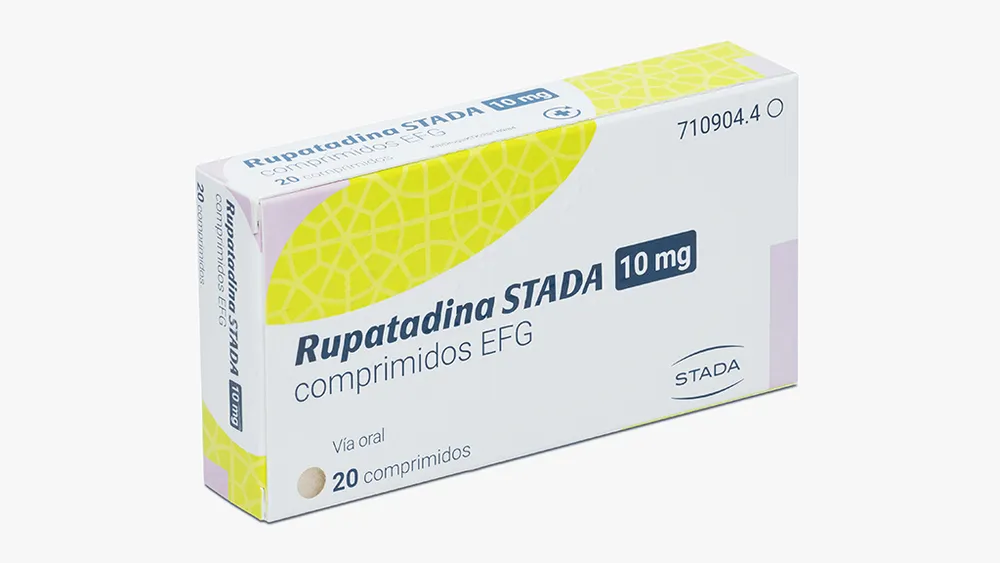
Table of Contents
Package leaflet: Information for the user
Introduction
Package leaflet: information for the patient
Rupatadina Stada 10 mg tablets EFG
Read the entire leaflet carefully before you start taking this medicine, because it contains important information for you.
- Keep this leaflet, as you may need to read it again.
- If you have any questions, ask your doctor or pharmacist.
- This medicine has been prescribed for you only, and you must not give it to other people, even if they have the same symptoms as you, because it could harm them.
- If you experience any adverse effects, consult your doctor or pharmacist, even if they are adverse effects not listed in this leaflet. See section 4.
Leaflet contents
- What Rupatadina Stada is and what it is used for
- What you need to know before taking Rupatadina Stada
- How to take Rupatadina Stada
- Possible adverse effects
- How to store Rupatadina Stada
- Contents of the pack and other information
1. What Rupatadina Stada is and what it is used for
Rupatadine, the active substance in Rupatadina Stada, is an antihistamine.
Rupatadina Stada is indicated for the relief of symptoms of allergic rhinitis such as: sneezing, rhinorrhea, itching of the eyes and nose.
Rupatadina Stada is indicated for the relief of symptoms associated with urticaria (allergic skin rash), such as itching and skin wheals (redness and swelling of the skin).
2. What you need to know before taking Rupatadina Stada
Do not take Rupatadina Stada:
- If you are allergic to rupatadine or to any of the other ingredients of this medicine (listed in section 6).
Warnings and precautions
Talk to your doctor or pharmacist before taking Rupatadina Stada.
If you have renal or hepatic impairment, consult your doctor. The use of rupatadine 10 mg tablets is not currently recommended in patients with renal or hepatic impairment.
If you have low blood potassium levels and/or a known abnormal heart rhythm pattern (prolonged QTc interval on ECG), which may occur in certain heart conditions, consult your doctor.
If you are over 65 years of age, consult your doctor or pharmacist.
Children and adolescents
This medicine must not be used in children under 12 years of age.
Other medicines and Rupatadina Stada
Inform your doctor or pharmacist if you are taking, have recently taken, or might need to take any other medicines.
If you are taking rupatadine, do not take medicines containing ketoconazole or erythromycin.
If you are taking central nervous system depressants or statin-containing medicines, consult your doctor before taking rupatadine.
Taking Rupatadina Stada with food and drink
Do not take rupatadine together with grapefruit juice, as it may increase the levels of rupatadine in your body.
Pregnancy and breastfeeding
If you are pregnant or breastfeeding, think you might be pregnant, or are planning to become pregnant, consult your doctor or pharmacist before using this medicine.
Do not take rupatadine during pregnancy or breastfeeding unless clearly instructed by your doctor.
Consult your doctor or pharmacist before taking any medicine.
Driving and using machines
The recommended dose of rupatadine is not expected to affect your ability to drive or operate machinery. However, when you first start using rupatadine, you should take caution and assess how the treatment affects you before driving or operating machinery.
Rupatadina Stada contains lactose.
If your doctor has informed you that you have an intolerance to certain sugars, consult your doctor before taking this medicine.
3. How to take Rupatadina Stada
Follow exactly the administration instructions for this medicine given by your doctor or pharmacist. If in doubt, consult your doctor or pharmacist again.
Rupatadina is administered to adolescents (from 12 years of age) and adults. The recommended dose is one tablet (10 mg of rupatadine) once daily, with or without food. Swallow the tablet with a sufficient amount of liquid (e.g., a glass of water).
Your doctor will advise you on how long to continue treatment with Rupatadina Stada.
If you take more Rupatadina Stada than you should
In case of overdose or accidental ingestion, contact your doctor or pharmacist immediately or call the Toxicology Information Service at telephone number 91 562 04 20, indicating the medicine and the amount ingested.
If you forget to take Rupatadina Stada
Take your dose as soon as possible and then continue taking your tablets at the usual times. Do not take a double dose to make up for forgotten doses.
4. Possible adverse effects
Like all medicines, this medicine can cause adverse effects, although not everybody gets them.
Frequent adverse effects (may affect up to 1 in 10 people) are:
Somnolence, headache, dizziness, dry mouth, feeling of weakness and fatigue.
Uncommon adverse effects (may affect up to 1 in 100 people) are:
Increased appetite, irritability, difficulty concentrating, nosebleeds, nasal dryness, sore throat, cough, dry throat, rinitis, nausea, abdominal pain, diarrhoea, indigestion, vomiting, constipation, rash, back pain, joint pain, muscle pain, thirst, malaise, fever, abnormal liver function tests and weight gain.
Rare adverse effects (may affect up to 1 in 1,000 people) are:
Palpitations, increased heart rate and allergic reactions (including anaphylactic reactions, angioedema and urticaria).
Reporting of adverse effects
If you experience any type of adverse effect, consult your doctor or pharmacist, even if it is a possible adverse effect not listed in this leaflet. You can also report them directly via the Spanish Pharmacovigilance System for Human Medicines: https://www.notificaram.es. By reporting adverse effects, you can help provide more information on the safety of this medicine.
5. Storage of Rupatadina Stada
Keep this medicine out of the sight and reach of children.
Do not use this medicine after the expiry date stated on the packaging and blister after EXP.
No special storage conditions are required.
Medicines must not be disposed of via wastewater or household waste. Dispose of unused medicines and their packaging at the SIGRE point at your pharmacy. Ask your pharmacist how to dispose of medicines and packaging you no longer need. This will help protect the environment.
6. Contents of the pack and other information
Composition of Rupatadina Stada
- The active substance is rupatadine. Each tablet contains 10 mg of rupatadine (as fumarate).
- The other components are monohydrate lactose, microcrystalline cellulose PH 102, pregelatinized corn starch, red iron oxide, yellow iron oxide and magnesium stearate.
Appearance of the medicine and contents of the pack
Rupatadina Stada are round, light salmon-coloured tablets, available in blisters containing 20, 30, 50 and 100 tablets.
Only certain pack sizes may be marketed.
Marketing Authorisation Holder and Manufacturer
Marketing Authorisation Holder
Laboratorio STADA, S.L.
Frederic Mompou, 5
08960 Sant Just Desvern (Barcelona)
Spain
Manufacturer
Meiji Pharma Spain, S.A.
Avda. de Madrid, 94
28802 Alcalá de Henares (Madrid)
Spain
or
Centrafarm Services B.V.
Van de?Reijtstraat?31-E?
4814 NE Breda?
The Netherlands
or
STADA Arzneimittel AG
Stadastrasse 2 - 18
61118 Bad Vilbel
Germany
or
Martin Dow Pharmaceuticals
Goualle Le Puy, Champ de Lachaud,
Meymac, 19250,
France
This medicine is authorised in the European Economic Area Member States under the following names:
Belgium: Rupatadine EG 10 mg tabletten
Germany: Rupatadin AL 10 mg Tabletten
Italy: Rupatadina EG 10 mg, compresse
Netherlands: Rupatadine CF 10 mg, tabletten
Slovakia: Rupastad 10 mg tablety
Spain: Rupatadina Stada 10 mg comprimidos EFG
Date of latest revision of the leaflet: August 2018
Detailed information on this medicine is available on the website of the Spanish Agency of Medicines and Health Products (AEMPS) (http://www.aemps.gob.es/)