Rizmoic 200 micrograms film-coated tablets
Spain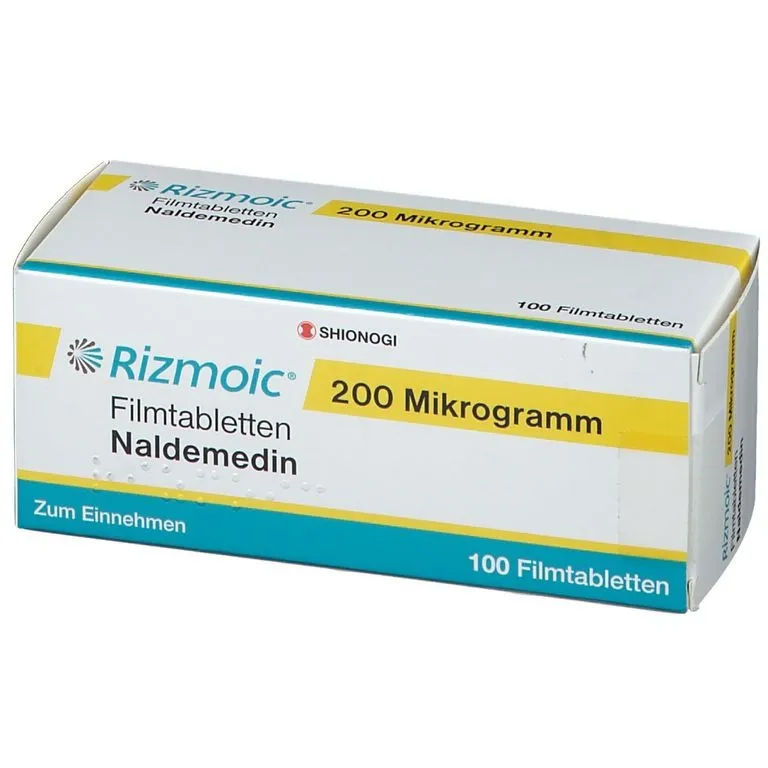
Table of Contents
Package leaflet: Information for the user
Introduction
Package leaflet: information for the patient
Rizmoic 200 micrograms film-coated tablets
naldemedina
Read all of this leaflet carefully before you start taking this medicine, because it contains important information for you.
- Keep this leaflet. You may need to read it again.
- If you have any questions, ask your doctor or pharmacist.
- This medicine has been prescribed for you only and must not be given to other people, even if they have the same symptoms as you. It may harm them.
- If you experience any adverse effects, talk to your doctor or pharmacist, even if the effect is not listed in this leaflet. See section 4.
Contents of this leaflet
- What Rizmoic is and what it is used for
- What you need to know before taking Rizmoic
- How to take Rizmoic
- Possible side effects
- How to store Rizmoic
- Contents of the pack and other information
1. What Rizmoic is and what it is used for
Rizmoic contains the active substance naldemedine.
It is a medicine used in adults to treat constipation caused by painkillers called opioids (e.g., morphine, oxycodone, fentanyl, tramadol, codeine, hydromorphone, methadone).
Your opioid painkiller may cause you the following symptoms:
- reduced frequency of bowel movements;
- hard stools;
- stomach pain;
- rectal pain when passing hard stools;
- feeling that the bowel is still not completely empty after a bowel movement.
Rizmoic can be used in patients who are taking an opioid for long-term cancer pain or non-cancer pain, after having previously been treated with a laxative.
2. What you need to know before taking Rizmoic
Do not take Rizmoic:
- if you are allergic to naldemedine or to any of the other ingredients of this medicine (listed in section 6);
- if you have intestinal obstruction or intestinal perforation, or if you are at high risk of intestinal obstruction, as the obstruction may lead to a hole in the intestinal wall.
Do not take this medicine if any of the above apply to you. If in doubt, consult your doctor or pharmacist before starting to take Rizmoic.
Warnings and precautions
Talk to your doctor or pharmacist before taking Rizmoic:
-
if you have a disease that may affect the intestinal wall, such as:
-
a stomach ulcer;
-
an enlarged colon due to a condition called Ogilvie's syndrome;
-
diverticulitis (a condition involving inflammation of the intestine);
-
intestinal or peritoneal cancer. The peritoneum is the lining of the intestine;
-
a disease causing severe inflammation of the gastrointestinal tract, such as Crohn's disease.
-
if you have brain cancer or central nervous system cancer, multiple sclerosis, or Alzheimer's disease. If you have any of these conditions and develop symptoms of opioid withdrawal (see section 4) or if the opioid no longer provides adequate pain control, contact your doctor immediately;
-
if you have had a heart attack, stroke, or transient ischemic attack within the last 3 months. Your doctor should monitor you if you take Rizmoic;
-
if you have severe liver disease such as alcoholic liver disease, viral liver infection, or hepatic failure. Rizmoic should not be used in these patients;
-
if you are taking certain medicines such as itraconazole for fungal infections, or an antibiotic called rifampicin for tuberculosis and other infections. See "Other medicines and Rizmoic".
If any of the above apply to you, or if you are unsure, consult your doctor or pharmacist before starting to take Rizmoic.
Contact your doctor or pharmacist immediately while taking Rizmoic:
- if you experience severe, persistent, or worsening stomach pain, as this could be a sign of developing a hole in the intestinal wall, which may be life-threatening.
Contact your doctor or pharmacist immediately and stop taking Rizmoic:
- if you experience symptoms of opioid withdrawal (see section 4 Possible side effects), which may occur from minutes to several days after taking a medicine like Rizmoic. Stop taking Rizmoic and contact your doctor if you experience opioid withdrawal symptoms;
- if you experience severe diarrhea or severe stomach pain, inform your doctor so they can monitor you and provide rehydration and appropriate medication if necessary.
Children and adolescents
This medicine must not be used in children or adolescents under 18 years of age, as the effects of the medicine in children and adolescents are unknown.
Other medicines and Rizmoic
Inform your doctor or pharmacist if you are taking, have recently taken, or might need to take any other medicines.
Talk to your doctor or pharmacist if you are taking any of the following medicines:
- rifampicin, clarithromycin, or telithromycin (antibiotics);
- itraconazole or ketoconazole (medicines used to treat fungal infections);
- ritonavir, indinavir, or saquinavir (medicines for HIV infection);
- phenytoin, carbamazepine, or phenobarbital (medicines used to treat epilepsy);
- St. John's wort (Hypericum perforatum), a herbal medicine used for depression;
- cyclosporine, a medicine used in transplant patients or to treat rheumatoid arthritis.
Using these medicines with Rizmoic may affect how naldemedine works or may increase its side effects.
Rizmoic and beverages
You should not drink large amounts of grapefruit juice while taking Rizmoic. Doing so may result in too much naldemedine in your blood, increasing the risk of side effects (possible side effects are described in section 4).
Pregnancy and breastfeeding
If you are pregnant or breastfeeding, think you may be pregnant, or are planning to become pregnant, consult your doctor or pharmacist before using this medicine. The effects of the medicine in pregnant women are unknown. Use of Rizmoic during pregnancy may cause opioid withdrawal syndrome in the newborn (see section 4). Your doctor will advise you whether you can take Rizmoic during pregnancy.
Do not breastfeed during treatment with Rizmoic, as it is unknown whether naldemedine passes into breast milk. Consult your doctor if you are already breastfeeding.
Driving and using machines
Rizmoic has no influence on the ability to drive or operate machinery.
Rizmoic contains sodium
This medicine contains less than 1 mmol of sodium (23 mg) per tablet; this is essentially "sodium-free".
3. How to take Rizmoic
Follow exactly the instructions for using this medicine as given by your doctor or pharmacist. If you are unsure, consult your doctor or pharmacist again.
-
The recommended dose is one 200 microgram tablet once daily.
-
You may take Rizmoic with or without laxatives.
-
You may take Rizmoic at any time of day, with food or between meals. However, once you start taking the medicine, take it at approximately the same time each day.
-
There is no need to adjust the dose of your opioid before starting Rizmoic.
If you stop taking your opioid
Your doctor will advise you to stop taking Rizmoic when you discontinue your opioid painkiller. Please consult your doctor or pharmacist before stopping treatment with Rizmoic to avoid worsening of symptoms.
If you take more Rizmoic than you should
If you have taken more Rizmoic than you should, contact your doctor or go to hospital. You will be monitored for symptoms of opioid withdrawal (see section 2, under "Warnings and precautions", and section 4).
If you forget to take Rizmoic
If you forget to take a dose of Rizmoic, take it as soon as you remember.
However, if less than 12 hours remain before your next dose, skip the missed dose and wait until it is time for your next tablet.
Do not take a double dose to make up for a missed dose.
If you stop taking Rizmoic
Stopping Rizmoic while continuing to take your opioid may cause constipation to return. Inform your doctor if you stop taking Rizmoic.
If you have any further questions about the use of this medicine, ask your doctor or pharmacist.
4. Possible adverse effects
Like all medicines, this medicine may cause adverse effects, although not everyone experiences them.
The most serious adverse effects observed in patients using Rizmoic have been opioid withdrawal symptoms. This adverse effect is uncommon (may affect up to 1 in 100 people).
Stop taking Rizmoic and contact your doctor if you experience a combination of 3 or more of the following opioid withdrawal symptoms on the same day:
- Depression
- nausea (feeling sick) or vomiting
- muscle pain
- watery eyes or runny nose
- dilated pupils
- goosebumps
- sweating
- diarrhoea
- yawning
- fever
- inability to sleep
The following adverse effects may occur with this medicine:
If you are being treated with an opioid for non-cancer chronic pain.
Rare (may affect up to 1 in 1,000 people):
- If you have a severe allergic reaction, stop taking Rizmoic and contact your doctor or go to hospital immediately. Serious allergic reactions include: swelling of the hands, feet, ankles, face, lips or throat which may cause difficulty swallowing or breathing, skin itching and hives.
Frequent (may affect up to 1 in 10 people):
- Diarrhoea
- stomach pain
- nausea (feeling sick)
- vomiting
If you are being treated with an opioid for cancer.
Very frequent (may affect more than 1 in 10 people):
- diarrhoea
Frequent:
- stomach pain
If you are being treated with an opioid for cancer or non-cancer chronic pain.
Frequency not known (cannot be estimated from available data):
- gastrointestinal perforation (a hole developing in the wall of the intestine)
Reporting of adverse effects
If you experience any type of adverse effect, talk to your doctor or pharmacist, even if it is a possible adverse effect not listed in this leaflet. You can also report them directly through the national reporting system included in Appendix V. By reporting adverse effects, you can help provide more information on the safety of this medicine.
5. Storage of Rizmoic
Keep this medicine out of the sight and reach of children.
Do not use this medicine after the expiry date stated on the carton and on the blisters after EXP. The expiry date is the last day of the month indicated.
Store in the original packaging to protect the tablets from light and moisture.
Medicines should not be disposed of via wastewater or household waste. Ask your pharmacist how to dispose of any unused medicine and its packaging. This will help protect the environment.
6. Contents of the pack and other information
Composition of Rizmoic
- Each tablet contains 200 micrograms of naldemedine (as tosylate).
- The other components are:
Tablet core: mannitol, sodium croscarmellose (see section 2 under "Rizmoic contains sodium") and magnesium stearate.
Film coating: hypromellose, talc and yellow iron oxide (E172).
Nature of the product and contents of the pack
Rizmoic is a yellow, film-coated, round tablet approximately 6.5 mm in diameter, marked with "222" and the Shionogi logo on one side and "0.2" on the other.
This medicine is available in aluminum blisters containing 7, 10 or 14 tablets.
Pack sizes of 7, 10, 28, 30, 84 or 100 tablets.
This medicine is also available in unit-dose aluminum blisters containing 10 tablets.
Pack sizes of 30 x 1 tablet in unit-dose blisters.
Only some pack sizes may be marketed in your country.
Marketing Authorization Holder
Shionogi B.V.
Herengracht 464
1017CA Amsterdam
The Netherlands
Manufacturer
Shionogi B.V.
Herengracht 464
1017CA Amsterdam
The Netherlands
For more information about this medicine, please contact the local representative of the Marketing Authorization Holder:
AT, BG, CY, CZ, EE, IE, EL, HR, HU, IE, IS, LT, LV, MT, PT, RO, SI, SK Shionogi B.V. Tel/Tel./Te?./Tlf/Tél/Puh/Sími/Τηλ: +31204917439 | DE Viatris Healthcare GmbH Tel: +49 800 0700 800 |
ES Casen Recordati, S.L. Tel: +34 91 659 15 50 | IT Shionogi Srl Tel: +39 06 94 805 118 |
UK(NI) Sandoz Limited Tel: +44 (0)1276 698020 | FR Viatris Santé Tél: +33 (0)1 40 80 15 55 |
PL Molteni Farmaceutici Polska Sp. z o.o Tel.: +48 (12) 653 15 71 e-mail: [email protected] | SE Viatris AB Tel: + 46 (0)8 630 19 00 |
DK Viatris ApS Tlf: +45 28 11 69 32 | FI Viatris Oy Puh/Tel: +358 20 720 9555 |
NO Viatris AS Tlf: + 47 66 75 33 00 | BE & LU Viatris Tel/Tél: + 32 (0)2 658 61 00 |
NL Mylan Healthcare B.V. Tel: +31 (0)20 426 33 00 |
Date of the most recent review of this leaflet:
Detailed information on this medicine is available on the European Medicines Agency website: http://www.ema.europa.eu/.