Rhinovin Alergia 50 micrograms/spray suspension for nasal spray
Spain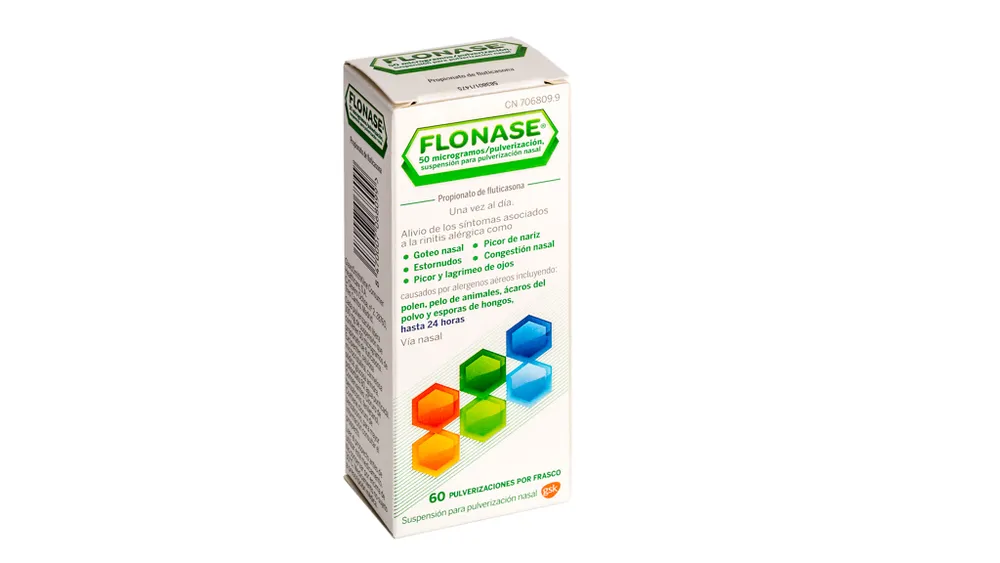
Table of Contents
- Package leaflet: Information for the user
- Introduction
- 1. What Rhinovín Alergia is and what it is used for
- 2. What you need to know before starting to use Rhinovín Alergia..
- Do not use Rhinovín Alergia:
- 3. How to use Rhinovín Alergia
- 4. Possible adverse effects
- 5. Storage of Rhinovín Alergia
- 6. Contents of the pack and other information
- Composition of Rhinovín Alergia
Package leaflet: Information for the user
Introduction
Package leaflet: information for the user
Rhinovín Alergia 50 micrograms/spray suspension for nasal spray
Fluticasone propionate
Read the entire leaflet carefully before you start using this medicine, because it contains important information for you.
Always follow exactly the instructions for administering this medicine as described in this leaflet or as indicated by your pharmacist.
- Keep this leaflet, as you may need to read it again.
- If you need advice or more information, consult your pharmacist.
- If you experience any adverse effects, consult your doctor or pharmacist, even if they are adverse effects not listed in this leaflet. See section 4.
- You should consult a doctor if your condition worsens or if you do not improve after 7 days.
Contents of the leaflet
- What Rhinovín Alergia is and what it is used for
- What you need to know before using Rhinovín Alergia
- How to use Rhinovín Alergia
- Possible adverse effects
- How to store Rhinovín Alergia
- Contents of the pack and other information
1. What Rhinovín Alergia is and what it is used for
The active substance is fluticasone propionate, a corticosteroid that, when used daily, has anti-inflammatory action. This nasal spray suspension helps control your body's reaction to allergens ("triggers") present in the environment.
Rhinovín Alergia is used in adults aged 18 years and older to relieve symptoms associated with allergic rhinitis caused by pollen and other airborne allergens, such as pet dander, house dust mites, and fungal spores. It relieves symptoms such as sneezing, runny nose, nasal itching or congestion, and itchy, watery eyes for up to 24 hours.
It may take 3 to 4 days to achieve maximum protection. Therefore, it is important to continue regular use to obtain the full therapeutic benefit.
You should consult a doctor if your condition worsens or does not improve after 7 days.
2. What you need to know before starting to use Rhinovín Alergia..
Do not use Rhinovín Alergia:
- If you are allergic to fluticasone propionate or to any of the other ingredients of this medicine (listed in section 6).
Warnings and precautions
Talk to your doctor or pharmacist before starting to use Rhinovín Alergia:
- If you are taking medicines containing corticosteroids (including eczema creams, asthma inhalers, tablets, injections, nasal sprays, or eye or nose drops)
- If you have an infection in your nose or sinuses, if you have a cold, fever, or have recently had surgery, injury, or ulcers in your nose.
If your symptoms do not improve after 7 days, speak with your doctor.
Do not use the medicine continuously for more than 3 months unless instructed by your doctor.
Contact your doctor if you experience blurred vision or other visual disturbances, which could be caused by conditions such as cataracts or glaucoma.
When nasal corticosteroid sprays are used at high doses over prolonged periods, adverse reactions due to systemic absorption of the drug may occur. These effects are much less likely than with oral corticosteroids and may vary between individual patients and different corticosteroid preparations. Potential systemic effects may include Cushing's syndrome, Cushingoid symptoms, adrenal suppression, growth retardation in children and adolescents, and, more rarely, decreased bone mineral density, effects on glucose metabolism, and a range of psychological and behavioral effects including psychomotor hyperactivity, sleep disorders, anxiety, depression, or aggression (particularly in children).
Treatment with doses higher than recommended of nasal corticosteroids may result in clinically significant adrenal suppression. If there is evidence of use above recommended doses, additional systemic corticosteroid coverage should be considered during periods of stress or elective surgery.
Use of Rhinovín Alergia with other medicines
Please inform your doctor or pharmacist if you are taking, or have recently taken, any other medicines, including those obtained without a prescription, especially:
- Medicines containing corticosteroids (including eczema creams, asthma inhalers, tablets, injections, nasal sprays, or nose or eye drops);
- ritonavir or cobicistat (a medicine for HIV)
- ketoconazole (for fungal infections).
Some medicines may increase the effect of Rhinovín Alergia, and your doctor may wish to monitor you closely if you are taking these medicines (including certain HIV medicines: ritonavir, cobicistat).
Use of Rhinovín Alergia with food and drinks
You may use Rhinovín Alergia at any time of day, with or without food.
Pregnancy, breastfeeding, and fertility
If you are pregnant or breastfeeding, think you may be pregnant, or are planning to become pregnant, consult your doctor or pharmacist before using this medicine. There are no data available on the effects of this medicine on fertility.
Driving and using machines
Rhinovín Alergia is unlikely to affect your ability to drive or operate machinery.
Rhinovín Alergia contains benzalkonium chloride
This medicine contains 0.02 mg of benzalkonium chloride per sprayed dose, equivalent to 0.2 mg of benzalkonium chloride in 1 ml of solution.
Benzalkonium chloride may cause irritation or inflammation inside the nose, especially when used for long periods of treatment.
3. How to use Rhinovín Alergia
Apply one spray in each nostril, 1 to 2 times a day, or as directed by your doctor. The usual duration of treatment is 7 to 14 days. Do not use for more than 7 days without consulting your doctor.
To administer the nasal spray:
1. Blow your nose gently to clear the nasal passages.
2. Shake the bottle well before use.
3. Remove the cap and prime the pump by pressing the nozzle several times until a fine mist appears.
4. Tilt your head forward slightly and insert the nozzle into one nostril, directing it toward the outer side of the nose (away from the nasal septum).
5. Press the pump while breathing in gently through the nose, to help the medication reach the nasal mucosa.
6. Repeat the process in the other nostril.
7. Wipe the nozzle with a clean tissue and replace the cap.
Important: Do not share the nasal spray to avoid spreading infections.
If you forget to use a dose, apply it as soon as you remember. However, if it is almost time for the next dose, skip the missed dose and continue with your regular schedule. Do not double the dose to make up for a missed one.
In case of overdose, especially if accidental ingestion occurs, seek immediate medical attention. Symptoms may include drowsiness, confusion, or difficulty breathing.
Keep this medication out of the reach of children.
Active substance: Azelastine hydrochloride.
Excipients: Benzalkonium chloride, glycerol, sorbitol, disodium edetate, hydrochloric acid, sodium hydroxide, and purified water.
Store at room temperature (15–25 °C), protected from light and moisture. Do not freeze.
For external use only. Avoid contact with the eyes. If contact occurs, rinse thoroughly with water.
Do not use if the seal is broken or damaged.
For more information, consult your doctor or pharmacist.
Follow exactly the instructions for using this medicine as described in this leaflet or as directed by your doctor or pharmacist. If in doubt, consult your doctor or pharmacist.
Adults from 18 years of age:
The recommended dose is two sprays into each nostril once daily (200 micrograms of fluticasone propionate), preferably in the morning.
Once your symptoms have improved, you may reduce the dose to one spray into each nostril once daily.
If your symptoms are particularly severe, you may need to use two sprays into each nostril twice daily until symptoms improve, but this is only for short-term use.
-Do not use more than 8 sprays (4 sprays per nostril) per day.
-Use the lowest possible dose that controls your symptoms.
-If your symptoms do not improve or are not well controlled after 7 days, consult your doctor or pharmacist.
-Do not exceed the recommended dose.
Use in children and adolescents:
This medicine must not be used in children or adolescents under 18 years of age.
Method of administration
For nasal use only.
Do not swallow.
Do not spray into the eyes.
Before using a new bottle of Rhinovín Alergia:
The Rhinovín Alergia spray has a cap that protects the nozzle and keeps it clean. Remember to remove it before using the spray (Figure 1).
Before starting a new bottle of Rhinovín Alergia, or if you have not used it for several days, you must prime the device (press the spray pump several times) to ensure you receive the correct dose.
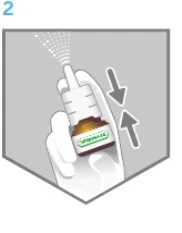
Hold the bottle with your thumb underneath and your index and middle fingers on either side of the neck, on both sides of the nozzle. Keeping your thumb steady, press down several times with your fingers until a fine spray appears (Figure 2).
When doing this, ensure you do not point the nozzle towards yourself or others.
If the spray still does not work, try cleaning it as described in the section “Cleaning the spray device”. Do not attempt to unblock or enlarge the small spray orifice with a needle or other sharp object, as this may damage the spray mechanism.
Figure 1
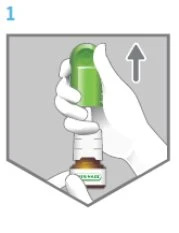
Figure 2
Using Rhinovín Alergia:
- Gently blow your nose.
- Shake the bottle well and remove the protective cap.
- If this is a new bottle of Rhinovín Alergia, or if you have not used the spray for several days, you must prime the device. Press down the spray pump several times until a fine spray appears.
- Hold the bottle as shown in Figure 3. Insert the nozzle into one nostril and close the other nostril.
- Tilt your head forward slightly and hold the bottle upright as shown in Figure 4. Point the nozzle slightly away from the center of your nose.
- Begin to breathe in slowly through your nose. While inhaling, press firmly on the spray pump with your fingers to release a spray into your nostril (Figure 4).
- Breathe out through your mouth. Repeat step 4 to administer a second spray into the same nostril.
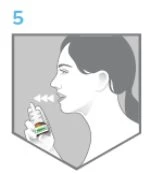
- Remove the nozzle from the nostril where you have already applied the medication and breathe out through your mouth (Figure 5).
- Repeat steps 4 to 6 in the other nostril.
- After using the spray, carefully wipe the nozzle with a clean tissue and replace the protective cap.
Figure 3
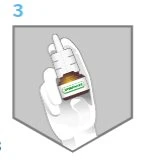
Figure 4
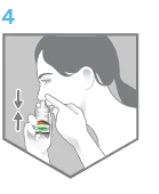
Figure 5
Cleaning the spray device:
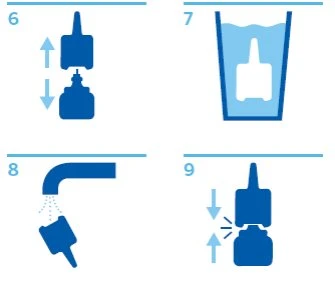
- Remove the protective cap and the nozzle (Figure 6).
- Soak the nozzle and protective cap in lukewarm water for several minutes (Figure 7), then rinse under running water (Figure 8).
- Shake off excess water and allow to dry in a warm place—do not let it get too hot!
- Reattach the nozzle to the spray device (Figure 9).
- If necessary, press down the spray pump several times until a fine spray appears. Replace the protective cap.
- Do not attempt to unblock or enlarge the small spray orifice with a needle or other sharp object, as this may damage the spray mechanism.
Figures 6, 7, 8, 9
It may take 3 or 4 days to achieve the maximum protective effect of Rhinovín Alergia. To prevent symptoms, start using Rhinovín Alergia before exposure to your usual “triggers” (e.g., pollen).
Do not use Rhinovín Alergia for longer than the duration of your exposure to your usual “triggers”.
If you use more Rhinovín Alergia than you should
Speak to your doctor if you use more Rhinovín Alergia than recommended.
In case of overdose or accidental ingestion, contact your doctor or pharmacist immediately or call the Toxicology Information Service at telephone: 91 562 04 20, indicating the medicine and the amount ingested.
If you forget to use Rhinovín Alergia
If you forget a dose, simply use the next dose at the usual time. Do not use a double dose to make up for the missed dose.
If you have any further questions about the use of this medicine, consult your doctor or pharmacist.
4. Possible adverse effects
Like all medicines, this medicine may cause adverse effects, although not everyone experiences them.
When nasal corticosteroid sprays are used at high doses over long periods of time, adverse effects may occur due to absorption of the drug into the body.
Some adverse effects could be serious.
Very rare but very serious adverse effects: seek immediate medical help.
- Signs of an allergic reaction, such as skin rash, swelling of the mouth or face, or difficulty breathing.
- Changes in vision occurring after starting to use this product. Rare cases of eye problems, such as cataracts or glaucoma, have been reported in people who have used large amounts of corticosteroids over several years.
- Small holes (perforations) in the nasal septum.
- Eye problems, such as pain.
If you develop any of these symptoms, stop using the medicine and seek immediate medical help.
Adverse effects with unknown frequency
It is unknown how often these adverse effects occur:
- Blurred vision.
- Sores in the nose.
If you develop any of these symptoms, stop using the medicine and seek immediate medical help.
Other adverse effects
Very common adverse effects
Affect more than 1 in 10 people
- Occasional nosebleeds
Common adverse effects
May affect up to 1 in 10 people
- Sneezing after using the spray. These soon stop.
- Unpleasant smell or taste.
- Dryness or irritation of the nose or throat.
- Headache.
Very rare adverse effects
May affect up to 1 in 10,000 people
- Nasal problems such as persistent pain and/or bleeding.
If you experience any of these symptoms, stop using the medicine and seek medical advice.
Reporting of adverse effects
If you experience any type of adverse effect, consult your doctor or pharmacist, even if it is a possible adverse effect not listed in this leaflet. You can also report them directly through the Spanish Pharmacovigilance System for Human Medicinal Products: https://www.notificaRAM.es. By reporting adverse effects, you can help provide more information on the safety of this medicine.
5. Storage of Rhinovín Alergia
Keep this medicine out of sight and reach of children.
Do not use this medicine after the expiry date stated on the bottle after "EXP". The expiry date refers to the last day of the month indicated.
Do not store above 30°C.
Medicines should not be disposed of via wastewater drains or household waste. Dispose of empty containers and unused medicines at the Sigre Point located at your pharmacy. If you are unsure, ask your pharmacist how to properly dispose of containers and unused medicines. This will help protect the environment.
6. Contents of the pack and other information
Composition of Rhinovín Alergia
- The active substance is fluticasone propionate. Each spray delivers 100 mg of suspension containing 50 micrograms of fluticasone propionate as the emitted dose.
- The other components (excipients) are glucose (anhydrous), microcrystalline cellulose, sodium carboxymethylcellulose, phenylethanol, benzalkonium chloride, polysorbate 80, and purified water.
Appearance of the product and contents of the container
Rhinovín Alergia is a white, opaque aqueous nasal spray suspension.
The amber glass bottle is equipped with a spray device, nasal applicator, and protective cap. The bottle contains either 60 sprays, with a total content not less than 7.0 g, or 120 sprays, with a total content not less than 14.0 g.
Marketing Authorization Holder and Manufacturer
Marketing Authorization Holder:
Haleon Spain, S.A.
Paseo de la Castellana, 259D, 32nd floor, 28046 – Madrid, Spain.
Manufacturer:
Glaxo Wellcome S.A., 09400, Aranda de Duero, Burgos, Spain
or
Haleon Germany GmbH
Barthstrasse 4, 80339 Munich, Germany
This medicinal product is authorized in the European Economic Area member states under the following names:
Belgium: Otrivine Anti-Allergie 50 micrograms/dose, suspension for nasal spray
Estonia: Flixonase, 50 mikrogrammi/pihustuses ninasprei, suspensioon
Hungary: Flixonase Allergia 50 mikrogramm/adag szuszpenziós orrspray
Ireland: Fluticasone propionate 50 micrograms/actuation, nasal spray, suspension
Latvia: Flixonase 50 mikrogrami/izsmidzinajuma deguna aerosols, suspensija
Luxembourg: Otrivine Anti-Allergie 50 microgrammes/dose, suspension pour pulvérisation nasale
Netherlands: Flixonase GSK ConsHealth 50 microgram/dosis, neusspray, suspensie
Norway: Otrason 50 mikrogram/dose nesespray, suspensjon
Poland: OtriAllergy Control 50 mikrogramów/dawke aerozol do nosa, zawiesina
Portugal: Vibrocil Anti-Alergias 50 μg/dose Nasal spray suspension
Romania: Flonase 50 micrograme/doza spray nazal, suspensie
Spain: Rhinovín Alergia 50 microgramos/pulverización suspensión para pulverización nasal
United Kingdom (Northern Ireland): Fluticasone propionate 50 micrograms/actuation, nasal spray, suspension
Date of the most recent review of this package leaflet: July 2023
Detailed information on this medicinal product is available on the website of the Spanish Agency of Medicines and Health Products (AEMPS): http://www.aemps.gob.es/