RespiBien Antialérgico nasal spray solution
Spain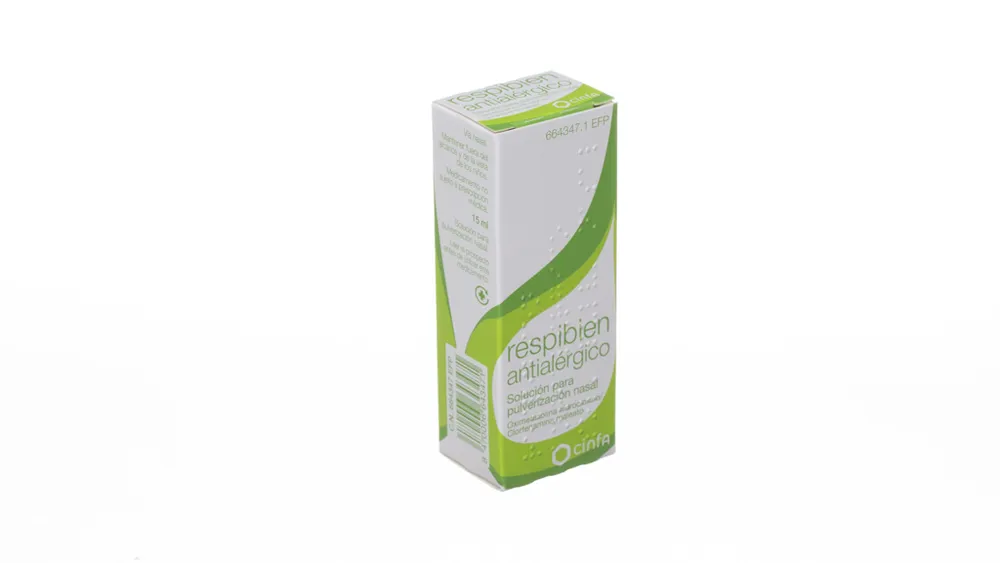
Table of Contents
- Patient Information Leaflet
- Introduction
- 1. What respibien antialérgico is and what it is used for
- 2. What you need to know before using respibien antiallergic
- 3. How to use respibien antialérgico
- 4. Possible adverse effects
- 5. Storage of respibien antialérgico
- 6. Contents of the pack and other information
Patient Information Leaflet
Introduction
Patient Information Leaflet
respibien antiallergic nasal spray solution
oxymetazoline hydrochloride, chlorpheniramine maleate
Read the entire leaflet carefully before you start using this medicine, because it contains important information for you.
Follow exactly the instructions for use provided in this leaflet or those given by your doctor or pharmacist.
-
Keep this leaflet, as you may need to read it again.
-
If you need advice or more information, consult your pharmacist.
-
If you experience any adverse effects, consult your doctor or pharmacist, even if they are effects not listed in this leaflet. See section 4.
-
You should consult a doctor if your condition worsens or if you do not improve after 3 days.
Leaflet Contents
- What respibien antiallergic is and what it is used for
- What you need to know before using respibien antiallergic
- How to use respibien antiallergic
- Possible side effects
- How to store respibien antiallergic
- Contents of the pack and other information
1. What respibien antialérgico is and what it is used for
respibien antialérgico is a combination of two active substances, oxymetazoline and chlorpheniramine. Oxymetazoline belongs to the group of medicines known as direct-acting sympathomimetics and has a decongestant effect. Chlorpheniramine belongs to the group of medicines known as antihistamines, which help reduce excessive nasal secretion.
This medicine is used for the local and temporary relief of nasal congestion caused by allergic rhinitis.
2. What you need to know before using respibien antiallergic
Do not use respibien antiallergic
- If you are allergic to chlorpheniramine, oxymetazoline, other nasal decongestants, or any of the other ingredients of this medicine (listed in section 6).
- If you have recently undergone head surgery (cranial, transnasal, or transoral surgery).
- In case of dry inflammation of the nasal mucosa (dry rhinitis).
- If you have experienced asthma attacks after using medicines containing chlorpheniramine or other allergy medications (antihistamines).
- If you are asthmatic and have experienced bronchopulmonary problems after using allergy medications (antihistamines).
Warnings and precautions
Consult your doctor or pharmacist before starting to use respibien antiallergic.
- If you are being treated with: medications for depression, tranquilizers (phenothiazines), or medications to lower blood pressure (methyldopa).
- If you have had or currently have, even if only once, any of the following conditions or symptoms:
- high blood sugar levels (diabetes mellitus)
- high blood pressure (hypertension)
- any heart or circulatory system disease
- glaucoma or high intraocular pressure
- stomach problems such as obstructive ulcer or obstruction at the stomach outlet (pyloroduodenal obstruction)
- respiratory problems such as emphysema or bronchitis
- any thyroid disease
- prostate disease with difficulty urinating (prostatic hypertrophy or vesical neck obstruction).
- If you have ever experienced insomnia or dizziness while being treated with other sympathomimetic drugs, such as those used to treat heart conditions, low blood pressure (hypotension), or asthma.
- Patients who are allergic (sensitive) to any antiallergic medication (antihistamines) should consult their doctor before using this medicine, as they may also be sensitive to other antihistamines, including this one.
Consult your doctor if you are taking medications used to treat depression (tricyclic antidepressants) or drugs with similar action and you develop gastrointestinal problems (stomach or intestinal).
In rare cases, due to its oxymetazoline content, this medicine may increase nasal congestion symptoms instead of reducing them; this is because its effects are temporary and prolonged use may lead to this rebound effect.
Therefore, do not exceed the recommended dose indicated in section 3, How to use respibien antiallergic.
To prevent transmission of infections, this medicine must not be used by more than one person, and the applicator should always be cleaned after each use with a clean, damp cloth.
Other medicines and respibien antiallergic
Inform your doctor or pharmacist if you are taking, have recently taken, or might need to take any other medicines.
This medicine must not be used by people who are taking or have taken within the last 2 weeks: medicines for depression (tricyclic antidepressants or monoamine oxidase inhibitors (MAOIs)) or a medicine to lower blood pressure (methyldopa), as this may increase the risk of adverse effects.
It should also not be used if you are being treated with a tranquilizer (phenothiazine) or medicines for asthma.
Concurrent use of this medicine with alcohol or other medicines such as tranquilizers and those used to treat insomnia or anxiety (central nervous system depressants) may increase the risk of adverse effects.
Interference with diagnostic tests
If you are due to have any diagnostic tests (blood or urine tests, skin tests using allergens, etc.), inform your doctor that you are using this medicine, as it may alter the results of these tests.
Children
Do not use in children under 6 years of age.
Children may be particularly prone to adverse effects from this medicine.
Use in people aged 65 years and older
Consult your doctor or pharmacist, as elderly individuals are more sensitive to the adverse effects of this medicine.
Pregnancy and breastfeeding
If you are pregnant or breastfeeding, think you may be pregnant, or are planning to become pregnant, consult your doctor or pharmacist before using this medicine.
This medicine must not be used during pregnancy or breastfeeding, as it may cause serious adverse effects in the newborn.
Driving and using machines
Although it is not expected that this medicine will affect your ability to drive or operate machinery, if you experience drowsiness or dizziness, do not drive or operate dangerous machinery.
respibien antiallergic contains sodium
This medicine contains less than 1 mmol of sodium (23 mg) per ml; hence, it is essentially "sodium-free".
3. How to use respibien antialérgico
Follow exactly the instructions for use provided in this leaflet or those given by your doctor or pharmacist. If in doubt, ask your doctor or pharmacist.
The recommended dose is:
Adults and children over 6 years of age:
One spray in each nostril once daily is recommended. If necessary, an additional spray may be administered 12 hours later. Do not use more than twice within 24 hours.
Children under 6 years of age:
This medicine must not be used in children under 6 years of age.
Method of administration:
This medicine is for nasal use.
If this is the first time you are using the product or if you have not used it for a long time, it is necessary to prime the spray. To do this, hold the container away from the body and press the spray several times until a fine mist is released.
Blow your nose thoroughly before using this medicine.
Administer one firm, quick spray into each nostril, inhaling deeply while pressing the spray and keeping your head upright.
To prevent transmission, the container must be used by only one person.
After each use, clean the tip of the applicator with a clean, damp cloth and immediately close the container.
The maximum duration of treatment is 3 days. If symptoms worsen or persist after 3 days of continuous treatment, discontinue use and consult your doctor.
If treatment needs to be repeated, it should be done several days after completion of the previous treatment.
If you use more respibien antialérgico than you should
With excessive or prolonged dosing, you may experience: headache, tremors, insomnia, excessive sweating, palpitations, tachycardia, increased blood pressure, or sleep disturbances.
In case of overdose or accidental ingestion, contact your doctor or pharmacist immediately or call the Toxicology Information Service at telephone number 91 562 04 20, indicating the medicine and the amount ingested.
If you forget to use respibien antialérgico
Do not use a double dose to make up for a missed dose.
If necessary, resume use as indicated in section 3. How to use respibien antialérgico.
If you have any further questions about the use of this medicine, ask your doctor or pharmacist.
4. Possible adverse effects
Like all medicines, this medicine may cause adverse effects, although not everyone experiences them.
Excessive or prolonged use of this medicine may lead to increased nasal congestion. During the period of use of oxymetazoline via nasal route and chlorpheniramine via oral route at doses higher than those of this medicine, the following adverse reactions have occurred, although their frequency could not be accurately determined.
The most frequently observed adverse effects are: stinging at the application site, dryness, nasal mucosa irritation or sneezing. Mild drowsiness, dizziness, muscle weakness; these adverse effects may disappear spontaneously after 2–3 days of using the medicine in some patients. Other possible effects include difficulty moving facial muscles, clumsiness, tremor, disturbances in sensation and tingling, dry mouth, loss of appetite, disturbances in taste or smell, gastrointestinal discomfort (such as nausea, vomiting, diarrhea, constipation, stomach pain), as well as urinary retention, dryness of the nose and throat, thickening of mucus secretions, sweating, blurred vision, or other visual disturbances.
Rarely occurring adverse effects include: tremors, palpitations, headache, nausea, skin redness (rash), anxiety, increased blood pressure, tachycardia, and hallucinations. These usually occur with high doses and more frequently in elderly patients and children, who may experience nervous excitation with symptoms such as restlessness, insomnia, nervousness, and even convulsions.
Other adverse effects: chest tightness, lung sounds, rapid or irregular heartbeat (tachycardia), generally occurring with overdose; liver disorders (which may present as stomach or abdominal pain, dark urine, or other symptoms); allergic reactions, some of which may be severe (cough, difficulty swallowing, rapid heartbeat, itching, swelling of the eyelids or around the eyes, face, tongue, breathing difficulties, etc.); sensitivity to sunlight (photosensitivity); allergy to other medicines related to chlorpheniramine (cross-sensitivity); rarely, blood disorders such as changes in blood cell levels, including agranulocytosis, leucopenia, haemolytic anaemia, thrombocytopenia, and pancytopenia; low or high blood pressure, swelling (oedema), ear disturbances, impotence, menstrual disorders.
If you consider any of the adverse effects you experience to be severe, or if you notice any adverse effects not listed in this leaflet, inform your doctor or pharmacist.
Reporting of adverse effects
If you experience any type of adverse effect, consult your doctor or pharmacist, even if it is a possible adverse effect not listed in this leaflet. You can also report them directly through the Spanish Pharmacovigilance System for Human Medicines: https://www.notificaram.es. By reporting adverse effects, you can help provide more information on the safety of this medicine.
5. Storage of respibien antialérgico
Keep this medicine out of the sight and reach of children.
This medicine does not require any special storage conditions.
Do not use this medicine after the expiry date which is stated on the packaging after EXP. The expiry date refers to the last day of the month indicated.
Medicines must not be disposed of via wastewater drains or household waste. Dispose of unused medicines and their packaging at the SIGRE collection point at your pharmacy. If in doubt, ask your pharmacist how to dispose of medicines and packaging you no longer need. This will help protect the environment.
6. Contents of the pack and other information
Composition of Respibien Antialérgico
- The active substances are oxymetazoline hydrochloride and chlorpheniramine maleate.
Each ml contains 0.5 mg (65 micrograms per 0.13 ml spray) of oxymetazoline hydrochloride and 0.5 mg (65 micrograms per 0.13 ml spray) of chlorpheniramine maleate.
- The other components (excipients) are: sodium chloride, sodium dihydrogen phosphate dihydrate, sodium hydrogen carbonate, thimerosal, niaulí essence, phosphoric acid and/or sodium hydroxide (to adjust pH), and purified water.
Nature of the product and pack contents
This medicine is a clear, low-viscosity aqueous solution for nasal spray.
It is supplied in a white high-density polyethylene bottle equipped with a metering pump and a screw cap ensuring proper storage.
Each container holds 15 ml of nasal spray solution.
Marketing Authorization Holder and Manufacturer
Laboratorios Cinfa, S.A.
Carretera Olaz-Chipi, 10. Polígono Industrial Areta
31620 Huarte (Navarra) – Spain
Date of the most recent review of this leaflet: December 2021
Detailed information on this medicine is available on the website of the Spanish Agency of Medicines and Health Products (AEMPS) (http://www.aemps.gob.es/)