RespiBien 0.5 mg/ml solution for nasal spray
Spain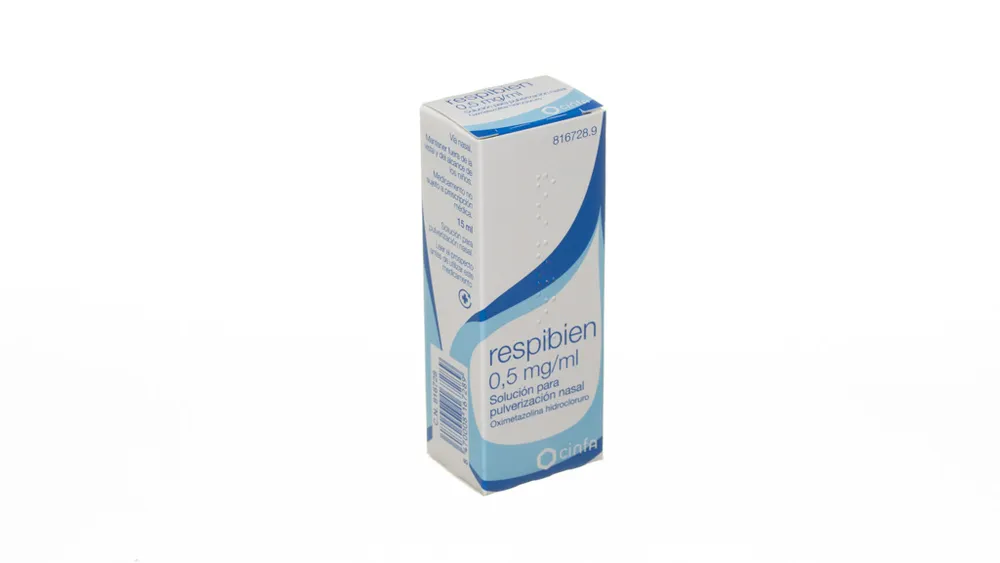
Table of Contents
Patient Information Leaflet
Introduction
Patient Information Leaflet
respibien 0.5 mg/ml nasal spray solution
oxymetazoline hydrochloride
Read the entire leaflet carefully before you start using this medicine, as it contains important information for you.
Follow exactly the instructions for use provided in this leaflet or those given by your doctor or pharmacist.
- Keep this leaflet, as you may need to refer to it again.
- If you need advice or further information, consult your pharmacist.
- If you experience any adverse effects, consult your doctor or pharmacist, even if they are effects not listed in this leaflet. See section 4.
- You should consult a doctor if your condition worsens or if you do not improve after 3 days.
Leaflet Contents
- What respibien is and what it is used for.
- What you need to know before using respibien.
- How to use respibien.
- Possible side effects.
- How to store respibien.
- Contents of the pack and other information.
1. What respibien is and what it is used for
This medicine belongs to a group of medicines called sympathomimetics. It is a nasal decongestant containing oxymetazoline as the active substance. Oxymetazoline administered through the nose produces local constriction of blood vessels, thereby decongesting the nasal mucosa.
It is indicated for the local and temporary relief of nasal congestion in adults and children over 6 years of age.
You should consult a doctor if symptoms worsen or do not improve after 3 days of treatment.
2. What you need to know before using respibien
Do not use respibien
- If you are allergic to oxymetazoline hydrochloride, to other nasal decongestants, or to any of the other components of this medicine (listed in section 6).
- If you are taking monoamine oxidase inhibitors (MAO inhibitors, used to treat Parkinson's disease and depression). MAO inhibitors can increase the hypertensive effects of oxymetazoline.
- If you have narrow-angle glaucoma.
- If you have recently undergone head surgery (if you have had cranial, transnasal, or transoral surgery).
- If you have inflammation of the skin and mucosa of the nasal vestibule and nasal crusts (dry rhinitis).
- If you have acute cardiac disease or cardiac asthma.
- If you have ever experienced insomnia or dizziness while being treated with other sympathomimetic medicines, such as those used to treat heart conditions, hypotension (low blood pressure), or asthma.
- In children under 6 years of age.
Warnings and precautions
Consult your doctor or pharmacist before using respibien if:
-
You have had or currently have, even if only once, any of the following conditions or symptoms:
-
High blood sugar levels (diabetes mellitus),
-
High blood pressure (hypertension),
-
Any heart or circulatory system disease,
-
Prostate disease with difficulty urinating (prostatic hypertrophy),
-
Any thyroid disease (hyperthyroidism).
In rare cases, oxymetazoline, due to its temporary effects and prolonged use, may increase nasal congestion instead of reducing it; this is known as rebound effect.
Rarely, insomnia may occur after using this medicine. If this happens, avoid using it late in the afternoon or at night.
Do not exceed the recommended dose stated in section 3 How to use respibien.
To prevent transmission of infection, this medicine must not be used by more than one person, and the applicator should always be cleaned after each use with a clean, damp cloth.
Children
Do not use in children under 6 years of age.
Children may be especially susceptible to adverse effects of this medicine.
Other medicines and respibien
Inform your doctor or pharmacist if you are taking, have recently taken, or might need to take any other medicines.
This medicine must not be used by people who are taking or have taken within the last 2 weeks: medicines used to treat depression (tricyclic antidepressants, maprotiline, or monoamine oxidase inhibitors [MAOIs]), or a blood pressure-lowering medicine called methyldopa.
It should also not be used if you are being treated with phenothiazine (a tranquilizer) or medicines used to treat asthma.
Pregnancy and breastfeeding
If you are pregnant or breastfeeding, think you might be pregnant, or plan to become pregnant, consult your doctor or pharmacist before using this medicine.
This medicine should not be used during pregnancy or while breastfeeding.
Driving and using machines
Although problems in this regard are not expected, if you experience drowsiness, do not drive or operate dangerous tools or machinery.
respibien contains benzalkonium chloride.
This medicine contains 0.2 mg of benzalkonium chloride per ml.
Benzalkonium chloride may cause irritation or inflammation inside the nose, especially when used for long treatment periods.
3. How to use respibien
Follow exactly the instructions for use provided in this leaflet or those given by your doctor or pharmacist. If in doubt, consult your doctor or pharmacist.
The recommended dose is:
Adults and children over 6 years of age
1 spray into each nostril no more than 2 times in 24 hours.
Use in children under 6 years of age
This medicine must not be used in children under 6 years of age (see section 2. Do not use respibien).
Elderly patients (over 65 years of age)
Consult your doctor or pharmacist, as elderly patients are more sensitive to the adverse effects of this medicine.
How to use
This medicine is for nasal use.
Before applying this medicine, clear any existing nasal secretions by blowing your nose thoroughly.
If this is the first time you are using this product or you have not used it for a long time, it is necessary to prime the spray. To do this, hold the container away from your body and press the spray several times until a fine mist is released.
To prevent infection, after each use and before closing the container, clean the tip of the applicator with a clean, damp cloth. In addition, each container must be used by only one person.
If your symptoms worsen or do not improve after 3 days of treatment, stop treatment and consult your doctor.
If you use more respibien than you should
With excessive or prolonged dosing, or if the product is accidentally swallowed, you may experience: headache, tremors, insomnia, excessive sweating, palpitations, tachycardia, increased blood pressure, or sleep disturbances.
In children, these effects may include: hallucinations, excitability, urticaria, nausea and vomiting, hysteria, drowsiness or lethargy, abnormal gait, facial edema.
In case of overdose or accidental ingestion, contact your doctor or pharmacist immediately or call the Toxicology Information Service at telephone number 91 562 04 20, stating the medicine and the amount ingested.
If you forget to use respibien
Do not use a double dose to make up for missed doses.
If necessary, resume use as indicated in section 3. How to use respibien.
If you have any further questions about the use of this medicine, ask your doctor or pharmacist.
4. Possible adverse effects
Like all medicines, this medicine may cause adverse effects, although not everyone experiences them.
The following adverse effects have been observed during the period of oxymetazoline use, although their frequency could not be precisely determined.
The most frequently occurring adverse effects are:
Burning sensation at the application site, dryness, sneezing, and irritation of the nose, mouth, and throat.
The adverse effects that may occur rarely are:
Anxiety, restlessness, insomnia, hallucinations, tremors, fatigue, irritability, and sleep disorders in children. Tachycardia, palpitations, increased blood pressure. Headache, nausea, rash (skin redness), nasal mucosa inflammation, and visual disturbances.
Excessive or prolonged use of this medicine may lead to rebound nasal congestion.
Reporting of adverse effects
If you experience any type of adverse effect, consult your doctor or pharmacist, even if it is a possible adverse effect not listed in this leaflet. You can also report them directly through the Spanish System of Pharmacovigilance of Human Medicines: https://www.notificaram.es. By reporting adverse effects, you can help provide more information on the safety of this medicine.
5. Storage of respibien
Keep this medicine out of the sight and reach of children.
This medicine does not require any special storage conditions.
Do not use this medicine after the expiry date stated on the packaging after EXP. The expiry date is the last day of the month indicated.
Medicines must not be disposed of via wastewater or household waste. Dispose of empty containers and unused medicines at the SIGRE Point in your pharmacy. Ask your pharmacist how to dispose of containers and medicines you no longer need. This will help protect the environment.
6. Package contents and additional information
Composition of respibien
-
The active substance is oxymetazoline hydrochloride. Each ml contains 0.5 mg of oxymetazoline hydrochloride (65 micrograms per 0.13 ml spray).
-
The other components are: benzalkonium chloride, glycine (E-640), povidone (E-1201), non-crystallizable liquid sorbitol (E-420), and purified water.
Appearance of the product and contents of the container
respibien is a colourless or slightly yellowish solution.
It is supplied in white high-density polyethylene bottles equipped with a dosing pump and a screw cap ensuring proper preservation.
Each container holds 15 ml of nasal spray solution.
Marketing Authorization Holder and Manufacturer
Laboratorios Cinfa S.A.
Carretera Olaz-Chipi 10. Polígono Industrial Areta
31620 Huarte (Navarra) - Spain
Date of the most recent revision of this leaflet: August 2019
Detailed and up-to-date information on this medicinal product is available on the website of the Spanish Agency for Medicines and Health Products (AEMPS) https://www.aemps.gob.es/